Episode Overview
Choosing a surgeon shouldn’t feel like guessing on Google. Yet most patients make high-stakes decisions about surgery with little visibility into what actually drives better outcomes. Star ratings and hospital billboards don’t tell you whether a procedure is appropriate, how often a surgeon performs it, or what their real complication rates look like.
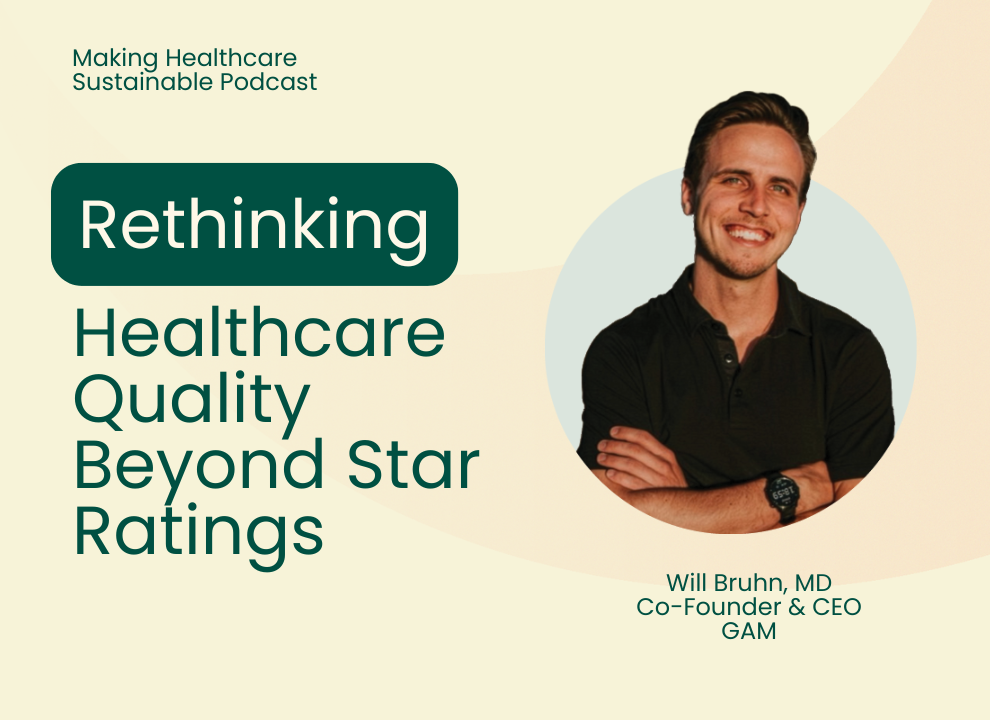
In this episode of Making Healthcare Sustainable, Nancy Ryerson sits down with Will Bruhn, MD, Co-Founder and CEO of Global Appropriateness Measures, or GAM, to unpack what quality in healthcare really means. Will shares how misaligned incentives can lead to unnecessary procedures, why appropriateness should be the first question patients ask, and how transparent data can help employers steer members toward better care.
In this episode, you’ll learn:
- Why appropriateness of care matters as much as outcomes
- How to evaluate surgeons beyond online reviews and hospital rankings
- Why there is no consistent link between higher cost and higher quality
Highlights:
(00:00) Meet Will Bruhn
(01:52) Innovations in network design for specialty care
(03:00) Why a metric for appropriateness of care matters
(05:17) The biggest misconception about healthcare quality
(07:28) What finding quality care looks like today
(13:20) Why some procedures happen even when they’re not appropriate
(17:06) Real-world factors that affect appropriateness scores
20:52) The myth that higher cost equals higher quality
(22:04) The complexities of billing specialty care
(24:15) Centers of excellence vs. networks of excellence
(27:14) The quality transparency revolution
Resources:
Nancy Ryerson’s LinkedIn: https://www.linkedin.com/in/nancyryerson/
Will Bruhn’s LinkedIn: https://www.linkedin.com/in/will-bruhn-md/
GAM website: http://www.gameasures.com
Episode Highlights
What the broken healthcare system can learn from Amazon
In every other market, you can compare quality and price before you buy. Healthcare has long been the exception. Will Bruhn explains how better data could reshape how patients shop for care on Making Healthcare Sustainable.
Episode Transcript
This has been generated by AI and optimized by a human.
Will Bruhn (00:00):
Most of the time when you recommend a service to somebody as a physician, the first question that the patient’s going to ask is, “Do I need that thing done? Do I actually need that MRI? Do I actually need that prescription? Do I actually need that surgery?” It hasn’t been until recently and our team kind of founded this idea of appropriateness of care that we’re starting to answer that question now. Are physicians delivering those treatments? So I think the big misconception overall is that all quality scores are kind of made the same. I think that’s not true. And I think within that, you really need to make sure that whatever you’re doing on the quality front incorporates that idea of appropriateness of care.
Nancy Ryerson (00:39):
This is Making Healthcare Sustainable, brought to you by Lantern. Hi everyone and welcome to the show. If your doctor told you that you needed a surgical procedure done, how would you find a surgeon? Would you Google it, ask for your doctor’s recommendation, ask a friend, ask ChatGPT? The problem with all of these options is that chances are none of them have access to the metrics that really make a difference in whether you get the best care. Even your doctor and Dr. Google might not have the right information to steer you. So what would you need to know to make the best choice and how can benefits leaders connect employees with that knowledge? To help us navigate this, we’ve invited Will Bruhn, founder of Global Appropriateness Measures, or GAM, who has years of experience in clinical quality research. Will has been at the forefront of measuring and improving quality in healthcare.
(01:37):
And today he’s here to tell us about what numbers and outcomes you should really be looking at to know whether a provider is truly excellent. Before we dive in, Will, I’d like to start with our think, feel, do segment. Which did you choose?
Will Bruhn (01:52):
I chose Do. There’s so many amazing solutions and innovation going on in the specialty care space. Obviously, I’m a big fan of Lantern, and so groups like Lantern and others that are trying to do this idea of navigating towards the highest quality specialty care physicians, and that comes in many different forms of care nav, COEs, whatever it might be. I really feel like that is the future towards helping with this cost of care issue that employers are running into, because so much of obviously the cost of care that employers are worried about is related to that specialty care or surgical services. And so I think the one thing that benefits leaders and employers can do related to specialty care is use organizations like Lantern to do either tiering or network design or care navigation.
Nancy Ryerson (02:39):
Well, we appreciate that. And to our listeners, that was not scripted, I promise, but it is of course great advice. And Will, I think to start off, it would be great to hear about your background. I know that you are a doctor, but how did you found GAM and what got you interested in this specific space of quality metrics and appropriateness?
Will Bruhn (03:00):
My initial interest, I didn’t go to med school thinking I’m going to be the next quality researcher that wasn’t necessarily the coolest topic to try to go become the next thing. And so I went to medical school with a pretty open mind as to what I wanted to do with my medical career. I was attracted to primary care. It was during my rotations in medical school that I really started to create a passion for this issue of quality of care or appropriateness of care. There’s a handful of experiences I had. One that I kind of say oftentimes is in my very first rotation in medical school, I had this older patient that was in the hospital for, I think she had pneumonia initially. She was older and had a lot of other complicated issues. And I remember I was helping take care of this patient and we had ordered this ultrasound scan to look for any type of clots forming in her arms or legs.
(03:50):
You can order this, what’s called a bilateral ultrasound of the extremities. We ordered this exam, the radiology team comes in with their wand and the ultrasound machine, and they look at the right arm and the right leg. And then I noticed they got all of their stuff together and got out the door. And I remember thinking, well, we actually ordered that for both sides of the body. So I ran out into the hallway and I was like, “Hey guys, this was supposed to be a bilateral scan, both sides.” And they’re like, “Oh, we only do one side of the body per day.” And I remember being like, “How does that make any sense? If a clot is forming on the left leg right now and that turns into a DVT and then a pulmonary embolism, that could be catastrophic for this patient.” And I remember them saying, “Well, you don’t understand how this works.
(04:28):
We only get paid for one side of the body per day, and so we’ll come back tomorrow and do the left side so that we can kind of maximize billing.” I had a lot of these experiences in clinical medicine that really showed me that the incentives that sometimes the providers or insurance companies have are not at all aligned with what’s best for the patient. And so that’s really what spurred me into this area of research. And then now developing GAM is kind of this passion of how do we actually identify with data these gaps in quality and appropriateness of care that are being delivered?
Nancy Ryerson (04:58):
Yeah, that’s a good example and kind of troubling. It makes you wonder when you go to the doctor how many of those decisions are based in what’s best for the patient versus our very complicated structure of how doctors are getting paid.
Will Bruhn (05:12):
Exactly.
Nancy Ryerson (05:12):
What do you feel like are the biggest misconceptions you hear about healthcare quality?
Will Bruhn (05:17):
I think a lot of times employers in particular have approached quality as sort of a checkbox kind of like, yeah, we do quality and they look at the, let’s say CMS star ratings or HEDIS or MIPS or whatever might be these standard quality approaches that have been taken. This probably is obvious coming from somebody like myself that has dedicated their career to quality measurement. But I really feel like, ironically, the quality of the quality analyses is really important. Whether or not somebody is really taking the time to create quality measurement and quality data that is both clinically sophisticated, but also getting after questions that patients care about the most, like I’ve mentioned it multiple times already, the appropriateness of care. That is one of the biggest gaps that’s been in the quality space has been most quality measurements been only those outcomes derived quality measurements like after the care is delivered, are they having good readmission rates, are they having low complication rates?
(06:11):
That’s left to open this huge gap in the quality question, which is most of the time when you recommend a service to somebody as a physician, the first question that the patient’s going to ask is, “Do I need that thing done? Do I actually need that MRI? Do I actually need that prescription? Do I actually need that surgery?” It hasn’t been until recently and our team kind of founded this idea of appropriateness of care that we’re starting to answer that question now. Are physicians delivering those treatments? So I think the big misconception overall is that all quality scores are kind of made the same. I think that’s not true. And I think within that, you really need to make sure that whatever you’re doing on the quality front incorporates that idea of appropriateness of care.
Nancy Ryerson (06:52):
Yeah, because even if there isn’t a complication after a spinal surgery, if it didn’t need to happen, that should definitely be a part of the story.
Will Bruhn (06:59):
Yeah, exactly. The outcomes only matter if the care was appropriate in the first place. And sometimes there’s an inverse relationship actually between appropriateness of care and outcomes because if you’re only taking low risk patients that don’t really need surgery to surgery, oftentimes they’re going to look really good on the outcomes measurements. And so that’s why having that first question answered is really important.
Nancy Ryerson (07:20):
Let’s say you or someone you know needs surgery or a procedure done, what steps do you take or would you advise or find to take?
Will Bruhn (07:28):
Yeah, I feel like I’ve now become Dr. Google to all of my friends and family. Anytime a friend or a family member needs something, they’re always like, they see me as the quality guru now. So they’re like, “Hey, Will, can you look in your secret database to see if this doctor’s high quality?” And so I get probably three or four of those texts or calls a week and
(07:45):
I actually do pretty routinely use our own database to identify who’s a good ENT doctor for this person to go to or for family members who’s like the best primary care doctor. So yeah, I actually do use our data pretty frequently. That just helps show with the data, are patients satisfied with this care that they’re getting from this doctor? Do they have good appropriateness of care? Are they doing the right treatments? And in the care that they are delivering, are they having good outcomes? And to me, that really is like the three-prong approach to measuring quality for a physician. And I feel thankful to be in a position to actually have that data on the vast majority of providers in the country.
Nancy Ryerson (08:20):
That’s great. And through our partnership with GAM, obviously that’s all worked into the Lantern system. But let’s say you’re someone who you don’t have Lantern, you don’t know Will personally. How do the GAM metrics you’re talking about differ from what is out there if you were just a regular person or even a benefits leader trying to find appropriate or high quality care for someone?
Will Bruhn (08:41):
Yeah, I think this is a huge issue broadly is in any other market that people shop in in America, you go to Amazon, you go to buy a new car, any other market, you have pretty good transparency around the quality of the product as well as the price of the product. So like when you go on Amazon and you need to buy a new toothbrush, you’re looking at that star rating, do people think it’s a high quality product? And then you’re looking at the price, you’re going to buy whichever product has the highest quality, lowest price to purchase. We have historically had neither of those things in healthcare. There’s been no star score, there’s been no quality indicators for everyday patients, and the price has been completely hidden from the patients of how much the cost of care is for whatever they need to get done.
(09:26):
Obviously we’re having a lot of new developments in healthcare technology. Price transparency data is becoming more and more commoditized, which is great, but that quality component is one of the biggest things that nobody has any understanding. Like you said, people mostly go to Google or Yelp or Healthgrades where it’s just kind of a patient review site. The reality is most people will put a review on a doctor based upon how good the parking was or the wait times. It’s not really the quality of care that they’re delivering. And so this is one of my passions. This is why I’m in this space is I really hope and dream of a time in healthcare where we have a very healthy, transparent market like we have anywhere else. In the same way you can go to Amazon and buy anything, I really dream of a time in healthcare where everyday Americans can shop for their care with good information at their fingertips to make the right decision for their own care.
Nancy Ryerson (10:16):
Yeah, absolutely. And I chose a new dentist recently and I did go based on wait time in the office. I was looking at reviews because we only have so many hours in the day and I feel like that’s okay. I got some fillings done, teeth feel fine. But what about something like surgery or specialty care? Maybe we could talk a little bit about some of the specific metrics that GAM looks like for surgery and why those are so important for these more complex procedures.
Will Bruhn (10:41):
The more complex the care need is, the more important it is to have that good quality information. And not to mention the cost as well. Obviously those costs can get insanely variable once you get towards those high cost procedures. But just on the quality front, it’s so important to understand these things because we probably all know somebody that got some back operation or something else done to them that likely was not needed. I have a friend that got almost certainly an unnecessary spinal fusion like 10 years ago and he has been in chronic pain for years now and just has had to get two re-operations, been through years of physical therapy, injections, and nothing has really worked. And I think all that stems from this unnecessary infusion. And so that’s where I feel passionate about this is it’s not just a theoretical data question. It’s like, this is actually impacting people’s lives and we all probably know somebody that’s been impacted by either low quality or unnecessary care.
(11:36):
And so within those surgical specialties, you really want to make sure you go to somebody that number one has been proven through data that they’re delivering the right treatments for their patients. Surgeons are trained to cut. And so there’s a lot of surgeons doing the right thing, but there are some surgeons out there that everybody that walks in the door, they just see a scalpel. And so that’s not always the necessary thing for people. Sometimes physical therapy or injections or some of these new therapies that are coming out are more appropriate than going to surgery. And so the first question is, are they delivering the right appropriate treatments to their patients? The second question is, when they’re doing the operations, are they having good outcomes? Are they having low complication rates, readmission rates? Are they having low re-operations? And then the last question is really around volume.
(12:20):
Are they an expert in that thing? Because when you think about orthopedic surgery, there’s a lot of general orthopedic surgeons that will do 20 of these, 20 of those per year. But then there’s, let’s take knee replacement, for example. There’s some surgeons out there that are doing five, six, 700 plus knee replacements per year. And those are the doctors that I want to send my mom to because I know every single day they’re just doing this one thing and they’re experts at it versus the physician that might be doing okay quality care, but only doing 10 of those procedures per year. I kind of want to navigate away from those doctors for that particular kind of high cost procedure.
Nancy Ryerson (12:55):
Yeah. We talked about that a lot at Lantern and it’s something I hadn’t really thought of when you think of someone as an orthopedic surgeon, they went to medical school, they did all this training, but yeah, you don’t really have access to know, well, how often do they do this specific procedure versus others? And when you say someone got, for example, an unnecessary spinal surgery, what are some of the reasons that a doctor might operate when it’s not appropriate?
Will Bruhn (13:20):
That’s a golden question. I really do believe that most doctors out there are doing the right thing or trying to do the right thing for their patients. I don’t think that we have this epidemic of terrible doctors. There are a subset of those in any given specialty. And when we’ve done these analyses to try to understand why are doctors outliers on specific things like unnecessary spinal fusions or whatever it might be, we found like, yes, there are definitely fee-for-service incentives to do unnecessary procedures. That’s the core of it is the more you cut, the more you get paid. That is the core of the issue here that even the health systems themselves are pushing their physicians to hit certain RVU targets. But I also think it’s worth mentioning that there are a lot of physicians out there that just have their own solo practice in some rural part of America, and maybe they don’t understand what the practice patterns or the best guidelines look like nationally, and they just need some education.
(14:12):
And so I think it’s both of those things. It’s a fee-for-service driven model to where they’re incentivized to cut. But then I think also sometimes even those that might not be doing that intentionally, they just need better education, whether that’s CME or follow up of what’s the best guidelines and the best evidence of the specific procedure.
Nancy Ryerson (14:29):
And I know that’s something that GAM does part of or does as well, right? Sends those report cards or feedback to doctors if you’re not meeting that quality level to help them potentially improve.
Will Bruhn (14:42):
We feel really passionate as a group of physicians that it is our responsibility on some level to get this information into the physician’s hands. There’s this whole quality industry in America, and I feel as though the way it’s been done up to this point has been very almost in secret away from the doctors. Whereas at GAM, we’ve really tried to embrace the clinical community in this process because number one, you need the physicians involved to create these measures. You need the specialists at the table to make sure you’re not unfairly characterizing doctors. So you need the physicians, first of all, to create the measures. But then even with that, we have this amazing data set of outlier practice patterns in the country. Why not send the doctors that information to let them know, “Hey, this is a quality measure we developed with physicians in your specialty.
(15:29):
Here you are on the bell curve of all of their doctors nationally.” And we’ve actually done a lot of these studies and we’ve shown up to 83% of outlier doctors will correct their own behavior just from seeing a letter of how they do on a specific measure. And so we feel really passionate that that is part of our calling at GAM is that we would embrace the clinical community rather than hide from them because we don’t want to face the fire of specialists being mad at the way that we’re doing quality measurement. We actually want them to be involved in it. And so I think that’s maybe a little bit of a distinction with us in the market is trying to bring those physicians close and let them know what their data looks like.
Nancy Ryerson (16:04):
Yeah. And the impact could be that there are more providers out there who are providing more appropriate care than they were before. I know I was always very report card-driven. I’m sure you go into medical school, you can relate to if you get something in the mail that’s like, “You’re not measuring up an X, Y, Z way.” I think you could react defensively depending on how it’s presented, but to your point, if there is buy-in with the community, then they can say, “Okay, yeah, I do see that and maybe I can course correct.”
Will Bruhn (16:31):
Yeah. And there are always going to be the physicians that have a legitimate excuse for being a “outlier.” No quality measurement is perfect at adjusting every single level of patient panel nuances, but we feel like, yeah, it really should be our duty to provide this in the sense of transparency in the market, that the doctors should be part of that equation as well.
Nancy Ryerson (16:50):
Yeah. How do you account for maybe someone who, not that they’re trying to skew their numbers, but maybe they turn down patients who other doctors will take who are more complicated and how do you factor that into the outcomes that you’re looking at?
Will Bruhn (17:06):
That’s always the question we get when we’re speaking with the physicians, especially when we do these report cards is, “My patients are sicker, you don’t understand.” Like I said, there are cases where no quality measurement is perfect and you might pick up signals in the data that weren’t appropriately adjusted for. So we try to keep a humble approach with our team to say, “Hey, if there’s good feedback we get from a physician, we’re going to take that into consideration.” But before we ever post a measure or do an analysis on a specific group of physicians, we really try to do our best to sit down with the best specialists in that space to understand what are the ways in which a specific measure might be skewed by a worse patient population or in spine surgery specifically. A lot of people have tried to measure overuse of spinal fusion procedures because it’s a very expensive procedure, and so there’s an incentive to try to measure overuse there.
(17:57):
If you just do a broad analysis on how often you’re taking patients to spinal fusion procedures without that really clinically sophisticated risk adjustment, you’re going to unfairly characterize a lot of good doctors out there that subspecialize in certain patients that should appropriately receive those procedures. For instance, in spinal fusion, some doctors will subspecialize in seeing mostly scoliosis patients, and those scoliosis patients really are not good candidates for getting the alternative procedures like a laminectomy, which is cheaper and usually the better approach for most of these spine surgeries. And so if you don’t know that, you don’t talk to the physicians and you don’t risk adjust properly to exclude some of those patient populations, you’re going to end up with a quality measurement that’s half baked. And we really try our best. That’s kind of our guiding light is to try to never unfairly characterize a doctor that’s doing the right thing for their patients, but just has a specific practice.
Nancy Ryerson (18:54):
Yeah. I remember I was at our medical advisory board session and you were there and I remember the doctors asking that. And it’s a fair question with it. It does sound like there is a lot of nuance depending on the procedure. And thinking about, I live in New York, there are a lot of big hospitals who do a ton of advertising and I’ll see a billboard that says five stars according to someone. How would you say those kind of quality measurements, where did those numbers come from? Do you know what those are based on?
Will Bruhn (19:23):
I don’t really know a lot of times. I kind of always just assume it’s whoever’s willing to pay the most money to be on those lists. Some of those things are definitely pay to play. I don’t know if all of them are, but I think it’s a wrong approach from the start because in those situations, they’re essentially advertising this hospital is high quality oftentimes. The reality is most quality variation is at the individual physician level. Yes, there are dynamics within a hospital that can cause things to be better or worse run and maybe have higher infection rates or things of that sort based upon the staff and the policies of the hospital. There are some things that vary within hospital hospital, but when it comes to outcomes and appropriateness of care, a lot of that is mostly variable at the physician level. And so that’s why I’ve never understood a lot of those advertisements is I’m like, Johns Hopkins is an amazing hospital.That might be true, but within that hospital, there’s going to be some doctors giving really good care and some that are giving low quality care, and that’s just the reality of medicine.
(20:24):
So I’m not sure where all of those come from, but I think it’s kind of the wrong premise to start.
Nancy Ryerson (20:30):
Yeah. And to your point, we know Atlanta and the facility does matter and we do look at those, but we do take a surgeon-first approach in our network of excellence for the reason you described.
Will Bruhn (20:40):
Yeah. And obviously the facility has a huge part to play in the cost. I mean, the facility to facility cost variance is massive. I just think the quality component of it is more at that individual physician level.
Nancy Ryerson (20:52):
Do you think there’s ever a relationship between cost and quality in healthcare?
Will Bruhn (20:58):
No, not today. I hope at some point there is. There’s this interesting study done about 10 years ago where they looked at CABG procedures, like coronary artery bypass graft procedure, and they called, I think it was 50 hospitals that performed this procedure and they had outcomes data on these hospitals to show the quality. And they got a price for this procedure at 50 different hospitals that range. I think it was from like 50,000 to like $500,000 for this procedure. So pretty massive range of cost and they matched that up with the quality data that they had related to the outcomes. And the conclusion of the study was there was no correlation between good outcomes and higher cost or low cost and lower outcomes. So I think we’re at a place right now in the market where it’s just not a healthy market in healthcare. There’s not a correlation between those things.
(21:48):
But like I said at the beginning, my dream is that we have transparency to the point where those things do start to become more correlated so that if you do have to pay more, you’re maybe seeing a physician that’s going to deliver better care.
Nancy Ryerson (22:00):
Yeah. What are some of the factors behind cost discrepancies like that?
Will Bruhn (22:04):
I mean, billing, there’s a huge game of billing between the insurance companies and the providers and all the middlemen, the PBMs, the GPOs. I mean, it’s such a convoluted system. And the reality is nobody except for the employer and patient are incentivized to drive down the cost of care. Even the health plans themselves are not really incentivized to have a lower cost of care. And so this whole system unfortunately ends up becoming a burden on, as you guys know, the employers, the largest employers that are paying the bill for the healthcare and then the patients themselves, even those that have to pay cash. And so the reason for these billing variances is to me just sort of a random connection between what’s the negotiator rates that payers and providers are willing to settle on. And I think we’re starting to see more push towards independent imaging and surgery centers, ASCs.
(22:55):
It’s becoming more well known that you’re going to get a better price at those procedures more often than not. And so I’m excited to see that more and more of these procedures that can be done in outpatient setting are starting to become more popular that way. We’re also seeing hospitals start to buy those surgery centers. And so I do have a fear a little bit that these surgery centers are going to start to slowly creep towards those hospital prices again. But I guess to answer your question, I think it’s just the reality of this complex billing and negotiator rate dance that the providers and payers do.
Nancy Ryerson (23:26):
Yeah. And most employers just don’t have the buying power, even large employers to do those negotiations themselves or to really impact those costs.
Will Bruhn (23:36):
Yeah, exactly. These are busy people that are just trying to keep the lights on. And so to expect them to become an immediate expert in health plan billing and negotiator rates and provider group quality and all that, it’s impossible. And so I think that’s why we need innovation, like what we’re seeing right now in American healthcare to help bring those things to the employers to help steer and tier and the other things that are happening right now.
Nancy Ryerson (24:00):
And do you have a point of view on what we call more traditional centers of excellence as opposed to Lantern’s model and how those definitions of excellence are different and also I would say in the old model aren’t particularly transparent?
Will Bruhn (24:15):
I think the Centers of Excellence idea has always been good. I think the intention there has always been good. Kind of goes back to what I said about the billboards and the facilities advertising high quality care. The big difference, and one of the reasons that I really like what Lantern is doing is this distinction between like a center of excellence and a network of excellence, which really goes down to we’ll have this physician that’s delivering high quality care in the network that’s available to our patients, but this one that might be in the same building is not. And I think that is really where the quality variance exists, like I said earlier. And so I think what Lantern and anybody else in this space that’s doing more of the network level analysis, like individual physicians, to me that gets closer to guaranteeing that patients are going to have a good outcome and a good experience with their care versus just sending them to a hospital building and assuming that whichever physician they end up in the hands of is going to deliver good care.
Nancy Ryerson (25:09):
I think it’s worth mentioning too that a given hospital that’s well ranked, it’s not like all of the great doctors are inside there and they don’t operate anywhere else in the country. You can get great care outside of a large metropolitan area, but again, it sounds like it would be hard for the average person to necessarily find that doctor.
Will Bruhn (25:26):
Yeah, exactly. And in the typical centers of excellence space as well, you also have an access issue. Not everyone can fly to Cleveland Clinic. Not everyone can fly to Mayo. So being able to find high quality physicians within a patient’s community, I think is more important than ever. And one, it’s better for the patient to not have to travel so much. And number two, it’s good to stay in the community. Healthcare should be a local activity. And so I love the idea of building out high quality doctors all over the country rather than just these 15 good facilities that you have to fly to.
Nancy Ryerson (26:00):
Is there anything else you want to share with benefits leaders?
Will Bruhn (26:03):
No, this has been great. I think the self-funded employer space to me is the thing that is going to drive innovation in healthcare. They are the ones getting hammered by these increased premiums every year and getting slammed by the increasing cost of care. I feel really excited actually. People feel pretty down on American healthcare and I think there’s a lot of reasons for that that I agree with, but I think we’re in a really exciting time and place where innovation and transparency and data is now available to these organizations and hopefully to the everyday consumer soon, to where people can now start making smart decisions for their healthcare. And so I feel excited and I think really the people that are going to drive this change is going to be those self-funded employers because they’re the ones feeling the pain. So just an encouragement to any benefits leaders out there listening, you guys are the ones that are going to be really driving this.
(26:52):
And so keep your foot on the gas.
Nancy Ryerson (26:54):
Love that. And I appreciate the optimism. I think you’re right that not everyone enters a conversation about healthcare feeling particularly optimistic. So I like that you focused on some of the positive changes. And along those lines, we like to enter conversations with your big predictions for the next few years. So what’s in your crystal ball?
Will Bruhn (27:14):
It’s sort of what I’ve already touched on, but the last four or five years in healthcare have been really this price transparency revolution, trying to get this transparency and prices into the hands of consumers of healthcare and employers and others. And I really see the next four or five years being the quality transparency revolution. And once we get to that point in place where quality and price are pretty transparent in the market, I think we now will start to see really true shifts in the way healthcare is consumed by patients as well as the cost of care, hopefully driving down because I think shining a light on a dark market can only bring about good things for everyone. And so my big bold prediction is that by 2030, I think we’re going to have a transparent marketplace in American healthcare where consumers can shop for care and actually understand what they’re buying, how much it’s going to cost, and whether or not this doctor is doing good care.
Nancy Ryerson (28:06):
Love it. Well, thanks so much for joining us, Will. Really appreciate you taking the time.
Will Bruhn (28:10):
Yeah. Thanks, Nancy. Good to be with you.
Nancy Ryerson (28:15):
Thank you for listening to Making Healthcare Sustainable. If you want to learn more, be sure to check out our YouTube channel, Lantern Specialty Care, or check out our website where you can find additional resources.