Episode Overview
If you needed knee replacement surgery and had the choice between someone who does around 30 a year, or someone who does 600, it would be an easy choice. But that critical information isn’t something you’ll likely find if you ask your primary care physician.
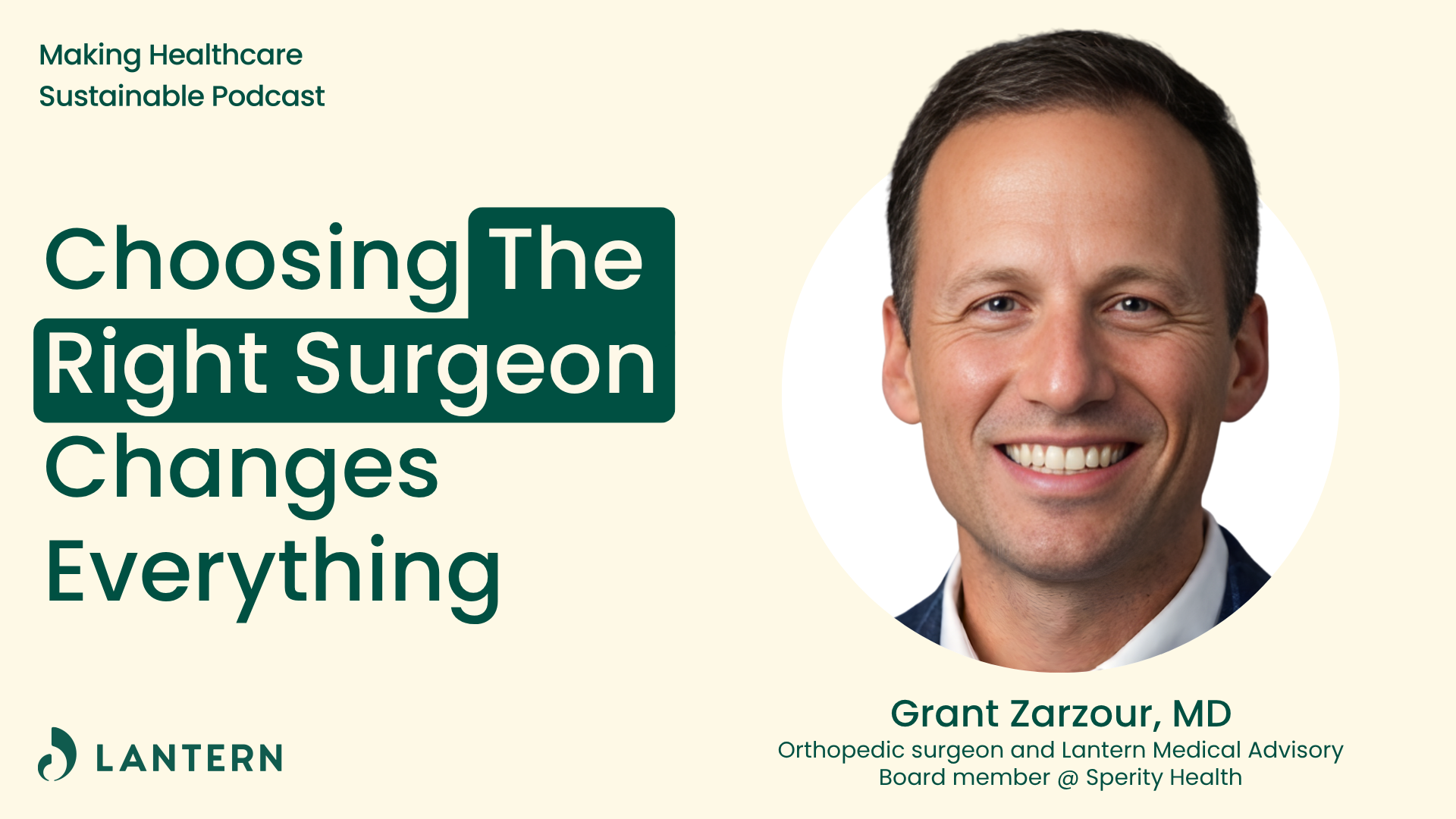
In this episode of Making Healthcare Sustainable, Nancy Ryerson speaks with Grant Zarzour, MD, orthopedic surgeon and Lantern Medical Advisory Board member, on what actually drives better surgical outcomes. He shares how volume shapes results, why appropriateness comes first, and what faster recovery really looks like.
In this episode, you’ll learn:
Why high surgical volume leads to better outcomes and faster recovery
How to guide members to the right procedure and avoid unnecessary surgery
What quality really means beyond reputation and referrals
Highlights:
(00:00) Meet Dr. Grant Zarzour
(01:46) Navigating healthcare during a family crisis
(04:29) Partial vs total knee replacement decision
(08:09) Why appropriateness matters before surgery
(12:41) How to define quality in surgery
(13:58) What patient-reported outcomes reveal
(14:50) Coaching patients through recovery
(15:54) What great post op care looks like
(19:45) What is driving faster surgical recovery
(23:03) GLP one drugs and the real tradeoffs
(26:13) Breaking sugar habits and spikes
(31:27) Why prevention still gets overlooked
(36:11) Why personalized care plans matter
(37:01) What the future of healthcare looks like
Resources:
Nancy Ryerson’s LinkedIn: https://www.linkedin.com/in/nancyryerson/
Dr. Grant Zarzour’s LinkedIn: https://www.linkedin.com/in/grantzarzour/
Episode Highlights
Why Quality Surgeons Want In
Timestamp: [11:23]
A question Lantern hears from prospects: why would a great surgeon agree to lower rates?
Dr. Zarzour answers it from the inside.
“I think direct-to-employer is a big part of the future. I think that because of these rising health insurance premiums that are out of control, benefits leaders, CFOs, executive teams are having to come up with creative solutions to cut costs and improve quality, which doesn’t exist in the world. You don’t go from the Toyota to the Lexus and it’s cheaper, but with Lantern, that’s able to be accomplished. But one, you don’t want your employers and your community starting to get in direct employer relationships and you’re cut out. So great surgeons are actively seeking to become members of the Lantern Network because they don’t want to miss out on the opportunity to take care of people.”
What “Back to Work” Looks Like With a High-Quality Surgeon
Timestamp: [19:37]
Many members expect surgery to mean weeks in a facility and months off work. The reality, with the right surgeon and the right protocols, is very different.
“I’ll tell you, I mean, for our patients, we tell them that average return to work or a total knee replacement is five to six weeks. And for an anterior hip replacement is three weeks. And they go, ‘Wait, what? I thought this was 90 days and I’m going to go to a facility for 21 days.’ I’m like, ‘No, no, no, no, no, no.’ I tell them, ‘You came to the top shelf. Okay. We’re going to get you up and at them, moving quicker, recovering faster, back to doing what you want to do with your family, producing for your family at work. Everybody’s going to win here, but we don’t need some 90-day max short-term disability experience. We need a return to normalcy without pain.’”
Episode Transcript
Grant Zarzour, MD (00:00):
You should not be afraid to ask your surgeon, how many of these do you do? And if they get insulted, you should run. And they’ve answered the question for you. But any high volume person’s going to be thrilled to tell you about their protocols, what they’re focused on, patient outcomes, and you’re going to do great. This is a big decision for you. You need to be equipped with the right questions, but if there’s only one question you remember, it’s how many of these do you do? Because right now, if you don’t have Lantern guiding you, you’re just relying on maybe your primary care to send you to their friend or somebody you go to church with or in your neighborhood or suggest X, Y, or Z. It’s a coin flip. Your knee or hip doesn’t go perfectly. This is really risking your retirement life and quality of life.
(00:46):
We want you walking, going on cruises, hiking, traveling the world, chasing around grandkids and great-grandkids. This is a part of that puzzle that needs to go well.
Nancy Ryerson (00:58):
This is Making Healthcare Sustainable, brought to you by Lantern. If you needed a knee replacement, would you rather go to someone who does 25 a year or 600 a year? It’s an easy question to answer, but it’s much harder to find that information on your own or to know that you should be asking about it in the first place. Benefits leaders want to make it easy for members to find and use high quality care. That starts with understanding the right way to define a quality provider and the real world impact true quality can deliver. To help answer those questions, I’m joined by Grant Zarzur, MD, a leading orthopedic surgeon who specializes in knees and hips. Dr. Zarzur is also a member of the Lantern Medical Advisory Board. With his extensive expertise in joint replacements and passion for advancing healthcare quality, he’s here to share valuable insights on the metrics that matter and quality and how benefits leaders can empower their people to lead healthier lives.
(02:07):
Grant, before we get into the main part of our discussion today, we’ll start with our think, feel, do segment. Which did you choose?
Grant Zarzour, MD (02:16):
I chose Field.
Nancy Ryerson (02:17):
Great choice.
Grant Zarzour, MD (02:18):
I unfortunately have experience on trying to wade through the system with a cancer family member, a diagnosis. I’m an orthopedic surgeon. My dad was an orthopedic surgeon. I grew up wanting to be around him. Big role model for me. And at 70 years old, he got a brain tumor. And we had to try to navigate the system and try to get in and find the best doctors. And he was an MD. I was an MD and you would think that we could just open up doors and get in. And it was tragically difficult to the point where I had to leave my board exams early, catch a plane to Baltimore to take him through the emergency room at Johns Hopkins in order to be seen because they said it was going to be three months to see the neurologist there who was the expert in this particular field.
(03:10):
And it’s just a very complex system we have right now. And you feel awful alone when you get that kind of diagnosis. And you need a resource, you need a team to help you, certainly when it matters most. And years ago, we didn’t have that. It was certainly a big challenge and something I’ll never forget.
Nancy Ryerson (03:30):
Yeah. I’m sorry to hear about your dad and that experience.
Grant Zarzour, MD (03:33):
Well, the key to life is adapting and overcoming and putting one foot in front of the other. And that’s what we’re here to talk about and everything else is we know today, maybe he’s not perfect, but how do we beat yesterday and improve on that each day, one day at a time? So I think we’ve got some building blocks to work with.
Nancy Ryerson (03:49):
Yeah. How do you feel like that experience, it sounds like you were maybe in medical school or working on becoming a doctor. How did that experience shape how you ended up approaching your practice?
Grant Zarzour, MD (04:01):
I think it made me look at the whole patient more than just the knee or the hip. We get kind of compartmentalized and siloed, and it’s easy to kind of go off on that thought process, but the whole patient really matters. I tell people 90% of my job is psychiatry and encouragement and telling people they can do it and how we’re going to help them with the new knee or new hip or physical therapy or injection or whatever the treatment may be, but presenting a confident, proactive solution and helping them understand that there’s a real bright future ahead, but they have to play a role. They’ve got to play a role in their own healthcare. And when we bring those two things together, a patient who’s motivated and a surgeon with the right expertise, it’s a win-win. Yeah.
Nancy Ryerson (04:45):
And I think that leads well into a question I wanted to ask. I know you’ve shared a story at some of our recent client events about an experience you had with a Lantern member who came to you and initially wasn’t actually that happy to be in your office. So I was hoping you could share that story.
Grant Zarzour, MD (05:01):
Yeah. Sometimes I’ll see Lantern members who’ve had to drive 45 minutes or so and they maybe have passed another orthopedic surgeon office on the way, or they may already have an orthopedic surgeon that’s not in the Lantern network and now they’re being told, “You need to go see this other doctor that they’ve never heard of. ” And recently I had one who had a physician they were happy with, but they came to see me and they come in the room and I love these situations, Nancy, because it’s a challenge and I love trying to win people over. And she was an evaluation for a total knee replacement and had failed extensive conservative treatment. And she had lined up a knee replacement with her current doctor that was an hour away where she lived. And I said, “Listen, let’s go through a physical exam. Let’s look at your imaging.” I said, “Listen, I’m looking at everything.
(05:56):
You have isolated pain on the inside part of your knee. I think you’re a candidate for a partial knee replacement.” And she goes, “Oh no, my doctor told me if anybody mentioned partial knee replacement, just run the other way. They don’t last. I need a total knee replacement.” And I said, “Well, the data says that if you are high volume and you do more than 20 a year partial knees, that your outcomes are really quite consistent with a total knee replacement, but you have less pain, faster recovery, faster return to work. You can almost forget you’ve had knee surgery and it’s a shorter procedure, but the doctor actually makes less on a partial than a total. And it’s challenging, but it’s a great procedure because the patient loves it. Patient satisfaction scores through the roof.” She said, “Oh, I just don’t know. I think that my other doctor, and I found out her other doctor was a sports doctor, which great sports surgeon, but not a specialist in hip and knee replacement, not fellowship trained.” And so after I kind of gave the pros and cons, she goes, “Oh, let me think about … ” I said, “You know what?
(07:02):
Once you kind of have your mind set on a total knee, it’s probably best to just pursue the total knee. So we’ll just have that as our working plan.” She goes, “Well, I don’t know. It sounds pretty good. There’s less pain, faster recovery, faster return to work, less short term disability. My life’s back. I forget, maybe I want to do this partial.” And I said, “Well, if that’s what you want to do. ” So we kind of came full circle on helping her understand what the opportunity was, what her diagnosis was, but she had very valid questions and very valid concerns, and it’s my job to answer them, and then she gets to pick what she wants to do. Now, she did move forward. We did the partial knee and she went back to work, I think, in 11 days. So great outcome, but a key part of that story is focusing on your craft and lots of hips and lots of knees equal great outcomes.
Nancy Ryerson (07:53):
Yeah. And I really like how you helped paint a picture of what her recovery could look like with both options to help her make that decision.
Grant Zarzour, MD (08:01):
There’s certainly, listen, outcomes are great with total knees as well, but partial knee is just faster, better. Not everybody’s a candidate for a partial knee for sure, but you need a physician who can really evaluate the x-rays, the physical exam, the history, everything comes into play to come out with a great plan.
Nancy Ryerson (08:18):
I think it’s a good story too for just having the volume of cases that you see. You know what to do in different situations. I think there could be an interpretation of, oh, doing all these knee replacements a year, did every single one of those people need that? But it’s how do you think about appropriateness and how that fits into volume and other metrics we look at?
Grant Zarzour, MD (08:41):
Appropriateness is very, very critical part of the conversation because the last thing you want is somebody going, “Oh, you send your patient a doctor’s arms or he’s cutting on them before they even sit out. ” And very valid concern under, but I’ll be thrilled to share. So first part is, is that the average orthopedic surgeon does 28 joint replacements a year and I do 650, but the average orthopedic surgeon does some shoulder, does some back, does some elbow, does some ankle. I just do hip and knee. That’s just my niche, my fellowship training. I put my outcomes up against anybody in the country on hip and knee, but not on the shoulder. I don’t do it. So we just stay in our category. But I think that we’re, at least for my training, like when you go do your board exams and you do your oral boards, you have to validate all of the surgeries you do to a group of your peers in order to be board certified and get through that process.
(09:34):
And I think that I would tell you that the vast majority of us always are looking with that first do no harm, make sure we want to get a great outcome for the patient that they’re happy with their result and that they went through the process. Your brand and your reputation is on the line with each outcome. So I take every single person’s outcome personally. Now, if we operate on people who don’t need it, they’re going to say, “God, my knee hurts side. This wasn’t worth it. ” We don’t want that. I don’t want that associated with me. And I know that the Lantern Network, that’s something that really is vetted on appropriateness of care. And there’s a really cool organization, GAM that Lantern’s partner with too that really is helping identify surgeons who are doing the appropriate conservative treatment before. And Lantern evaluates each case.
(10:22):
I mean, it’s amazing attention to detail, but did we make sure extensive conservative treatment was exhausted before jumping to surgery? So it’s really kind of a comprehensive look. Again, I just go back to that. Your surgeon doesn’t want to be associated with bad outcomes, and the way to do that is only offer appropriate care. Yeah,
Nancy Ryerson (10:42):
That’s a great point. We talked to Will from Gam on the podcast as well, and that database is so amazing for finding quality providers, but most people don’t have access to that. They probably are going on Google or Yelp or asking around. And if someone says, “Oh, I hate that guy. I was in terrible pain afterwards.”That’s definitely not good for your business. But speaking on the business aspect, one question we get at Lantern is, why do surgeons want to be in your network? Because we do negotiate lower rates. Of course, we generally pay the surgeons similar. The facility fees are where we see a lot of the discounts. But I think it is a question that we get. So I’d love to hear your perspective on that.
Grant Zarzour, MD (11:23):
I think director employers are a big part of the future. I think that because of these rising health insurance premiums that are out of control, benefits leaders, CFOs, executive teams are having to come up with creative solutions to cut costs and improve quality, which doesn’t exist in the world. You don’t go from the Toyota to the Lexus and it’s cheaper, but with Lantern, that’s able to be accomplished. But one, you don’t want your employers and your community starting to get in direct employer relationships and you’re cut out. So great surgeons are actively seeking to become members of the Lantern Network because they don’t want to miss out on the opportunity to take care of people. And two, I think it’s really important that quality always being the North Star. I love to share that the only reason I’m involved with Lantern is their answer to the question on when, get a new client somewhere and maybe don’t have a full network of orthopedic surgeons available.
(12:18):
And so someone’s going to have to drive an hour and they wish that they had somebody locally, but you got to drive an hour. Lantern doesn’t cut corners and say, “You know what? We’ll just take somebody local who’s an okay person.” They say, “I’m sorry, this is what we have to offer and we’re not going to extend the results or extend the qualifications in order to meet a business need.” The quality of the patient care is the North Star. And that’s really hard to find in today’s business world, that focus on quality and not just to talk about it, but to actively on a day-to-day basis prove it. That’s why I’m involved with Lantern is, I think that’s a fascinating and wonderful North Star.
Nancy Ryerson (12:59):
Yeah, we appreciate that. And I think the story you shared was a good example. We do have a local network, but at the same time, you might pass by other hospitals or locations on your way if it is a 30 or 45 minute drive. So I’m curious, how do you describe quality to patients? What do you find resonates or helps them understand the difference between yourself and someone else they might’ve heard of or seen?
Grant Zarzour, MD (13:26):
There’s several thoughts on that, like the efficiency of the procedure, infection rate, but patient reported outcomes are so critical. How does the patient feel about their experience? Because that’s really what matters the most. It doesn’t matter if I say their X-ray looks perfect and I did a great job. If they’re unhappy, we did something along the way incorrect. So that’s why patient reported outcomes are kind of the best way I like to talk about it. And we’re real proud of, whether it be an anterior hip procedure where you’re avoiding cutting muscle averages takes about 40 something minutes or it’d be a partial knee replacement or total knee replacement, which are around that 40 minute mark as well. The patient’s up and walking with a nerve block right after, quickly mobilizing. And if the surgery is efficient, it’s less recovery of your soft tissues. It’s less anesthesia that you’re under.
(14:19):
And the infection rate certainly is tied to length of procedure. That quality piece is really all encompassing on a number of different metrics. But to me, the biggest one is how does the patient feel?
Nancy Ryerson (14:30):
Yeah. What kind of questions are asked in those patient reported outcomes?
Grant Zarzour, MD (14:35):
Well, they’ve got to fill out a little questionnaire, usually at different time points throughout, but it’s basically how are they able to get up out of a chair and walk? How often are they thinking about their pain? What was it like before? What was it like during the recovery at each stage? There’s a number of consistent questions that they’ll get and they get asked the same questions at each interval so you could really compare and contrast. And what we want to see obviously is an improvement, but we can tell them that, oh, what you’re six weeks out of your knee replacement, we’ve still got on average, 50% more improvements coming. If you like where you are now, just wait, keep that physical therapy going, keep doing your exercise and stay with your positive thinking and it all works. There are questionnaires that are easy for the patients to fill out that don’t take too much time and the patients really enjoy being involved with
Nancy Ryerson (15:21):
It. That’s great. What role do you feel like mindset plays in recovery? It seems like it’s something that you do focus on and think about a lot in your practice.
Grant Zarzour, MD (15:30):
I tell them, I think there are two pieces. I think one is a high volume surgeon and another two is strength between here. Family network certainly matters, but I really enjoy coaching people up. Some of my patients aren’t the mentally strongest and they need some encouragement, but I’m very happy to provide it. And it’s every step of the way where it’s the pre-op visit, the visits where we’re going through physical therapy, then pre-op, then the day of surgery, it’s real important before surgery to engage and tell them how great. And then after surgery to check in whether you’re walking with therapy, whether it be a phone call that night or a few days later and the post-op visits, it’s all this recurring theme on you’re getting better, you’re doing great, this is an investment in your future and each step of the way that encouragement matters.
(16:18):
And I really think gives a lower level of anxiety with the surgery and the whole process and certainly much more calm.
Nancy Ryerson (16:25):
Yeah. And then in your work on Lantern’s medical advisory board, is this kind of post-op protocol something that Lantern also looks for in our network? Is this a best practice that makes someone a quality surgeon?
Grant Zarzour, MD (16:38):
You have to submit your post-op protocols, what you do. And Lantern’s going to evaluate it and make sure it’s correct. We want to limit opioid use after surgery. Now, listen, you’re going to need a few pills because there’s going to be some pain, but we want to know, are we doing affected regional anesthesia with nerve blocks to have the nerves not be firing so much on the sensory part, all the pain part? And that really helps with the effective anesthesia partner. So the Lantern surgeon has to have an affected anesthesia partner for a successful episode of care. So that’s a big part of it. You think, oh, you got to pick the surgeon. Well, the surgeon needs to help make sure that we have the right anesthesia there. And then we don’t need a hundred narcotic pills going home with the patient after surgery. We’re asking for a problem if we do that.
(17:27):
We need the minimum amount needed, but also we’re going to use Tylenol, we’re going to use anti-inflammatories, a multimodal ice, compression elevation, compression socks, all those type of things play a role. And the education starts before the surgery so that they know what is expected after surgery and can really get success.
Nancy Ryerson (17:47):
Yeah. Yeah. It sounds like what happens after surgery is so critical to those final, those outcomes in the end.
Grant Zarzour, MD (17:54):
Exactly. It’s all a huge part of the process every step of the way. And that’s why Lantern surgeons, I think the outcomes are so good is that we’ve really thought of every piece of the puzzle because it all matters.
Nancy Ryerson (18:06):
What about before surgery? It sounds like you might give people a little bit of a pep talk of the kind of results they can see. What else is part of pre-op?
Grant Zarzour, MD (18:15):
Yeah. Certainly we want to address what questions they have or concerns they have. I love asking, “What’s your biggest concern with the surgery?” And it’s all over the board. I may be getting a ride to get to surgery or it may be family. I take care of people in my family. How are they going to do if I’m not able to take care of … I think many people think, “Oh, I’m going to be in a bed for several days.” You’re going to be walking an hour after surgery with physical therapy and a walker, a walker for 10 days, a cane for 10 days, and then nothing. And they’re like, “Oh, wow. Okay. It’s not your grandmother’s knee replacement.” 20 years ago it was different, but in 2026, the rapid recovery is just really fantastic. And we’ve kind of gotten the process down pet, but I love asking that, “What’s your biggest concern?” And helping take that off the table and tell them how we’re going to address it and make sure that’s not an issue.
(19:08):
And another way of getting that anxiety level done. Because for me, I’m in surgery all day, surgery I’m very, very comfortable with. I tell people in the morning, they go, “Oh, I’m nervous.” I said, “You’re supposed to be nervous, but I’m not. We got this. ” And they go, “Okay.” I try to get them to laugh a little bit because humor is some good medicine too.
Nancy Ryerson (19:25):
I could see that really helping people feel more comfortable going into it. And I can also understand people feeling concerned, how long will I be out of work and knowing that you can get back to your regular life sooner. I’ll
Grant Zarzour, MD (19:37):
Tell you, I mean, for our patients, we tell them that average return to work or a total knee replacement is five to six weeks. And for an anterior hip replacement is three weeks. And they go, “Wait, what? I thought this was 90 days and I’m going to go to a facility for 21 days.” I’m like, “No, no, no, no, no, no.” I tell them, “You came to the top shelf. Okay. We’re going to get you up and at them, moving quicker, recovering faster, back to doing what you want to do with your family, producing for your family at work. Everybody’s going to win here, but we don’t need some 90-day max short-term disability experience. We need a return to normalcy without pain.”
Nancy Ryerson (20:15):
Absolutely. Yeah. You mentioned this isn’t your grandmother’s knee replacement. What has been behind some of the … It sounds like there have been some advances. I don’t know if it’s in technology or just things people have learned over the years. Where those advances come from? Well,
Grant Zarzour, MD (20:30):
I think one is subspecialty training. It used to be 20% of surgeons did a fellowship. Now it’s almost every orthopedic surgeon has done at least one fellowship. So it’s just that advanced further focus on that subspecialty of whatever it may be. But for me, it’s knee and hip replacement. So I think that really improves the efficiency of the procedure. The procedure used to take on average three hours. Again, ours are 40 minutes or so. And then day of surgery was always bedrest. And sometimes in a knee immobilizer, let the soft tissues rest because they had been insulted for three hours. When you have the more efficient procedure, you don’t need to do bedrest. We’re up and walking and moving. Some other things that have really helped, transexamic acid is a great way to lower blood loss during surgery. So the transfusion rate is plummeted. We just don’t see a lot of blood loss with a hip or a knee to where a transfusion’s ever going to be needed.
(21:18):
So transexamic acid is a medicine that pretty much everybody uses now during surgery to help make it so less blood loss. And the technology’s a big deal. Everybody has different levels of, whether it be a robot or an accelerometer or some people are using just still manual instrumentation. The data is pretty clear. The surgeon is what matters. The technology can be a supplement, but what’s most important is what surgeon do we have in the room and do they have the right team around them, which certainly I’m relying on my team and luckily they have such a great team around me.
Nancy Ryerson (21:50):
That’s pretty cool to hear about. If you were someone who maybe you don’t have Lantern, maybe you don’t, no grant, what are the chances that you would go and get a knee replacement and have more of that three-hour experience? Is that something that still happens? Or what’s the variation, I guess, in quality that’s out there?
Grant Zarzour, MD (22:09):
Well, I go back to that. That’s a current stat on number of joint replacements done per year for an average orthopedic surgeon is 28. So when you have somebody that does two a month, it’s just going to be a different … I mean, today is the end of the week here. I did 21 this week. You should not be afraid to ask your surgeon, how many of these do you do? And if they get insulted, you should run. And they’ve answered the question for you. But any high volume person’s going to be thrilled to tell you about their protocols, what they’re focused on, patient outcomes, and you’re going to do great. So this is a big decision for you. You need to be equipped with the right questions, but if there’s only one question you remember, it’s how many of these do you do? Because right now, if you don’t have Lantern guiding you, you’re just relying on maybe your primary care to send you to their friend or somebody you go to church with or in your neighborhood or suggest X, Y, or Z.
(23:08):
It’s a coin flip. And this is your life. This is quality of life. Your knee or hip doesn’t go perfectly. This is really risking your retirement life and quality of life. We want you walking, going on cruises, hiking, traveling the world, chasing around grandkids and great-grandkids. This is a part of that puzzle that needs to go well.
Nancy Ryerson (23:28):
Yeah. Going back to the idea of getting back to your life on the other side of surgery, definitely.
Grant Zarzour, MD (23:34):
Exactly.
Nancy Ryerson (23:35):
Now you have, I know, an interesting take on GLP-1s and the relationship between those and what you see in your practice. So I think it’s just a topic that is on so many people’s minds. So we’d love to just hear you speak on that.
Grant Zarzour, MD (23:50):
My bold bet for the future is that GLP-1s are not the future. I think that it’s become very, very popular and it’s the easy button, which in America, we love an easy
Nancy Ryerson (24:00):
Button. We do.
Grant Zarzour, MD (24:01):
But so commonly that easy button comes with side effects or problems or doesn’t live up to the hype. The number one reason I don’t like GLP-1s is that you lose just as much muscle as you do fat. And that muscle is your key to quality of life later in life, really at all points. Muscle is so critical for the cocoon around your body to protect your bones. Your quad muscles in your thighs determine how good you are at climbing stairs or stepping up on a curb or how likely you are to fall. And if you want to become my patient and have a fall and break your hip, that is the easiest way to lower your quality of life and it will never recover. So I need stable, strong quad muscles. And the way to do that is nice diet, exercise. And I love 25 whole grains, fruits and vegetables a week.
(24:55):
GLP-1s make you anorexic. So you’re now, instead of taking in that 150 grams of protein a day, you’re taking 30. Your muscle just evaporates. And there’s MRIs that show this. It’s also causing osteoporosis. So your bones are getting weaker probably because all that muscle’s gone. We’re robbing Peter to pay Paul here. Now, are there examples of people on GLP-1s that it’s totally transformed their life and it’s been the best thing that’s ever happened to them? Absolutely. There are examples of that, but it’s becoming increasingly rare. The average person stays on a GLP-1 for 11 months, 16 months later, all the weight is back. 16 months later, all the comorbidities are back. One employer recently told me they spent $60 million on GLP-1s for weight loss for 6% of their employee population, and their medical spend went up more than the regular folks without the weight loss.
(25:53):
So we didn’t move the needle. And imagine if we spent $60 million on some sort of preventative, proactive solution for everybody. So I’m just a big believer that we need muscle mass going down later in life. And I’ll tell you the most powerful weight loss tool on the planet. And we’re getting off orthopedics here, but it’s a continuous glucose monitor, Nancy, that tells you your body’s relationship with sugar. And if you want to lose weight, see what happens after you eat pita bread or take ice cream or whatever. And I’m not saying you should never have those things. Life’s not worth living if you can’t have those things. I tell people five days out of the seven for a week, let’s try to be good. But a CGM is the most powerful weight loss tool on the planet, not a GLP-1.
Nancy Ryerson (26:38):
Yeah. Can you say more about how those work just for anyone in our audience who is not as medical as yourself?
Grant Zarzour, MD (26:44):
Yeah. So people think of it for diabetics to monitor their blood sugar. And when you eat anything that has sugar in it, and I’ll tell you, a big violator is the caramel frappe mocha chocolate latte. Everybody drinking those in the morning with a hundred grams of sugar and a thousand calories, you can’t lose weight for three days after you eat one of those things. So the hidden calories and sugar and drinks and fake sugar also bad. And I’ll tell you, Nancy, when I tell my patients in orthopedics, when they’re trying to lose weight, I say, “You can drink three things.” And they go, “Okay, certainly I’m going to like one of these three things.” Water, and they go, “Oh, strike one, black coffee.” And they go, “Oh.” And they go, “Maybe the third one.” And I say, “Unsweet tea.” And Nancy, in Alabama, unsweet tea doesn’t go over very well.
(27:34):
I
Nancy Ryerson (27:34):
Can imagine not.
Grant Zarzour, MD (27:36):
So I tell them, but the sugar is so bad, but the CGM monitors your blood sugar. And so when you take in sugar, it has three destinations, your liver gets some of it automatically, and then it’s either fat or muscle. If you move around after you eat, some goes to your muscle more and more. If you eat ice cream at 8:30 at night, sit on the couch, all of that sugar grows to fat. So when you can see your data on the CGM and go, wow, look how much my spiked after that dinner. And if you learn, man, if I go for a 15-minute walk after dinner, my spike is 50% less. Wow, maybe I should incorporate a 15-minute walk after I ate a big meal. It teaches a man or a woman to fish with your own data. Because right now, to be honest, we’re blissfully ignorant on our relationship with sugar.
(28:26):
And some people, a banana makes them go crazy and an apple doesn’t and vice versa. We need to find out which are our superfoods and which aren’t. And the only way to do that is a one month, two month, three month continuous glucose monitor.
Nancy Ryerson (28:40):
That’s interesting. And are there some people who are kind of genetically blessed and they can eat ice cream and it doesn’t really affect them all that much?
Grant Zarzour, MD (28:47):
Yes, Nancy. And we hate those people. Okay, we do. We don’t like them. We don’t associate with them. No, I’ll tell you, I’m pretty involved in a good proactive company. One of our sayings is eat ice cream for breakfast because it costs half as opposed to eating it for dessert after dinner Because when you eat it earlier in the day and you go run around and move around, your muscle is using that as energy and it’s not all going to fat. We like that because you still have to live, you still have to have fun, you still got to go to that football game, have a beer, but we’re just trying to make incremental improvement and help share the data.
Nancy Ryerson (29:21):
Yeah, I think you’re so right. I think for so many people and we’ve all been there the thought, oh, I can never have that again, but I love ice cream.That’s not motivating. That’s not going to get you to suction. That’s not
Grant Zarzour, MD (29:33):
Sustainable.
Nancy Ryerson (29:33):
Yeah. Yeah. Well, similarly, I know you also have a longevity company, so would be curious to hear how you initially got into that. I’m sure in your life as a doctor that these kinds of things come up, but yeah, curious to hear how you went in that direction as well.
Grant Zarzour, MD (29:47):
Yeah, Sperity Health is the name of it. I practice reactive care in orthopedics, which I really enjoy helping people walk again. And I get people who tell me, “You helped me walk my daughter down the aisle with your hip replacements and things like it’s Really awesome. On the longevity company, I have four children, a boy and three girls. And my son is 10, but when he was two, he went to school for the first time. First kid, school calls day two. Something’s wrong with your boy. And I said, “Nothing’s wrong with my boy. He’s fine.” They said, “No, no, he’s anxious. His speech delay. You need to go to a doctor.” We go to a neurologist. We spent 45 seconds in the room. The neurologist says, “This boy needs to be in an antipsychotic medication every day. Never going to make it at regular school.
(30:33):
And mom, dad, buckle up. It’s going to be a long, hard ride.” And we just refused to accept that and said, “We’re going to dive into something I learned nothing about in medical school, which is proactive preventative care.” And so the research is really clear as why it was diagnosed with autism, moderate severity. Proactive approaches work, diet, sleep, exercise, gluten. I didn’t believe in being gluten-free. I’ll be honest, when I first heard about gluten, I said, “If you don’t want your gluten, I’ll eat your gluten.” I was wrong. Some of us can’t. Speech therapy, cognitive behavioral therapy, neuro STEM, all these great supplements that Wyatt … And long story short, from two to 10, he’s now flourishing and doing fantastic at school, regular school, not on an antipsychotic. He’s my biggest success story. No matter what else I do or have done, you’re only as well as your sickest child.
(31:24):
And what we learned is that those strategies work for cancer, cardiovascular disease, and dementia. Everybody’s concerned about those three things, or if you’re not, you should be. And for health insurance, the big drivers, cancer and cardiovascular disease aren’t going anywhere. We feel like the current strategy is hope and it’s not working. We’ve got to switch that strategy to prevention. And so Sperity Health’s kind of the quarterback to implement that for companies, for employees and for executives. And I’m super passionate about it because don’t tell me we can’t save the world with prevention because I think we can.
Nancy Ryerson (31:59):
That’s so interesting. You said that you really didn’t learn about prevention in medical school. You’d think that that would be part of the curriculum.
Grant Zarzour, MD (32:06):
I tell you, I told people in pathology class, they’re talking about all these issues and ailments and how to treat them and here are the symptoms. And of course, I’m part hypochondriac. I’m like, oh, I think I have that. I think I have that. I mean, I thought I was pregnant, Nancy, for a while when I heard all the different things. Yeah, good to hear that. I had everything. Yeah, exactly. But so going through that, you learn how to treat it. And listen, the United States is amazing at reactive care. Nobody’s better at keeping people alive once they get a diagnosis, but insurance doesn’t cover preventing a diagnosis. There’s no CPT code for that. I think the future, there will be. But right now, we’re in an area where we have to take our healthcare in our own hands. And I think that people think that their genetics determine their destiny.
(32:51):
There’s actually some great data that your genetics determines 18% of your destiny. 82% is how you treat your body. And you can manipulate that 82% positively or negatively. And I really feel like, why don’t we choose the positive side and focus on diet, exercise, sleep, preventative imaging and labs. But people go, I don’t know where to start. Longevity is 80% snake oil, which I agree with. Sparity Health is proud to be in the 20% focused on data and science and to provide a quarterback on here’s the imaging, here’s the labs. We’re going to go over it with you. It’s not going to just be some app where you don’t hear from a human. We love eyeball to eyeball interactions because that’s the way you drive change. Face-to-face is what activates people to change. One of our employers, 50% of their managers smoke. And you have no chance on your health insurance if 50% of your managers smoke.
(33:48):
So well, how do you fix that? Well, it starts with education. It starts with putting the wearable and the data and showing how that’s affecting them, and then it becomes their idea to put them down. So I’m not telling you it’s 100%, but it’s a lot better than the status quo.
Nancy Ryerson (34:02):
Yeah. And I’m sure a lot of benefits leaders out there have tried some of those more preventive programs. Where do you feel like those maybe go wrong or what do you feel like is missing from those?
Grant Zarzour, MD (34:15):
The gym membership, only the healthy people go. The app, single digit engagement, people do it one time, never open it again. To me, we put these wearables on people and stuff. In 2026, we have great wearables and data. Let’s use it because people think that their neighbor may get cancer. Their neighbor may have a heart attack or dementia, but not me. It’s the American way. We think, “Oh, it won’t happen to me. ” Well, your data says you’re going down that path toward dementia, toward … You’ve got a 50% blockage in your coronary … When you start showing them their own data, that activates their amygdala, a small part of their brain that’s fear and emotional center. Another way of activating that amygdala is meeting one-on-one with a physician, a nutritionist, an exercise physiologist, and somebody to draw your labs. And that experience and that curated personal solution doesn’t exist in the marketplace, to my knowledge, where you come on site and it’s not just a one-day deal.
(35:16):
You have to stay engaged throughout the year. We need KPIs. Everybody knows KPIs for the business. We need KPIs for your health, and we’re going to hold you accountable to it. You said these are your three for this quarter. We’re going to talk at the end of the quarter, and we’re going to look at your data from your CGM, from your wearable, and your sleep, your heart rate variability. And we’re going to look at the record. We’re going to hold you accountable, just like that spreadsheet does for your financial situation at work. We tell people, what are you making this money for if you’re not going to have the health to spend it? So we got to start focusing on that health because a sick man or a sick woman wants only one thing. And it’s not the biggest bank account. It’s to get them out of that doctor’s office.
(35:55):
So we love focusing on that and helping people see their own mortality. So I think that really helps differentiate us from a lot of these other solutions that people have tried and then sunset.
Nancy Ryerson (36:06):
Yeah. And it’s seeing your own mortality, but not as like, “Well, you’re doomed. These are the actions you can take.” There’s
Grant Zarzour, MD (36:14):
Always a … People are like, “Well, I’m already 65. Is it … ” No, it’s never too late. It’s like a 401. You can make it at any time. Certainly the earlier is the better, but it always works. And we’re trying to maximize and beat yesterday. And again, we don’t paint this. You got to be perfect. Let’s get that five out of seven days.
Nancy Ryerson (36:34):
That’s great. Yeah, because I think you’re right. Feeling like you have to be perfect and that’s not motivating either because it’s like, “Oh, well, I failed. I give
Grant Zarzour, MD (36:41):
Up.” Exactly.
Nancy Ryerson (36:42):
Yeah.
Grant Zarzour, MD (36:42):
Exactly. You have to meet the person where they are, meet the employee, meet the executive. And us coming on site really helps with, they don’t have to travel as much, but understanding their concerns and their goals and then making a specific plan because healthcare is individualized. Lantern does a great job of finding the right doctor for everybody and that doctor gets to make an individualized plan. It’s not a cookie cutter solution. It never is in healthcare. And I think that’s some of the issue with these point solutions. They expect, “Hey, here’s our one offering. At Sparity Health, we have a thousand.” It’s dependent on what the member needs, not on what we think they need. They got to help guide us.
Nancy Ryerson (37:20):
Yes. Like you were saying earlier, you don’t really know. There’s so many different barriers to care people can have too. Maybe they don’t have a ride or they don’t have childcare or a million other things and you can’t really know until you ask. Well, you spoke to one prediction for the future, but I think you have a few more. We like to wrap up with what’s in your crystal ball for the next few years in healthcare. And I like the optimistic theme we have going. So maybe there’s something optimistic you could share, but no pressure. If you want to be pessimistic, that’s fine.
Grant Zarzour, MD (37:51):
I think that on the orthopedic front, I mean, I see a lot of direct to employer relationships expanding and a lot of companies considering that more and more based on the needs in the marketplace, but also seeing like Lantern proving this, better outcomes, better care, lower cost, there’s no downside anymore. So I really think as even medium size or smaller size companies, a lot of the larger companies are figuring it out, but medium and smaller companies need help too. And they may not have as much volume of surgeries, but that doesn’t make them any less significant each of those surgeries. So I think that that marketplace is going to grow tremendously over the next 10 years and you’re going to see better outcomes as a result. You’re going to see more care being directed to the best surgeons, which the best baseball players get to play more nights.
(38:45):
The best pitchers get to start the first game. We need the best surgeons. Right now, it’s everybody gets paid the same. Everybody is the same in the eyes of the insurance company. Let me be honest with you, orthopedic surgeons are no different than any other category of humans. We are not all the same. You’ve got great ones and you’ve got subpar ones. Let’s direct the care to the great ones. And I think that’s the future. So I’m very optimistic on patient outcomes improving by further advantage of these direct to employer relationships. So I’m really optimistic about that.
Nancy Ryerson (39:18):
Love that. That’s a great one. Well, thanks so much for being on our show. Really appreciate you taking the time. And I know I’m sure you have more surgeries to do either today or next week, so do another 20, 25.
Grant Zarzour, MD (39:31):
I have my scrubs right over there. I’m going to go change your dog.
Nancy Ryerson (39:33):
Perfect. Well, thank you so much. Really appreciate it.
Grant Zarzour, MD (39:36):
Thanks, Nancy.
Nancy Ryerson (39:40):
Thank you for listening to Making Healthcare Sustainable. If you want to learn more, be sure to check out our YouTube channel, Lantern Specialty Care, or check out our website where you can find additional resources.