



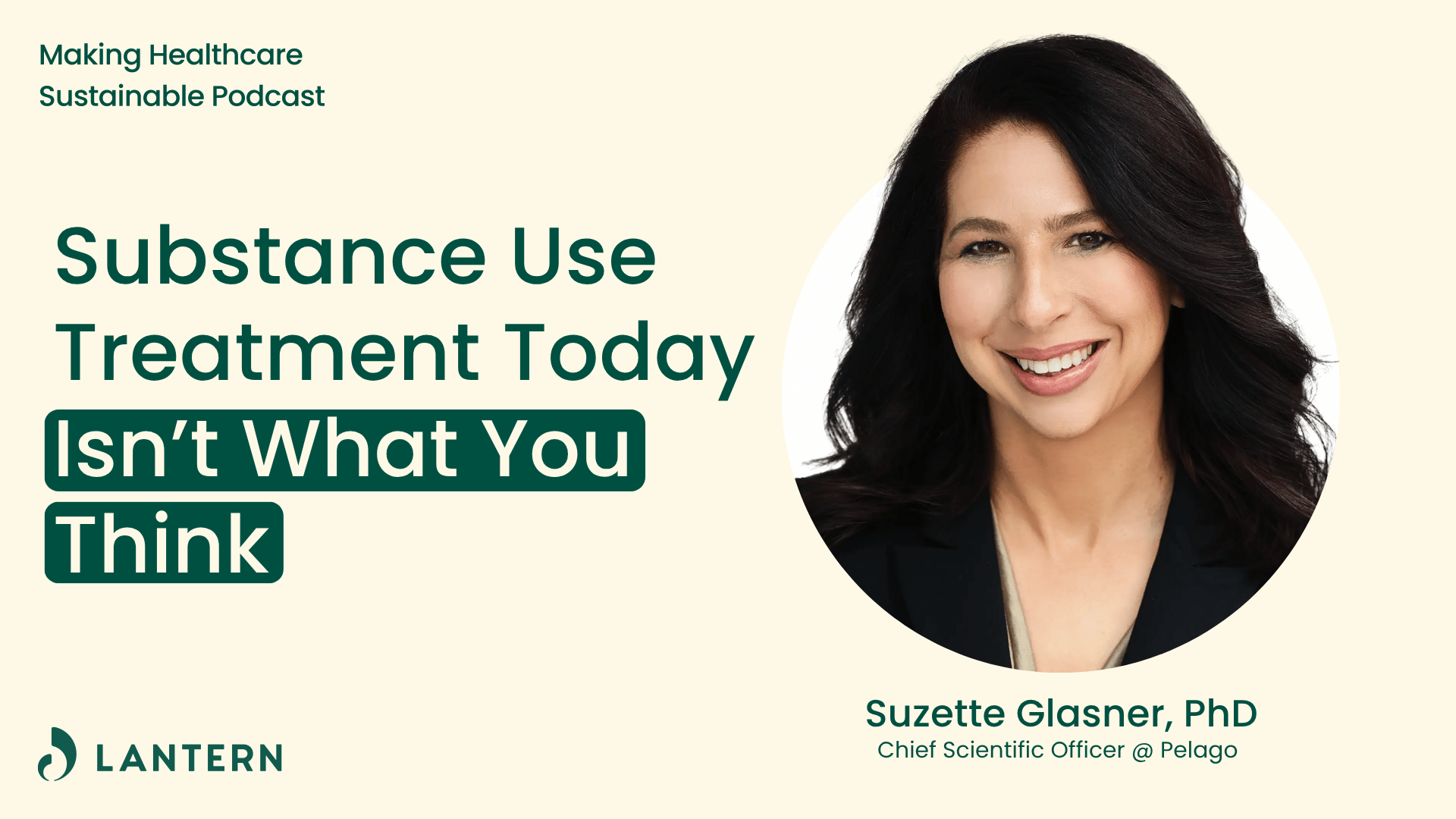
Episode Overview
If substance use disorder were an issue in your workplace, would you know it? And would you know how to help?
Dr. Suzette Glasner, Clinical Psychologist and Chief Scientific Officer at Pelago, discusses the hidden impact of addiction in your claims data, how employers are taking action, and what might surprise you about the latest research on effective addiction treatment.
In this episode, you’ll learn:
- The physical impact of addiction on employees and how this trickles down to healthcare costs
- Misconceptions about addiction treatment and Dr. Glasner’s thoughts on the headlines around psychedelics as addiction treatment
- Surprising research Pelago led on the right “dose” of human support for recovery
Highlights:
(00:00) Meet Dr. Suzette Glasner
(02:07) The hype vs reality of psychedelic treatments for addiction
(03:20) Why effective treatments are underutilized
(07:13) The barriers of stigma, access, and insight
(10:37) Why employers play a crucial role in addressing SUD
(20:14) How harm reduction can engage people in treatment
(28:49) Balancing human touch and AI in treatment approaches
(32:10) What makes a recovery-ready workplace
(39:44) Closing the gap with evidence-based solutions
Resources:
Nancy Ryerson’s LinkedIn: https://www.linkedin.com/in/nancyryerson/
Dr. Suzette Glasner’s LinkedIn: https://www.linkedin.com/in/suzette-glasner-ph-d-5846804/
Dr. Suzette Glasner’s podcast: https://www.youtube.com/@drglasner
Pelago’s LinkedIn: https://www.linkedin.com/company/pelago-health/
Key Moments
When Substance Use Disorder is Hiding in Claims Data
Substance use disorder can feel like a difficult problem to size. You know it exists in your workforce. You’re hearing about it, and you may be catching glimpses of it in behavioral health claims. But connecting the dots to a dollar figure? That’s where things get murky. Dr. Glasner explains why the true cost of substance use disorder is so easy to underestimate, and why that blind spot is costing employers more than they realize.
“It is often hiding in claims data. So some leaders will say, ‘I know it’s a problem. I’m hearing about it. I’m seeing it in some of my behavioral health claims, but I don’t know if it’s as big of a problem as people say it is the 75% in the workforce and the rising prevalence of various forms of substance use disorders.’ And the reason for that is that even though we have studies that show over $15,000, one of the larger studies that came out of a commercially insured population in recent years, over $15,000 in excess healthcare costs for individuals with substance use disorders compared to those who don’t have substance use disorders.
When we really dig into the data, the sources of that are usually on the physical health side. So that substance use is causing physical health problems or worsening other chronic conditions. So in that regard, it ends up being somewhat hidden in claims and not directly tied in the claims data to a substance use disorder.”
ROI in Substance Use Disorder Treatment
Addiction has a significant impact on physical health. When it’s treated, employers see real ROI.
“We end up seeing in all cause medical costs, pretty dramatic reductions in costs in the first year after treatment. The range is between about, depending on the methodology that’s used in an ROI study, that it’s between $6,700 and over $11,000 per individual in the first year after treatment reduction in costs. So it roughly translates to between like four and a half or five to one ROI. And really when we dig into where’s that coming from, about 80% of it is coming from changes in physical health related all cost medical spend versus behavioral.”
Driving Utilization with Substance Use Disorder Treatment
To drive engagement with programs like Pelago, company culture matters a lot. Suzette Glasner shares that companies like Dick’s Sporting Goods reduced pharmacy costs by 41% by creating a recovery-ready workplace.
“It’s very hard because you’re blending work life with their personal life and how do you say the right thing and not the wrong thing? So training people in the workforce to have these conversations in a way that doesn’t feel intrusive but also enables them to express that they care and that there’s help available and they’re supportive of that.
And what we see on the other end of that is that there’s a culture shift. People are talking more about it. There’s better uptake of programs like Pelago and then they see it in their outcomes and in their costs. I mean, I think with Dick’s Sporting Goods, they reported a 41% reduction in their pharmacy costs related to substance use disorder claims, for example. And by client, we do an evaluation of return on investment when we’re entering a renewal period or something like that. And we’re seeing that those who are really leaning into the maximizing the accessibility and the kind of conversations around programs like these are seeing really good outcomes in terms of their all- cause medical spend.”
Episode Transcript
This has been generated by AI and optimized by a human.
Dr. Suzette Glasner (00:00):
70 to 75% of people with a substance use disorder between the ages of 18 and 64 are in the workforce. We picture people who are unemployed who are really low functioning, but actually three quarters of them are quite the opposite. They’re out there working, they’re holding it together in some form, but they’re suffering and they’re underperforming not only in their role at work, but in their roles otherwise in their lives.
Nancy Ryerson (00:30):
This is Making Healthcare Sustainable, brought to you by Lantern. Substance use disorder is one of the most costly and most misunderstood issues in employer healthcare. It shows up in absenteeism, productivity loss, skyrocketing ER bills and surgical complications. But it rarely shows up in benefits conversations because stigma keeps it hidden and most employers don’t know where to start. Today’s guest has spent her career making sure that changes. Dr. Suzette Glasner is a clinical psychologist, addiction scientist, and one of the country’s leading voices on making evidence-based substance use treatment accessible at scale. She’s an associate professor of psychiatry at UCLA’s David Geffen School of Medicine, the author of Addiction: What Everyone Needs to Know, published by Oxford University Press and the host of her own podcast, the Dr. Suzette Glasner Podcast, where she translates cutting edge addiction science for everyday people and families navigating these challenges. She’s also chief scientific officer at Pelago, the leading digital substance use management clinic for employers and health plans, where she ensures every program is grounded in clinical rigor and drives real validated outcomes.
(01:47):
Dr. Glasner is going to help us cut through the noise on what actually works, what employers get wrong, and why addressing substance use disorder isn’t just the right thing to do. It’s also a smart benefits investment. Dr. Glasner, before we get into our discussion today, we’ll start with our think, feel, do segment. Which did you choose?
Dr. Suzette Glasner (02:06):
Think. What I wanted to highlight was a recent executive order that was passed by the Trump administration to accelerate research into psychedelics for addiction and mental health disorders. I’m very excited by it because on the one hand, we really need more emphasis and more dollars allocated to advancing addiction science and expanding the array of treatments that we have available for addiction as well as mental health disorders. But I also found that it highlighted for me what I think is an important tension where on the one hand there is this increasing awareness of addiction as a public health problem. There’s greater willingness to talk about it and to really work on expanding solutions by studying innovative treatments and really driving that expansion with a sense of urgency. On the other hand, there is this sort of implicit assumption that the problem with addiction care today is that treatments are failing and that finding better treatments is the solution and that is where the major misconception lies because we actually have very efficacious evidence-based treatments for addiction.
(03:30):
And the root of the problem for employers, for society and really for public health as a whole is that they aren’t being utilized. So we know that less than 10% of people in need of care for a substance use disorder actually receive that care and that’s the storyline that I think is getting missed.
Nancy Ryerson (03:52):
Yeah. I mean, off the top of my head, I feel like there are a lot of reasons people get excited about the psychedelics research. I think it feels different from what they might’ve heard of before. I think there’s also sometimes a belief that it’s kind of a one-time thing. You take these psychedelics and then you’re cured and you can kind of just go on with your life. So I guess what are some misconceptions there and what do you think people misunderstand about the impact of existing treatments?
Dr. Suzette Glasner (04:18):
I would say certainly the sort of shiny object of a miracle cure that works really rapidly, just one dose, et cetera, that is a bit of a distortion of what the data actually show on psychedelics as treatment interventions for addiction where I’ve actually traced it back to a couple of studies because there’s this statistic that keeps getting repeated of an 80% cure and it could be referring to a couple of different things. One of them is the rate of individuals in some of these small pilot observational studies that have been done in addiction who report abstinence. And what that 80% statistic tends to magnify is that a lot of people sort of drop out of sight during the observation period. And so it’s 80% of the people who they could reach who would say they were abstinent from opioids, for example. When in fact, when you look at the percentage of people that they weren’t able to reach, we take a pretty conservative approach when people don’t show up, especially in the SUD space we assume that to mean that they may not be doing well.
(05:25):
So we don’t count them into the denominator of people who are doing well just to ensure that we’re not inflating the success rates. So in reality, the success rates are indicating something closer to 50% after a month are saying that they’re abstinent and then after a year it’s closer to 30% and these are certainly positive signals, but they’re not miracle cure signals, nor are they super different from what we see today. The other thing that they don’t really take into consideration is that people are doing often a whole lot of other things in the interest of sustaining their recovery. They’re going to outpatient treatment, they’re going to therapy, they’re engaging in self-help, they’re doing really hard work in recovery. When you get super focused on a success rate that’s touted as a cure rate based on administration of a medication, it sort of puts that in the backdrop when actually as a clinical psychologist who’s worked with so many people who have overcome addiction with the assistance of really effective medications, there are a lot of other things that impact their outcomes as well that they’re doing in the interest of sustaining their recovery.
(06:32):
So I think those are some of the things that are getting missed there, despite the fact that the other place that the 80% may be coming from, as I’ve traced back the studies, is that 80% of people will experience a halt in their withdrawal symptoms from opioids when they take psychedelic medications like ibugain. And that is really genuinely very exciting because withdrawal is a key piece of the picture of what keeps people coming back to avoid experiencing when they’re continuing to use opioids in an addictive kind of way. I mean, there’s really two sides to it. It’s super exciting, but it’s sort of missing the broader context of what it takes to sustain recovery long-term.
Nancy Ryerson (07:13):
If what’s missing isn’t necessarily a new treatment, what do you feel like are some of the factors that are missing from the treatment paths that people have access to that lead to those results?
Dr. Suzette Glasner (07:26):
There are a few things in clinical research and epidemiological research into the reasons why we’re facing this one in 10 or less than one in 10 rate of people actually accessing the care that they need, it comes down to typically three things. The first is the concern about stigma. People are afraid to enter treatment, afraid to acknowledge that they have a substance use problem, afraid to do it in a way that might be documented and surface to other people who might employ them in the future, or just even people who know them and might judge them for it. Another reason is accessibility. We only have so many specialty treatment programs. There are a lot of people who are geographically or otherwise not well positioned to access them or just don’t know where to go to access them or can’t find the time and resources to access them.
(08:30):
There are a lot of accessibility kind of issues that stem both from the size and magnitude of the workforce as well as the fact that substance use disorder care mostly lives in specialty settings and that’s something we’ve been working as a field to try and advance and expand into more primary care settings, other healthcare settings where people feel qualified and trained to provide addiction medicine, for example. But the third reason is that people don’t think they have a problem or they feel like it’s an all or nothing kind of thing and they’re not ready to completely give up the substance that they’re using. Let’s say it’s alcohol. They don’t realize that the way that they’re drinking is considered risky and carries significant health risks, or they don’t have the insight to recognize the way that it’s starting to affect them adversely in their relationships or in other contexts.
(09:22):
So I don’t think it’s that the treatments themselves are the wrong treatments, but I think the way that they’re being communicated, the way that they’re being accessed, the messaging around what it takes to make a change as difficult as changing one’s substance use and how it could impact a person’s life, I think that’s something that needs further expansion and needs to be shifted in a way that appeals to a broader range of people because we know that substance use disorders fall on a spectrum from mild to severe and that people with mild and moderate problems could be prevented from going down that very tough road of severe addiction that’s harder and harder to come back from the more severe it is, but they don’t have the knowledge that there are ways they can meaningfully change their substance use that yes, it involves substance use care, yes, it involves treatment, but that doesn’t necessarily peg them as somebody with a severe addiction and all of the sort of misconceptions and labels that people attach to severe addiction.
Nancy Ryerson (10:28):
Yeah. And you mentioned people worrying about, “Oh, what if my job finds out about this or thinking about how substance use can interfere with work?” So what interested you in the employer world as kind of a path for people to be able to access care? What brought you into this space?
Dr. Suzette Glasner (10:48):
The decision was really about wanting to maximize my impact because before I came into the employer space, I spent 15 years full-time on faculty at UCLA doing clinical research into digital health treatments for addictions and related conditions and I still lead NIH funded research there. I was doing really exciting work developing and validating scalable digital delivery modalities for evidence-based care for substance use disorder. But my biggest learning I think at UCLA as far as what do I want to do with my life kind of question was that scalability really doesn’t guarante that an approach will actually reach people at scale in a way that will drive public health impact. So then I was really looking to where could I make the biggest impact, make the biggest kind of dent in this problem of underutilized care for substance use disorder? And I found that the employer spac was actually what to me seemed like the greatest opportunity because 70 to 75% of people with a substance use disorder between the ages of 18 and 64 are in the workforce.
Nancy Ryerson (12:07):
Does that number surprise people? I think we have an image of people who are in addiction and they’re not at work probably in most people’s imagination.
Dr. Suzette Glasner (12:17):
Yeah, that’s what most people imagine. We all kind of have our own biases and image of what addiction means and what it looks like. And I think we picture people who are unemployed, who are really low functioning, but actually three quarters of them are quite the opposite. They’re out there working, they’re holding it together in some form, but they’re suffering and they’re underperforming not only in their role at work, but in their roles otherwise in their lives.
Nancy Ryerson (12:45):
And are benefits leaders surprised to hear that number too?
Dr. Suzette Glasner (12:48):
Yes and no. I mean, I think the number itself surprises them, but a lot of the time they’re starting to see this unfold in their workforce in different ways. It also depends on the industry, sort of how clear and obvious it is, but there is increasing recognition that this is posing problems at many levels.
Nancy Ryerson (13:08):
Yeah. And I’m curious when you hear from employers, I think you can imagine someone, if they go to work and they are impaired, that would probably lead more to disciplinary action. But it sounds like there is also this interest in helping people and guiding them to treatment rather than just kind of exiting them at that time. So I’m curious about the thought behind that and how benefits leaders are thinking about supporting people who are managing these issues.
Dr. Suzette Glasner (13:36):
There’s two sides of sort of the cost issue around substance use disorder. There’s the obvious cost. So sometimes leaders will say, “Wow, I’m seeing claims related to alcohol use skyrocketing in my data. What is going on? We need to do something about this. ” And the question and the problem that’s often underlying that is that people will wait until they’re at a point of a crisis before they seek out care and then when they are in a crisis, then it feels like the only choice they have is something costly like inpatient care. And so that’s kind of the first place that they go is like, “Oh, I need to go to rehab. I need to go inpatient to get this under control.” When the reality is that the data show that the majority of people can be … I mean, certainly there’s a place for inpatient level of care for some people who are unsafe or could harm themselves or are in physical withdrawal and need to be medically stabilized.
(14:38):
But for the most part, even if somebody falls into the category of severe substance use disorder, our data show that they can be very effectively treated on an outpatient basis. So I’d say that’s one of the ways that benefits leaders become very aware is the costs are showing up. On the other side of it though, it is often hiding in claims data. So some leaders will say, “I know it’s a problem. I’m hearing about it. I’m seeing it in some of my behavioral health claims, but I don’t know if it’s as big of a problem as people say it is the 75% in the workforce and the rising prevalence of various forms of substance use disorders.” And the reason for that is that even though we have studies that show over $15,000, one of the larger studies that came out of a commercially insured population in recent years, over $15,000 in excess healthcare costs for individuals with substance use disorders compared to those who don’t have substance use disorders.
(15:43):
When we really dig into the data, the sources of that are usually on the physical health side. So that substance use is causing physical health problems or worsening other chronic conditions. So in that regard, it ends up being somewhat hidden in claims and not directly tied in the claims data to a substance use disorder. And that’s where I think it becomes a little bit less clear for benefits leaders. Where does this fall into priorities? And it’s only when we’re able to demonstrate that when you treat a substance use disorder effectively, here’s where your costs start to drop in significant ways. And we’re seeing them in the physical health, predominantly in the physical health domain. 80% of costs that are reduced are in physical health. They’re in cardiovascular disease and diabetes and MSK. That’s where we’re seeing people’s health improve. But until you can demonstrate that, there is this sort of skepticism or questioning where does this fall in terms of things that I should be worried about.
Nancy Ryerson (16:44):
I think that makes sense. We know intellectually that obviously your physical health is impacted by substance use disorder, but I wouldn’t have guessed that that’s where you even see the impact. I would think it would be more in productivity or kind of softer potentially ROI areas.
Dr. Suzette Glasner (17:01):
Yeah. We end up seeing in all cause medical costs, pretty dramatic reductions in costs in the first year after treatment. The range is between about, depending on the methodology that’s used in an ROI study, that it’s between $6,700 and over $11,000 per individual in the first year after treatment reduction in costs. So it roughly translates to between like four and a half or five to one ROI. And really when we dig into where’s that coming from, about 80% of it is coming from changes in physical health related all cost medical spend versus behavioral.
Nancy Ryerson (17:42):
Yeah. And I think a few places where Lantern and Pelago intersect. I mean, one of them is cancer. I definitely have been seeing headlines in this last year about the impact, especially alcohol use does have on your cancer risk. I mean, that’s more long-term beyond the year that you mentioned, but I would think that that’s something that benefits leaders would keep in mind as well.
Dr. Suzette Glasner (18:01):
Absolutely. I mean, this has been a really interesting time for us in the field of substance use and understanding the impact of substance use on overall health because you had the studies for many years saying a glass of wine every day is protective against certain types of diseases. And I’ve had friends and colleagues who have cited that research to me and said like, “Hey, let’s go out and drink a glass of wine. It’s good for us,” and things like that. So I mean, permeated society, I think, at many levels. And then over the last several years there have been really large population studies that are showing quite the opposite and really coming to the conclusion that there’s no amount of alcohol that is actually good for your health. So now alcohol, and I think it’s leading to some cultural shifts as well as far as whether drinking is in or not, but alcohol is now recognized as the third most preventable cause of cancer behind tobacco and being overweight and over 16% of breast cancer cases are caused by alcohol and now alcohol is actually linked with seven different types of cancers, including colorectal cancer, mouth and throat cancer.
(19:15):
The breast cancer risk is quite significant and those risks actually persist regardless of the type of alcohol consumed. Some people are like, “Well, is that if you drink hard liquor? Is that if you drink certain types of alcohol?” It’s beer, wine, spirits. So I think that’s really kind of shifting the mindset around the importance of addressing alcohol use. And that’s a really good moment for me as an addiction scientist and for us as providers of substance use care to really raise awareness of how individual and global level health can change if we make a concerted effort to address it.
Nancy Ryerson (19:55):
Yeah. I would think that it could also be a good opportunity for benefits leaders to highlight if they do have a program like this, like maybe you’re seeing this in the news, “Hey, we have this program.” You mentioned one of the challenges of treating addiction is getting people started, getting them acknowledging that they have an issue and then sticking with it. How does Pelago address those? How do you identify people who might need support and get them involved?
Dr. Suzette Glasner (20:21):
Yeah. So we have spent many years studying very systematically what kind of messaging really resonates with people who don’t view themselves as having an addiction and what kind of messaging will really engage people and reassure them simultaneously that they’re not going to be labeled as a result of raising their hand and saying, “I want to try this. ” And also sort of emphasizing that nothing that they do here is going to be shared with their employer. That’s really important. What we’ve learned about the messaging is that people don’t necessarily want to change their health habits in general because someone said it’s bad for you. They want to change their health habits because they notice that something they’re doing is affecting them in a way that they don’t like. So we try to sort of lean into that. How is drinking affecting your sleep? Have you noticed a connection?
(21:27):
How is drinking affecting your alertness and your energy the next day? So kind of leaning into the idea that health behavior change might be something that is going to produce a desirable change for the person in their life and also more of a kind of educational slant of, do you want to learn more about your relationship with alcohol or do you want to learn more about your relationship with cannabis and sort of how you can feel more in the driver’s seat around how and when you use this? So I think the harm reduction philosophy becomes really important here, which is where we’re definitely not leaning into this saying, who wants to quit? Because that ends up being a nonstarter for a lot of people. And that’s part of the reason that harm reduction actually came about is that people were not entering treatment for all kinds of addictions because they felt that the prerequisite of stopping altogether was a real turnoff and was either because they didn’t want to give it up or they didn’t even feel like they could.
(22:32):
So we really emphasize meeting people where they’re at. And even though as a clinical psychologist and an addiction expert, I know that a lot of the people who say, “Oh, I just want to cut back actually would be better off stopping altogether.” You have to start somewhere and sometimes cutting back works and we can stick with that and sometimes just as a result of forming that relationship with us and exploring it as kind of a hypothesis, what would happen if I tried to cut back, people will learn that that’s harder than they thought it was going to be and that maybe they’ll change their goal in the course of the program and they’ll end up becoming abstinent, but not because someone told them that’s what they needed to do, but because they came to that conclusion with the guidance of an expert.
Nancy Ryerson (23:19):
That’s interesting. That sounds like it starts with you set your goals in the program.
Dr. Suzette Glasner (23:24):
Exactly.
Nancy Ryerson (23:25):
And that could even be bringing it back to Lantern and something like surgery, maybe your doctor said, “Hey, you need to quit smoking before you’re able to get the surgery that you need because it does increase complications.”
Dr. Suzette Glasner (23:37):
We do know from research studies that smokers have more complications from surgery than non-smokers by a pretty large order of magnitude actually. So providing that kind of education around, look, going into surgery is a scary thing to begin with. Here’s a way that we can reduce the risk of complications. And you can look at this as a pre-surgery push to stop smoking for a month or two and then you can reevaluate it when you get to the other side of it and decide if you want to keep it going. Because what we find is once people get out of the sort of mindset of compulsive use of a substance and they’re far enough away in time from the last time they used it, their whole perspective on life without it changes. It feels going into it like it’s going to be too hard to give up.
(24:33):
They rely on it for something, whether it’s relaxation or even attention and concentration. We know that nicotine actually helps with focus. So sometimes people with attentional problems are drawn to it as a way of helping them concentrate. But if they have really good tools to manage the things that come up for them in the absence of nicotine being part of their life, then they start to realize the benefits of it and develop insight into how much better they feel physically, how much farther they can walk and run without being out of breath and sort of getting further away in time and space from the smell that they probably kind of became almost immune to. But now they’re like, “Wow, I hated that smell and I don’t smell like that anymore.” All the benefits, if they have the opportunity to experience them for long enough, they will likely not want to return to it.
(25:19):
The desire really goes down.
Nancy Ryerson (25:21):
For any listeners who aren’t familiar with Pelago, I’d love to hear a little bit more about the program and how it works.
Dr. Suzette Glasner (25:27):
Pelago is what we refer to as a digital clinic for addictions. And what we mean by that is not that all of your care is delivered by an app, but it’s through the app that you receive a combination of access to behavioral therapy and medications. And a lot of people coming to our program don’t even know until they start talking to us that there are medications that exist that help people with cravings for alcohol, for example, or to cut back their alcohol use. So a big part of it is education, but you download a digital app and the app has built in digital exercises, therapeutic exercises and education that you can do, but then that gets surfaced to a member of our care team. So there are different things that you can do in collaboration with our care team. You can receive behavioral treatment, which is mostly cognitive behavioral therapy, which is one of the most well validated intervention for substance use disorders as well as sort of motivational enhancement therapy because we know that the motivation for any health behavior change from day to day or even hour to hour sometimes.
(26:36):
So we do a lot of motivational work sort of helping people articulate what it is that makes them want to make this change and what makes it worth all the trouble it is because it’s not easy to change these types of habits and behaviors. And so it’s between the sort of digital app and the therapist that you sort of work through those exercises and then through our video conferencing telehealth portal, you can also do visits with a licensed physician who can prescribe medication to manage cravings or withdrawal symptoms and even for mild to moderate mental health symptoms as well if you’re experiencing those too. We also have an asynchronous chat function so people can chat with their counselor or clinician in between their sessions. And then we also have ways of sort of objectively monitoring your substance use. So these are opt-in and not punitive by any means, but through urine tests and breathalyzers and connected devices that allow you to sort of do some self-monitoring and also surface information to your clinician around how you’re doing.
(27:43):
And then finally, something that we’ve added to our program very recently is an evidence-based therapy known as contingency management and that is where we provide rewards, whether monetary or through gifts to reinforce treatment oriented behaviors like coming to your sessions or self-monitoring your substance use. And it actually has a really long history in our clinical science literature for being one of the most efficacious therapies, especially when it is delivered in combination with CBT and motivational enhancement therapy for certain types of addictions. Stimulants is a big one, but it’s also been used in alcohol and other substance use disorders.
Nancy Ryerson (28:22):
Yeah. We started our conversation talking about really your passion for clinical validation. So it sounds like every piece of the program, I’m sure it does have a lot of research behind it.
Dr. Suzette Glasner (28:33):
Yes, that’s a really important part of our whole value system as an organization is that we’re very data-driven, not only in understanding our outcomes, but also in selecting the types of interventions that we use to help people with these conditions.
Nancy Ryerson (28:49):
Has anything ever surprised you in the data? Maybe that even with your background, you were surprised to see just how people interact with the program.
Dr. Suzette Glasner (28:58):
One pilot study that we did and that we’ve sort of leaned into quite a bit is trying to figure out ways to make that human connection. And now I think this is very especially interesting with the way that we’re all leaning into AI to not only to become more efficient, but also to reach more people and figuring out for whom a digital experience is their preference. What we do find is that the human element of care is really important. It looks different for everyone, but the people who do really well in treatment have some contact with a human clinician. And because a lot of people tend to avoid that, especially in this day and age, one of the things that we have experimented with that I think had somewhat surprising results was if you introduce a human even for a very brief call, like 10 minutes just to connect with a person, how does that impact engagement?
(29:57):
And we found that in Engagement was really strongly bolstered by just even having an introductory conversation with somebody to put a human behind the treatment. If we incentivize as part of our contingency management program, a 10-minute meeting with a human, we see really great engagement thereafter, regardless of which path they choose to go on. Even if it’s just a small amount of human contact, it very consistently bolsters outcomes when you have a human in the loop or involved, that seems to make a big difference. So I’m very interested in exploring what’s the right dose of human when you’re combining that with AI first interventions, which many of us are experimenting with.
Nancy Ryerson (30:41):
Yeah, that’s such an interesting research question. And it sounds like Pelago is always running these experiments and looking for additional data to inform the program.
Dr. Suzette Glasner (30:52):
Yeah. We’re very focused on measurement-based care and also iterations to our programs based on what the data are telling us. So we’re big believers in rapid experimentation and we do that all the time.
Nancy Ryerson (31:05):
That’s cool. Yeah. And when you look at the data of who’s using Pellico, what kind of employers are signing up? Is it kind of across board or are there certain industries that you see more utilization from?
Dr. Suzette Glasner (31:20):
When I started working at Pelago, which was then Quitgenius because we were only tobacco cessation at the time and we rebranded to broaden our impact to other substance use disorders that people don’t simply quit. We just had a handful of clients really when I started. So I’ve really had the great privilege of watching this organization grow and reach more clients and industries and really sort of ranging in size from small to mid-size to large employers. And we’re really hitting a very wide range from an industry standpoint now. We have manufacturing, retail, construction, healthcare. I mean, you name it at this point, we’re seeing a large expansion, a lot of diversity in the types of industries that are recognizing that they need to do something about their substance use in their workforce.
Nancy Ryerson (32:10):
And are there any stories that stand out from any of those clients that you’ve heard?
Dr. Suzette Glasner (32:16):
Yeah, many. We recently, we were at conference board in San Diego and we did a workshop together with some of our employer clients, Live Nation and Amazon who have seen really positive changes in their populations. And a lot of this comes back to sort of creating a recovery ready work environment and we really kind of dug into what that means. Another one of our clients that has done this really well is Dick’s Sporting Goods. I know you guys know them very well as well. I mean, what it really means to be recovery ready, it’s a lot of things, but I would distill it down to a couple. One is you’re really creating a culture where it’s okay to talk about your substance use and a lot of the time that comes directly from people on the inside who the workforce there really esteems or admires.
(33:10):
Sometimes it’s just forming groups internally of people who are in recovery and speak about it. But when a leader will speak up about whether this is behavioral health, mental health or addiction and say, “Hey, I was in a bad place at X time in my life for Y reason and I accessed care and it changed everything for me, ” that does a lot of things. A, it gives people permission to need help and B, it also says even the people who you would never guess might be struggling with something not only do, but they’re willing to talk about it because it’s nothing to be ashamed of. So I think part of it is this culture shift where it’s okay to talk about it. Another part of the culture shift though is having activities and things that you promote and do as an organization that don’t involve drinking, for example, because people go and do happy hours and it becomes baked into their culture, particularly when we were talking with Live Nation where they’re in entertainment, so drinking is a big part of what people do.
(34:13):
So they have even more to cut through in order to kind of change things in that regard, but they were hosting mocktail parties and things like that where they’re making this very intentional and explicit kind of effort to say, “We want to be inclusive of it. When we plan something that is social or outside of working hours, we really want to be inclusive of and really kind of validate the fun in doing something for people who are choosing not to drink for whatever reason.” So those are a couple of things around the environment, but also being willing to message the population in a way that conveys and makes it clear how to access these things. A lot of people, they work somewhere, they have a benefit for something they don’t even know about and they don’t know where to look or how to find it.
(34:59):
So they don’t know what exists. They’re not going to use it. So part of that comes from making it easy to access the benefits and an understanding of what they are, but part of it is around consistent messaging to the population about this is available. We want you to take advantage of it. We want you to use it if you need it because we recognize that a lot of people need this. So our employer clients, like the ones that I’ve mentioned like Amazon and Dick’s Sporting Goods and Live Nation who have really kind of leaned into making it accessible, talking about it. And then the other thing I would say is preparing their workforce to talk with their employees about it. So there are different ways of doing this, but Mental Health First Aid is a training that is just for supervisors to know a lot of the time they notice something is off about somebody that works under them and they just don’t know what to say or how to say it.
(35:49):
It’s very hard because you’re blending work life with their personal life and how do you say the right thing and not the wrong thing? So training people in the workforce to have these conversations in a way that doesn’t feel intrusive but also enables them to express that they care and that there’s help available and they’re supportive of that. And what we see on the other end of that is that there’s a culture shift. People are talking more about it. There’s better uptake of programs like Pelago and then they see it in their outcomes and in their costs. I mean, I think with Dick’s Sporting Goods, they reported a 41% reduction in their pharmacy costs related to substance use disorder claims, for example. And by client, we do an evaluation of return on investment when we’re entering a renewal period or something like that. And we’re seeing that those who are really leaning into the maximizing the accessibility and the kind of conversations around programs like these are seeing really good outcomes in terms of their all- cause medical spend.
Nancy Ryerson (36:54):
Yeah. Dick Sporing Goods, they do such a great job of promoting their benefits and creating that ecosystem and then also just having that culture of trust, it sounds like, where people feel like they can share, it could be very vulnerable information and ask for those resources. So we love hearing about that.
Dr. Suzette Glasner (37:12):
Yeah. It’s really not an easy thing to achieve, but I think if it becomes a focus for an organization, it’s very doable. We’ve seen it.
Nancy Ryerson (37:19):
Well, we generally will close our conversations with a prediction for the future, I would be curious to hear yours.
Dr. Suzette Glasner (37:27):
The way that addiction and mental health are being surfaced and spoken about, emphasized, prioritized from a public policy standpoint as far as funding more research in that direction and just even hearing them discussed on podcasts more and more often, people sharing their stories very openly, a lot of public figures coming forward, sharing their stories. I just feel like I’m seeing that more and more. So I think there’s the public awareness of like this is a problem and is a problem a lot of people struggle with so you’re not alone with it. That I think has the potential when you combine it with this sort of increasing accessibility of digital solutions for substance use and behavioral healthcare. I think that we’re really well positioned and now when you add AI into the mix, I do think that it unlocks a scalability potential for us that we’ve never seen before because we literally don’t have enough human beings in the addiction treatment workforce to meet the rising demand that we’re seeing for addiction care.
(38:38):
So if AI hadn’t come along, I don’t know what the answer would’ve been, but this has combined with digital health interventions and the growing data base that we’re seeing in support of these interventions as being just as good, if not better in some cases as in- person care for impacting substance use outcomes, reducing overdoses. I think we’re at a very exciting inflection point now where we have the potential to reach a lot more people with evidence-based care than ever before. I’d like to be part of the movement of seeing that realized and I’m very optimistic about it.
Nancy Ryerson (39:20):
That’s great. Yeah. Love to hear an optimistic take on AI. I think you make a great point in an area where there just simply aren’t enough humans. And then what you were saying earlier about the dosage, figuring out the dosage of including a person in the program, but maybe filling in some of those gaps with AI. That’s really interesting and yeah, thanks for sharing that.
Dr. Suzette Glasner (39:41):
Yeah, I think so too.
Nancy Ryerson (39:44):
Any final words of wisdom for our listeners, benefits leaders out there?
Dr. Suzette Glasner (39:48):
I mean, I think that the one thing that people probably either don’t know to begin with or they forget is that evidence-based treatments for addiction actually work. There are research studies that show that three out of four Americans who have ever had a substance use disorder report that they’re living in recovery, whereas people often think, “Do I really want to put my dollars there? Do I really want to put my emphasis there? It doesn’t work. People have to go through treatment so many times to be successful.” Those stories obviously exist, but those are the most severe stories and they’re not really the norm. So thinking about making that investment in a treatment that is highly effective and is so transformative because if you think about the same extent to which addiction destroys lives and it really does, it destroys people’s health, it leads to high rates of mortality, it destroys their families, it destroys their financial situation.
(40:51):
I mean, it’s a very, very devastating force. To the extent that it’s devastating, it’s also dramatically life changing when people get well and so many people do get well if they access the treatment that they need. So if I had something to leave a benefits leader with, I would leave them with that thought.
Nancy Ryerson (41:12):
I think that’s very full circle too, to what we were talking about at the beginning, one of the reasons people get so excited about the psychedelic treatment. And I think you’re right, there is a belief like, “Oh, this is impossible to treat, there’s nothing out there that even helps people. ” But I think the statistic you shared really counters that. Well, thank you so much for joining us. Really appreciate you taking the time.
Dr. Suzette Glasner (41:35):
Thank you for having me. Really enjoyed our conversation.
Nancy Ryerson (41:40):
Thank you for listening to Making Healthcare Sustainable. If you want to learn more, be sure to check out our YouTube channel, Lantern Specialty Care, or check out our website where you can find additional resources.