
Episode Overview
It’s something many benefits leaders consider when they’re evaluating Centers of Excellence and narrow networks, but fewer decide on: required procedures.
But if you believe in your program—and present it the right way—mandatory plan design doesn’t have to be a communications nightmare.
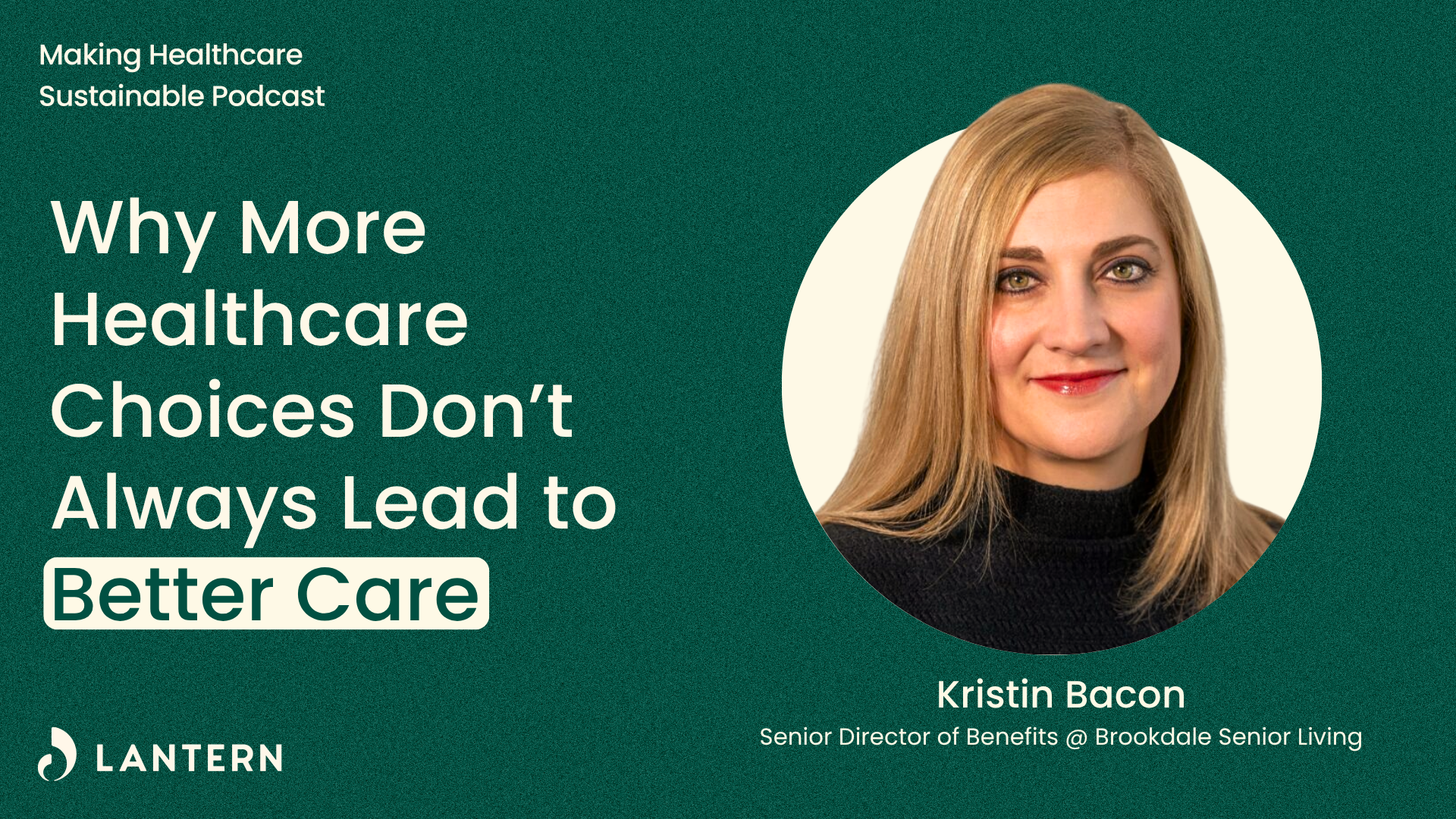
Kristin Bacon, Senior Director of Benefits at Brookdale Senior Living, shares how her team moved from voluntary engagement to required usage for some procedures, and why the transition didn’t lead to as much “noise” as they feared. O
In this episode, you’ll learn:
- How guided healthcare pathways can increase engagement with valuable benefits and improve care decisions
- Strategies for communicating benefit changes to distributed workforces and building employee trust
- Why mandatory care pathways can help employees access high-quality providers and better outcomes
Highlights:
(00:00) Why valuable benefits still struggle with engagement
(01:00) How Brookdale supports a frontline workforce across 41 states
(02:00) The healthcare cost challenge behind finding a solution
(03:00) Why voluntary programs were not driving enough engagement
(04:00) How guided care pathways changed employee access
(05:00) Addressing concerns around mandatory healthcare programs
(07:00) How communication helped employees embrace the change
(09:00) Why early health plan coordination matters for success
(10:00) Explaining the value of high-quality lower-cost care
(12:00) How Brookdale increased specialty care engagement
(13:00) Why benefits leaders should rethink voluntary adoption
(14:00) What retirement auto-enrollment teaches healthcare leaders
(15:00) How guided pathways can improve healthcare outcomes
Resources:
Nancy Ryerson’s LinkedIn: https://www.linkedin.com/in/nancyryerson/
Kristin Bacon’s LinkedIn: https://www.linkedin.com/in/kristin-bacon-290a3053/
A Distributed Workforce, A Familiar Challenge
Brookdale supports around 30,000 associates across 41 states and 500-plus senior living communities. Its workforce is caregivers, dining staff and housekeeping staff who are on their feet caring for residents most of the day, not sitting at a desk checking email. About 20,000 are full-time benefits eligible, and before Brookdale made any changes to its Lantern program, about half of that group was enrolled.
Reaching them meant getting creative. “We will try any and all means of communication to reach our population,” Bacon said. Email, an intranet site, bulletin boards and break room postings all played a role, but Bacon said the team leaned most heavily on HR business partners and community leaders to spread the word in person, plus home mailers. “It’s amazing to watch our engagement when that mailer hits,” she said. “Engagement spikes. That is one of the best ways to reach our population.”
Voluntary Got Results, But Brookdale Saw an Opportunity for More
Brookdale rolled out Lantern on a voluntary basis in 2024. “We saw moderate engagement, but I think the piece that really was exciting to us was the overwhelming response was positive,” Bacon said. Associates who used the program liked it. That was a signal to the benefits team that they could do more to drive engagement.
“As we looked at the results from the voluntary program, I think what stuck out to us was our associates are finding value in the program, and Brookdale is finding value in the program,” Bacon said. “But the key gap was really engagement.”
So the team made the call to require Lantern for the higher-cost, more complicated procedures where guidance matters most: joint and spine surgeries. “I think Lantern is one of those rare win-win cases,” Bacon said. “Yes, we’re making this mandatory, but I almost think of it as we’re guiding our associates to that best-in-class care, because healthcare’s confusing and it’s really challenging when you’re faced with a big decision like a surgery to figure out where should I go, who is the best surgeon.”
Planning for the “Noise” Before It Happens
Bacon said the team knew a mandatory change carried real risk of employee pushback. “Oh yeah, definitely. It’s scary when your benefits change,” she said. “You’re used to your programs. And as we’re all trying to manage this healthcare trend, it feels like changes are happening more quickly and more often.”
Two decisions helped ease that risk. First, the team grounded every communication in what employees would gain, not just what was changing. “We really focused on that associate value proposition,” Bacon said. “Here’s kind of what’s in it for you by using Lantern and not only guiding you to quality, but removing some of those financial burdens that you might face otherwise.”
Second, they built in an exception process from the start. “We recognized Lantern, while the program is amazing, in some cases it might just not work or it might not be the best decision,” Bacon said. That flexibility mattered for associates in remote areas, or without someone to travel with them for care. “We didn’t want that to be a reason that somebody couldn’t receive the care that they need.”
Getting the health plan’s third-party administrators looped in early was just as important behind the scenes. “That’s probably one of the key areas of if a team is thinking about moving to mandatory: really getting their TPAs engaged early on,” Bacon said. “We want to try to find them as far upstream as possible and really avoid those last-minute, ‘Oh, you have surgery tomorrow. Well, you can’t see this doctor. You have to go this route.’”
Communicating It Long After Open Enrollment Ended
Brookdale had an advantage most first-time mandatory rollouts don’t: Lantern wasn’t a new name to its workforce. “It helped that initially the program was voluntary,” Bacon said. “Lantern was not a new vendor to our population. They had heard of it. Coworkers who’ve used it have shared their experience.”
Even so, the team didn’t treat open enrollment as a one-time announcement. They changed how surgery coverage was presented in the benefits lineup, ran webinars, trained leaders to answer questions and made sure the message kept landing well past enrollment season. “In October I wasn’t planning on having a surgery, so I heard about it, but I wasn’t worried, because that doesn’t impact me,” Bacon said. “So just continuing to communicate as we got into 2026, and really just on a regular cadence, just to make sure it stays front of mind.”
Explaining the actual value proposition took some work, too. “You’re explaining to your associates, ‘Look, we are going to offer you this great center of excellence through Lantern. They are going to help you navigate this complicated system, they’re going to help you find best in class care, and Brookdale’s going to cover the cost of the surgery.’ And so they’re like, ‘What’s the catch?’” Bacon said. Her answer: “If you are receiving best in class care by these best in class providers, you are going to have a better experience. There’s less risk of complications, there’s less risk of bad outcomes. We want you to come back to work and start caring for our residents as you were beforehand.”
The 401(k) Comparison
Asked what she’d tell other benefits leaders weighing the same decision, Bacon reached for a comparison outside of healthcare entirely: retirement plans.
“Even high-value programs, sometimes we see limited uptake if the employee has to initiate participation themselves, because it’s just not often top of mind,” she said. “We sort of thought of it in a similar fashion to 401k plans. Historically, the plan saw really limited uptake. They relied on employees to make those elections, even with really generous matches. Employers learned through that process that auto-enrollment was really sort of a best-in-class route to go. Employees enrolled, they were saving for retirement, and we saw adoption just increase.”
Her takeaway: “Mandatory doesn’t always have to have a negative connotation.”
The Results So Far
Brookdale reviewed its data for the first half of 2026 and found completed procedures through Lantern are up nearly 70% since the shift to mandatory. “With that increased engagement comes increased savings,” Bacon said. And the exception process the team built in as a safety net hasn’t seen much use: “We really haven’t had any exceptions to this point. So knock on wood, it’s been relatively seamless.”
For Bacon, the lesson for other benefits leaders considering the same move starts with an honest look at their own voluntary numbers. “Be honest about your voluntary adoption,” she said. “Guided or mandatory pathways can really expand access, improve those outcomes.”
Transcript
Nancy Ryerson (00:03):
This is Making Healthcare Sustainable, brought to you by Lantern. Many benefits leaders spend years trying to gently nudge employees to use their point solutions. Today’s guest skipped some of that nudging and made a harder call instead. Kristin Bacon is Senior Director of Benefits at Brookdale Senior Living, the largest operator of senior living communities in the country. Kristin’s team supports a distributed workforce, caregivers and community staff across hundreds of locations nationwide, so not a typical desk-based population. Recently, her team made a move more benefits leaders were considering these days. They decided to require employees to use a network of excellence for certain procedures. We’re going to get into what engagement looked like before that decision, what changed after, why they pulled that lever, and what she’d tell other benefits leaders weighing the same move. Kristin, welcome. Thanks for joining me.
Kristin Bacon (01:00):
Thank you. Thanks, Nancy. I appreciate you having me. Of
Nancy Ryerson (01:03):
Course. So I’d love to kick off with hearing a little bit about Brookdale and who you support and basically your workforce and what kind of work they do.
Kristin Bacon (01:13):
So we support around 30,000 associates and we have associates dispersed across 41 states in about 500 plus communities. And they’re not your traditional, as you mentioned, desk workers. So we have a lot of caregivers, dining staff, housekeeping staff. So they are caring for our residents throughout most of their day. And so it can be challenging from a benefits standpoint to reach them, but yeah, that’s who we are, that’s who we support. We’ve got about 20,000 or so that I would say are full-time benefits eligible. About 50% of that population is enrolled in our programs.
Nancy Ryerson (01:51):
Okay. And what kind of challenges or costs were you seeing before you decided to look for a solution like Lantern?
Kristin Bacon (01:58):
I think probably like most employers, we’re continuing to feel the pressure of healthcare inflation and just looking for ways that we can help manage that cost without really just shifting costs onto our associates. And Lantern’s option was really one of those rare win-wins where we’re guiding associates to really best in class care, best outcomes, but at affordable pricing. And so that’s really what led us down this path.
Nancy Ryerson (02:27):
Yeah. And I feel like you started to hint at it, but it sounds like your employees, they’re not checking email all day. So I imagine it can be somewhat challenging to inform them about their benefits. So what are some of your typical approaches when you’re trying to spread the word?
Kristin Bacon (02:43):
Yes. So we will try any and all means of communication to reach our population. So it is challenging because your traditional emails do not necessarily reach everyone. And so we will go that route. We submit emails or send those out to our population. We have an intranet site where we’ll post information, bulletin boards, break rooms, all the traditional routes. But we really rely heavily on our amazing HR business partners, our community leaders to really kind of spread that word and push that message out to their associates. And we do home mailers as well. Those tend to really reach our population. It’s amazing to watch our engagement when that mailer hits, engagement spikes. And so that is one of the best ways to reach our population.
Nancy Ryerson (03:32):
Yeah. So it sounds like there’s mail, but then also some in-person connections that help spread the word.
Kristin Bacon (03:39):
Correct. Yes.
Nancy Ryerson (03:40):
So when you first started out with Lantern, what kind of engagement were you seeing before you made the decision to start requiring some procedures?
Kristin Bacon (03:48):
Yeah, so we rolled out Lantern on a voluntary basis in 2024. And I would say we saw moderate engagement, but I think the piece that really was exciting to us was the overwhelming response was positive. So we knew our associates, they found value in the program if we could just get them there. So again, moderate experience, but not necessarily at the levels we would’ve hoped for, but overwhelmingly positive. So that was great.
Nancy Ryerson (04:19):
So tell me about what you decided next in terms of how to try and drive more engagement and savings and those better results, et cetera.
Kristin Bacon (04:28):
As we looked at the results from the voluntary program, I think what, again, stuck out to us was our associates are finding value in the program, and Brookdale is finding value in the program. But the key gap was really engagement. And so we really decided that we’re going to move to mandatory for some of the more high cost complicated procedures, joint and spine surgeries. And I think that Lantern, like I mentioned earlier, is one of those rare win-win cases. Yes, we’re making this mandatory, but I almost think of it as we’re guiding our associates to that best in class care because healthcare’s confusing and it’s really challenging when you’re faced with a big decision like a surgery to figure out where should I go? Who is the best surgeon? And often we’re asking our friends, our neighbors, trying to research through the internet. And Lantern has done a lot of that work already and they’ve vetted their surgeons.
(05:29):
And so I think there’s something that brings peace of mind knowing that they’re only recommending best in class. It wasn’t, I say a relatively easy decision to make because there’s not necessarily a drawback outside of choice. But again, we’re helping you make that choice with best in class surgeons.
Nancy Ryerson (05:52):
Yeah, I know sometimes benefits leaders are concerned about noise or employee complaints. Was that something you all were concerned about?
Kristin Bacon (06:00):
Oh yeah, definitely. It’s scary when your benefits change. You’re used to your programs. And as we’re all trying to manage this healthcare trend, it feels like changes are happening more quickly and more often. So that was definitely a concern for us. I think we took a step back and just really focused on that associate value proposition. Here’s kind of what’s in it for you by using Lantern and not only guiding you to quality, but removing some of those financial burdens that you might face otherwise. And to ease some additional concerns, we did add in an exception process because we recognized Lantern, while the program is amazing, in some cases it might just not work or it might not be the best decision. And so that was really important to add an exception process that if it doesn’t work out, you’re not left without the ability to receive the care you need.
Nancy Ryerson (06:57):
Yeah, absolutely. I’m sure sometimes people, maybe they do live in a remote area that doesn’t have care. They’re not able to travel a little bit farther. Yeah.
Kristin Bacon (07:07):
Exactly. Yeah. Sometimes we live in remote areas or we might not have somebody to travel with us to help us. And so we didn’t want that to be a reason that somebody couldn’t receive the care that they need.
Nancy Ryerson (07:21):
Yeah, of course. And how did you go about communicating this change? I would think that it’s not necessarily something people are familiar with, like needing to use a narrow network. I think your typical person hasn’t really heard of that before.
Kristin Bacon (07:36):
Yes. So I think it helped that initially the program was voluntary. So Lantern was not a new vendor to our population. They had heard of it for coworkers who’ve used it. They’ve shared their experience. We did a lot of communications during open enrollment leading into 2026. We made sure the communications landed in everybody’s home. We changed the way that we present our benefits lineup and specifically call out surgeries and how those are covered. We did tons of webinars, a lot of training for our leaders so that they could understand what the change was, how they can share it with their employees, who our associates can call if they have questions. And so just communications through every channel, but then continuing those communications. Because open enrollment is one time of year. And in October I wasn’t planning on having a surgery, so I heard about it, but I wasn’t worried because that doesn’t impact me.
(08:38):
So just continuing to communicate as we got into 2026 and really just on a regular cadence just to make sure it stays front of mind.
Nancy Ryerson (08:47):
And how did you work with your health plan in case people did try to go the more traditional route?
Kristin Bacon (08:54):
Yes. So I would say that’s probably one of the key areas of if a team is thinking about moving to mandatory is really getting their TPAs engaged early on, making sure that they can support the mandatory component because it’s not as quick as just flipping a switch. You want to make sure that all the connections behind the scenes are set up. So as early as possible, we engaged our TPAs. Before we even finalized decisions, we made sure that they could support what we were doing and that they were connected with Lantern because we want to try to make sure a member that is going down this path who doesn’t remember to call Lantern first is connected with Lantern early. We want to try to find them as far upstream as possible and really avoid those last minute, “Oh, you have surgery tomorrow. Well, you can’t see this doctor.
(09:50):
You have to go this route.” So just really connecting with them early on and making sure that all the mechanics behind the scene were set up.
Nancy Ryerson (09:58):
Yeah, that’s definitely a concern we hear as well. You don’t want people having that experience where, yeah, like you said, their surgery is tomorrow and then they find out, wait, what’s Lantern? So it sounds like you’ve been able to largely avoid that situation.
Kristin Bacon (10:11):
Yes. It’s undoubtedly going to happen, but we’re trying to do everything we can to avoid those types of scenarios.
Nancy Ryerson (10:19):
And I’m always curious to hear how employers describe Lantern in terms of it’s high quality, but it’s also lower cost. As we always say Lantern, it’s just not something you’re used to hearing together. And I think it can be a little difficult to explain.
Kristin Bacon (10:35):
It is challenging because you’re explaining to your associates, “Look, we are going to offer you this great center of excellence through Lantern. They are going to help you navigate this complicated system. They’re going to help you find best in class care, and Brookdale’s going to cover the cost of the surgery.” And so they’re like, “What’s the catch?” And so that is how we explain it. And we say, “There’s not really a catch because if you are receiving best in class care by these best in class providers, you are going to have a better experience. There’s less risk of complications. There’s less risk of bad outcomes. We want you to come back to work and start caring for our residents as you were beforehand.” And so that’s just the way we’ve explained it is this is best for you. It’s best for Brookdale. It helps us manage our costs so that we aren’t having to do significant changes year after year.
(11:36):
But initially it is a bit of a head scratcher.
Nancy Ryerson (11:39):
Yeah, that’s a good angle though to bring up like, “Hey, we want you to be able to come back to work. We don’t want you to have to get a new surgery or be in recovery for months at a time.” I feel like I could see that clicking for people because a business is a business. It’s not like, oh, it’s just out of the kindness of our hearts. There’s no benefit. But yeah, I think people understand like, oh, okay, everyone benefits in this situation. It’s the win-win-win that you mentioned. Yeah. And what kind of improvement in engagement have you seen since going mandatory?
Kristin Bacon (12:12):
So we actually just took a look at the first half of 26, and we’ve definitely seen a bump in our engagement. Our completed procedures are up nearly 70%. So yeah, really, really great results so far. And then of course, with that increased engagement comes increased savings. So for the first half of 26, things are looking great. We’re continuing to promote Lantern beyond just the mandatory procedures. So we really haven’t had any exceptions to this point. So knock on wood, it’s been relatively seamless.
Nancy Ryerson (12:50):
Well, it sounds like your team did a great job of rolling it out and communicating that this was coming. And that’s a good point too, that people were already familiar with Lantern as well.
Kristin Bacon (13:00):
Yes. Yeah. Thank you.
Nancy Ryerson (13:02):
Well, any final words of wisdom for other benefits leaders who might be considering requiring procedures through a COE?
Kristin Bacon (13:09):
Yeah, it is a little bit scary to think about making certain procedures mandatory, but I would just say really think about your program that you have today. Be honest about your voluntary adoption. Even high value programs, sometimes we see limited uptake if the employee has to initiate participation themselves because it’s just not often top of mind. And so I think guided or mandatory pathways can really expand access, improve those outcomes. And mandatory doesn’t always have to have a negative connotation. We sort of thought of it in a similar fashion to 401k plans, retirement programs. Historically, the plan saw really limited uptake. They relied on employees to make those elections even with really generous matches. Participation sometimes lags behind when we rely on our employees to make those decisions. So I think employers learned through that process that auto enrollment was really sort of a best in class route to go.
(14:22):
Employees enrolled, they were saving for retirement, and we saw adoption just increase. We sort of think of it in a similar fashion just as automatic enrollment dramatically increased 401k participation. It improved retirement readiness. And so mandatory or guided specialty care pathways can really just help associates access those high quality providers and really make sure that they’re achieving the best outcomes. So I guess that would be my last word of advice.
Nancy Ryerson (14:52):
Yeah, I think that that’s a great comparison. So obviously saving for retirement is good for you, but it’s just not something that’s necessarily on your radar in your busy day-to-day, especially if you’re younger, it seems so far in the future. And it’s similar to surgery. Most people don’t think, “Oh, if I need surgery, what would I do?” You don’t have a plan for that necessarily, so that guidance really makes a difference.
Kristin Bacon (15:14):
Right. Yes.
Nancy Ryerson (15:16):
Well, so glad it’s going well for you. Kristin, really appreciate you sharing your experience with us.
Kristin Bacon (15:20):
Yeah, thanks, Nancy. We appreciate you having us.
Nancy Ryerson (15:26):
Thank you for listening to Making Healthcare Sustainable. If you want to learn more, be sure to check out our YouTube channel, Lantern Specialty Care, or check out our website where you can find additional resources.