
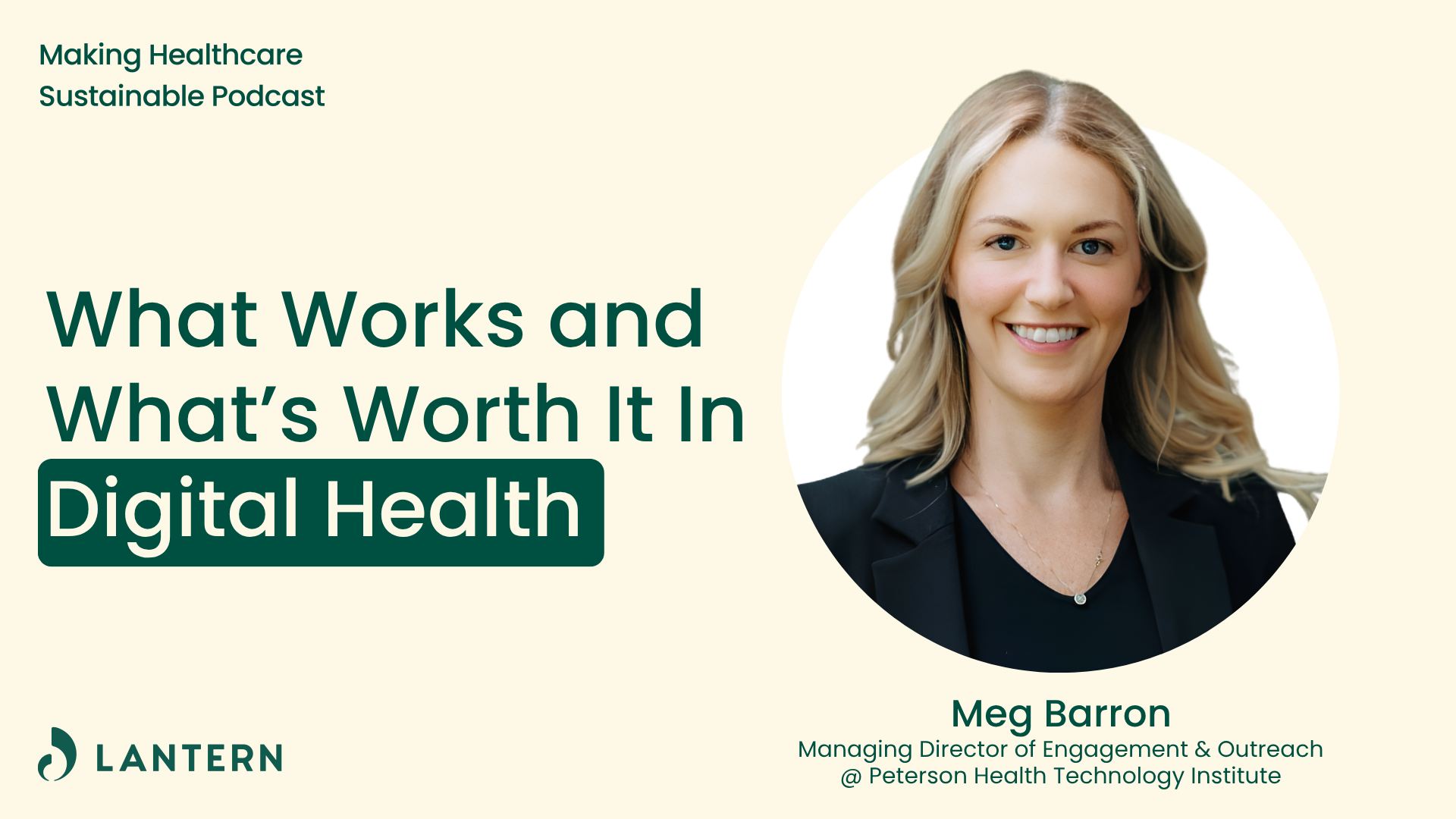
Episode Overview
A healthcare solution can look successful on paper and still fail the people it was built to help. So how can employers separate real impact from impressive numbers?
Meg Barron, Managing Director of Engagement & Outreach at the Peterson Health Technology Institute, shares how organizations can evaluate healthcare technologies through evidence-based research, meaningful outcomes, and stronger partnerships with vendors.
She discusses why engagement metrics alone fall short, how performance-based contracts drive accountability, and what leaders should look for when choosing solutions that deliver results.
In this episode, you’ll learn:
- How evidence-based evaluations can help employers identify healthcare solutions that deliver measurable clinical and financial outcomes
- Why traditional engagement metrics fall short and what meaningful engagement should look like for different healthcare programs
- Strategies for aligning with vendors upfront through performance-based contracts, clear expectations, and outcome-driven partnerships
Highlights:
(00:00) Meet Meg Barron
(01:32) How PHTI evaluates digital health solutions objectively
(03:36) Why employers need evidence beyond vendor claims
(05:07) The three questions that define a successful solution
(08:11) Why meaningful outcomes matter more than app usage
(11:09) How centers of excellence create predictable healthcare experiences
(12:55) Building contracts around outcomes instead of promises
(15:55) The seven elements of effective performance-based contracts
(23:52) Why communication strategy impacts healthcare engagement
(24:05) How AI and new channels could transform benefits access
(26:11) Connecting fragmented benefits into one employee experience
(30:48) The future of smarter healthcare purchasing decisions
Resources:
Nancy Ryerson’s LinkedIn: https://www.linkedin.com/in/nancyryerson/
Meg Barron’s LinkedIn: https://www.linkedin.com/in/megbarron
Lantern’s LinkedIn: https://www.linkedin.com/company/lantern-specialty-care/about/
Key Moments
Vendors Have Always Graded Their Own Homework
For most of digital health’s history, employers judging whether a solution worked had 2 options: take the vendor’s outcomes data at face value, or piece together case studies and word of mouth on their own. Barron, who leads engagement and outreach at the Peterson Health Technology Institute (PHTI), said that gap is why the organization exists. PHTI is an independent, philanthropy-funded nonprofit, no vendor can pay to be included in one of its assessments or left out of one, and it evaluates digital health solutions category by category: diabetes, hypertension, mental health, MSK and, soon, GI care, among others.
For each category, PHTI asks the same 3 questions: what clinically works among the market-leading solutions, who it works best for, and whether it’s worth it once purchasers weigh clinical results against total cost of care over a 1- to 3-year window. That 3-question framework is worth borrowing even outside a formal evaluation, because it forces a definition of success before a program launches instead of after.
Engagement itself has been part of the problem, Barron said. Vendors have long been able to set their own bar for what counts as engaged. “In the past, engagement could be defined simply as opening an app given years of per member per month arrangements with different digital solutions on market,” she said. “The bar has definitely and rightfully been raised and purchasers need and are expecting more, and they’re looking for validated clinical measures… rather than just relying on more black box or self-reported vendor data.”
Misalignment After Signing Wastes Everyone’s Time
Barron sees the same dynamic play out with centers of excellence and other benefits solutions. “People value and purchasers value quality,” she said. “Purchasers value often curation if and where needed, and they value fair pricing at the end of the day too.” Getting that mix right is worth the effort: cost and quality variation across the same use case can be massive, and narrowing that variance is what actually improves outcomes for members.
The harder part is getting specific about expectations before a contract is signed. “Aligning upfront on what good should or could look like is also essential,” Barron said. “Sounds easy, often very difficult or laborious to do in any kind of relationship with the vendor or solution provider that you’re working with. But ultimately, everyone wants to ensure that they’re getting what they paid for…”
What to Nail Down Before You Sign Anything
Employers and vendors will usually agree, in principle, that they want to pay for outcomes rather than activity. The harder problem is translating that agreement into specific contract language, which is a problem Barron has spent time researching directly with employers, health plans, health systems, vendors, brokers, consultants and data partners.
A few things worth defining upfront, regardless of what solution you’re evaluating:
- What meaningful engagement means for this specific use case and patient population, not just whether someone opened an app
- What data you’ll actually receive, and how often, to track progress against the outcomes you agreed on
- Who is responsible for marketing and communication to members, and what that will look like
- What happens at renewal if results fall short, and how that gets resolved
One tactic Barron hears about consistently: employers asking vendors for a sample data file before signing, so there’s no ambiguity about what they’ll actually get once the program is live. “They ask upfront for a data file or an example of the data file, meaning the purchaser asks that from the vendor to make sure that, again, there’s extreme alignment of this is what my expectations are or not, and to have that conversation before you’re inked an agreement or a contract,” she said.
Vendors have generally welcomed this shift rather than resisted it. “It’s been a pretty welcome conversation,” Barron said. When a vendor can’t meet a requested term, “that’s a conversation that needs to usually happen between the employer and the company to ensure that there is alignment or how can you get there at the end of the day.”
Communication Needs to Be Part of the Contract, Not an Afterthought
Marketing to members is where a lot of programs quietly break down, and Barron said it belongs in the contracting conversation rather than being left for after launch. She compared coordinating outreach across benefits vendors to “playing air traffic controller of all the different messages that are going to a member or to ultimately a patient at any given point and how you, again, orchestrate that to be both effective, but also organized at the same time.”
A few tactics benefits leaders have used to get ahead of that problem:
- Agreeing with vendors on marketing cadence and channels before signing, not after launch
- Having multiple solution vendors get on a recurring call with each other to coordinate outreach, something Barron said at least one employer does monthly or quarterly, “to connect the dots if and where appropriate or at a minimum to organize what the communication strategy is out to the larger employee base”
- Building in-person or high-touch moments, like open enrollment events or performance review season, so a benefit doesn’t get lost in a general email blast
Her bottom line for benefits leaders: “The biggest takeaway is just that alignment upfront.”
Before You Launch or Renew Anything This Fall
Asked for parting advice, Barron kept it simple: “Please do not launch or renew a solution until you have clarity on what the outcomes you want to achieve are.” That clarity has to go beyond clinical results alone. It means agreeing upfront on what engagement looks like for your population, how you’ll track progress, and what communication to members will look like, all settled before a contract is signed rather than discovered at the 6-month check-in.
Barron also pointed to a related, newer effort called Peterson Health Analytics, aimed at giving employers more visibility into true market prices. The impetus: employers are “overpaying for healthcare services by 30 plus percent” partly because that visibility hasn’t existed until now.
Episode Transcript
Nancy Ryerson (00:03):
This is Making Healthcare Sustainable, brought to you by Lantern. If you’re introducing a new benefits program as part of open enrollment, the stakes are high. Will it be disruptive? Will employees complain? Or even worse in some cases, will no one really use it? Engagement is a critical metric, but sometimes benefits leaders and vendors aren’t aligned on what engagement means, what good outcomes look like or what the real goal of the program is. My guest today is here to help you get aligned with your vendors long before you hit send on that first email so you can feel confident on launch day and beyond. Meg Barron is from the Peterson Health Technology Institute where she leads rigorous evidence-based evaluations of healthcare technologies to help employers improve outcomes and lower costs. She’s one of the sharpest voices out there on a question every benefits leader is wrestling with.
(01:01):
How do you actually know if a program is working and how do you get your people to use it? She thinks a lot about measuring what matters, and that’s exactly what I want to dig into today. Meg, welcome. So glad to have you.
Meg Barron (01:13):
Thank you. Thanks so much for having me, Nancy. It’s really great to be here.
Nancy Ryerson (01:17):
Great. So would love to kick things off just by hearing a little bit about who and what PHTI is and what your mission is.
Meg Barron (01:26):
Yeah, of course. Well, again, thank you for having me. For those not familiar with PHTI, we are the Peterson Health Technology Institute, and we are an independent assessor of digital health solutions. We’re self-funded and we’re a nonprofit and we’re based in New York City, and we conduct digital health evaluations by category areas. So think for diabetes, for hypertension, for mental health. And our goal here is to help purchasers know what will meet or ultimately, hopefully, exceed their expectations. And purchasers in this instance, meaning employers, health plans, and health systems, and all of this is on behalf of their members and their patients. One other thing I’ll know is we’re fully funded by philanthropy funding through the Peterson Center on Healthcare, meaning no one can pay us to be assessed, no one can pay us to not be included or assessed in a specific report. And again, our goal is determine which solutions can really help the industry improve health outcomes and lower costs and to scale those that can really meet or exceed that mark.
Nancy Ryerson (02:33):
And how long have you been around?
Meg Barron (02:35):
Yeah, so we have been around, this will be three years, and time flies when you’re having fun because it has really flown by. And again, I feel like we were really born out of some necessity in the fact that really there was a gap in the market that I would often get asked or approached even in my role at AMA of can you help me decipher, again, what works and what’s worth it in digital health? And it was very difficult to do outside of case studies or maybe some best practices or anecdotes that you could point to, but no one really existed to dive in to that topic and to do so in a very rigorous fashion to be able to look at all the available clinical outcomes for any given category. And then to also look at from a budget impact perspective, how will this net impact my bottom line at the end of the day?
Nancy Ryerson (03:29):
Yeah, I feel like prior to something like PHTI, you have what the vendor gives you when they’re trying to sell the solution to you, but I think it’s natural to feel like they’re definitely putting their best foot forward, whereas you can have a more unbiased approach.
Meg Barron (03:45):
Absolutely. And I think that this is an area where health technology has such massive potential to really help reduce costs and improve patient health, but that’s only if decision makers have the evidence that they need to really understand what works both clinically and financially. And as we look back over the past decade or so, I mean, there’s been billions of dollars of investment into digital health. And historically, again, there’s just really not been a recognized authority or group responsible for being able to dissect that clinical efficacy piece or economic impact piece, which was lacking. And I think, again, a goal that we had at Peterson Health Technology Institute to fill that gap.
Nancy Ryerson (04:28):
Yeah. And I mentioned just introducing you metrics that matter. I think that was the name of one of the topics you spoke on with us at a previous summit, but I think it is a good summary of the work you do. And again, a vendor might want you to look at one number or one metric, but PHTI focusing on the clinical outcomes is obviously so important and the return on investment. And I would love to hear an example of some of the metrics you’ve looked at for a particular category.
Meg Barron (04:58):
Yeah, so maybe I’ll take it a bit wider to start. For digital health at large, we really aim to answer three key questions and we dissect any category. So take for instance, diabetes, hypertension, MSK, and each of our assessment reports ultimately are aiming at what clinically works of the market leading companies in any of those given categories. And for this, we do an entire systematic literature review of all the available published studies and outcomes data on any given topic. And then we go a level deeper and we want to know, well, for whom does it work best for? So which patients would do best leveraging these technologies or different solutions? And then lastly, we want to know, is it worth it? And because we know that purchasers, employers, health plans, health systems, that’s ultimately what they’re attempting to figure out. So meaning in comparison to usual care that nine times out of 10 they’re already providing, if they layer in this digital health solution, what can they expect both from a clinical standpoint, but of course also from a total cost of care financial standpoint.
(06:15):
And for that, we do budget impact modeling from a one to three-year time duration because again, we recognize that’s usually the time constraint. And even that’s probably generous, meaning three years that most purchasers are looking to make decision on whether something’s working or not.
Nancy Ryerson (06:30):
Three years, I feel like a lot of the time you’re put under pressure to figure that out even sooner. Yeah.
Meg Barron (06:37):
100%. And I think for the various employers, purchasers that we engage with, and I can take a step back and say as part of my role at PHTI, I have the opportunity to work directly with a purchaser advisory council, which is a group of nearing 50 direct decision makers across employers, health plans, and health systems across the country. And they give us a pretty direct and transparent ear on what they’re looking to utilize in the coming year or immediate future. And also what’s working and what’s not working for them, which helps us prioritize what topics that we should be focusing on at any given point. But I’ll also say, I mean, the outcomes that purchasers are looking for can really vary depending on what the use case is, depending on what their patient population is. And there’s really a spectrum for why someone’s purchasing a solution that can range from improving member experience to of course improving clinical outcomes.
(07:40):
And then on the other side of the spectrum is total cost of care, as I was mentioning. And ultimately, ideally the Nirvana is they’re looking for something that can usually address all of the above. And again, for that specific use case. But I’d say, and you alluded to this, Nancy, historically a huge hurdle has been a lack of trust and vendor-reported outcomes or a lack of really standardized metrics to leverage as a baseline. And in the past, engagement could be defined simply as opening an app given years of per member per month arrangements with different digital solutions on market. The bar has definitely and rightfully been raised and purchasers need and are expecting more, and they’re looking for validated clinical measures. So think in HbA1c reduction for diabetes or blood pressure control for hypertension rather than just relying on more black box or self-reported vendor data.
(08:40):
And I’m happy to speak to this, but the good news is that we’ve done six digital health assessments so far in the three years that we’ve been out in market, and we know that this is possible to accomplish. But again, without that kind of dissection and ability to surface the what is working and what’s worth it, it’s very difficult for purchasers at large to be able to recognize that and scale what is working faster.
Nancy Ryerson (09:07):
Yeah. Do you find that employers engage with you in the evaluation stage when they’re comparing different solutions? Because to your point, a lot of the time if two vendors are coming to you with, here are the results that we drive, but they’re using different formats for the numbers, it’s so hard to compare apples to apples.
Meg Barron (09:27):
It’s usually one of two things. It’s either, wow, thank you. That report was extremely validating to either thoughts that we had or initial findings that we had, or we had heard through someone else that they had similar findings. Or if they are just starting out and looking for a solution for any given category or use case, that’s where our goal is to help them make as informed purchasing decisions faster and to not have to do or go through hurdles that others have had to experience or live through and to know that information as upfront as possible. One other thing I’ll know is we include the market leading companies that, again, fit the criteria for any of the categories that we end up doing an assessment on. But what we do not do is we don’t force rank the companies. We do it by category and again, subcategorization based on the solution’s mechanism of action and what their focus is within, again, that use case area.
Nancy Ryerson (10:30):
And for something like a center of excellence, whether it’s lantern or something else, what do you find people are looking for? Because I think we found cost savings obviously is very important in this economic climate, but the outcomes, we had found that is just important. And for a lot of clients, not having a disruptive member experience is also part of that. So curious, what do you see for that kind of solution?
Meg Barron (10:54):
We haven’t done a report on this topic, but I can speak, of course, just to what I hear from employers, both in our purchaser advisory council and otherwise from what I hear and see, when a center of excellence is optimized, it’s not just really a list of preferred providers. It’s more of an opportunity to provide really predictability in a very often chaotic system. And to again, ensure you’re achieving the outcomes that you need as an organization, as an employer. So whether it’s a center of excellence, whether it’s a digital health solution, or really when you think about it, any tangible item someone is purchasing, I mean, people value and purchasers value quality. Purchasers value often curation if and where needed, and they value fair pricing at the end of the day too. And often, while those things seem simplistic, that is usually incredibly complex to be able to navigate and get the right secret sauce compiled for your organization as an employer on behalf of your members and employees.
(12:01):
And it’s really worth getting right because that variation in cost and quality, especially in the US, can be massive. And by really narrowing that variance, you’re working to ensure that the best outcomes possible are achievable for your employees at the end of the day. And the other thing I would just note here is this is where aligning upfront on what good should or could look like is also essential. Again, sounds easy, often very difficult or laborious to do in any kind of relationship with the vendor or solution provider that you’re working with. But ultimately, everyone wants to ensure that they’re getting what they paid for and that they don’t want to have to do Columbo S detective work to prove that out. And for these reasons, I’ll mention that we set out more than a year ago to really help tackle this problem and to develop some research with employers to help purchasers and also vendors optimize performance-based contracts because we kept hearing that come up of, of course we want to be paying for outcomes, but it’s really hard at times to operationalize that into the actual agreements or contracts that folks are signing.
(13:17):
So to build this work, we ended up engaging more than 50 stakeholders across the digital health sector. So think employers, health plans, some health systems, but also perspectives from digital health vendors, including Lantern, brokers, consultants, and even data partners to really flesh out, well, what should good look like here? And I’ll note that we ended up putting out two things. The first is a playbook, a performance-based contracting playbook that really distills the learnings that we heard and the insights that we heard from more than 50 plus interviews. And then on top of that, we wanted to take it a step further and not have that just be something that an employer or vendor would have to go and figure out on their own. We took it a step further and we actually developed model template contract toolkits that translate both our assessment findings for a given use case area.
(14:18):
So think for diabetes for instance, or for hypertension. And then we actually have translated over those findings into a model template contract for that specific use case area with pre-filled recommendations so that purchasers can take and utilize those in conversations and in negotiations with their vendor to make sure that there’s alignment upfront. And that, again, the outcomes that they’re looking for are directly mapped over into their contracts or agreements that they have with the solution vendors.
Nancy Ryerson (14:50):
Yeah, that’s great. And I really like the idea of aligning upfront because I’m sure vendors don’t necessarily want that mismatch between expectations and what they deliver on, so that’s really smart. Do you have any maybe key learnings or examples from that that work on performance-based contracting that stands out?
Meg Barron (15:10):
Yeah, so we have four toolkits currently available, one for diabetes, so virtual solutions for diabetes management, a second for virtual solutions for hypertension management solutions. The third is for virtual solutions for MSK or musculoskeletal or virtual physical therapy. And then we have one for virtual mental health. And soon we’ll also have one for, our latest report was on virtual solutions for GI care, and we’ll have a corresponding purchaser toolkit or model template contract for that as well. I’d say really two things. One, from all of the interviews that we ended up doing, really there were seven key design elements that include things like how do you get to not just engagement, but meaningful engagement and what does that mean by use case area for any given, again, category, which is incredibly important, but it also gets as into the weeds as aligning upfront on what the expectations are for marketing to members and making sure that there’s alignment upfront.
(16:20):
And that’s something that I’m sure at Lantern, you hear quite often and that I know I hear quite often from employers, but also just was presenting at the AHIP, the health insurance conference with a number of different health plans, and everyone struggles with this on almost playing air traffic controller of all the different messages that are going to a member or to ultimately a patient at any given point and how you, again, orchestrate that to be both effective, but also organized at the same time. And that’s very difficult. And again, I don’t think anyone has the secret, secret sauce to this quite yet. And it really does take work upfront, inclusive of the contracting process to make sure that the goals that you have then map to the specifics of, well, what marketing tactics are going to be planned for this? And not tactics per se, but how is this going to get communicated to members and what does good look like at the end of the day?
Nancy Ryerson (17:25):
Yeah, I think that’s so important too when you’re aligning on in that evaluation stage, here’s the projected engagement or results, and is that dependent on certain marketing activations taking place? Sometimes if an employer says, oh, well, we don’t want to send out a million email blasts about everything we do, but what’s the downstream effect then on specific programs?
Meg Barron (17:49):
Yeah, and I think it can really vary based on the culture of the organization, based on, again, how any given employer or organization handles just marketing in general. And to be fair from the company or vendor side too, I mean, at times certain things need to be true in order to get initial engagement. But our recommendation is always engagement is a piece of it, but ultimately the end goal is what outcomes are you looking to achieve and to measure and to make sure you’re contracting accordingly in any agreement for those outcomes and to make sure that that kind of allotment is categorized appropriately in what you’re signing.
Nancy Ryerson (18:34):
Yeah, that makes a lot of sense. And on the engagement side, I know you said no one really has found a silver bullet, but we want to bring you on just as such a smart voice in metrics and how to think about this stuff. So maybe what advice do you have for benefits leaders on the communication side?
Meg Barron (18:52):
Yeah, I think from the communication side, it’s interesting for me to be a fly on the wall and to hear various employers speak to what’s worked for some. And the granularity of getting into some conversations around mailers or email versus direct outreach is always fascinating to me and have a background in marketing as well. Unfortunately, the short answer is it’s usually case by case based on your patient population, based on what the, again, use case or solution that you are looking to create awareness for is. That said, I think nine times out of 10, it’s usually multifaceted in one way, shape, or form and taking that into account from the front end. And to me, the biggest takeaway is just that alignment upfront because what no one wants to happen, the purchaser or the vendor, is to have friction after you’ve signed an agreement or that, again, there was misalignment on what the expectations were because that’s not a good use of anyone’s time.
(19:55):
And again, it’s definitely not a good use of a member patient’s time at the end of the day to get something that’s not specific to you where you don’t feel seen or where you don’t feel like you’re getting some value out of something, which is ultimately both, again, any employer’s goal and any vendor’s goal at the end of the day. And of course, I’d be remiss to say we want employers and vendors to be leveraging work such as the performance-based contracting playbook that lays out these seven key design elements for any optimized performance-based contract. But two, the granularity of the toolkits that we put together that can really specify key recommendations based on what kind of solution area you’re looking to purchase or go into a vendor relationship with. And that, again, is inclusive of things such as just the data sharing arrangements that you’re getting into, the renewals of, again, a contract and specificity around, well, what does meaningful engagement look like based on what that end goal or use case is for any organization?
Nancy Ryerson (21:07):
Yeah. I’m curious about what kind of feedback you’ve heard from employers who maybe do approach a vendor with this more performance-based contracting approach. Do they get a lot of pushback or is it generally a welcome conversation?
Meg Barron (21:22):
Yeah, I would say luckily from what we’ve heard, it’s been a pretty welcome conversation. Now, granted upfront as well, that’s a huge reason where we wanted to make sure to engage with vendors as part of the work that we were synthesizing from all those interviews that we did. And it was more so feasibility testing too of tell us why or why not you would be able to meet these expectations or in a perfect world, here is what employers as purchasers are looking to have in their contracts. Tell me why or why not you’d be able to accomplish this.This is where too, from us translating over the findings from each of our assessment reports that we’ve done, it’s been, I’d say, a welcome response from vendors saying, “That’s no problem. We would be able to make these tweaks to accomplish X.” And if they aren’t, I think that’s a conversation that needs to usually happen between, again, the employer and the company to ensure that there is alignment or how can you get there at the end of the day because everyone’s bar is being raised in terms of what good should look like.
(22:34):
And again, I think there’s a new set of expectations on the table. And I’d say from a purchaser standpoint or employer standpoint, it’s definitely music to our ears that we’re here the second that they’re starting a renewal process or net new looking to work with a vendor or a company that we’re hearing, and you mentioned open enrollment and all beginning and different conversations that are occurring related to that. We want folks to not have to recreate the wheel and/or start from scratch, but more so to be able to leverage based on all the feedback that we surface, based on the extensive research we do for any of our assessment reports, what we’ve already determined to be a testament to here’s solutions that work. And if you are going to optimize for performance-based contracting, here are the elements or things that would need to be true and represented in your contract accordingly.
Nancy Ryerson (23:31):
From what you’ve seen, how big of a role do you think benefits marketing and communications plays on that engagement piece? Or do you think there are enough other ways that vendors now have to reach people beyond an email blast from their employer?
Meg Barron (23:48):
It’s always incredibly difficult. And the good or bad news is that’s not unique to healthcare per se. You’re always trying to find and meet people both where they are, but also at the exact moment that they need something. I think that you’re obviously hearing a lot more about ways that AI can or could be helpful in this vein, meaning if I’m a patient, of course I want the path to least resistance to be able to find benefits/solutions to my problem as quickly as possible. I’d say if a employer via their portal of sorts of how folks are finding different employee benefits today, if AI’s not integrated into that yet, probably an opportunity for the near future. I’d say outside of that, historically mailers, emails, et cetera, have been the norm. I think it’s been interesting to hear from certain employers some more of the activation or engagement tactics that they’ve taken as far as creating a whole half day or one-day event for people to be able to learn about their benefits or during annual review or performance review timelines to be able to also include what benefits that they have available.
(25:10):
Because again, at times it can be potentially lost on certain employees, the full suite of different offerings that may or may not be available to them. So again, those have been anecdotes that I think are interesting to hear, but it is so specific based on the patient populations or employee populations that you have. And again, what goals that you’re looking to accomplish based on your employee base.
Nancy Ryerson (25:42):
Yeah, absolutely. Yeah, those in-person events really can help bring the programs to life a lot more. Something else we talk about a lot is having, you talked about all of these different categories of benefits, but having them speak to each other. It’s so common, maybe you have diabetes, but you also have a mental health struggle. And do the tools know that you’re the same person and that you have these needs?
Meg Barron (26:05):
Yeah, that’s a great point. At least one, if not a few employers have mentioned to me that they actually end up having any solution vendor or company that they’re engaging with get on even a monthly or quarterly call with each other. A, to do just that, to connect the dots if and where appropriate or at a minimum to organize what the communication strategy is out to the larger employee base. So I think that is interesting. It’s definitely not the norm that I hear about at this point in time, but I think it is an anecdote that could be worth repeating at the end of the day. I’d say some other groups, we hear back to more the specificity of performance-based contracting and different elements of that related to the goal of ensuring that there’s nothing nebulous about what data is going to be exchanged and how will I know if X, Y, Z outcomes are being met.
(27:10):
They ask upfront for a data file or an example of the data file, meaning the purchaser asks that from the vendor to make sure that, again, there’s extreme alignment of this is what my expectations are or not, and to have that conversation before you’re inked an agreement or a contract.
Nancy Ryerson (27:31):
Yeah. So you don’t want to, okay, we’re a year in or we’re having our six-month check-in, and what you get is not what you were imagining and not what you want to show to your boss as far as the impact of your program.
Meg Barron (27:43):
I mean, I think the nirvana is of course right message, right time, right audience. And just in reality, that can often be just extremely difficult to both manage and predict. But again, employers don’t want to necessarily put a lot of constraints on the vendors across the board, but you also can’t have a free-for-all of people reaching out to their employee base, and you need to have some organization to that back to the air traffic control analog of ensuring that you can get as specific as possible to the right patients or right members that you can based on what the solution is and what the goals of that solution are.
Nancy Ryerson (28:23):
Yeah. And you said you have a marketing background yourself, so I think the idea of awareness, general awareness for something like Lantern, most people don’t need surgery. You might not know you need surgery necessarily, but if you have a general awareness of it, but then you also get a message when you do need care, you could say, “Oh, I know what this is, but now I’m ready to learn more and take the next step.”
Meg Barron (28:46):
I mean, I’d be curious not to reverse the question, but what key learnings you guys have found from experimenting with different marketing campaigns and to different organizations that can range in member-employee base?
Nancy Ryerson (29:02):
Yeah, I’d say across the board in a lot of the conversations that I have with benefits leaders, word of mouth and then testimonials from members sharing their experience, that really resonates most. I think something like Lantern, it is a little complex to understand, and the concept of you’re paying less and getting better care can be a little confusing. But if you have someone who you know is your colleague sharing that they went through the program and they can explain it to you and vouch for it, that’s really effective. And then also targeted marketing, so reaching people when they know they need surgery, but before they’ve selected a surgeon and being able to intercept that and say, “Hey, we could help you find the best person for you and also waive that cost share.” Getting just the right moment is really effective. But like you said, definitely challenging.
(29:56):
Because if, let’s say you don’t need surgery and you get a message like that, that’s a strange experience. So we really try to prevent that, but we have heard that I think we’re also used to being targeted by ad advertising at this point, that we’re finding that there’s more comfort on the benefits side as well. So it’s a bit more of an expectation, but of course privacy is such a concern for healthcare at the same time.
Meg Barron (30:22):
Yeah, great point.
Nancy Ryerson (30:23):
Well, I think I can just go to our last question. Do you have any final words of wisdom for benefits leaders heading into the fall? It sounds like after open enrollment, a lot of people start really digging into new solutions they might want to bring on. I think all the resources you mentioned would be super helpful for that.
Meg Barron (30:41):
Yeah, maybe three things. I would say number one, hopefully please do not launch or renew a solution until you have clarity on what the outcomes you want to achieve are. And to that end, please use our freely available, both our assessment reports on the different digital health solution category areas, but also resources like our performance-based contracting playbook and toolkits. And everything we put out is, again, freely available at phti.org. So again, appreciate so much the engagement with employers to help to create these. And then lastly, I would just know Peterson at large has recently also put out an effort called Peterson Health Analytics. And this is really to help address that employers, as I know you are not a stranger to, are currently overpaying for healthcare services by 30 plus percent, but often really lack visibility into true market prices and historically have had really little that they could do about that outside of working with brokers or consultants.
(31:43):
And that’s really led to a lot of the rising costs and kind of wasted resources that we’ve seen. But Peterson Health Analytics was really formed to help to have more of a single source of truth, to be able to look at all of your data in one place and to be able to determine where can I really be pushing to get the best outcomes at the best prices for my members at large.
Nancy Ryerson (32:06):
Well, great. Well, thank you so much for joining us. Really appreciate you taking the time, Meg.
Meg Barron (32:10):
Thank you so much, Nancy. Thank you for having me.
Nancy Ryerson (32:12):
Thank you for listening to Making Healthcare Sustainable. If you want to learn more, be sure to check out our YouTube channel, Lantern Specialty Care, or check out our website where you can find additional resources.