



For three years running, employers have forecast their healthcare costs and been wrong. In 2025 the median forecast was 6.8% and actual costs came in at 8.8%, the widest miss in a decade.
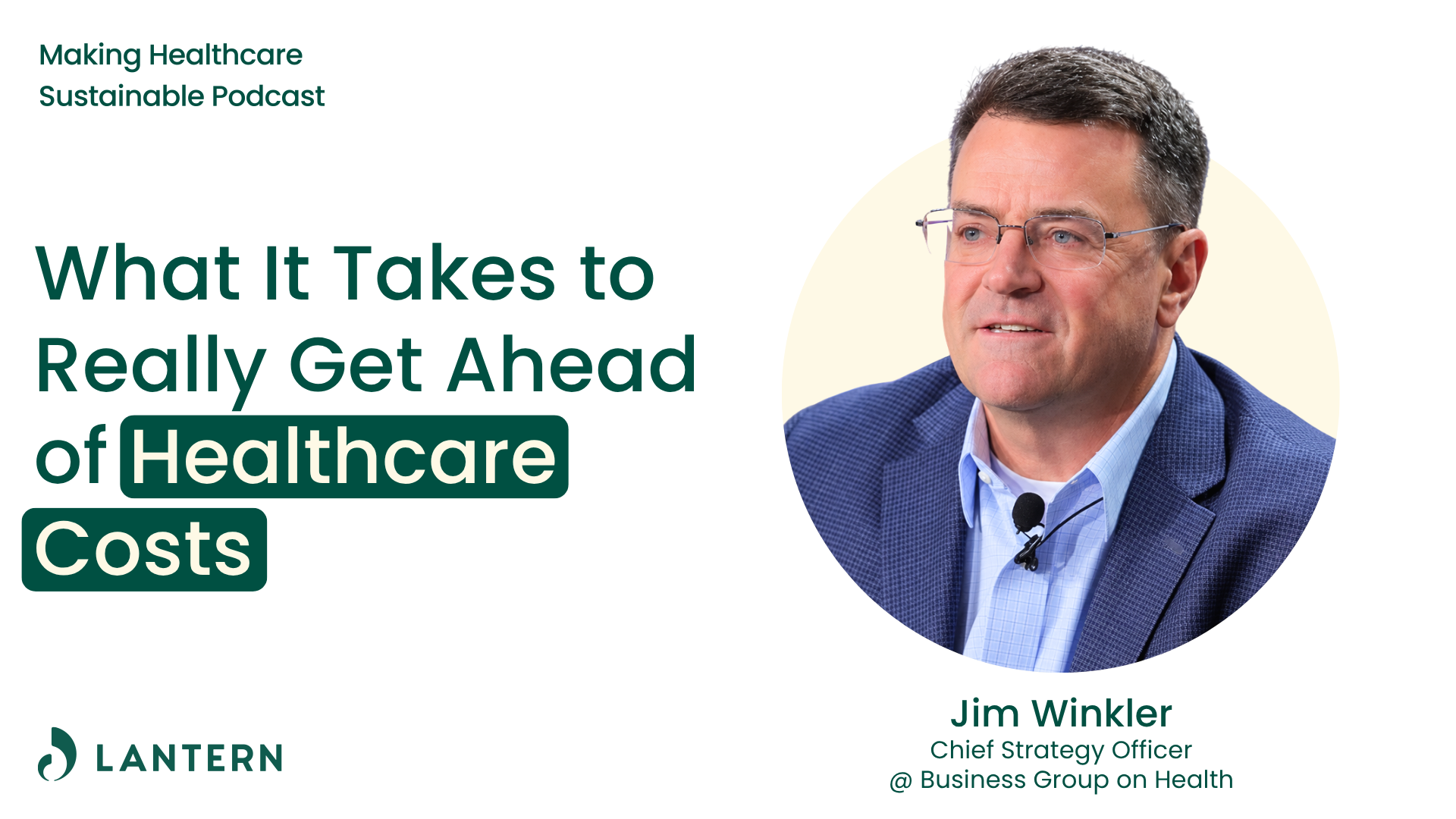
Jim Winkler, Chief Strategy Officer at Business Group on Health, joins Nancy Ryerson to unpack what’s behind the miss and what it should change about how benefits leaders plan.
He talks through hospital and outpatient pricing, the pharmacy spend hiding inside the medical plan, why employers keep considering changes instead of making them, and why he believes protecting the current system is more disruptive than changing it.
In this episode, you’ll learn:
- Why a widening forecast miss is pulling CFOs and CEOs into benefits decisions
- How to find the pharmacy and infusion spend sitting inside your medical claims
- What to look at now so a cell and gene therapy claim isn’t a 2028 problem
Highlights:
(00:00) Meet Jim Winkler
(03:25) The colored sticker on his brother’s folder
(04:59) Where electronic health records still fall short for patients
(06:51) Three straight years of missed cost forecasts
(09:24) What’s pushing hospital and outpatient costs up
(10:47) Why cell and gene therapy spend is so hard to predict
(12:58) The gap between what employers consider and what they implement
(15:33) How framing changes employer appetite for limiting choice
(18:07) Why navigation reaches people too late
(28:42) The pharmacy spend hiding inside the medical plan
(31:51) The No Surprises Act and AI-driven upcoding
(35:16) What a benefits leader should do Monday morning
(39:13) Why maternity could be the next cost surprise
Resources:
Nancy Ryerson’s LinkedIn: https://www.linkedin.com/in/nancyryerson/
Jim Winkler’s LinkedIn: https://www.linkedin.com/in/jimwinkler/
Lantern’s LinkedIn: https://www.linkedin.com/company/lantern-specialty-care/about/
Key Moments
Why Your 2028 Healthcare Costs Are Already Being Decided
For three years running, employers have forecast their healthcare costs and been wrong. In 2025 the median forecast was 6.8% and actual costs came in at 8.8%, the widest miss in a decade.
Jim Winkler, Chief Strategy Officer at Business Group on Health, joins Nancy Ryerson to unpack what’s behind the miss and what it should change about how benefits leaders plan.
He talks through hospital and outpatient pricing, the pharmacy spend hiding inside the medical plan, why employers keep considering changes instead of making them, and why he believes protecting the current system is more disruptive than changing it.
In this episode, you’ll learn:
- Why a widening forecast miss is pulling CFOs and CEOs into benefits decisions
- How to find the pharmacy and infusion spend sitting inside your medical claims
- What to look at now so a cell and gene therapy claim isn’t a 2028 problem
Employers Have Missed the Forecast 3 Years Running
The numbers come from Business Group on Health’s 2027 employer healthcare strategy survey, based on responses from 127 employers representing 11 million covered lives. Winkler said the headline figure gets most of the attention and it isn’t the part that matters.
“There’s obviously a lot of media coverage of our results and information others put out in the market, and sometimes that tends to focus on the absolute number. Oh, 2027 is going to be 9.2%. And then listen, let’s face it, that’s a terrible number. That’s a really challenging thing for employers,” he said. “But I think the real story is that three-year miss. And the fact that the miss is widening, 8.8 versus 6.8 in 2025 is much worse than what we saw in 24 or 23.”
A widening gap is also what pulls other executives into the conversation, which shows up in the survey as a bigger role for CFOs and CEOs in benefits decisions.
“When you manage or have responsibility for managing an expense line as substantial as healthcare costs are for almost every organization and you’re having trouble accurately predicting the number, that becomes a business governance imperative,” Winkler said. “This is not just a benefits thing or even an HR thing, it’s a business thing.”
He doesn’t expect the streak to end this year either. Employers are telling Business Group on Health their 2026 costs are running north of 8%.
“I don’t have a whole lot of confidence that that’s going to end up being the number. I think the actual costs will be higher again. So I suspect a year from now we’re going to be talking about how it’s four years in a row, and I think that’s a really fundamental challenge for employers,” he said.
Winkler pointed to 2007 and 2008, when volatility pushed the market toward private exchanges and high deductible health plans, and to the collapse of the HMO model 10 to 15 years before that. The system responds to sustained pressure, he said, and not always in a way that’s good for individuals. The takeaway is that “you just can’t keep operating in a system where costs exceed your forecast year after year after year.”
Today’s Decisions Set Your 2028 Costs
Nothing in this year’s survey surprised Winkler, but a few things alarmed him. One of them was how much employers say they’re evaluating compared with how much they’ve actually done.
“There’s still a lot of things that employers say they are considering as opposed to have actually put in place,” he said.
Alternative health plans and alternative PBMs are one example. Adoption is rising, and a sizable group of employers still describe them as something on the radar for this year or next. Winkler walked through what that timeline actually means.
“So if you’re looking at it in middle of 2026, you’re probably not implementing it for next year, you’re probably looking at it for 2028. That’s really getting kind of late to the game to be addressing some of these systemic challenges, but employers are starting to recognize that they need to look at a little bit of everything,” he said.
The same lag applies to the cost categories employers are most worried about. Winkler drew a line between the two that often get discussed together.
“Infusion spend is a now problem, particularly when you think about it in the context of what we talked about earlier regarding cancer, but also things like GI and autoimmune and other conditions,” he said. “Cell and gene therapy feels a bit like now with a overwhelming watch out for what’s coming soon.”
On cell and gene therapy, north of 80% of employers are relying on their health plan’s contracting strategy. Winkler doesn’t think that’s automatically wrong, but he does think it won’t hold once the category becomes a flashpoint.
“So whether that’s looking at financial mechanisms like reinsurance or pooling or carve out vendors that can handle certain things like Lantern’s infusion program or things of that nature, I think employers have to lean into those and probably lean into them faster and not wait for it to become a problem,” he said. “So lean into that now, even if it’s not a flashpoint in your claim spend today, it’s coming.”
A Different Colored Sticker Every Visit
Winkler’s conviction about all of this traces back to his older brother, Peter, who had dealt with physical and mental health challenges for most of his adult life and was diagnosed with colorectal cancer at 49, before any screening guideline would have caught it. The two brothers had a name for what followed. They called it the comedy of the color of the sticker on the folder.
“For my brother, anytime he would engage with the healthcare system, depending upon what the ailment was that brought him there that day, that became a colored sticker on the folder and that medical professional took the lead. And rare, if ever, was anyone focused on his holistic health,” Winkler said.
Peter would joke about which version of himself had shown up for a given admission, a cancer patient one time and a diabetic or someone dealing with depression the next.
“Nobody ever was sort of the quarterback in charge,” Winkler said.
Peter was diagnosed in 2013 and died of the disease 6 years later. Winkler has spent his career in employee benefits, including 25 years at Aon, and he said that experience shaped what he now pushes employers toward.
“It has made me fiercely passionate about the need for things like navigation and advocacy and a focus on value and quality and the role that primary care physicians and others who exhibit excellence need to play in not just being world-class at combating a condition or a medical ailment, but world-class at helping that person be a person who holistically has their conditions,” he said.
Asked whether any of this has improved, Winkler said electronic health records work better for clinicians than for patients, and that consolidation has scattered patient information across competing systems. Where he does see progress is Centers of Excellence. In 2013, he said, they existed “for things like organ transplants and maybe bariatric surgery, and maybe there was a little bit of musculoskeletal in the system, but not what we have today.”
Protecting the Current System Is the More Disruptive Choice
This year’s survey included questions about employers’ tolerance for disruption. The barrier that comes up most, Winkler said, is worry about workforce noise. His answer to that worry is the argument he keeps making to members.
“There’s very little about the current system that’s working really, really well for people. So why the heck are we afraid to disrupt it? In fact, protecting that system is probably more disruptive to people’s abilities to navigate their own health and wellbeing than making a bunch of changes,” he said.
The survey results shift depending on how the question lands.
“It’s all in how you ask the questions and all in how you frame things. Yes, when you ask the question about limiting choice, the willingness to disrupt does drop. When you talk about it as I’m willing to disrupt if it can improve quality and improve cost, more employers say yes to that type of disruption,” he said.
Take a high performance network, which by definition offers fewer providers than a broad PPO. Winkler’s case for it starts with what the broad network actually permits.
“Within that broad PPO, I have wild variations of cost and quality, and I really shouldn’t be letting you go wherever you want to go. Yes, that’s great for you to have choice, but the system allows you to make bad choices. It allows you to go to lower quality surgeons, poor quality hospitals, expensive facilities that aren’t better in terms of clinical outcomes,” he said.
He went on: “What if we orchestrated a system that said, yep, the choices, the list is smaller, you have less choice, but you are choosing among providers that we have vetted with a third-party partner like Lantern, that these are higher performing, higher quality, better economic outcomes, and oh, by the way, a satisfactory experience. But yes, it’s going to be a smaller number. And it might mean you can’t use the doctor that Fred down in accounting recommended. That’s not the way you ought to choose a medical professional.”
IDR and AI Upcoding Are Already in Your Claims
Two of the cost drivers Winkler raised are in employers’ claims today and largely unsized. One of them was the closest he came to admitting surprise.
“If I was surprised by anything, it’s that almost a third of employers said they have no idea whether the No Surprises Act independent dispute resolution is impacting their claims. Because the answer is it is impacting your claims. You may not have a handle on how much, but you need to go figure that out,” he said.
The other is what AI is doing on the provider side of the ledger.
“We’ve seen estimates from industry experts, this isn’t our numbers, but industry experts saying it could be upwards of one and a half to two points of healthcare trend is a function of upcoding and AI revenue optimization on medical facilities,” Winkler said. “And the health plans don’t have corresponding AI driven tools that bring costs down. We’re not fighting that fight equally.”
He connects both back to the forecast problem. “Those are things that employers probably are not as focused on as they should be to understand and size those. And I think that contributing to why people are missing their forecast.”
What Winkler Would Do Monday Morning
Asked what he’d do if he were running a benefits team right now, Winkler gave a short list.
“On my Monday morning to-do list would be figure out IDR impact, get a better handle on my total pharmacy spend. And if I’m covering GLP-1s for weight loss today, I would be exploring the direct to employer and direct to consumer models that are out there and figure out whether that is a better way for me to deliver value to my employees and economic value to the organization,” he said.
Total pharmacy spend is the item most employers think they already have covered. Employers reported 25% of healthcare spend going to pharmacy, and Winkler thinks the real figure is higher, because a decade of tight PBM management has made the PBM the default view into pharmacy while infused medicines sit in the medical plan.
“It’s not like the things like infusions and stuff like that are sort of hidden in the medical claims, a good data warehouse teases that out. It’s just we haven’t really, for a long time, you just sort of didn’t care about that because you though, ‘Well, it’s probably just small potatoes. It’s one-off things that are over in the medical plan,’” he said.
The last item on his list is a second look at whatever the team already turned down.
“What are the ones we explored a few years ago? And we said no, because they were either too new or potentially too disruptive. Let’s go revisit those. Solutions evolve and improve and change over time,” Winkler said. “Looking at Lantern today versus Lantern three or four years ago is a different value proposition. If I looked at Lantern three years ago and said, ‘Yeah, no, it’s not for me,’ look at it again.”
Episode Transcript
Jim Winkler (00:00):
There’s very little about the current system that’s working really, really well for people. So why the heck are we afraid to disrupt it? Protecting that system is probably more disruptive to people’s abilities to navigate their own health and wellbeing than making a bunch of changes. So lean into change. And we saw that in the results. More employers willing to lean into disruption if that disruption helps manage costs and improve quality.
Nancy Ryerson (00:28):
This is Making Healthcare Sustainable, brought to you by Lantern. Every year, employers and their consultants sit down and forecast what healthcare is going to cost them. And for three years running, they’ve gotten it wrong and not by a little. In 2025, the median forecast was 6.8%. Actual costs came in at 8.8%, the widest miss in a decade. Now the outlook for 2027 sits at 9.2% before plan changes. And if that number holds, healthcare costs will have climbed cumulative 76% since 2018. That’s roughly double general inflation over the same period. Those numbers come from Business Group on Health’s newly released 2027 employer healthcare strategy survey based on responses from 127 employers representing 11 million covered lives. My guest today helped bring that data into the world. Jim Winkler is chief strategy officer at Business Group on Health, where he leads the initiatives that shape what large employers do with the findings like these.
(01:32):
Before joining Business Group, Jim spent 25 years at Aon where he built the firm’s health innovation program and testified before Congress on healthcare reform. Few people have spent as much time translating here’s what the data says into here’s what an employer should actually do about it. We’re going to get into what surprised Jim most in this year’s numbers, why centers of excellence are becoming less optional and more required, and where high cost therapies like infusions and cell and gene therapy are pushing employers next. Jim, welcome.
Jim Winkler (02:02):
Thanks, Nancy. Pleasure to be a part of this.
Nancy Ryerson (02:04):
Before we get into the main part of our discussion, we’ll start with our think, feel, do segment. So which did you choose?
Jim Winkler (02:09):
Yeah. Well, first I have to say you made a reference to what surprised me. And I will say that having been in this industry for as long as I have, nothing genuinely surprises me, but there are some things that are rather alarming. So when we get into talking about the details, I’ll come at it that way. But I want to share a story, so a feel in your model, share a story where healthcare maybe didn’t work the way it was supposed to and how that influences and colors and shapes the way I think about our healthcare system today. So it’s a story about my older brother, Peter. My older brother lived most of his adult life dealing with both physical and mental health challenges. And at the age of 49, so earlier than any recommendations to go get a colonoscopy or anything like that, he was diagnosed with colorectal cancer.
(02:53):
And he began a journey into the medical care system that he and I would jokingly refer to as the comedy of the color of the sticker on the folder. And if you think about in a world in which patient folders, paper things often had little colored stickers designated who you are and more often than not what you are. And so for my brother, anytime he would engage with the healthcare system, depending upon what the ailment was that brought him there that day, that became a colored sticker on the folder and that medical professional took the lead. And rare, if ever, was anyone focused on his holistic health. And so we would often talk about that. So he would jokingly say, “Hey, yep, I was in the hospital and this time I was a cancer patient or this time I was a diabetic or this time I was dealing with depression or, or, or never end.” Nobody ever was sort of the quarterback in charge.
(03:57):
And that was his medical journey for six years as a cancer patient until he finally succumbed to the disease. But coming out of that for me, and as somebody who has spent my adult life in this field of employee benefits and healthcare specifically, it has made me fiercely passionate about the need for things like navigation and advocacy and a focus on value and quality and the role that primary care physicians and others who exhibit excellence need to play in not just being world-class at combating a condition or a medical ailment, but world-class at helping that person be a person who holistically has their conditions. And so that’s my field story for the day.
Nancy Ryerson (04:38):
I’m sorry to hear about that experience he had. That sounds so frustrating to have such a disconnected experience with so many chronic or conditions going on simultaneously, but no connectivity.
Jim Winkler (04:49):
Exactly.
Nancy Ryerson (04:50):
I’m not sure how long ago that was, but do you feel like that’s gotten any better with more electronic health records or not as much as we want it to get better necessarily?
Jim Winkler (04:58):
So electronic health records to me work well for medical professionals, not great for patients necessarily. And I do think we are at a point probably where a treating physician when they’re doing their sort of chart review before talking to a patient are seeing a broader picture because of medical health records. The counterbalance to that is the sort of healthcare systemization of the system where in any given community, hospital systems acquiring physician groups and building little clinical fiefdoms, if you will, you might have some of your health information in a version of an EMR with one health system and some of your health information in a version with another system. And unless you as a patient are very diligent about always using a particular system, you may not have that connected information. Where I do think it is better, and I know this is part of what you talked about in the intro, is in a world in which centers of excellence are more prevalent and more capable, my brother was initially diagnosed back in 2013, and in 2013, centers of excellence existed for things like organ transplants and maybe bariatric surgery, and maybe there was a little bit of musculoskeletal in the system, but not what we have today.
(06:13):
And so I do think that’s where there is progress, the ability to direct somebody into a care setting where someone is rewarded as a medical professional for delivering high value holistic care that is both cost-effective and driving towards the right outcomes, whether that’s in a COE model or advanced primary care or some combination.
Nancy Ryerson (06:32):
Yeah, though I think definitely this year’s survey found that finding your way to that is still challenging unfortunately for most people. Correct.
Jim Winkler (06:40):
Correct.
Nancy Ryerson (06:40):
Yeah. So you mentioned before we started recording that you’re probably not too surprised anymore from being in the space for so long, but what stood out to you about this year’s results?
Jim Winkler (06:50):
Well, Nancy, it’s great that you started your intro in framing the results in the context of employers now having three consecutive years of missing results. There’s obviously a lot of media coverage of our results and information others put out in the market, and sometimes that tends to focus on the absolute number. Oh, 2027 is going to be 9.2%. And then listen, let’s face it, that’s a terrible number. That’s a really challenging thing for employers. But I think the real story is that three-year miss. And the fact that the miss is widening, 8.8 versus 6.8 in 2025 is much worse than what we saw in 24 or 23. And when you think about that, you can very quickly connect the dots to some of the survey points about the increasing role of CFOs in benefits decisions and even CEOs in benefits decisions. When you manage or have responsibility for managing an expense line as substantial as healthcare costs are for almost every organization and you’re having trouble accurately predicting the number, that becomes a business governance imperative.
(07:54):
This is not just a benefits thing or even an HR thing, it’s a business thing. And historically, when we’ve had these kinds of moments, like 2007, 2008 when we had significant spikes in healthcare and a lot of volatility, the system tends to react and tends to react in a somewhat dramatic way. 2007, 2008, we got healthcare exchanges with private versions of the government versions, and we moved a whole lot of people into high deductible health plans. Go back another decade or 15 years and we blew up the HMO system and put everybody into national PPO and point of service plans. The system will respond and react dramatically, maybe not in a way that ultimately is good for individuals, but the system will react dramatically. And I think that’s the reckoning point that we’re at right now. So I think that to me is the biggest takeaway is you just can’t keep operating in a system where costs exceed your forecast year after year after year.
(08:56):
And as we sit here now heading into the final part of 2026, employers are telling us they think their 2026 costs are north of 8%. And I don’t have a whole lot of confidence that that’s going to end up being the number. I think the actual costs will be higher again. So I suspect a year from now we’re going to be talking about how it’s four years in a row, and I think that’s a really fundamental challenge for employers.
Nancy Ryerson (09:17):
I’m curious, what do you think is going on with the forecasting itself? Did things just come up this year that you think were surprising? I
Jim Winkler (09:23):
Think there are a couple factors. We had a blip in hospital cost coming out of the pandemic. We attributed it, I think as a system, we sort of said, well, there’s an increase in labor cost in the healthcare industry, the challenge that the healthcare warriors that served our country through the pandemic, and now we had to figure out how to fill nursing vacancies and things like that. But we’re now a couple years into that, so we can’t keep saying it’s just that. I think there are more fundamental challenges going on around hospital pricing and the viability of the hospital systems that we have in our country right now. We’re also similarly seeing significant increases in outpatient facility costs. And some of that is a function of hospital systems buying up physician practices and those practices now become outpatient facilities and they charge a higher fee for that.
(10:09):
And then you’ve got this dynamic at play, whether it’s GLP-1s, infused medicines for things like cancer, the pure rate of utilization of cancer services and other expensive conditions like autoimmune and gastrointestinal and things like that that are jumping up in their cost exposure for employers. All of these things kind of coming at you at once makes it really difficult to get your arms around true cost and forecasting appropriately.
Nancy Ryerson (10:37):
Yeah, and I would think something like some of those autoimmune conditions and infused medications and cancer, it can be hard to predict if a huge claim will come up for employers.
Jim Winkler (10:47):
Take a space like cell and gene therapy. We talk about cell and gene therapy a lot in our industry, and a lot of the headlines focus on the gene therapy part and this notion of a multimillion dollar one-time event that cures some horrific condition. And that is definitely something that employers have to be better at thinking about and planning for how the heck am I going to pay for that when that happens? But we sort of lose sight of the fact that even just within cancer treatment today, we’re doing much more that’s cell-based, whether it’s CAR-T or other strategies around cancer and doing a better job matching chemotherapy regimens to a person’s DNA. So hopefully more effective medicine and maybe less of an awful patient experience for the individual who goes through that, but it’s expensive. And as you said, those are really hard to predict.
Nancy Ryerson (11:39):
Yeah. And it sounds like those would be some of the factors behind cancer has been the top cost, but that’s an even higher percentage of respondents said that it was.
Jim Winkler (11:48):
Yeah. I think it’s that whole combination. Inpatient care is up, facility care is up. The prevalence of cancer is up where employers are telling us they have more cancer cases often in earlier ages. So folks similar to what my brother experienced, diagnosed with cancer at an age that precedes the guidelines for when you would go get a standard test, whether that’s women in their 30s getting breast cancer, things like that. And then the severity of cases, people getting diagnosed with stage three or stage four type of cancer. We actually just did a business group podcast on the growing concern about lung cancer, particularly in women and particularly among people who never smoked. You think the only people that get lung cancer, the ones we screen for are those who’ve smoked a pack a day for decades. We don’t have a good mechanism for testing people who may have had some kind of environmental exposure and now have lung cancer.
(12:39):
So there are things like that that are driving cancer for sure.
Nancy Ryerson (12:42):
And getting into what employers are doing about all of this, what stood out in terms of shifts year over year on that side?
Jim Winkler (12:50):
Maybe as I said before, not a lot surprises me, but some things that are alarming. I would say maybe a little bit alarming is that there’s still a lot of things that employers say they are considering as opposed to have actually put in place. So we did see one positive, as we mentioned earlier, centers of excellence. So the number of employers that have at least one center of excellence in place, north of 80% of employers, that’s excellent. More should have COEs in place for more conditions. And as you alluded to in your introductory comments, we still have difficulty getting people to use those. And so employers starting to consider more stringent things, whether it’s incentives for COEs or more requirements to use them, those are probably some things that we need to move faster on. Alternative health plans and alternative PDMs are another area. The adoption rate is increasing, that’s great, but there’s still a pretty sizable number of employers that say that’s on their radar screen to look at this year and into next year.
(13:50):
So if you’re looking at it in middle of 2026, you’re probably not implementing it for next year, you’re probably looking at it for 2028. That’s really getting kind of late to the game to be addressing some of these systemic challenges, but employers are starting to recognize that they need to look at a little bit of everything. We had some really interesting questions in the survey about tolerance for disruption. And you know this from working with employers, leaning into change, the biggest barrier that often comes up is worry about disrupting the workforce, causing disruption and noise, and what does that mean? And part of our talk track, if you will, on this is there’s very little about the current system that’s working really, really well for people. So why the heck are we afraid to disrupt it? In fact, protecting that system is probably more disruptive to people’s abilities to navigate their own health and wellbeing than making a bunch of changes.
(14:49):
So lean into change. And we saw that in the results. More employers willing to lean into disruption if that disruption helps manage costs and improve quality. And so I think you’re going to see employers having more candid conversations with employees about why they might be doing things like implementing a high performance network or a center of excellence or an advanced primary care model. And yes, that might mean you have to change the way you access healthcare, but we’re going to do it because it’s cost-effective, it’s high quality, it’s going to have a better experience. It’s the better way for us to move the system forward.
Nancy Ryerson (15:22):
Yeah. Did you see an increase in appetite for limiting choice? Because it feels like that’s always been the scariest thing to consider in terms of disruption.
Jim Winkler (15:32):
It’s all in how you ask the questions and all in how you frame things. Yes, when you ask the question about limiting choice, the willingness to disrupt does drop. When you talk about it as I’m willing to disrupt if it can improve quality and improve cost, more employers say yes to that type of disruption. And so you start to think about, okay, take something like a high performance network. So a high performance network is smaller than a broad PPO network. By definition, that’s limiting choice. But as an employer, if I look at that and I say, within that broad PPO, I have wild variations of cost and quality, and I really shouldn’t be letting you go wherever you want to go. Yes, that’s great for you to have choice, but the system allows you to make bad choices. It allows you to go to lower quality surgeons, poor quality hospitals, expensive facilities that aren’t better in terms of clinical outcomes.
(16:32):
What if we orchestrated a system that said, yep, the choices, the list is smaller, you have less choice, but you are choosing among providers that we have vetted with a third-party partner like Lantern, that these are higher performing, higher quality, better economic outcomes, and oh, by the way, a satisfactory experience. But yes, it’s going to be a smaller number. And it might mean you can’t use the doctor that Fred down in accounting recommended. That’s not the way you ought to choose a medical professional.
Nancy Ryerson (17:05):
Yeah, I think that’s so true. I mean, as consumers, we have visibility even in the healthcare space. I don’t know how you chose your last doctor, but I still am just like, oh, hey, who’s close by? That’s the main factor I look at. Do
Jim Winkler (17:16):
They have good office hours? Can I get an appointment later in the day because I have to work? And those are real. Those are very real, right? And let’s face it, there’s an incremental element to this. If I need relatively straightforward medical care, I have some skin thing on my arm that I need somebody to look at, that is one thing. That is different than someone diagnosing me with cancer and trying to figure out what do I do about this? Who do I go see? If I need surgery, where’s the right place?That’s a more complicated decision calculus. As an employer, I want to be able to say to my employee, I got you. Here’s what we’ve architected for you for that type of situation. I don’t want you to have to worry about whether you’re picking a good doctor or not. We’ve curated a system that narrowly navigates you there, but puts that in front of you.
Nancy Ryerson (18:08):
I feel like navigation functions have been in place at least for a while. What do you feel like is still missing there? I
Jim Winkler (18:15):
Mean, for something like cancer in particular, a lot of it I think has to do with the timeline. So you’re not feeling great, something’s bothering you, maybe you see your primary care physician, they send you for some blood work, they send you to go get this test or that test, and all of a sudden somebody is sitting in front of you or your loved one saying you have cancer. And at that point, we think back to the days when we used to try to say, let’s turn everybody into a healthcare consumer. At my former employer, we used to say, everybody’s a consumer until they’re a patient, and then emotion kicks in. You’re sitting across the table from someone who just said, you have cancer, your spouse or your partner’s cancer, God forbid, your child has cancer. Your ability to be an objective, practical consumer versus a highly emotional, I need help kind of event.
(19:04):
And so at that point, when the person you’re sitting across from, you say, well, what do I do? And they say, well, I’m going to refer you to Dr. So-and-so at XYZ hospital, you think that’s a good call. You’re going to go. You’re not going to think, I remember back at open enrollment, my employer told me about this navigation thing that they rolled out. I should probably call them and ask them who to go to. So I think it’s a timing thing. It’s like, when does it appear on your radar screen and is that happening when we really need it to happen? I don’t know what the answer is to that. I mean, I’m hopeful AI play a role in that in terms of speed of analytics and pushing information to me in real time. My phone knows I’m sitting across the table from a physician because of geolocation.
(19:52):
My medical record on my phone should know the information that this doctor is now presenting to me. There should be a way for that to connect and have my navigator ping me and be like, “Hey, Jim, before you go any further, give us a call.” We have to figure out how to make that. And that feels intrusive and big brother-ish, and some people I think get squirrely about that, but if we want to truly intercede and intervene and get two people before they are in those situations, we may need to do something about
Nancy Ryerson (20:20):
It. Yeah. We had our VP of analytics on the podcast and for our targeted marketing team members, she talked about how it feels intrusive in big brother, especially if it’s wrong. If you say, “What are you talking about? I don’t need surgery. That’s weird why they get this email,” but it’s actually helpful and it is what you need at that moment. Her perspective was the perception change, and then it’s just, “Oh, great. I’m glad that I got this right when I needed it.”
Jim Winkler (20:44):
And I think sometimes in the world of benefits, understandably, but we worry about the 5% of the time we might be wrong and therefore blow off the opportunity of the 95% we would get right. And maybe it’s 10 and 90 or even 15 and 85, but we worry about the minority of circumstances where a system like that might fail. Someone gets a message that says something about surgery when that wasn’t appropriate. We throw caution to the wind on the other eight or nine people who we might catch at the right exact moment and engage them in a better outcome.
Nancy Ryerson (21:16):
Yeah, I think that goes back to your point on something’s got to give, something has to push employers to make bigger changes. Do you think having CEOs, CFOs more involved will be that impetus for some employers?
Jim Winkler (21:31):
I think it’s part of it, for sure. I don’t want to suggest, I want to be careful to not seem to suggest that benefits professionals won’t make tough calls until the CFO and the CEO are breathing done and next. I don’t think that’s fair. I think benefits professionals make really, really challenging calls every single day, and it’s a balancing act to manage cost and manage employee noise and disruption as we talked about. I do think leadership engagement helps because I think for starters, I think most corporate leaders don’t have a good understanding about the economics of health in our country, like what actually is happening inside a benefits plan, particularly a self-insured benefits plan. The reality that an employer sitting here in the fall of 2026 might be telling finance, “Hey, our spend is running hot versus plan.” And when finance says, “Well, what are you going to do about it?” The answer at that point in the year is kind of nothing.
(22:31):
They can’t do anything about it. There isn’t a pathway to short-term cost takeout by and large in benefits. And even candidly, by then and by September, October, you’ve already catch your dive for next year in terms of plan design and vendor offerings and employee pricing. So you’re kind of locked in far ahead, and I’m not sure that that’s well understood in many organizations. So the more that leaders are involved and understanding that calculus, I mean, understanding things like if we choose to cover GLP-1s or not cover GLP-1s, what does that mean? What are the alternatives? What’s available in the marketplace if we don’t? If we’re going to be more requiring about something like the use of a COE, what would that mean in terms of employee noise? What is the potential savings opportunity? Over what time period do we realize that? That’s complex calculus, and the more that leaders understand that, I think the better for the good of how we make the system more viable long-term.
Nancy Ryerson (23:27):
Yeah, absolutely. So when a benefits leader is ready to make the case for a new program, leadership has a better understanding.
Jim Winkler (23:34):
Yeah. Why do we need it? What’s the near-term cost to implement it versus the long-term opportunity to get out ahead of the savings? Yeah.
Nancy Ryerson (23:42):
Yeah. Something else that stood out, I think to me just being at Lantern is the increased focus on infusions and cell and gene therapy. And it feels like those are bigger changes as well compared to the status quo that employers are considering.
Jim Winkler (23:56):
I think there’s a lot of things in that space, and we sometimes blend the dialogue when we talk about infusions and cell and gene therapy. And obviously there are non-cell and gene therapy things for which you get an infusion and whatnot. But if we think about that, there’s a couple factors involved. One is these are growing areas of impact, more prevalently used, if you will, and they are facility-based, whether doctor’s office, an infusion center, an outpatient facility or inpatient. And we start to think about it when we look at things like what percentage of healthcare are we spending on pharmacy? We reported 25% as the number that employers are telling us. I actually think that’s low because I think there’s a lot of pharmacy cost in the medical plan that we have a hard time quantifying. And I think we’re going to see more of that, whether it’s through infusions or cell and gene therapies or both.
(24:44):
Those facility charges become a part of that formula as well. And so I think employers are going to look at those areas and think, how do I do this more effectively? And infusion spend is a now problem, particularly when you think about it in the context of what we talked about earlier regarding cancer, but also things like GI and autoimmune and other conditions. Cell and gene therapy feels a bit like now with a overwhelming watch out for what’s coming soon. And I think employers are only starting to think about what to do there. The overwhelming percentage of employers, the numbers north of 80% of employers are relying on their health plan’s contracting strategy for cell and gene therapy. And that’s not necessarily a bad thing, but I think like so many other parts of the healthcare system, as it becomes a major flashpoint, you have to think differently about how you contract and engage.
(25:45):
So whether that’s looking at financial mechanisms like reinsurance or pooling or carve out vendors that can handle certain things like Lantern’s infusion program or things of that nature, I think employers have to lean into those and probably lean into them faster and not wait for it to become a problem. If you wait for cell and gene therapy claims to have punneled your cost, you’re two years before you can implement a great strategy to address it because of what we talked about before of how your decisions today are impacting your 2028 healthcare costs. So lean into that now, even if it’s not a flashpoint in your claim spend today, it’s coming. So lean into that now. And I think that’s part of what we saw in the surveys employers saying, “I’m looking at it now.”
Nancy Ryerson (26:30):
It feels like after seeing these years of increases, do you get the sense that employers are thinking, “Okay, we see a pattern now. We’re spending more than we expect year over year. How can we get ahead of it instead of, like you said, waiting for those catastrophic claims to come in? How can we be more proactive?”
Jim Winkler (26:50):
I think there are many employers that are thinking about it that way, that are thinking, “I’ve got a hefty to-do list to deal with costs in the here and now, but I also have to think about it longer term.” So 95% of employers did at least one RFP this past year. I think that will continue again next year, maybe not 95%, but I think that sort of stuff, 58% said, “I’m going to get rid of underperforming vendors,” and 58%, Luca said it was the same number, said, “I’m going to get rid of underperforming programs.” To me, those are reactions to the current costs, but also with an eye toward what do I need to be spending my money on going forward. So if I’ve got three or four programs that are underutilized, they may be very popular among the people that use them, but if they’re not having material impact on cost and quality, they’re low utilized, they cost me money and cost my team time to manage, I’m going to get rid of those so that we can put our energy into thinking about cell and gene therapy or leaning into a direct-to-employer strategy around GLP-1s so that we take it out of our PBM program.
(27:57):
I think there are things like that that employers are leaning into now saying, “I need to be working on that while also doing my proper governance due diligence to manage costs in the short term.”
Nancy Ryerson (28:07):
I feel like we’ve had a few clients joke that if all of their programs delivered the ROI that they claimed that they’d be making money from their benefits
Jim Winkler (28:14):
Program. Exactly. Exactly.
Nancy Ryerson (28:18):
Yeah. So is that what you see people doing, just really digging in what has this actually delivered?
Jim Winkler (28:23):
Yeah, I think the whole measurement, probably third party validation, so not taking a vendor’s own report card at face value, but digging into it’s using your actuary and your consultant or other third parties leaning into your data warehouse. I think that measurement accountability piece is only going to be amplified.
Nancy Ryerson (28:45):
That makes sense. What is it about infused medicines being in the medical plan that makes it so difficult to figure out your spend there? Is it just that it’s separate, someone might not think to combine it? I mean, I’m probably way oversimplifying it, but I’m just curious, what can people do differently to have a better understanding or what questions can you ask?
Jim Winkler (29:08):
Yeah, we’ve spent so much time in the last decade trying to tightly manage PBMs for a whole bunch of reasons, right? We’ve had questions about transparency and the rebate models and all of that. So I think so many employers have built a good discipline internally about managing the PBM, and as a result, that became their de facto view into pharmacy. Many larger employers have a person on the benefit team that “manages the pharmacy program,” which really means they manage the PBM and what the PBM offers. And so it’s not like the things like infusions and stuff like that are sort of hidden in the medical claims, a good data warehouse teases that out. It’s just we haven’t really, for a long time, you just sort of didn’t care about that because you though, “Well, it’s probably just small potatoes. It’s one-off things that are over in the medical plan.
(29:59):
I really need to micromanage this PBM thing I have over here. And I think now as we are seeing growth in things like cancer and autoimmune and other conditions that have more infusion and therapies or medications that are covered under the medical plan, I think employers just have to shift that focus to say, still need all that discipline around the PBM, but I also need to look at this piece over here and marry the two so I have a good view of total pharmacy, but also marry that infusion information, for example, to what am I seeing as my cancer utilization rates and facility costs and hospital costs in that condition as well.
Nancy Ryerson (30:41):
Yeah, it feels like, I’m sure employers feel like, okay, we got a handle on this part, but kind of behind the scenes or little did they know these other factors are just growing and growing. And it just seems like so much has been changing and compounding faster than they can solve for it really. It’s
Jim Winkler (30:56):
Sort of overly simplistic to think of it as like the kids getting whack-a-mole, but there are elements of that. The other thing to always keep in mind, we spend, pick a number, four or $5 trillion on healthcare as a country, and every single dollar of that is somebody’s income. And every effort we make to manage spend, to save money, to cut costs, somewhere in the ecosystem, somebody’s income is being impacted. A health plan, a physician, a hospital, a pharmaceutical manufacturer, what have you. And those organizations tend to fight back. And so you have to be constantly diligent. Again, I think this is another thing that I’m not sure that CEOs and CFOs fully understand about benefits is the whole how many different plot points there are within the value chain touching the system and extracting a piece of the profit that managing a cost area really tightly is a short-term success.
(31:54):
You have to be thinking, what’s the next thing I have to manage because at some point that cost is going to re-materialize.
Nancy Ryerson (32:01):
And something else that you mentioned in the report are these other factors like what happened with the No Surprises Act and then AI and upcoding. I imagine that those were probably surprises this year in terms of the impact on spend.
Jim Winkler (32:14):
I joked about not being surprised. If I was surprised by anything, it’s that almost a third of employers said they have no idea whether the No Surprises Act independent dispute resolution is impacting their claims. Because the answer is it is impacting your claims. You may not have a handle on how much, but you need to go figure that out. I think that was sort of concerning that that’s not on the radar screen. I think the AI driven upcoding that we’re seeing in the healthcare system is another one that I think employers intuitively know it’s out there, but probably haven’t tried to quantify what the impact is. And we’ve seen estimates from industry experts, this isn’t our numbers, but industry experts saying it could be upwards of one and a half to two points of healthcare trend is a function of upcoding and AI revenue optimization on medical facilities.
(33:03):
And the health plans don’t have corresponding AI driven tools that bring costs down. We’re not fighting that fight equally. Those are things that employers probably are not as focused on as they should be to understand and size those. And I think that contributing to why people are missing their forecast.
Nancy Ryerson (33:22):
Yeah. It feels like the hope is that AI in some way or another will ultimately lower healthcare costs, but it seems like so far it feels like it’s more increased than if anything.
Jim Winkler (33:34):
AI as a technology arena can do lots of things for lots of players in the space. But again, I can go back to I’m not as a provider of a service in the healthcare system, whatever that service is, if I’m going to deploy AI to make my service more efficient and more effective before I lower my price accordingly, I need to think about what does that mean to my viability from a revenue and profitability standpoint? So I lower my price, do I get a million more new clients? Okay, that’s a strategy that could work. Or do I keep my price where it is and now I’ve secured, I’ve gained some profit for myself? It’s the same kind of efficiency economics that businesses are constantly going through. And I think employers have to figure out how to start deploying more of it themselves from a claims analytics standpoint.
(34:20):
Most employers today are using AI for things like benefits communication and navigating benefits information, moving it from benefit speak into common language, allowing somebody, an employee to use a ChatGPT-like tool that an employer creates to say, literally the type, “I was just diagnosed with lung cancer, what do I do?” And actually find useful benefits information. That’s awesome. That is great. We now need to take that same thought process to say, drill into my claims that go find my infused claim costs, marry them to my hospitalization costs. Tell me by geography and by cancer type where my system’s working and where it’s not because I might want to change up my COE lineup. I might want to be more requiring about this particular condition or this particular location. I think that’s where AI can help employers make faster decisions.
Nancy Ryerson (35:14):
Yeah. And we usually wrap up the podcast by looking into the future, but I think I’m curious first to hear if you were a benefits leader, maybe one to three things you would do right now to try and create a better future in terms of cost and outcomes.
Jim Winkler (35:28):
On my Monday morning to-do list would be figure out IDR impact, get a better handle on my total pharmacy spend. And if I’m covering GLP-1s for weight loss today, I would be exploring the direct to employer and direct to consumer models that are out there and figure out whether that is a better way for me to deliver value to my employees and economic value to the organization. Those would be top of mind things I’d be doing right now. But I would also be tasking my team to be thinking about what alternatives are out there in the marketplace that we haven’t fully explored. What are the ones we explored a few years ago? And we said no, because they were either too new or potentially too disruptive. Let’s go revisit those. Solutions evolve and improve and change over time, as you well know. Looking at Lantern today versus Lantern three or four years ago is a different value proposition.
(36:21):
If I looked at Lantern three years ago and said, “Yeah, no, it’s not for me,” look at it again. Look at every issue in your healthcare claims and be thinking about what can we potentially deploy to address this situation? So I think you’d have to be incredibly diligent about that.
Nancy Ryerson (36:36):
Another survey that came out recently said that employers that do have that access to claims level data were more likely to use solutions like Centers of Excellence and narrow networks. I’m curious, what would you say are the barriers or the main barriers to accessing that information and being able to do the analysis that you’re talking about?
Jim Winkler (36:55):
Yeah, it’s a great question, Nancy, because we talk a lot in the industry about do employers have full access to their information? And candidly, for us in business group, that has not been a big area of focus for our members. They have not expressed that as a frustration. I don’t know if that’s because they tend to be a few thousand employees on up and so maybe they’re a little bit larger than the average American company. I think getting that information from your health plan and your PBM is one thing. Having a vehicle or a mechanism to actually do analytics around it is another. Claims data is messy, so you need either a data warehouse or your consulting firm has to be doing that kind of work for you. And then where I think it gets really tricky is how do you pull in information from what is now anywhere from probably 12 to 25 point solutions for most employers?
(37:45):
I need all of that information in order to have a full picture. So where am I pulling that in and then what analytics am I trying to do? We’re seeing more employers deploy data scientists and those types of analytics oriented folks on their own teams. And obviously we’re seeing consulting firms invest in that space. I think many vendors, solution providers are investing in the analytics so that they can be more service to their clients. So I think it’s like anything else, there’s a lot more data because it’s coming from more places. Do you have a good toolkit to analyze it? And if you don’t, you need to go out and get one of those.
Nancy Ryerson (38:23):
Yeah. If you were running a benefits team, do you think you would bring on an in-house data scientist to help with this kind of stuff?
Jim Winkler (38:29):
I think it depends on the size of your organization, candidly. I mean, I think if you scale as an organization, you’re a larger organization, I think there’s a lot of value in doing that, bringing that in-house. Even if you are still using some kind of data analytics engine like a data warehouse, having your own team writing queries, doing queries and digging into the information, leveraging AI to do some of that, I think there’s value in that. If you’ve got a few thousand employees, it may be a little bit harder to justify that expense.
Nancy Ryerson (38:58):
That makes sense. But yeah, hopefully AI will make that information more accessible and more able to bring all those threads together, like you mentioned. For sure. Well, if we were having this conversation this time next year or at this time two or three years from now, if you want, and I always say you can be optimistic or pessimistic. It’s up to you. What do you feel like we’ll be talking
Jim Winkler (39:20):
About? It’s hard to be optimistic to some extent in our industry, which is really an abysmal thing to say. I would say if we’re talking a year or two years from now, one topic we haven’t spent time talking about in this conversation that we would be talking about is the explosion in maternity cost. And that has a lot to do with the overly complicated unbundling of claim codes. So maternity for a long time has been one of the few purely bundled service. All of your prenatal care, the delivery, et cetera, all bundled under one code and the OB-GYN gets paid one amount for that. Starting relatively soon, we’re unbundling all of that for a variety of reasons. Some analysts say it should be revenue or expense neutral, that women who need more visits are going to get them because their provider will not get paid for those, but those who need less will get less.
(40:13):
And I think it’s going to lead to increased costs. That’s generally our perspective at the business group. And so I think that’s an area that we highlighted it in our survey report as a growing area of concern. I think it’s going to be one that gets even more dramatic. There’s other factors in that. I mean, women are having children later age-wise, which can sometimes make them more complicated. When you juxtapose on top of that, the dynamic of weight and obesity in our country further complicates pregnancy experience for a person. And so therefore, I think we’re going to see more maternity costs. And then I think that we will be having a continuation of the conversation about volatility of costs, the difficulty of forecasting, and the fact that things like infusion therapies, cell and gene therapies, et cetera, are continuing to explode. I think if we’re talking about a year or two years from now, the optimist in me would say, look at all the employers that are making changes.
(41:09):
I owe it to my employees and I owe it to my organization to think differently about this. I can’t keep doing the same thing over and over in a system that doesn’t serve people very well and think I’m going to have a different economic outcome. So I’m going to lean into change. I think we’ll see greater adoption of lots of things. Maybe not a next year’s survey because you probably had to make those decisions already, but certainly two years from now.
Nancy Ryerson (41:34):
I think there’s a case to be made for the optimistic view based on your survey results that it feels like there’s an increase in at least consideration. And like you said, the increased interest in or openness to disruption and change feels like a good signal as well.
Jim Winkler (41:47):
Exactly. Exactly.
Nancy Ryerson (41:50):
Well, Jim, thanks so much for taking the time to chat today. I really appreciate it.
Jim Winkler (41:54):
Yeah, my pleasure. Thanks for all that you and as an organization do to help drive change in the system and being a part of our community business group. And thank you for giving us time.
Nancy Ryerson (42:04):
Yeah, absolutely. Thank you for listening to Making Healthcare Sustainable. If you want to learn more, be sure to check out our YouTube channel, Lantern Specialty Care, or check out our website where you can find additional resources.