
Episode Overview
A union member needs a knee replaced. The surgeon everyone in town uses is fifteen minutes away; the surgeon with the best outcomes is two hours away. Travel is expensive, so the member decides to get care locally—and the fund absorbs whatever happens next.
At Lantern, we know that quality care isn’t limited to major cities. But in some areas, especially in rural parts of the U.S., it is necessary to travel for care. That doesn’t mean it’s easy, though.
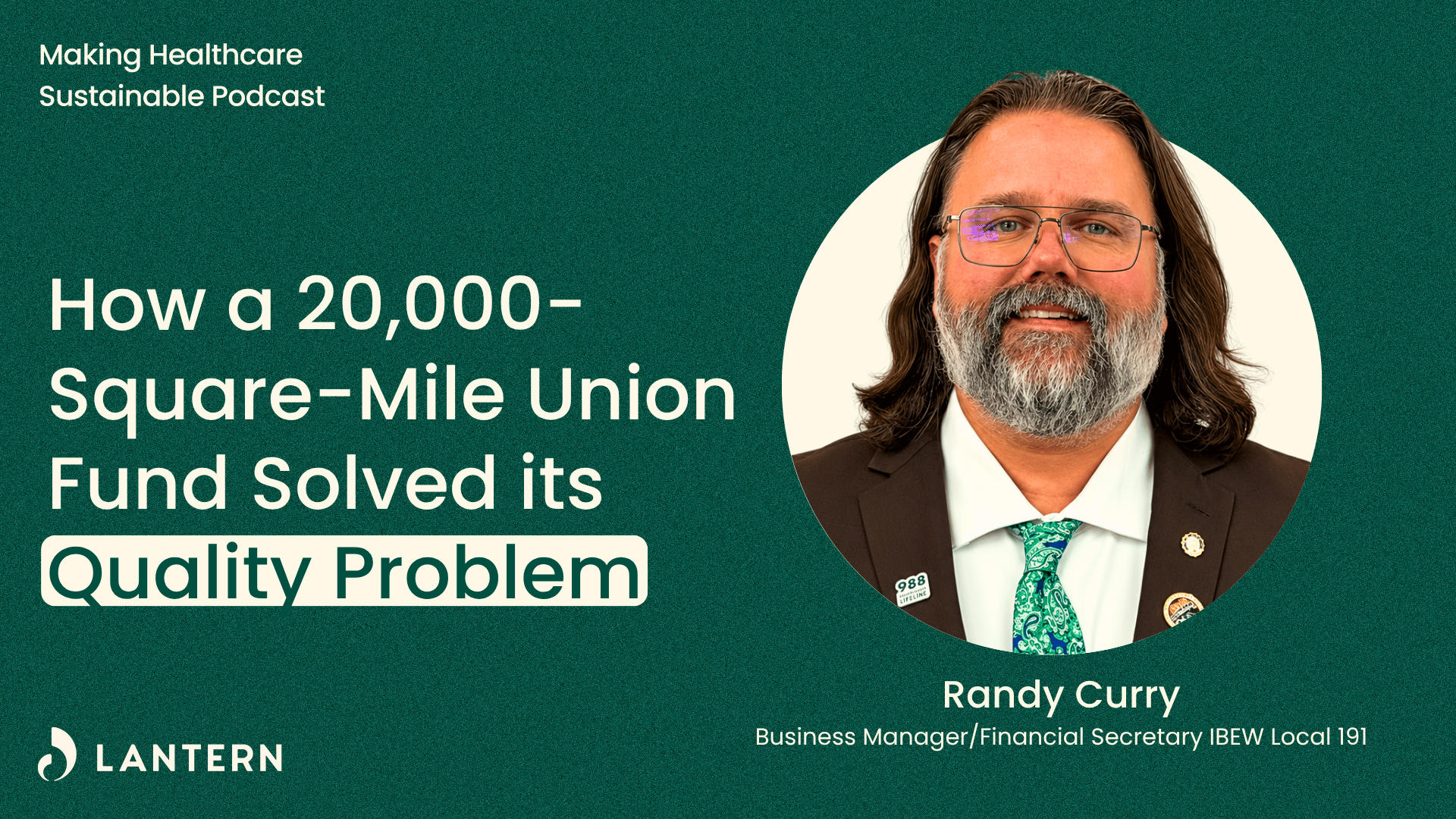
Randy Curry, Business Manager and Financial Secretary of IBEW Local 191, joins Nancy Ryerson and Lindsay Leeder, SVP of Labor, Union and Trust at Lantern, to unpack what pushed his fund toward a quality-first plan design and what it took to get that decision through a trust.
Randy and Lindsay talk through how one bad outcome becomes local news in a small town, why Lantern narrows a referral down to the specific procedure instead of handing over a full list of providers, and why he believes a Taft-Hartley trustee has no room to get this wrong. There’s no HR department standing between him and the members who elected him.
In this episode, you’ll learn:
- Why a small-town fund went after quality over convenience in its plan design
- How Lantern narrows a referral down to the top three providers for a given procedure
- What makes a Taft-Hartley trustee’s accountability different from a typical HR department
Highlights:
(00:00) Meet Randy Curry and Lindsay Leeder
(02:06) Think, feel, do: why “feel” won for Randy
(05:15) From healthcare worker to electrician to trustee
(08:07) What members in a one-hospital town were telling him
(09:55) Why quality beats convenience in rural healthcare
(13:02) The “telegraph, telephone, telewireman” test for a new benefit
(15:35) From specific-procedure vetting to the one-call navigation experience
(18:54) The travel benefit, and why 98% of members never need it
(20:50) Building trust among fellow IBEW business managers
(22:23) Why Taft-Hartley trustees can’t hide behind an HR department
(29:49) Randy and Lindsay’s five-year hopes for healthcare
Resources:
Nancy Ryerson’s LinkedIn: https://www.linkedin.com/in/nancyryerson/
Lindsay Leeder’s LinkedIn: https://www.linkedin.com/in/lindsay-leeder-msn-arnp-6a3740146/
Randy Curry’s LinkedIn: https://www.linkedin.com/in/randy-curry-a528261b7/
IBEW Local 191’s website: https://www.ibew191.com/
Episode Highlights
Members Were Already Crossing the Cascades
Lantern’s goal is to get members quality care as close to home as possible, and in most markets that means little or no travel. Local 191 is a different case. In parts of its Washington State jurisdiction, local care doesn’t have the best reputation, for good reason.
Curry said members were already choosing to travel when they could, but faced roadblocks, too. “A lot of them would make the choice to then travel across the Cascade Mountains over to Seattle area or a bigger metropolis where they can have a higher standard care and better care. But sometimes that travel isn’t always easy to do and can be burdensome on the family.”
A Bad Joint Surgery Can End an Electrician’s Career
For electricians, the stakes for orthopedic surgery going well are particularly high. “Electrician’s work is very demanding physically, so you need your shoulders, you need your knees, your hips, your ankles, you need all of it,” said Curry. “Those are some of the big things that could destroy a person’s career if they can’t get a quality surgery and be able to get back.”
He sees the cost argument running the same direction. “Looking at the quality and finding that quality potentially is going to cut down and actually save costs long-term, not only for that individual, but for the plans and for the medical field altogether.”
Lantern Starts From Quality, Then Narrows the Choice
Leeder said starting from quality limits who Lantern contracts with, and she framed it in terms Local 191 members know well. “If we’re going to contract with an electrician for the most important job in the city that we want to make sure there’s nothing that’s going to go wrong, why wouldn’t we do that for an invasive procedure?”
Members still get a say. A Lantern Care Advocate narrows the pool “to the top three in the given area for the specific thing they need to be seen for.”
When Members Do Travel, Lantern Handles the Logistics
Leeder said the travel is built into how Lantern structures the benefit for a fund. “When we structure this for funds, we eliminate all member cost share.” Because of the savings Lantern contracts for, she said “the funds can fund any travel benefit and waive all member cost share and still see great savings.”
Support doesn’t stop at the booking. Leeder said Lantern will “help facilitate that travel for them and a loved one or a caregiver, and that we’re going to continue to follow up until they’re safely done.”
Reaching Members in the Far Corners of the Jurisdiction
Local 191 covers a lot of ground, and Curry said that shaped how he thought about access. “We do cover 20,000 square miles in Washington State and a lot of it’s agricultural. So making sure that we can get those to our members that live in the furthest outreaches of our jurisdiction is also very important because it’s something that they might not ever ever realize they had before.”
Skeptical Members Get an Easy Invitation to Try It
Curry said some members were skeptical at first, and his answer is simple. “Hey, it’s a part of the plan. It’s not going to hurt you anything for calling it and not doing it. So if you’re skeptical, give it a shot and then let me know if there was something that you experienced that I didn’t say or that caught you off guard.”
So far, he said, no one has come back with a complaint. Word is moving beyond Local 191, too. “We always say telegraph, telephone, telewireman. So that spreads pretty quickly. And so the testimony from member to member is sometimes the biggest advocacy of that.”
Hear the Full Conversation
Listen to the full episode of Making Healthcare Sustainable to hear more from Curry and Leeder on quality, trust and what it takes to get a new benefit through a trust.
Transcript
Randy Curry (00:00):
Looking at the quality and finding that quality potentially is going to cut down and actually save costs long-term, not only for that interval, but for the plans and for the medical field altogether.
Nancy Ryerson (00:13):
This is Making Healthcare Sustainable, brought to you by Lantern. If you manage a health fund, you already know what the version of this problem that shows up in your claims data. Here’s the version that shows up in someone’s driveway. A member needs a knee replaced. The surgeon with the best outcomes for that procedure is a two-hour drive away across a mountain range in a city he goes to maybe twice a year. The surgeon 15 minutes from his house does a handful of these a year, and he’s the one everyone in town uses. Nobody has ever put those two options side by side for him. So he picks the one that’s close by and your fund absorbs whatever happens next. My guest today knows that challenge better than most. Randy Curry is business manager and financial secretary of IBEW Local 191, and he’s a trustee on the Local’s Health and Welfare Trust.
(01:11):
Randy is an electrician by trade. He came up through the local, served as its president, and now runs it. Local 191 represents more than 1900 members and holds agreements with over 100 contractors throughout Washington State. Randy went after quality and access as a plan design decision. Today, we’re getting into what he was seeing in his members that pushed him there, what it took to get it through a trust, and what a fund his size does when one catastrophic case can move the whole budget. We’re also joined by Lindsay Leeder, the SVP of Labor, Union and Trust at Lantern. Lindsay has a wealth of experience in both nursing and healthcare leadership, and her background gives her a unique perspective on the intersection of healthcare quality, member needs, and union benefit management. Randy and Lindsay, welcome to the show. Before we get into the main part of our discussion, we’ll start with our think, feel, do segment.
(02:06):
Randy, which did you choose?
Randy Curry (02:08):
Probably feel. So a lot of things that I felt as far as service for our customers, and the one thing that you let in on the intro as far as having a neosurgeon that you can drive to that does a little bit and far away, one of the things that led me to Landry was feeling like that the quality sometimes in smaller towns of the doctors or the surgeons, to your point, don’t necessarily have the skills that you might see in a bigger metropolitan era and being able to make sure that our members pay good money for healthcare and work hard for their benefits, that they have access to even bigger network with a higher quality and standard of care for our members.
Nancy Ryerson (02:44):
Absolutely. Lindsay, what’s on your mind?
Lindsay Leeder (02:48):
I think we’ve talked a lot about how people navigating the healthcare system have choice. I think what often gets lost in the picture is how providers operate and how that contributes to what choices patients are educated about. As a family nurse practitioner who’s been in practice for almost 20 years, although not actively practicing right now, but for the first five, 10 years of practice, I was really lucky to practice in a clinic that was independently owned. We were a large primary care practice, and then within the same building we had cardiologists, general surgeon, podiatry, optometry, radiology, all at our fingertips. And it was at a time before so much consolidation happened in healthcare. And because of that, we were able to really collaborate, even though we weren’t even part of all the same practice. When a patient came to us that maybe thought it was a primary care need, but maybe they needed surgery, rather than directing them right into the larger system and having them to go to the ER and start all over again, I could pick up the phone and call the surgeon and say, “This is the case.
(03:49):
Could you come look at this? Or what do you think needs to happen?” And I could do that with radiology, with cardiology, et cetera. And being able to just really operate to the full scope of my practice, having this open invitation to collaborate with other providers allowed me to have very transparent conversations with patients, keeping them at the center of care. And I think that’s really what’s been lost with the consolidation we’ve seen in healthcare, the continued gaps in how much things are costing versus maybe what they should. So lack of transparency and all of that. So really, I think it’s both feel and do. When I look at the healthcare landscape and where it’s changed over the last 20 years, I always go back to those moments of I know what was possible. And unfortunately, I feel like we’re getting further and further away from that, which even if you have the best benefits possible, like Randy and his team are trying to put forth for their members, they don’t necessarily have transparency in terms of the choices they make.
(04:45):
And there’s also limited access depending on where they’re geographically located.
Nancy Ryerson (04:49):
Yeah. And as consumers or just regular people, we have so little tools, so few tools to find quality or to know how to make those decisions and know where to start. And Randy, so I know you’re an electrician by trade. You also mentioned that you did have a healthcare career as well. So tell me a little bit about your career path and how you ended up being the business manager for the fund.
Randy Curry (05:15):
So in my early 20s, I worked in the healthcare field and various different CNA, dialysis technician, massage therapy. One of the things for me when I worked in the field was seeing even then, and I know it’s even gotten more stressful now than it was then, at the time I worked for a nonprofit hospital, which to me is my favorite version because eventually everything went for profit. And to me, at least in my hometown, that’s when I start seeing some of the healthcare things change. And then as far as being an electrician, I was just tired of a lot of the heavy lifts that’s done in the hospitals and care teams is usually done by the CNAs, LPNs and RNs. And they’re just too much. There’s too many patients and not enough staff. And I just don’t feel like also that they are compensated enough for what they do because they’re the ones that are their hands around all of our loved ones or us ourselves.
(06:09):
So going back, so eventually I just decided I wanted to become an electrician. I had a friend that did it. The doors just kind of opened up and I got into the apprenticeship and 20 years later, here I am. So definitely going from the field into the business manager piece was just kind of happened. That wasn’t ever my plan, but knowing that you can make changes on the health and welfare trusts and find good quality vendors to come in and be support for your members and have other options, finding those things and getting them across the finish line is what makes all this side of being an electrician worth it.
Nancy Ryerson (06:41):
That’s great. And it sounds like your background in healthcare probably helped you at least get started on the managing that fund side. But what did you have to learn in terms of how healthcare benefits work for a union to be effective in that job?
Randy Curry (06:55):
Well, one, going to your trust conferences to learn what your roles and responsibilities are as a trustee from the legal side to how you’re supposed to look at everything at the collection of the whole members. And then just as you become a trustee, then hearing some of the struggles that your members have and they bring things to you as a trust to take your trust. And then as you attend those conferences, getting to meet other people like Lindsay and Alice that can show you a side of healthcare that can bring benefits to your members that can overall could potentially really impact them not only financially in a positive way, but some of the stress for those things that provide. That’s kind of how it all morphed and those are the things that for me that I’ve enjoyed. And just listening to your members and giving them that time to actually hear what they’re trying to do and figure out what you can and cannot do with all your advisors and trust in the process.
(07:47):
It’s the small good feeling you get. And they’re not always every day, but when those land, they feel pretty good, especially when you see immediate benefits to the members.
Nancy Ryerson (07:56):
That’s great. So what were some of the questions that your members were coming to you with that then when you met Lindsay and our team, you though, “Oh, okay, this could be a solution to some of what I’m hearing.”
Randy Curry (08:07):
So in my hometown, which is part of our jurisdiction, when everything kind of went for profit as far as all the hospitals and clinics there, and there’s only one real big major provider. So it’s a small town, so people talk. So you hear not only from your family members, but your members that you represent about some of the challenges in a smaller town and the quality care they can get because a lot of them would make the choice to then travel across the Cascade Mountains over to Seattle area or a bigger metropolis where they can have a higher standard care and better care. But sometimes that travel isn’t always easy to do and can be burdensome on the family. And so some of the things that Lantern had laid out was the quality they do, the way they look at the quality of the care team and all the high standards of checks, and then also being able to provide services, whether it’s a pre-planned surgery or other things that can minimize the impact on a families, not only if it’s with a spouse or partner or more stressful, their dependents.
(09:09):
And so being able to provide those things so the members can still make the work and the care can still be given and even at a higher quality. They answered all the questions and a little bit of what I remember from my healthcare background, a lot of it made sense from what I remembered working at the hospital back then. So it also made it easy because I knew what they were saying was true or at least I had seen parts of that when I worked there.
Nancy Ryerson (09:33):
Yeah. Lindsay, I know we talk a lot at Lantern about trying to get people care as close to home as possible, but it really depends on the region. So I’m curious to hear from your perspective when we’re talking about care in a more rural area, what is the story and how do we think about still improving access but acknowledging that people might have to travel farther?
Lindsay Leeder (09:55):
Yeah, it’s such a good question. It actually came up recently in a conversation where we’re just talking about quality. When it comes to direct contracting, like Lantern’s model where we’re contracting directly with providers and directly with facilities, you can do that for any service anywhere in the country. But when you add in the layer of quality, which I would argue at Lantern is fundamental to anything we do, first and foremost, it’s going to limit who we’re contracting with because of our rigorous thresholds. And I have seen firsthand as a clinician when quality or practice or volume isn’t there and things happen anyway, that there can be such complications and downstream effects that can be really life-changing in a negative way. And so again, if we start from quality and we really educate the membership and the leaders making decisions around the benefits of going down the path of quality care versus convenience and access, what a difference it can make long-term, I think everyone quickly understands you want the knee surgeon that does over a hundred knees in a year and it has a fellowship trained in the specific knee surgery that we’re doing.
(11:01):
Because by doing that, we know when a member finally takes advantage of this benefit that maybe he or she has postponed for years for a variety of reasons, we have the best level of certainty that they’re going to have the best outcomes possible and get back to their life. And that’s what everyone wants, right? The challenge if we just say, “Well, there’s someone down the street and we’re not quite sure if they’re that good, but they’re easy, they’re there, who knows? You could have a complication and end up having multiple surgeries.” That’s not always the case, but by starting with quality, narrowing the funnel from the beginning, having absolute certainty that everyone within the network is meeting our standards, then we have the best level of certainty that it’s going to be a great outcome. Randy, you know this. When you become an electrician, you go through years of training.
(11:46):
There’s the apprenticeship program. By the time you’re at the top of your game as an electrician, you’ve spent years doing the same thing over and over and over again, which all research would show is going to give you the best results. The same thing happens in surgery. And if we’re going to contract with an electrician for the most important job in the city that we want to make sure there’s nothing that’s going to go wrong, why wouldn’t we do that for an invasive procedure? So I think when we can really educate members and bring it close to home for them about the same kind of narrative, it resonates. And it’s one thing with joint surgery, but you think about surgeries like spine or bariatric where there’s higher levels of complication and risk, it’s even more critical. So I think as long as we educate again around the quality, but then we make sure that we step up to the plate in terms of handholding that member experience, making sure that they know exactly what the benefit is, that we’re going to help facilitate that travel for them and a loved one or a caregiver, and that we’re going to continue to follow up until they’re safely done, then I think members get more on board.
Nancy Ryerson (12:50):
Yeah. And Randy, it sounds like the reputation of the local care, people maybe know that it’s not the best, but getting to the higher quality care is challenging.
Randy Curry (13:01):
No, it absolutely is. And just the healthcare system in itself is complicated. We have one big plan for all of our members, but you have others out there that don’t, and it can be so confusing and time-consuming. Most people in today’s world just don’t have the time to dig into that. And so being able to have trustees and advisors that can help our members walk through these processes. And then when one member has a great experience, especially in the electrician world, we always say telegraph, telephone, telewireman. So that spreads pretty quickly. And so the testimony from member to member is sometimes the biggest advocacy of that. That spreads the excitement when people know, well, no one’s excited, but I know if I was going to… Electrician’s work is very demanding physically, so you need your shoulders, you need your knees, your hips, your ankles, you need all of it.
(13:51):
But those are some of the big things that could destroy a person’s career if they can’t get a quality surgery and be able to get back. And then that leads down the road to higher healthcare costs over time, not only for that individual, but for the system itself. So to Lindsay’s point, looking at the quality and finding that quality potentially is going to cut down and actually save costs long-term, not only for that individual, but for the plans and for the medical field altogether. I think if we were to get back to that, you would actually probably see some of the costs get driven down overall and you would see more successful surgeries and people getting back out into the workforce and being a part of the society the way they want to be.
Nancy Ryerson (14:31):
Exactly. Yeah. And have you noticed in your claims data that people are having complications or needing to go back for multiple surgeries?
Randy Curry (14:40):
In the past, yes, I have. My workload here in the last year has gotten pretty busy, so I have other trustees that I depend on that actually we will converse. But I feel like with some of the changes we made apart with our trust and some of the advisors we brought on like Lantern, we’re starting to see little improvements. It’s new, but I’ve heard a lot of positive things so far, especially in our rural areas because we do cover 20,000 square miles in Washington State and a lot of it’s agricultural or farms type land. So making sure that we can get those to our members that live in the furthest outreaches of our jurisdiction is also very important because it’s something that they might not ever ever realize they had before.
Nancy Ryerson (15:20):
Yeah. Lindsay, maybe you could speak a little bit to the navigation aspect of Lantern and to the travel benefit that we provide because again, it really depends on the part of the country. A lot of the time you can get that quality closer to home than you might think, but sometimes you just can’t. One
Lindsay Leeder (15:36):
Of the earliest questions I always receive when I’m talking to trustees is let me see a list of all your providers or let me see a list of all your facilities. But the thing people need to keep in mind is really we contract at the specific provider level for specific procedures. So the person that’s next door that might do a total knee replacement might not do the really complicated knee repair for somebody who has certain conditions that maybe don’t meet the standards. That’s one example, but we go that specific. And so when a member joins into the journey, they’re deciding or they’re learning whether they need an invasive surgery, for instance. Their first step is to have a detailed intake by one of our care advocates. We have over 300 care advocates that sit in our headquarters, and that person is really with them along the entire journey.
(16:27):
And once that intake is done and the member is educated about what the Lantern benefit is, the next big step is to narrow down the pool of providers for them to the top three in the given area for the specific thing they need to be seen for. And that way the member still has choice in the matter. We have to take into account everyone’s feelings and preferences through this journey. I mean, autonomy is important. People want to have choice. They’re working really hard for these benefits. So if it’s an additive benefit, they want to make sure it’s also a great experience. So our care advocates do a wonderful job of educating them, but then again, narrowing it down based on the information they’ve received, the case notes they’ve received to say, “Hey, based on your preference, your condition, the language you speak, the geographic area you live in, here are the top three that would be great.” And then they can go so far as to actually schedule the appointment or the member might say, “You know what?
(17:18):
I have such a crazy schedule. I’d like to do it myself.” But they will get all the notes to them and then really confirm that that appointment is kept. They will also follow up all the way through that post-op care. And so to Randy’s point, it is so complicated to navigate the healthcare system. I have three kids, I’m an expert in this field, and every time I have to pick up the phone to call a health insurance or a provider group, I have to take a deep breath. I have to center myself and I have to get in the right span to have maybe 30 minutes on a phone. Not everyone has that ability and/or education to do it or the patients to do it. So to be able to have someone that says, “It’s one call. I’m going to walk you through this whole journey.
(17:58):
I’m going to really eliminate the fear, the question about if this is good quality, any cost concerns.” I think that’s what we hear the most from our members is it was so easy. And the last thing I’ll say about the travel benefit is when we structure this for funds, we eliminate all member cost share. So we want to make sure that we remove any barriers for members to utilize our benefit. And there’s such great savings to be had from the contract to contract savings perspective that the funds can fund any travel benefit and waive all member cost share and still see great savings. And so the member cost share is taken care of. We work really closely with the fund to ensure that they agree to a travel benefit if and when a member does need to travel, whether it’s a long mileage in a car or a flight that they need to take in hotel, that we’ve agreed on what the travel stipend would be, that the fund is covering, and then we can plan all that travel with the member.
(18:54):
98% of our members drive to care, so few members have to travel, but there are those instances when they do need to get on a plane and we want to make sure that we are really helping facilitate that to eliminate barriers and make it as seamless as possible.
Nancy Ryerson (19:08):
Thanks, Lindsay. Yeah. And Randy, I know you said a few people have used Lantern so far. So what kind of feedback have you gotten and have you gotten any skepticism? I know we hear a lot, “Oh, it’s free. It’s a little too good to be true.” So I’m curious what you’ve been hearing from your members so far.
Randy Curry (19:24):
So far, they’ve just been thankful for finding other options out there that can help be in assistance for their care and making sure that that takes a little bit of the stress away and support for the families. The skepticism I’ve heard from maybe a few, but when you just start, as far as when they say, “Oh yeah, quality or whatever,” and you just explain to them, “Hey, no, they do a quality care check on whatever service you’re needing and they go in because they do the director direct,” it eliminates a bunch of things, a bunch of layers and barriers to that care. And so you just try to listen to what they’re saying, make sure that you’ve heard what they’re saying and try to explain that piece of the benefit and then being willing to sit there when they make that call or encourage them to make that call and just tell them, “Hey, it’s a part of the plan.
(20:09):
It’s not going to hurt you anything for calling it and not doing it. So if you’re skeptical, give it a shot and then let me know if there was something that you experienced that I didn’t say or that caught you off guard.” And so far, no one’s came back with that. And one thing our members are good about is if you tell them something and it didn’t come out exactly the way they thought it was based on your conversation, they’re going to let you know about it.
Nancy Ryerson (20:31):
Yeah, it’s interesting. It sounds like you’re very, you and the others you work with, are very hands-on with members in terms of explaining the benefits and telling them how to use it. A lot of our clients will send mail or email, but I’m sure actually just talking to people is so effective for helping them understand what they have access to.
Randy Curry (20:50):
No, absolutely. And with how big our jurisdiction is, sometimes it’s hard to get that information out there, but that’s why we try to let everyone know who the trustees are on the labor side or management side if that’s what they want to communicate with. Maybe it’s somebody that works for a specific contractor, so they may talk to the management trustees. But so far, everything’s been a pretty positive experience and I haven’t heard of anything negative. In fact, I’ve actually discussed Lantern’s care with other business managers because I know that as a business manager and electrician, maybe some of the skepticism might be because somebody doesn’t want to bring that to their plan or it’s just another vendor trying to get you to bring them to their trust. And so I’ve had people actually reach out to me and be like, “Hey, what do you know about Lantern and what were your experiences?” And we have that conversation because I know as a fellow IBW member, I’m going to tell them straight what it’s about because if I’m not being straight and honest with them and then they bring it on, that’s going to reflect poorly on me and my local and my members.
(21:50):
That’s one thing about the IBW is it’s an all or nothing kind of thing sometimes with a local. So you got to make sure you’re representing not only IBW, but your local respectfully and honestly and truthfully. And so far I’ve had no other business managers, even some from other trades that I know that have reached out that aren’t electricians, explained what the benefit was, why we’ve decided to use them and told them if they see anything different to let me know. And I haven’t had any phone calls from any of those brothers, whether in the IBW or other parts of the building trades.
Lindsay Leeder (22:23):
I just want to piggyback a little bit. I think it’s really important to call out the difference in the way that a Taft Hartley fund works versus typical employer. It’s not like Randy and all the fellow trustees and the attorneys and the fund administrators are protected by an HR department like Wall. The trustees are very much involved in the day-to-day workings of the membership, whether they’re on the management side, so the employers or the labor side and working side by side, they have come up within the trade. I would say their decisions just, I don’t know if matters more is the right way to put it, but they’re definitely invested in making sure that those decisions are right for their membership because if they don’t make the good decisions, their members are the ones that are electing them, that are contributing every hour they work or putting money into the fund.
(23:14):
And so that fiduciary responsibility and just the responsibility because they’ve been elected by their membership is so different than a typical HR department. And that’s why these relationships just matter so much more. So I think we’re seeing engagement and utilization so much, I think greater than we expected within the Taft-Hartley space because of word of mouth, the relationship and the trust that’s built, but also through the direction through the fund administration, which has been really exciting to see. But they’ll definitely hear about it if we don’t do well. And I think I will say Lantern shows up as a good partner. So we like to hear if something’s not going well or if there’s confusion around why someone had to travel and just questions around things because we want to evolve with our clients and be good partners.
Randy Curry (23:59):
Yeah, and they’ve shown that.
Nancy Ryerson (24:00):
Yeah, exactly. That’s great to hear. Yeah, I think that’s a really good point, Lindsay, that Randy isn’t just sitting in an office miles and miles away. He does interact with people receiving the benefit all the time and you got the feedback and we can bring that back to our team as well.
Lindsay Leeder (24:16):
I wonder how many phone calls you receive in a day, Randy, and on which phone?
Randy Curry (24:21):
No, I definitely have a work phone and a personal phone and they both ring back and forth.
Nancy Ryerson (24:28):
Yeah, I actually was wondering that too, Randy. How many members do you talk to on a given day or given week?
Randy Curry (24:34):
Oh, well, sometimes I don’t get to talk to some members on some individual things as much as I’d like just because I’m trying to work on things that are a little bit, I don’t want to say a higher level, but a little more complex that we’re trying to navigate. But I do talk to quite a few. People have called nights, weekends, sometimes they’re frustrated, sometimes they just need an ear. And so just being prevalent, but it could be from probably 20 calls a day or it might be five calls a day, but each call was two hours long. So I’ve had days where my phone’s dead by noon, so I got to plug it in because I’ve been on it since 7:00 AM. And then there’s other days that it’s just a bunch of quick phone calls or trying to call people back. In fact, to my right here, I have a little list of things I got to do.
(25:20):
It’s like five things are call people back because I either missed their call by the end of yesterday or already this morning.
Nancy Ryerson (25:27):
Well, we appreciate you taking the time to talk to me, and I’m sure you’ll call everyone back after this conversation.
Randy Curry (25:34):
No, absolutely. You got to make time for it. Sometimes that’s the hard part, because if I got back and reached back out to everybody all the time, I’d probably be working 20 hours a day. So I try to trust the rest of my team as far as the hall goes to help facilitate some of those things. And if I know I can’t get back to somebody, then I’ll actually usually, if I can’t reach back out to them, I’ll have one of my team reach out to them and see what they need and let me know and then figure out if it’s something I should call them on or not. Just depends. But when you make the small wins and you take some of the stress off your members, those are the things that keep you going.
Nancy Ryerson (26:07):
Absolutely. And going back to what do you hear from other business managers, it sounds like, are they managing similar challenges to what you’re seeing in terms of quality and helping people navigate to the right place for them?
Randy Curry (26:19):
Absolutely. I’m pretty good friends with most of the business managers in Washoe State and others that I’ve made friends with over time. But yeah, everyone, a lot of them have Typhoria plans. Some are self-insured plans like ours. Others have different challenges, but usually when you find out a quality advisor that might be new or you just discovered, having those conversations so that you can introduce them or say, “Hey, have you thought of this?” Or sometimes they’ll bring some of those same challenges back to you. Healthcare is always a big challenge, I think not just for all of our members, but a lot of people in the country. What Lantern has provided for our members has been pretty phenomenal in my opinion, especially like I said, I keep going back to the standard because when I first met Allison, she told me about it. I thought it was a pretty awesome thing that they provided.
(27:04):
And then it was about a year later, I got to run back into Alice and Lindsay. And when Lindsay and I were talking and she started talking about the quality care check, instantly that was when I was like, “Okay, that’s a different standard than what I’ve been accustomed to on what you see.” And that piece to me was just like, “Okay, this is at least worth exploring.” And then all the other things that they have for, whether it’s pre-planned surgeries or all the other things that they are willing to offer, it just seemed like a no-brainer, not only to the plan itself as far as the savings she was discussing, but the stress and lower impacts on our members just all fits together well. I haven’t heard anything negative from anyone at this point, to be honest. And the other business manager reached out, some are just asking questions or like, “Hey, I heard you about this or somebody told me you told them about Lantern.” And so that whole networking piece is where some of that comes in.
(27:58):
And so they’ll share some of the same challenges that I’ve shared on this call today that are similar. And so being able to just connect those dots for them from what we’ve done is, like I said, it makes it easy. Plus when it’s IBW, there’s a level of trust there that a lot of people don’t have in the world today is trust, but having that ability to trust what you’re doing in the process is I think a very valuable thing that everybody looks for.
Nancy Ryerson (28:22):
Makes a lot of sense. And I think trust, so many people don’t have trust in the healthcare system, so I’m sure hearing from you rather than a doctor or someone like Lantern, that helps build that trust in the experience.
Randy Curry (28:37):
Yeah, because you’re given the time to do the investigation and part of being a trustee is spending that time doing the due diligence to dig into that stuff. And then take it back to your members and sometimes they’ll give you a perspective maybe you didn’t think about and it helps you go back and do more research. But overall, those conversations, the members that can be skeptical can also help the process because it gives you insight. And so again, that’s why I say it goes back to not just trust, but you got to listen and figure it out what they need. And if you’re not communicating on the right level, you got to figure out a way to bridge that and figure out how you can get them to the care that they ultimately are looking for.
Nancy Ryerson (29:15):
Yeah. Yeah. Listening is such a theme that I’ve really heard throughout this conversation from all the people that you talked to, Randy, and then bringing those experiences into how you designed the plan.
Randy Curry (29:25):
Yeah, no, it’s been exciting.
Nancy Ryerson (29:26):
That’s great. Well, we usually end our conversation with predictions for the future in terms of healthcare. We’ve talked about some of the challenges that people face. I always say that you can be optimistic or pessimistic, whatever you prefer, but if you’re looking say five years into the future, Randy, maybe what do you hope has changed in the healthcare system?
Randy Curry (29:48):
I would hope that the quality of care and listening to what the actual patients are looking for and having the time to do that and being able to call and get an appointment and taking The ones that are taking care of us when we’re sick, taking care from the CNA or the MA to the RN, just taking care of that care team because it’s a lot on somebody, not only physically but mentally because you got to think about a lot of things, but also mentally as far as some of the things you see when you’re in the healthcare. So just my overall hope is that we can get to a place where the standard care and quality is good. There’s enough care for people to get and patients are allowed to direct the care that they need while listening. You still got to listen to your doctors and your care team, but also you should be having a voice and it should be a round table, not just being a one way conversation.
Nancy Ryerson (30:43):
Yeah. Lindsay, I’m sure that resonates with you too, given your background on the healthcare worker side as well as your role here at Lantern.
Lindsay Leeder (30:51):
Yeah. When I look ahead, I mean, my biggest hope has always been more transparency so that individuals can make decisions that are informed. And I’ve sat on both sides of this. Again, I am a clinician, I am a mom, I am a patient. I’ve experienced it from all angles and unfortunately I think it’s just gotten harder. And so I’d love to see more diversification of healthcare options within given geographies so that there’s more checks and balances among those who are receiving money for services. I think as long as it’s continued to be consolidated and that it’s a volume driven system, systems only make money on higher cost of care. So if I’m a primary care provider and I have to see patients every 15 minutes, I don’t have a lot of time, structure, or motivation to really capture as much comprehensive care upstream as possible.
(31:46):
Therefore, I will refer for higher expensive care maybe when I don’t need to. And I think as long as that exists and as long as there’s just less time to navigate the system, less transparency within the system, it’s going to be hard. So that’s my hope and vision. I love what we’re doing. I’ve shared this to many people I’ve talked to is that as a primary care provider, I practice. Then I got into teaching where I was teaching providers and then watching them get burnt out. And then I spent years building out primary care solutions for funds. And so really loved that we were working on comprehensive care that was accessible to members upstream. But it’s this specialty care piece that was always so hard to solve for because even if we talked about having a high value network or insight into that, the data is just not great.
(32:32):
And so I really believe in the quality that we are delivering on the specialty care side, and these are the most critical, vulnerable, and costly moments in a person’s journey. And so to really stay focused there and have partnerships like the ones with IBW 191 and leaders like Randy that are just not only taking risks to make decisions that may or may not be conventional for their members and then really opening the conversation to a greater community across the country has been really, really awesome. So thanks Randy and yeah, thrilled to be here.
Randy Curry (33:06):
Yeah, no, thank you. I appreciate getting to know Lantern, Lindsay, Alice and their team and being able to help them out with just having conversations with other villain trades affiliates or IBW brothers and sisters. And I appreciate the opportunity to just come on here and share what we’ve experienced here at 191.
Nancy Ryerson (33:26):
Well, thanks so much Randy and Lindsay. I really appreciate you taking the time.
Randy Curry (33:29):
Thank you.
Nancy Ryerson (33:30):
Oh, thank you. Thank you for listening to Making Healthcare Sustainable. If you want to learn more, be sure to check out our YouTube channel, Lantern Specialty Care, or check out our website where you can find additional resources.