
At a recent presentation at the Health Action Council’s In-Value-Able Conference, Erin Tatar, SVP of Consultant Relations at Lantern, asked a room full of benefits leaders a simple question: “Keep your hand up if this is the most intense pressure on cost that you have ever experienced.”
Heads nodded. Hands stayed up.
As a benefits leader, you’re being asked to do the impossible: reduce plan costs in the middle of a financial affordability crisis, keep members happy, improve their experience and make sure they have access to the best care. It’s a constant tug of war.
Members need care, but solutions that limit access aren’t the answer. Instead, a site-of-care strategy that optimizes where members receive care can significantly lower costs while also improving the healthcare experience.
The Reality of Knee Replacement Costs
To understand the opportunity, Tatar recommended looking at where the money is actually going. She also posed a question to the conference attendees that stumped many:
“How much do you think a surgeon receives for a knee replacement? Any guesses?”
Some benefits leaders shook their heads, others guessed random numbers. The reality? Medicare pays less than $1,500. Commercial rates hover around $1,500 to $2,000. That fee covers everything from the pre-op consult to the surgery itself and the post-op follow-up.
Yet, the average allowed cost for a knee replacement in many communities is $46,000. So where is the other $44,000 going?
It’s the facility fee. “Surgeons are not driving cost of care,” Tatar said. “The building in which they do the surgery is what drives cost of care.”
This is the fundamental “aha” moment for site-of-care strategies. The surgeon gets paid roughly the same amount whether they operate in a massive hospital system or a streamlined Ambulatory Surgery Center (ASC).
Busting the “Hospital = Quality” Myth
One of the biggest hurdles that benefits leaders face is employees’ perception of quality.
“I think in general there is a belief… that by going to a hospital you will automatically have higher quality care,” Erin said. “And that is not the case.”
While hospitals are essential for complex, acute cases, most routine surgeries don’t require an inpatient stay. In fact, for healthy patients, hospitals can actually be riskier.
Consider the data on Ambulatory Surgery Centers (ASCs) versus hospitals:
Infection Rates: Research in the Journal of Bone & Joint Surgery and CDC reports indicate that surgical site infection (SSI) risks can be up to 10 times lower in ASCs compared to hospitals. This is attributed to the absence of “sick” inpatients (who carry MRSA or C. diff) and lower foot traffic.
Readmissions: 2024 Leapfrog and ASCA data show that 7-day risk-adjusted readmission rates for ASCs are approximately 0.82%, compared to 1.71% for HOPDs. (ASCA)
Turnover Time (Efficiency): ASCs typically have 25% faster “room turnover” than hospitals. For an employee, this means a shorter day at the facility and a faster return to work/life.
Patient Satisfaction: ASCs consistently score in the top quartile of the OAS CAHPS (Outpatient and Ambulatory Surgery Consumer Assessment of Healthcare Providers and Systems) for “Communication about Procedure” and “Facility Rating.” (Source: ASCA)
“It’s not rocket science,” Erin said. “A lot less foot traffic… and it’s actually also a much better member experience.”
“I think in general there is a belief… that by going to a hospital you will automatically have higher quality care. And that is not the case.”
The Consolidation Crisis
Why are hospital prices skyrocketing? Aside from general inflation, market consolidation is a major factor.
Multi-hospital systems now own roughly 95% of all hospital beds in the U.S. In highly consolidated markets like Houston and Seattle, costs have risen 19% and 13% respectively over just four years, compared to modest increases in less consolidated cities.
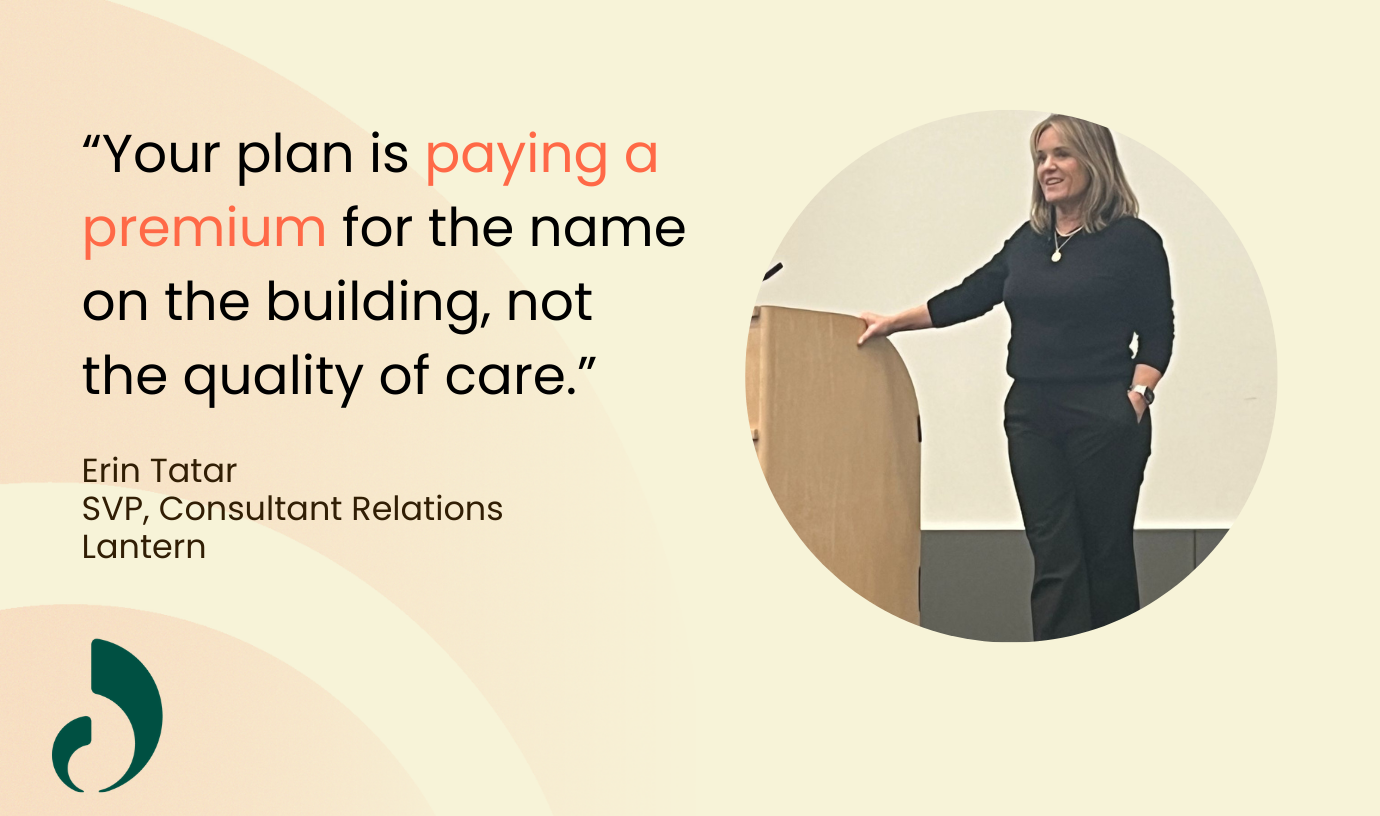
This consolidation gives large systems immense pricing power, leading to what Tatar called “inefficient spend.” If you don’t have a strategy to steer members away from these high-cost centers for routine procedures, your plan is paying a premium for the name on the building, not the quality of care, Tatar said.
Three Pillars of Employer Health Spend: Surgery, Infusions and Cancer
If you are looking to pull inefficient spend out of your plan using a site-of-care strategy, Tatar recommends focusing on the areas with the most variation in cost and quality.
1. Surgery (20% of Spend)
As mentioned, the facility fee is the driver here. By using a curated network (like Lantern’s Network of Excellence) to steer members to high-quality ASCs, plans can achieve unit cost reductions of 50% compared to traditional carriers.
The Strategy: Curate the highest quality surgeons (fellowship-trained, high volume) and pair them with an efficient site of care.
2. Infusions (10% of Spend)
Infusion drugs often see a 3x to 6x markup when administered in a hospital setting.
The Strategy: Shift these to home infusions or ambulatory infusion centers.
Tatar shared an example of a patient on Keytruda where the site shift saved $20,000 per session, totaling nearly $250,000 in annual savings for just one patient. The patient also gets to stay home rather than sitting in the hospital.
3. Cancer (20% of Spend)
Cancer is different. You can’t simply arbitrage unit costs because you can’t easily negotiate a discount on complex oncology in the same way.
The Strategy: Focus on care navigation and oversight. By embedding expert review (like National Cancer Institute-level oversight), you ensure the diagnosis and treatment plan are correct.
This prevents wasted spending on ineffective treatments and keeps care in the community where appropriate, rather than automatically defaulting to the most expensive research hospitals for standard care.
How to Implement an Effective Site-of-Care Strategy
The fear for every benefits leader is employee pushback. You don’t want to be the person telling an employee they can’t see their doctor.
The industry is finding that voluntary programs often work best to start. You don’t have to force employees; you just have to make the “better” choice the “easier and cheaper” choice. Tatar recommended ways to implement a site-of-care strategy:
Incentivize the shift: Waive the deductible or out-of-pocket costs for using the preferred site of care through a program like Lantern. For an employee making $60,000 a year, avoiding a $5,000 deductible is a massive financial relief.
Provide a white-glove experience: Surgery and cancer diagnoses are emotional journeys. “This is not an app-based experience,” Tatar emphasized. “Lantern has real nurses and care advocates who can explain why a specific surgeon or facility is better, guiding the member rather than forcing them,” she said.
Direct contracting: To truly unlock savings, you need more than just steering; you need direct contracts with facilities. This allows for bundled payments that eliminate “upcoding” and surprise bills, giving the plan a predictable rate. As a licensed TPA, Lantern negotiates directly with providers in its Network of Excellence.
Specialty Care Buyer’s Guide
Learn the essentials to connect employees to the right care at lower costs.

Shifting Site of Care for Financial Sustainability
Shifting site of care isn’t just about saving the company money—though saving 50% on surgical unit costs is significant. It is about financial sustainability.
When you lower the underlying cost of care, you can afford to waive member cost-sharing. You can protect your employees from financial ruin while simultaneously protecting the plan’s assets.
“Where there’s variation, there’s opportunity,” Tatar said.
By identifying the variation in your surgery and infusion spend, you can stop paying for the “building” and start paying for the care—delivering better outcomes, lower infection rates and a price tag that makes sense.
Ready to launch your own site-of-care benefits strategy?