
Is promoting a healthcare benefit the same as advertising jeans? Not really—and at the same time, yes. It all comes down to reaching people at the exact moment they need something. And not once they’ve already gotten a procedure done or finished up their shopping for the season.
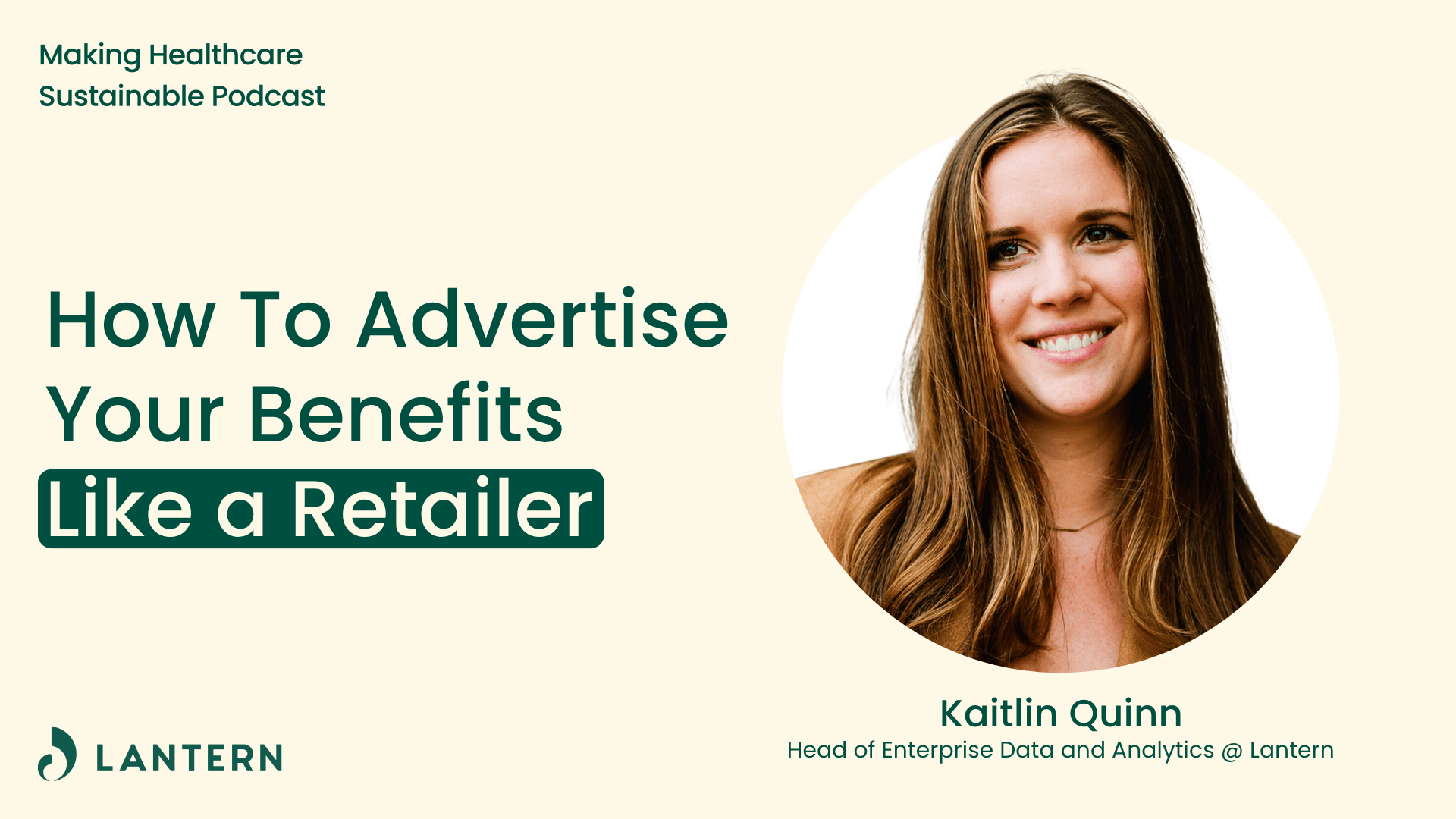
Kaitlin Quinn, Head of Enterprise Data and Analytics at Lantern, shares how her team uses marketing testing, targeted outreach, and data-driven experimentation to improve benefits engagement, build trust, and connect members with care when it matters most. And she has ideas on how benefits leaders can apply data science and marketing frameworks to benefits promotion.
In this episode, you’ll learn:
- How targeted benefits communications can significantly increase employee engagement by reaching people when they are most likely to need care
- Strategies for using simple marketing experiments to improve benefits awareness without requiring a large analytics team
- Why balancing broad awareness campaigns with personalized outreach builds trust and encourages greater benefits utilization
Highlights:
(00:00) Why “just send another benefits email” doesn’t work anymore
(00:46) The test Lantern ran to prove targeted marketing works
(02:03) What it costs to build a real marketing test
(03:56) Lantern’s targeted marketing test drove a 20% lift in engagement
(05:55) The jeans example that explains healthcare marketing
(06:49) Why word of mouth beats every other marketing channel
(07:46) The exclusion logic behind every message Lantern sends
(10:08) How sacrificing revenue for one test won over skeptical clients
(10:51) Envelope colors, subject lines, and other tests any team can run
(11:27) Awareness marketing vs conversion marketing, explained
(13:21) Why one coworker’s story outperforms a company-wide email
(14:20) Testing subject lines to see what actually gets opened
(15:56) How to tell if your test worked or you just got lucky timing
(16:55) A one click poll that tells you if people are engaged
(18:05) How Lantern tracks whether word of mouth is actually working
(18:30) Why Kaitlin says marketing Lantern is “good for good”
(19:46) The halo effect: why even non-users benefit from awareness
(20:20) What years in retail marketing taught Kaitlin about healthcare
(21:26) Timing outreach around ID cards, deductibles, and open enrollment
(22:19) Why you need both awareness marketing and conversion marketing
Resources:
Nancy Ryerson’s LinkedIn: https://www.linkedin.com/in/nancyryerson/
Kaitlin Quinn’s LinkedIn: https://www.linkedin.com/in/kaitlin-quinn-22514213/
Lantern’s LinkedIn: https://www.linkedin.com/company/lantern-specialty-care/about/
Key Moments
The Targeted Marketing Challenge
When Kaitlin Quinn, VP of Data and Analytics, joined Lantern, she was tasked with proving with hard evidence that targeted outreach, at the right moment, gives a significant lift to member engagement. Without accidentally reaching out to the wrong member at the wrong time.
Targeted marketing is a common approach in retail, but healthcare is clearly quite different when it comes to privacy and sensitivity. So it was critical that the experiment take place with the utmost caution.
The results? A 20% lift in engagement with Lantern compared with clients without targeted marketing.
A key part of the project was making sure targeting was as careful as possible, Kaitlin notes.
“You think of targeted marketing when you think of a retailer, right? Being able to present a pair of jeans when someone’s been searching for a pair of jeans in Google and being able to directly put that in front of them in Instagram when they hop over,” she said. “It’s a very similar concept, but when it comes to healthcare, it’s so personal and so private that it needs to be done with an extreme amount of care and patience and consideration.”
How Benefits Leaders Can Run Their Own Communications Experiments
Even if you don’t have all the resources Kaitlin discusses in the episode, you can still run your own marketing experiments to figure out what sticks.
“You don’t need an analytics team to get to some intrinsic understanding of what email worked and which one didn’t work,” she said. “In general, if they opened it up and they actually engaged with it, that is a great indicator that it reached more people.”
Not sure where to start? Ask your marketing team about the tools they use to send out emails about your product or services. Kaitlin says you can even use signals as simple as replies to your emails or emoji reactions in Outlook or Slack as indicators that your message is getting through. Compare a few different messages, and you have the results of your first experiment.
Metrics like email open rates tend to just tell you if someone is gaining some awareness of your program, not whether they’ll ultimately use it. But it’s a valuable start.
“It’s a bit of a fun scavenger hunt sometimes, but I find that to be the really exciting part when you created something that’s actually driven an action, and then you can see that validated at the end of the conversion cycle,” she said.
Episode Transcript
Nancy Ryerson (00:03):
This is Making Healthcare Sustainable, brought to you by Lantern. When it comes to benefits communication, most organizations are still guessing, sending emails and hoping something sticks. Today I’m joined by Caitlin Quinn, VP of data and analytics at Lantern. Over the past six months, her team has been running a serious marketing testing program that’s generating real actionable findings about what drives employees to engage with their benefits. We’re going to dig into what they learned, what surprised them, and how benefits leaders can start building their own testing practices. Caitlin, welcome. So glad to have you.
Kaitlin Quinn (00:44):
Thank you, Nancy. I appreciate it. Thanks for having me.
Nancy Ryerson (00:46):
Your team has been running a serious testing program for a while now. I would love to hear a specific example of a test that you ran, what you were trying to learn and what you found.
Kaitlin Quinn (00:56):
Yeah, absolutely. So I joined Lantern in September of 2025 and when I arrived we had really very directional but very good confidence marked understanding of the fact that targeted marketing, because it’s a best practice in the marketing area in general and in this function, that it is the best way to go to drive utilization and engagement buyer members. It’s marketing 101. It absolutely is something that you should enable across any industry and it ultimately creates a personalized message based on need for an individual so that it’s not a broad blast of all marketing material to all members that we cover. It’s very specific to those individuals who truly do have a need. Not all of our clients are enrolled in that. It’s absolutely voluntary. And so our job was to effectively identify true hard dollar, hard concrete evidence of improvement and engagement and overall savings validation and driving of that via target marketing offering to each client.
(02:03):
And so in doing that, what that comes is it comes with a cost because data itself is something that’s a differentiator in any market today. But in order to procure that information and then that insight to then drive to concrete recommendations for our clients, you have to create a testing program that’s robust enough and large enough to drive real statistically significant findings. And to do that, we needed a very large audience, which effectively means that we need to create a foldout proof, meaning a test and control brew, and did that hard evidence of saying, “Hey, it drive X percent increase in engagement when you have TMO or targeted marketing enabled versus when you don’t.” And that was a hard sell, especially for a startup, especially for a startup in growth mode, especially for the demand and the good things that our services bring to both clients and members.
(03:00):
So that was something that we wanted to deliberately… I was tasked with, I think from day one of entering Lantern in September of last year of saying, “We need to get to concrete evidence because we really need to be able to articulate the value and the impact this can make on a client’s member base by intervening at the right time when the need arises.” And so we were able to do that. It took about three months, which you don’t necessarily need that robustness of tests to test everything, especially when it could be a website feature versus a change in a subject line and an email. Those certainly don’t need as big of an audience or as much of a robust testing control variant to actually get to that outcome. But for this, it’s such an integral part of our business that we wanted concrete findings that we could then consistently redo every year to refresh and hopefully see even more impact.
(03:56):
And so that was luckily something that everyone was on board with. Everyone decided, yep, it’s worth the sacrifice and potential the inability to reach out in order to get to those findings to then create long-term impact for our clients and our members. And it had very concrete outcomes. We saw a 20% lift in those clients that actually had TMO enabled versus did not. And ultimately that’s because not only is our service adjacent to benefits offerings for clients and for members, we are also explaining what Lantern is, why it’s useful in addition to saying, and we know that it could be useful to you because you are in the process of identifying surgical care or getting surgical care at whatever stage that might be. And so being able to intervene at the right time, of course, the really great marketing principles of find them where they are, where they should be at the right time is very core to that.
(04:51):
And being able to do that via a targeted marketing offering and being able to get the data to actually create that ability to reach out to those members is critical for that. So that was a really, really exciting groundbreaking test that actually just wrapped in May. We’ve got really concrete outcomes from it that we’re really proud of and we’re then taking to market and obviously with a lot of our narratives and speaking with clients about the value it brings.
Nancy Ryerson (05:15):
And a 20% lift, that’s significant. And I think it makes so much sense knowing the background of when we’re reaching out to those members, those signals in their claims data that they are looking for surgery versus just somewhat randomly learning about Lantern. And we just are all bombarded with so much information. There’s studies that you have to see something seven times before it sticks. I think that number is higher now just in our world of information overload. So you could have seen something about Lantern but then forgotten it by the time you do have a moment of need. So I can totally see how that targeted piece would lead to those results,
Kaitlin Quinn (05:55):
Especially within this industry. You think of targeted marketing when you think of a retailer, right? Being able to present a pair of jeans when someone’s been searching for a pair of jeans in Google and being able to directly put that in front of them in Instagram when they hop over. It’s a very similar concept, but when it comes to healthcare, it’s so personal and so private that it needs to be done with an extreme amount of care and patients and consideration. I think that because of that, we almost over-index and doing nothing when it comes to targeted marketing across all healthcare segments. But in reality, when someone is in need of a surgery, especially one that’s going to bring them reprieve like a knee replacement, they want options. They want a customized service. They want something that’s going to make that process as easy and as possible and as financially conscious as it possibly can be.
(06:49):
And so we know our service can drive value. We want to be able to reach those people at their time if they need. The only way to do that is to obtain the data to actually create that signal and then to intervene at the appropriate time and avoid intervening at the inappropriate times. That can then hopefully drive great experience for our members and then ultimately word of mouth spread of that experience, which drives better conversion for us ultimately. Word of mouth, like most other brands is our highest converting inbound channel and so great experience is part of that and a great experience starts with intervening at the time’s need.
Nancy Ryerson (07:29):
And when we talk to benefits leaders, I know some are more hesitant, but have you heard of people who were kind of maybe convinced by the data or who started out unsure and were convinced that this would be effective and not overly intrusive for their population?
Kaitlin Quinn (07:46):
Yeah, we certainly have. And I think ultimately because there’s an enormous amount of logic that goes into using the claims data that we get for our members to then act on it. And one thing I’m really proud of is that we’ve got a really robust targeted marketing offering process and function that’s not only identified away, of course, of obtaining that inbound data, but then applying really conscious and careful logic to include those situations and scenarios that can certainly and most reliably lead to a surgical need and excluding those that are on the fridge and saying, “We’re not going to over-index and just cast a massive net.” We talk about just blasting an email to everyone in our entire network as a wide net, but then there’s layers of that. And even if you go back down a layer and down a layer and down a layer into the onion, we’re still not even maybe halfway into the onion as to where we stop and that’s really out of an abundance of care and it’s done because of really robust logic to identify somebody who’s right before they’re about to go to surgery, maybe they’re right before they’re about to go into their consult and maybe they’ve just seen a specialist for the first time.
(09:02):
And so there’s levels of intervention and there’s areas in which like right before surgery, they are absolutely on their way to the OR. We want to go ahead and intervene immediately so that they get the benefit of our service, but then there’s those other individuals that maybe have just seen a specialist, but we need to be incredibly sure that that is something that would ultimately qualify for a longterm benefit. And so there’s layers and layers and layers of logic and exclusions and assumptions we then put onto that information to make crystal clear that that need is a true need and not something that’s maybe a little bit more generic that could be a false signal. And I think that’s really important in healthcare more than probably anything else, especially in retail and other areas because you can put a pair of jeans in front of somebody who’s looking for a shirt and they’re not going to be obviously harmed or feel personally violated as an outcome of that.
(09:55):
That’s not the case in healthcare and when we’re getting this very personal information about our members.
Nancy Ryerson (10:00):
Yeah, absolutely. I’m sure hearing about that level of care helps build trust in our approach to outreaching to members.
Kaitlin Quinn (10:08):
Yeah, it really does. And explaining that and taking the time to explain it to clients and taking them on the journey with us through the customer, their member experience rather is a really important part of articulating that message. And so to your question, we have definitely seen a wide variety of clients change their perspective, not only as an outcome of seeing how we develop that logic across each of those stages of qualification, but also around generally how we tested it and said, “We’ve really put our skin in the game here of ultimately sacrificing revenue in order to prove this point.” And luckily as an outcome of that, it was a pretty substantial savings amount as well as revenue driving and utilization gather.
Nancy Ryerson (10:51):
Yeah. Well, congrats to your team on that. And I think that benefits leaders, obviously taking advantage of programs like this through your vendors can make such a huge impact, but I think there’s also a lot that they can try on a smaller scale if you have a tool that does allow something like subject line testing or if you want to, I know something we tried at Lantern was actually envelop color and testing call rate from different things like that. So what are some maybe lower lift or simpler but still impactful tests that a benefits leader might be able to run?
Kaitlin Quinn (11:27):
I think there’s like two different avenues and it’s really around if you’re focused on awareness marketing or conversion marketing. From an awareness perspective, if you just want to make individuals within your organization aware that a benefit exists, that doesn’t necessarily come with a lot of downstream signals that it worked. It’s mostly just, again, a marketing one-on-one principle that you have to invest significantly in awareness marketing to just make individuals conscious of something existing, let alone whether or not they want to use your service right away, but maybe in nine months when they do want their knee surgery, they’re going to remember that that email they got from the benefits department around, “Hey, we’re going to tell you for the 45th time, here are your benefits.” That’s why they exist and therefore your success metrics for top of funnel, the highest part of the funnel, which is awareness, they’re going to be very different than your conversion metrics, which is utilization.
(12:26):
And so from a benefit side of the house, what I think really a big focus for Lantern is how can we help you drive that awareness? And what I believe to be something very low lifts around what those departments can do for their members is in my opinion, a lot of customer success or NPS ratings. So again, going back to the reference I made around word of mouth being our highest converter, the thing that drives the most utilization are individuals or members’ competence and a service potentially being right for them is the person sitting right next to them in the desk saying, “Hey, I just got a knee replacement through Lantern and it was awesome.” So seems so quick, you should really check them out. It’s a free service. It’s like pet insurance. I think that’s a good way of probably something that people talk about of what are the adjacent opportunities and benefits that an employer offers in addition to the main carrier benefit.
(13:21):
In this case, because our business model is certainly complex, but it drives so much value, it’s allowing them to relate to something that they’ve heard before of saying, “Huh, this is really a really nice supplemental piece of my care journey that I’ve never heard of before, but I certainly should leverage.” And so word of mouth and being able to drive that, I think through surveying your members who have had the manure benefit, surveying your members who can use any of the benefits and getting their general opinion of how it went and what they would change and what they would do differently, or maybe what were their favorite parts of it. Then effectively putting those testimonials out to the entirety of the organization is massive. Those members want to hear from fellow members. They probably trust them the most, but then across the board in marketing material, whether it’s an email or direct mail or even the asset on the company’s homepage, just changing the dynamic a little bit to say, “Here’s Lantern, this is what it’s all about.
(14:20):
” And effectively having a spotlight every week of a different benefit offering for each of within your benefit portfolio. I think there’s a good amount of exposure opportunities, but then testing that is around impressions on the website and looking at just your general Google tags on how to actually get to that inclusion, looking at open rates for emails. I mean, it doesn’t have to be rocket science. You don’t need an analytics team. This is coming from ahead data and analytics, but you don’t need an analytics team to get to some intrinsic understanding of what email worked and which one didn’t work. In general, if they opened it up and they actually engaged with it even from just seeing it for the first time, that is a great indicator that it reached more people and that could have been because the subject line was intriguing, but it could have been because of something else.
(15:10):
It could have also been because of the preview. So you don’t exactly know what they saw, but you know that something in that first exposure caused them to open that email. So that’s where you want to poke in a little bit further of saying, “Huh, what worked in that subject line that’s different from all the others that actually drove more people to open that email?” Let’s then replicate that and create variance of that. It’s fun. It’s creative. I think that you can get a lot of value even out of the smallest metric. I would say one recommendation I have is try to look at at these two metrics together versus just one is you’re indicating a key metric of success versus failure and see how those two things move in the same direction. And so I think I’d say if you’re using the same asset maybe in an email, put that same asset on the website and see how they do.
(15:56):
Do they both drive value up? So then maybe it’s the actual image itself. And so it’s always nice to pressure test against two different mediums with the same asset or maybe the same copy and to ensure that, hey, it is actually this. It’s not just a point in time where everyone’s kind of trying to find more information on benefits because election is next week. So you have to pressure test a little bit around the context and the scenario as well.
Nancy Ryerson (16:21):
And to your point, I mean, I work in marketing and you work in data analytics, so we do think this kind of thing is fun, but I’ve heard from a lot of benefits leaders that they have had to become marketers themselves and some have even hired former marketers on their benefits team. But I think if you’re someone who you haven’t tried this kind of stuff out, ask your marketing team, see if they have a tool where you can send benefits emails through and you can start tracking these open rates and click-through rates and that kind of stuff and just start experimenting. And I think every test is helpful even if it doesn’t work out, that teaches you something too.
Kaitlin Quinn (16:55):
A hundred percent. Or even adding a poll into an email or something where they have to get back to you or maybe encouraging the, if you’re in an Outlook, like the thumbs up or the heart in the corner, any signal that being engaged with is a signal you can use to identify whether or not it’s working. It doesn’t have to be a request to IT to pull impressions, which I know can feel laborious or to marketing. And luckily I hope everyone it’s a quick process for anyone on the benefits side who can actually to get to that information. But if it’s not easy to get to that information, there are other things that you can leverage to actually give you some sense of, in this working, do people care? Are people looking at this and does it work? Because then you could then match with, “Hey, what are we seeing on the other side of the house with all of these benefits offerings and their engagement?” You can match it to the timing of when you’re sending these emails.
(17:48):
It’s a bit of a fun scavenger hunt sometimes, but I find that to be the really exciting when you see something, you created something that’s actually driven an action and then you can see that validated at the end of the conversion cycle.
Nancy Ryerson (18:05):
Exactly. Yeah. And I know at Lantern we do track referral sources. So was it word of mouth? Was it target marketing? Was it a letter or an email that someone received? So I think your idea of running a testimonial program at Lantern, we’re happy to help show if word of mouth increased after that program. And probably for any vendor, they’d be happy to help run these kinds of experiments.
Kaitlin Quinn (18:30):
And the majority of my experience has been in the marketing and analytic via digital platforms. Seeing the outcomes of that, it’s something that I just have to get so much energy from, especially because of the amount of tools that you need to actually enable it is so few. You can drive so much value with a very small amount of technology enabled tools available to you, data available to you because there’s a lot of room for experimentation and creativity in there from marketer and non-marketer. At Lantern, we really value it. We put a lot of credibility into it because we just know that that’s what’s very helpful is to just inform individuals around what Lantern is and what their options are during a really hard time in their life or something that they’re facing that might be a little challenging or they’re afraid of or there’s fear associated to that.
(19:21):
Our service in general brings a lot of reprieve to that. And then marketing that and saying, “Hey guys, did you know about this is good for good sake?” And so a lot of times I really talk about Lantern and it’s good for all parties involved and that’s something we really like to get out there and a targeted marketing program is just one way of figuring out how to get that message out there. And I think the same goes for any benefits department.
Nancy Ryerson (19:46):
It’s good news. And we just talked about this on another podcast episode that even if you’re not someone who needs Lantern at that time, just hearing that your employer offers something that makes care more affordable and that your colleagues are using, there’s really a halo effect. So I think target marketing is great, but even when everyone hears about it, there are definitely benefits in that too.
Kaitlin Quinn (20:07):
Yeah, 100%. Yeah. And it’s really a show of the employer truly cares about their members and making their difficult times and difficult journeys in which they’re away from work as easy as possible and as seamless as it possibly can be.
Nancy Ryerson (20:20):
Yeah. Well, before I let you go, I know and you mentioned before joining Lantern, you worked in digital marketing or digital analytics for a lot of retail companies. So I’m curious, what do you feel like Lantern or healthcare marketing has in common with retail marketing?
Kaitlin Quinn (20:36):
So depending on what retailer you work for, the demographic is very different, right? The demographic of the prior company I was at was around 18 years old and obviously those mediums and the digital footprint that we need and the ingredients to the secret sauce is so different than maybe a lantern with a slightly older demographic. And so what I think they have in common though is you really identifying somebody at the exact time of their need is the same across the board. Again, like the jeans example I mentioned, if we can intervene at the time that someone’s looking for jeans on the digital marketing for a retailer, we are going to have such a higher percentage of conversion rate than if we were to catch them the next day when they completely forgot about the men needing jeans and they’re back at work or they’re back doing their day-to-day.
(21:26):
If the same goes for Lantern. And while our mechanisms today are very much social driven, they’re also email and direct mail via hard copy, those things go in and out of popularity. I think a lot of people actually like getting mail these days again, it’s back. But I think intervening at just the right time, that makes a lot of sense. So is it right when they get their ID cards? Is it right when they have a couple of months? Is it right before they’ve hit their deductible before the end of the year? These are all considerations that we make of saying, not only do we want to find them at the time of need, but we also want to find them at the time that they’re actually seeking a need too. And so the fundamentals of a digital retailer and marketing space as well as what Lantern tries to accomplish via our targeted marketing offering are very similar.
(22:19):
It’s only going to work if it’s ultimately on a conversion basis focused on driving people when they have a need or when they’re about to have a need and on an awareness perspective, making people aware that a service like Lantern even exists in the world. And that’s a really important thing for a company like Lantern that’s newer, that’s very beneficial to, again, all parties involved. It’s a bit of a unicorn of saying like, wait, this actually can provide reprieve to this healthcare ecosystem that we’re trying to navigate and it’s been pretty tricky lately. So we’ve got to balance very nicely the awareness and the conversion driving marketing efforts. And that’s the same across any retailer or any company really on the planet is just saying like, let’s catch someone that need is hot.
Nancy Ryerson (23:06):
Yeah, because I think you’re right, you need both. You want to catch them in that moment, but if this is the first time they’ve ever heard of you, you might not have that trust established.
Kaitlin Quinn (23:16):
Exactly. And that’s why we also see our utilization increase year over year and it’s its exact same thing as awareness. It’s like creating that awareness in the first year would naturally create an increase in year two. It’s not because they have more members in their member base for buy a client. It’s not because they all of a sudden just like year two and everyone wants to get a knee surgery. It’s because of the awareness that we see grow over time.
Nancy Ryerson (23:39):
Exactly. Well, Caitlin, thank you so much for this conversation. It was, I think, super helpful for our benefits leaders, so really appreciate you taking the time.
Kaitlin Quinn (23:47):
Yeah. Thank you, Nancy. Really appreciate it.
Nancy Ryerson (23:50):
Thank you for listening to Making Healthcare Sustainable. If you want to learn more, be sure to check out our YouTube channel, Lantern Specialty Care, or check out our website where you can find additional resources.