
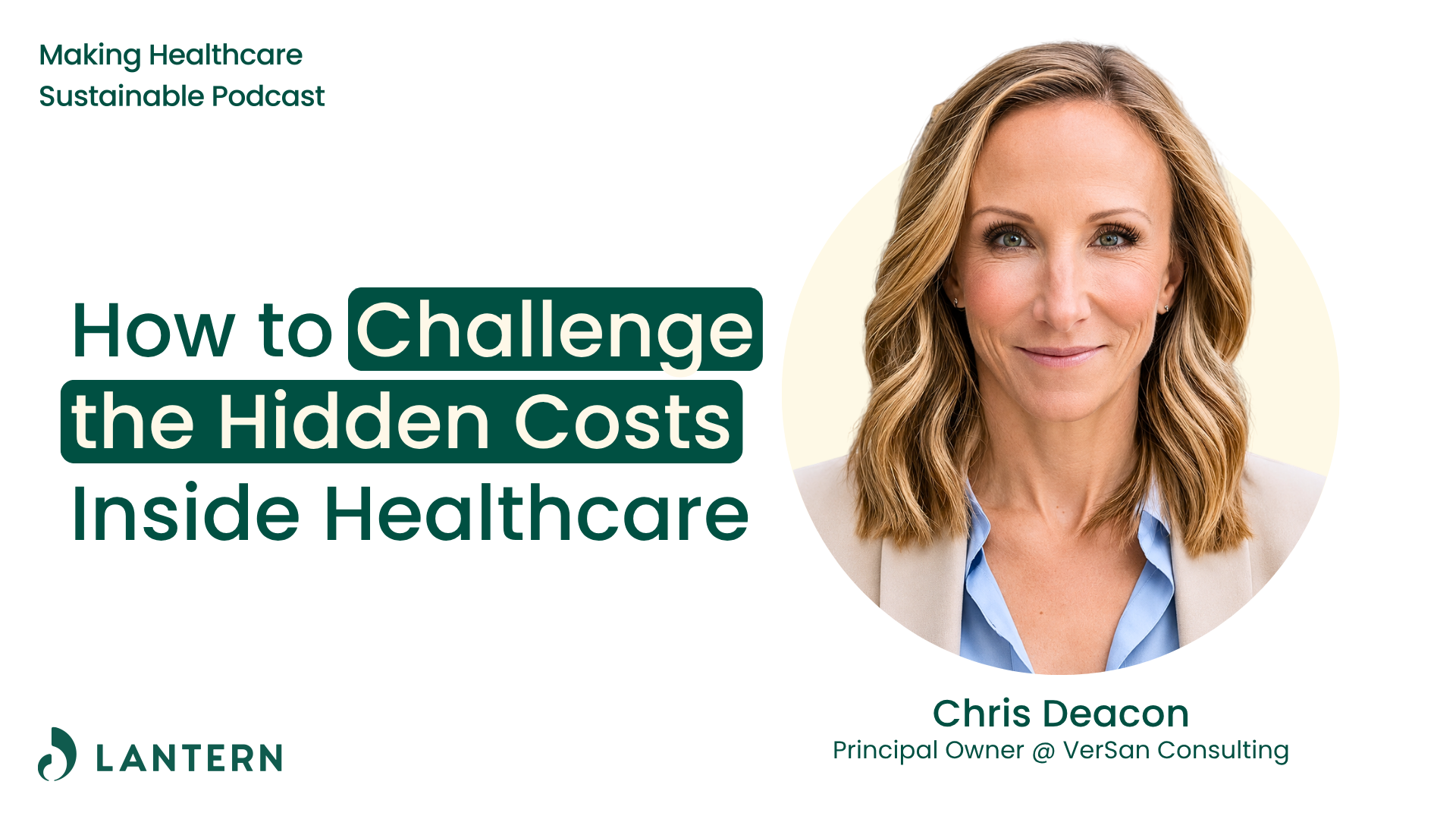
What if the biggest challenge in healthcare isn’t the cost itself, but the systems that keep employers from understanding where their money is going?
For many organizations, a lack of transparency, unclear incentives, and limited access to claims data make it difficult to create a smarter benefits strategy.
Chris Deacon, author of The Great American Healthcare Heist, shares what she learned while leading one of the nation’s largest health plans, why employers need to challenge traditional healthcare models, and how greater transparency can lead to better outcomes. She also explores the role of trust, employee education, and AI in building a more sustainable healthcare system.
In this episode, you’ll learn:
- How employers can uncover hidden costs by accessing claims data and challenging benefits assumptions
- Why transparency and quality-focused decisions are key to a sustainable healthcare system
- How education, communication, and technology build employee trust and drive better health outcomes
Highlights:
(00:00) Meet Chris Deacon
(01:32) Why employers need to examine IDR reports
(04:40) Chris Deacon’s path to healthcare reform
(05:49) The whistleblower case behind a $100 million settlement
(09:25) The claims data that revealed overpayments
(12:26) Why employers struggle to get their claims data
(13:37) How employers can push for better data access
(15:56) When healthcare problems become personal
(20:07) The quality gaps hiding behind healthcare networks
(23:02) Building employee trust around benefits changes
(27:30) AI’s role in fixing or worsening healthcare
(30:19) Where AI can help employers
Resources:
Nancy Ryerson’s LinkedIn: https://www.linkedin.com/in/nancyryerson/
Chris Deacon’s LinkedIn: https://www.linkedin.com/in/cdeaconc/
Two Reports to Pull Today
Asked what one thing she would have employers do right away, Deacon was specific. “I would ask you to pull your IDR reports or requests from your TPA or your carrier, your independent dispute resolution reports from the No Surprises Act,” she said. “And I would ask that you really take an in-depth look at those and try and understand them and also compare them to your out-of-network shared savings reports.”
The No Surprises Act protected patients from surprise bills, but Deacon said employers have felt the impact. “If we’re losing 80% of the cases and paying thousands of percent of CMS to providers, that’s oftentimes the employer footing the bill.” Shared savings fees add to it. “If they have shared savings fees provisions in their administrative services agreement, they are paying shared savings fees on IDR claims.”
A Claims Review Turned Up Payments Above Billed Charges
Deacon ran the New Jersey State Health Plan, which covered 820,000 lives. While sizing up how much spend happened outside the state, she reviewed those claims in depth and saw the plan paying more than the billed amount in many instances. The plan’s contract said it would pay the lesser of billed or negotiated rates.
“What you would anticipate is paying a discount. That’s what you’re buying when you buy a network,” she said. In practice, she saw the plan paying “a hundred percent of billed charges plus,” and she said it isn’t unique to New Jersey.
That review became part of the whistleblower complaint behind a $100 million settlement. Deacon said it started with “looking at claims data for one purpose and finding something that looked off and questioning it.” The answers she got back followed a pattern. “There’s always an explanation or some error that can be accounted for or solved for.”
Her Own Bills Showed the Same Thing
Deacon had been told the overpayments only happened outside New Jersey. Then her daughter went to the ER. “When I received the explanation of benefits, I saw that the billed amount was one amount and the plan paid amount was substantially higher,” she said. “So it was happening in the state.”
She had a second experience at an orthopedic urgent care, where staff couldn’t find her insurance and she offered to pay cash. “I put my American Express down and it was $299,” Deacon said. “They subsequently reprocessed the claim because they found my insurance and it paid it over 2,000.”
Employers Often Can’t Get the Full Claims Data
Deacon said the barrier is access. “Employers are having a really, really hard time getting access to any sort of meaningful claims data.” Sometimes key financial fields are left out. In other cases, “they’re only going to share it with your consultant and your consultant can’t share it with you because they’ve signed an NDA.”
She credited Stacy Richter with a line that sums it up: “Where there’s mystery, there’s margin.”
A Script and a Demand Letter Can Change the Answer
Deacon has a script for employers who get pushback, plus a demand letter that can be customized and lists the legal reasons to gain access. “I literally have a script that if any of your listeners wanted to have access to, I’m happy to share it with them,” she said.
She was clear that it doesn’t work every time. But when employers push, “they will get a response that says, ‘We will make an exception for you. We don’t share this generally, but we’ll make an exception in this case for you.’” Her advice: “There are ways to try and push harder and resources to do that.”
AI Can Help Employers Comb Through Their Data
Deacon is skeptical of AI layered on top of a broken system, but she sees a role on the employer side. “I’ve seen some interesting use cases of AI actually helping on the employer side, combing through data to find anomalies or pattern recognition that could be helpful to the employer,” she said. That matters for employers without in-house healthcare expertise.
Episode Transcript
This has been generated by AI and optimized by a human.
Chris Deacon (00:00):
I was reviewing those claims in debts and I saw that we were in many instances paying millions and tens of thousands, hundreds of thousands of dollars above the billed amount. So above sticker price. We hear in healthcare all the time like, oh, that number, that doesn’t mean anything. There’s a discount. But in our case, we were playing sticker price plus a whole lot more.
Nancy Ryerson (00:28):
This is Making Healthcare Sustainable, brought to you by Lantern. If you’re listening to this podcast, I probably don’t have to tell you that healthcare in America is broken. From rising costs to a lack of transparency, the system often feels like a complex maze leading to more problems. But today we’re going to take a closer look at some of the systems driving these issues and what can be done to fix them. Our guest is Chris Deacon, a leading expert on healthcare reform and the author of the Great American Healthcare Heist. Chris has spent years working within the industry from law to healthcare leadership, and even took a stand as a whistleblower in one of the biggest fraud cases in healthcare. Her work sheds light on the deep systemic issues affecting the US healthcare system from price manipulation to unfair incentives, and she’s on a mission to drive change.
(01:24):
Chris, before we get into the main part of our discussion today, we’ll start with our think, feel, do segment. Which did you choose?
Chris Deacon (01:32):
So if there was one thing that I would ask employers to do today, it’s actually going to be very specific. I would ask you to pull your IDR reports or requests from your TPA or your carrier, your independent dispute resolution reports from the No Surprises Act. And I would ask that you really take an in-depth look at those and try and understand them and also compare them to your out-of-network shared savings reports. I think you will find some really, really interesting things as you bump those two up next to each other. Again, I know it’s pretty specific, but hopefully you haven’t heard that one before.
Nancy Ryerson (02:14):
No, no. And I’m curious to hear more. Can you give maybe a little teaser of what they might find?
Chris Deacon (02:20):
Yeah, so I think we’re all fairly familiar with the No Surprises Act and what it was intended to do. Really sort of protect individuals from getting these surprise bills. And we’ve seen how that has played out for the last few years. And one really important angle that I feel has been underestimated, underappreciated is the impact it’s had on employers. So if we’re losing 80% of the cases and paying thousands of percent of CMS to providers, that’s oftentimes the employer footing the bill. And so I think we really need to pay attention on strategy there. The other thing I think most employers don’t know, if they have shared savings fees provisions in their administrative services agreement, they are paying shared savings fees on IDR claims. So not all because not all are successful, but they’re paying it all upfront and maybe they’re getting a refund if in the end the carrier loses.
(03:23):
But those fees can be substantial. And I don’t think the No Surprises Act was intended to increase that revenue stream for carriers. So pay attention.
Nancy Ryerson (03:35):
That’s great advice. Yeah, I think the No Surprises Act is a great example more recently of it was set up to solve one problem and it seems like it has helped on the patient side. Patients aren’t really getting those surprise bills anymore, but it opened this door to other revenue streams for other parts of healthcare that seemed to be being exploited.
Chris Deacon (03:56):
Absolutely. I mean, it’s the law of unintended consequences. And I think some of these consequences, quite frankly, could have been foreseen and were foreseen. But we know how the sausage gets made in Washington. I certainly do that at the federal and state level. And so in order to get this across the finish line, some compromises were made. And I think hopefully we are able to take a second bite at the apple here and fix it in ways that it needs to be fixed.
Nancy Ryerson (04:23):
Yeah, I think that’s a great way to open our conversation. And as we get into it, I would love to hear your origin story for how you got so passionate about all of these issues in our system, especially when you were working for the New Jersey State Health Plan and what you saw there.
Chris Deacon (04:40):
Yeah. I think that at the end of the day, my drive to keep pushing for answers that started in the state plan with the state of New Jersey, because I was running the state health plan for 820,000 lives, is just that I took my sort of oath and my commitment to public accountability and stewardship of our plan’s dollars and our members’ dollars very, very seriously. And whether that’s your fiduciary duty as an ERISA plan sponsor or my responsibility protecting taxpayer dollars and member dollars, I approached every decision in question with that frame. And I think just this sort of unwavering commitment to those principles will inevitably lead you down this path. And did I walk into many brick walls? Absolutely. Were some of them immovable? Yes. But I found either a different door or a different window and yeah, just unwavering in that commitment.
Nancy Ryerson (05:42):
And can you share a little bit about your experience as a whistleblower and what you discovered and what happened next?
Chris Deacon (05:49):
I actually stumbled upon what ultimately became the basis for the whistleblower complaint, or at least a component of the whistleblower complaint that ultimately led to the hundred million dollar settlement. Looking at claims data for one purpose and finding something that looked off and questioning it. And I think all of my brethren who’ve run plans here will sympathize with the fact that you ask a question, you will get a, oh no, no, there’s a reason for that or the reason it looks like that is because of this. There’s always an explanation or some error that can be accounted for or solved for. But I trusted my gut and I kept pushing and I kept pushing for answers. I refused to be sort of gaslit into believing the responses that I knew couldn’t be true. And eventually you wrinkle enough feathers. And with an organization the size of the one I was up against, they have a very good in with certain political heads.
(06:52):
And so I was ultimately faced with you either you look past this or you move on. And so I decided to move on and ultimately filed this whistleblower complaint a couple months after I left based on that fact pattern that was the basis of the settlement, but also a whole host of other things that I actually uncovered in the process of that investigation, but also in the process of experiencing the health plan with my own daughter. So it was interesting. And I mean it took five years, almost five years to ultimately come to a resolution. It settled or four years. It settled in November of 2025. As a whistleblower, you can’t talk about it for the interim. So it was all filed under seal. It was definitely a life decision that I made with my family to pursue this because it had ramifications and consequences that I still deal with from a professional and personal perspective.
(07:51):
But I wouldn’t change it. Despite how everything turned out and the manner in which I was treated towards the end of the case, I wouldn’t make any different decisions.
Nancy Ryerson (08:01):
I think it’s interesting that you say anyone with your values, if you’re committed to transparency and actually getting people the care they need, that anyone would kind of be led to your path. I think you were definitely brave though to stand up to the forces that you stood up against.
Chris Deacon (08:15):
Yeah, I think too, I recognize my privilege. I recognize how extremely lucky and privileged I am and was to be able to take that step with the comfort of being okay with my family financially. I was not the sole breadwinner. And I think these are very real things that often inhibit folks from stepping up to the table and calling out things that are problematic. They do have mortgages to pay and families to feed. And I’m very sensitive to that fact. And so not everybody has the privilege that I did of being in a position to take on that fight. And because I was in that position, I really felt not only compelled to do it, but it was in a way I had a responsibility to take that position and take that freedom and really be the one to step up because I could.
Nancy Ryerson (09:13):
We opened by talking about, hey, look at your claims data. It’s almost like you don’t know what you’re going to find. Is there one maybe specific data point that first caught your eye and suggested to you like, oh, something is wrong here?
Chris Deacon (09:25):
Yeah. Well, so I was actually in the process of identifying how much of our spend was actually happening outside of the state of New Jersey. So we had a Blue Cross Blue Shield plan, so we were accessing all of the Blues networks outside of Horizon Blue Cross Blue Shield in the state. And so I wanted to know what the impact financially was if we were unable to have our statutorily mandated claims review process actually review those claims. So there was a statute that was passed in New Jersey and it said every claim had to go through a claims review process before being paid. The implementation process of that was very difficult. And one of the things we learned is we wouldn’t be able to review those claims outside of our network. And so in attempting to identify and put a number to the value that we were missing, I was reviewing those claims in debts and I saw that we were in many instances paying millions and tens of thousands, hundreds of thousands of dollars above the billed amount.
(10:31):
So above sticker price. We hear in healthcare all the time like, oh, that number, that doesn’t mean anything. Nobody pays the bill. There’s a discount. But in our case, we were playing sticker price plus a whole lot more. And that really is one of the things that sort of led to looking and looking and looking and not taking no for an answer when I asked for a follow-up.
Nancy Ryerson (10:54):
And it was supposed to be the opposite, right?You’re supposed to be seeing a discount, but instead you saw so much extra.
Chris Deacon (11:01):
So what you would anticipate is paying a discount. That’s what you’re buying when you buy a network. That’s what they tell you you’re buying. That’s what they guarantee you when we’re looking at guarantees. But in reality, we see, and it’s not unique to New Jersey, that there is oftentimes we’re paying a hundred percent of billed charges plus. There was an individual I just saw posted on LinkedIn recently explaining a case where he actually had a durable medical equipment being provided to his son. The billed amount was, let’s say $150 close enough. But when it ultimately got paid by his plan, it had gotten marked up to 165 approximately. So not only, again, it’s the billed amount, but it’s now it’s more than the billed amount. And I think that’s contrary to what every benefits professional thinks that they’re actually buying, which is a discount to a network.
Nancy Ryerson (12:02):
Exactly. And I think when benefits leaders look into their claims data, maybe it won’t lead exactly down the path that you found. But one theme that really stood out from your book to me was there are so many barriers to even having that transparency and seeing what you’re really spending. And it just seems like the system really is just kind of built to keep everyone in the dark more or less.
Chris Deacon (12:26):
Absolutely. I agree. Where there’s mystery, there’s margin. Credit Stacy Richter with that quote. But employers are having a really, really hard time getting access to any sort of meaningful claims data. Like, oh yes, you can get access to your claims data, but we’re not going to give you the paid field or the build field or one of the financial fields that you absolutely have to have in order to analyze your claims. Or you run up against the fact that they’re only going to share it with your consultant and your consultant can’t share it with you because they’ve signed an NDA. I mean, the host of reasons that employers are given as to why they can’t get their claims data or why they don’t want to get their claims data, threatening, well, you don’t want that liability and you don’t want the HIPAA concerns. We’ve heard it all and it’s pretty remarkable.
Nancy Ryerson (13:19):
What advice do you have for pushing back? I liked it in your book at the end it was you shared questions that benefits leaders should be asking their broker or their plan. What do you do if you’re not the most confrontational person? If they say, oh no, or give those reasons you said, do you have kind of a script for pushing back?
Chris Deacon (13:37):
I literally have a script that if any of your listeners wanted to have access to, I’m happy to share it with them. It’s also in a workbook that I put out last year. It’s on Amazon. It’s like nine bucks. I wanted to make it very affordable for anybody. So there’s actually a script. And then I have an updated demand letter that can be customized to any employer that lists all of the sort of legal reasons and justifications as to why you should gain access. Now, are they successful in every instance? No. But what I’ve seen a lot of is when employers push and use some of that information, they will get a response that says, “We will make an exception for you. We don’t share this generally, but we’ll make an exception in this case for you.” And they’re able to get most or some of the data.
(14:26):
And I’m not saying it’s successful every time, but there are ways to try and push harder and resources to do that.
Nancy Ryerson (14:32):
Yeah. I think what I like about that advice is that it is very actionable. You can go and try that and start to make a difference versus obviously you do a lot of advocacy work as well. And at the federal level, that just could take a lot longer, but this is something people can really start to try in their day-to-day.
Chris Deacon (14:49):
Yeah. Although I think what we’ve seen over the last six months, six to 12 months, is things take so. They happen all at once. I mean, we saw with the PBM legislation and with the CAA 2026, and then the PBM regs that came out of DOL. That all happened within the span of six weeks. And we’re actually seeing now movement on the hill, both the Senate and the House, transparency bills, some better than others, that deal with this very issue. There’s a bill that just came out, a committee in the Senate that would very specifically give claims data access to employers in a specified format on a frequency that is defined. And there are real teeth if they don’t get access to that. So I am hopeful that this is starting to hopefully move in the right direction for employers.
Nancy Ryerson (15:43):
That’s definitely positive. And going over to the human aspect, you mentioned that your daughter experienced the system and our healthcare system. If you’re open to it, would like to hear more about that experience.
Chris Deacon (15:56):
It’s similar to what I sort of described earlier with the billed amount being changed so that we’re actually paying more. And in that case, I had been told that the reason the data looked like it did in terms of paying over the billed amount is it’s important to note that our contract said that we would only pay the lesser of billed or negotiated rates. So it was very clear that that was not happening. And I was told, no, no, no, it’s only outside of the state of New Jersey that that happens because we can’t control those networks. Not happening inside the state. Well, lucky or unlucky for me, my daughter needed to go to the ER. And subsequently when I received the explanation of benefits, I saw that the billed amount was one amount and the planned paid amount was substantially higher. So it was happening in the state.
(16:50):
And I think I’ve had numerous other personal experiences. One, I went into an orthopedic urgent care and they couldn’t find my insurance because I had been a federal employee at one point and a state employee. So they just couldn’t locate it in their system. And I said, “You know what? I’ll just pay cash.” And they said, “Well, we can’t do that.” And I said, “Well, let’s do this. I’m going to walk out and I’m going to walk back in, and I’m going to tell you that I’m going to pay cash and I’m not going to mention insurance.” And so I did that and I put my American Express down and it was $299. They subsequently reprocessed the claim because they found my insurance and it paid it over 2,000. These are all things that we all have worse stories and personal anecdotes. Everybody has their healthcare story.
(17:36):
I’m sure you do. And when I go to conferences around the country, the hands shoot up. Everybody’s had their own story and experience with something of this oak or flavor.
Nancy Ryerson (17:47):
Yeah. And that’s so interesting that even because you were covered by the state health plan that you saw in your explanation of benefits, the exact issue you were digging into. Yeah,
Chris Deacon (17:58):
Exactly.
Nancy Ryerson (17:59):
And then walk us through some of the reactions when you shared this like, “Hey, I can see right here that this is happening in network that we’re not paying the lower rate we’re supposed to be paying.”
Chris Deacon (18:09):
A lot of, again, gaslighting I think is, I hate to throw that word around, but I don’t want to psychobabble anybody, but it is what it is. That’s the term that accurately describes what it feels like because you know you’re seeing something, you know you’ve experienced something, and you are being told that that’s not really what’s happening. Eventually you’re met with that brick wall. And whether that brick wall is the carrier or your own internal leadership because you are ruffling too many feathers, it was very frustrating. But at the end of the day, I also understand, I mean, the particular carrier in our case gets approximately $9 billion in revenue in admin fees and Medicaid fees from the state of New Jersey. I mean, it’s a massive number. And so to have any sort of action taken that could have ramifications for other contracts is huge.
(19:07):
And all of these entities and the systems with which they contract give a lot of money to politicians. And we can’t ignore that fact. It’s real, it’s there. And I think ultimately it’s not just New Jersey, it’s the federal government. It’s every state in the US.
Nancy Ryerson (19:26):
Yeah, definitely widespread. And I think another theme that stood out to me from your book and for what we’re talking about is that we’re paying more and the quality isn’t better. And beyond that, it isn’t correlated with these contracts. Something you talk about a lot at Lantern is the lack of steerage to quality doctors within a regular insurance network. And at antern, we are able to steer to our vetted network. But I think it also came up when you talked about the formulary and PBMs and, “Oh, you can take this drug now. Oh, it’s not because it’s better, it’s because of these financial incentives.” So that was just something that stood out to me that I wonder if people are that aware of.
Chris Deacon (20:07):
Oh, absolutely not. I mean, I think people see, for example, when you go, “Who’s in my network?” And they look for the doctors that your carrier is putting up in front of you and populating. They think that there’s a certain amount of due diligence that has gone in to that provider becoming a credentialed provider in your network. There should be some sort of level of entry that I think consumers assume that there’s been some vetting and quality control. Unfortunately, I don’t think the level of that quality control is consistent with consumer’s expectations. And as you also said, if a doctor writes a script with a pen that was recently delivered by a pharmaceutical rep for a very expensive drug, most consumers are going to say, “Well, that’s the drug I should be taking because that’s the drug that my doctor prescribed.” Because they think there’s some benefit there not knowing that maybe that’s just what the provider has to push or that’s the drug that your formulary covers.
(21:14):
And so I think that there’s an education deficit that I think is narrowing a little bit. But yeah, there’s certainly a lot of assumptions that we make about quality that are not far off or not accurate. I think the US healthcare system can be one of the most dangerous things to your health if interacted with in the wrong way.
Nancy Ryerson (21:37):
Yeah. Is there an example that really brings that fact to life for you?
Chris Deacon (21:41):
Not that I’ve experienced personally, but I would say one huge example that a lot of employers will probably, this will resonate with them, is in the substance use disorder space. You pick up the phone, you call whomever you need to in crisis. You’re sent to a residential treatment facility, and you’re assuming that you’re there to get better. And what we see, unfortunately, is many of these institutions are run like profit centers. How many labs can I run a day? How many prescriptions can I get this person on while they’re here? I’m going to bill on a daily basis so that I can evade any sort of triggers that might render a review of this as a high cost claim. All of the tricks of the trade. And oh, by the way, the more efficacious we are at treatment, the less our total addressable market. So you see these people coming back and back and back again.
(22:41):
That just is an example of an area where we could really deal with a little bit more visibility into quality and outcomes.
Nancy Ryerson (22:49):
And let’s say you are a benefits leader again, what do you feel like you would do differently running? Let’s say you had a clean slate. We talked a lot about accessing your own data. What else do you feel like you would do as a leader?
Chris Deacon (23:02):
One of the things that we can’t underestimate or underappreciate is employee education and trust. If we are to do anything that is, let’s say, progressive or outside of the norm, outside of the BUCA network with the standard big three PBM, we are going to have to have our members trust us that we’re making decisions that are in their best interest, be that financially and from a quality and healthcare perspective. So I think being very communicative and figuring out that comm strategy with your workforce is really valuable because you have to have it to make any of your solutions successful. I mean, so centers of excellence approach, for example. If I have a tremendous amount of trust with my employees and I then introduce them to a Lantern, for example, they are much more apt to engage with them at the point that they need that care.
(24:02):
And we know that that then turns into better results for my members and lower costs to me as an employer. If I don’t have that trust, if I’ve just shuffled them around and increased their premiums 15% year over year and shifted all the costs to them as my only means of saving money, I don’t think they’re going to trust that flyer or that email when it comes out. So be very intentional about that.
Nancy Ryerson (24:25):
Yeah, that’s good advice. And it’s something we hear sometimes from Lantern members. I think it’s just natural to feel skeptical like, okay, why is this free? So then to actually use a program like that, you do have to have that trust in your employer. And some of the union leaders, health fund leaders I’ve spoken to, I feel like their members really understand the relationship between their own pay and their healthcare. And hey, if we can save in this area, we don’t have to impact your salaries and you can keep getting cost of living raises. I feel like they do a good job of communicating that message. I wonder if other self-insured employers, because I think most people don’t even really know about self-insured employers.
Chris Deacon (25:06):
No, or the value of the benefits. I think you’re right that unions are specifically well-positioned to understand that dynamic just because of the way that they contract for benefits and that’s what the union is doing for them. So it’s sort of front and center. Whereas with another employer that’s just sort of run-of-the-mill, non-unionized workforce, it’s part of a package, but nobody’s sitting down with that employee and saying, okay, now your benefits here are worth of your wages, they’re worth $27,000. And if those stay flat, your cost of living increase can be X, Y, and Z.That conversation doesn’t happen. And it happens in union shops across the country all the time because that’s one of their primary value propositions to their members is engaging in those conversations.
Nancy Ryerson (25:57):
It would be interesting to see more of those conversations at the more private in the private sector.
Chris Deacon (26:03):
Yeah. And again, going back to the communication strategy that I think employers need to make sort of foundational to their processes and how they’re running their shop, communicating, for example, using your benefits in an intelligent way. So let’s say going with the centers of excellence or going to primary care or using a virtual urgent care option that I’ve contracted with. Understanding that the $2,000 savings in that ER visit, it might not be coming back into my pocket today right now, but if we all use our benefits wisely, maybe we won’t be hit with a double-digit rate increase next year. Or maybe we will be in a position to expand our benefits to offer fertility benefits or some other weight loss drugs or whatever the thing is, the latest lifesaving CAR T cell therapy. Let’s do the smart thing so that we can do the right thing.
(27:04):
And I think that that has to be, again, front and center.
Nancy Ryerson (27:07):
Yeah, I like the idea of changing the message and having that communication strategy. We’re all in this together. We can all improve how we use the system. Great. Well, I feel I enjoyed this conversation. We’d like to end our conversations with a bit of a bold prediction for the future. Curious what comes to mind for you?
Chris Deacon (27:30):
I think we’re at a very precarious crossroads. My LinkedIn post today was a picture of a toilet and the name tagline was shittivation. There’s a lot of innovating or what we’re calling innovation with AI on a fundamentally broken system. And I think that there’s a set of questions that we need to be asking ourselves before adopting the latest and greatest in terms of what AI is being used for and what the latest technology is being used for. And when I say we’re sort of at this crossroads, I think unfortunately we are not heading in the right direction. I think there’s still time to course correct and steer in the right direction. I can’t help but seeing report after report after report predicting $9 trillion in spending in 2030 or PPO costs for a family going up to $40,000 for an employer. It’s hard to hold out hope, but I think we have to.
(28:35):
I’m hopeful that some things in Washington will help us get there. But yeah, so again, I think we’re at a crossroads and I think everybody that’s listening to this, every individual across the country has to interact with this system and they can all do so in a way that moves us more towards the right direction.
Nancy Ryerson (28:53):
You don’t need to put any particular AI products on blast or anything, but I’m curious if you have an example of the kind of use of AI that you feel like is just kind of building on a broken system versus something that would actually drive either quality or savings improvements.
Chris Deacon (29:10):
I think the best example is probably in the arms race between AI being used in the hospital system’s revenue cycle management shops and AI being used in the carriers to catch the revenue cycle manager’s AI arms race. So you have over here ambient listening, all of the ways in which we can capture more codes, more revenue capture, and make sure that we aren’t denied or can process prior auths quicker, whatever. How can we really maximize that machine? And then over here with the carriers you have, how can we use AI to find all of the ways that they are trying to maximize? And so I find that to be very unproductive
Nancy Ryerson (30:00):
Yeah. How could we deny what the other AI found? Right.
Chris Deacon (30:04):
If everybody were to adopt these systems, would the cost of healthcare go down? The answer to this clearly in this example is no.
Nancy Ryerson (30:12):
Yeah, it would go up, it sounds like. Yeah. Are there any uses of AI that you see potentially improving things?
Chris Deacon (30:19):
In the employer space, I think using AI to ingest maybe vast amount contracts, identify issues in contracts for employers. Maybe if they don’t have the level of sophistication, not every 500 person employee has an in-house general counsel and if they do, that is knowledgeable about healthcare and healthcare transactions, or even a full-time person dedicated to healthcare. So I’ve seen some interesting use cases of AI actually helping on the employer side, combing through data to find anomalies or pattern recognition that could be helpful to the employer. So I’m not against innovation and moving forward. I’m against throwing gasoline on a otherwise broken system.
Nancy Ryerson (31:04):
Those are great examples. Well, thanks so much, Chris. Really enjoyed this conversation. Thanks so much for coming on the show.
Chris Deacon (31:10):
Yeah, thanks for having me.
Nancy Ryerson (31:14):
Thank you for listening to Making Healthcare Sustainable. If you want to learn more, be sure to check out our YouTube channel, Lantern Specialty Care, or check out our website where you can find additional resources.