
If you’ve ever tried to find a specialist on your own, you know how challenging it can be. Do you pick one based on proximity? Google reviews? A recommendation from a family member?
The reality is that this choice isn’t necessarily data-driven for physicians, either. When making a referral, the average primary care doctor chooses a specialist based on reputation, not necessarily on the outcomes data that truly capture quality.
Even with a good referral, the trouble often continues. Patients can get lost in the handoff between primary care and the specialist, and that gap can be costly.
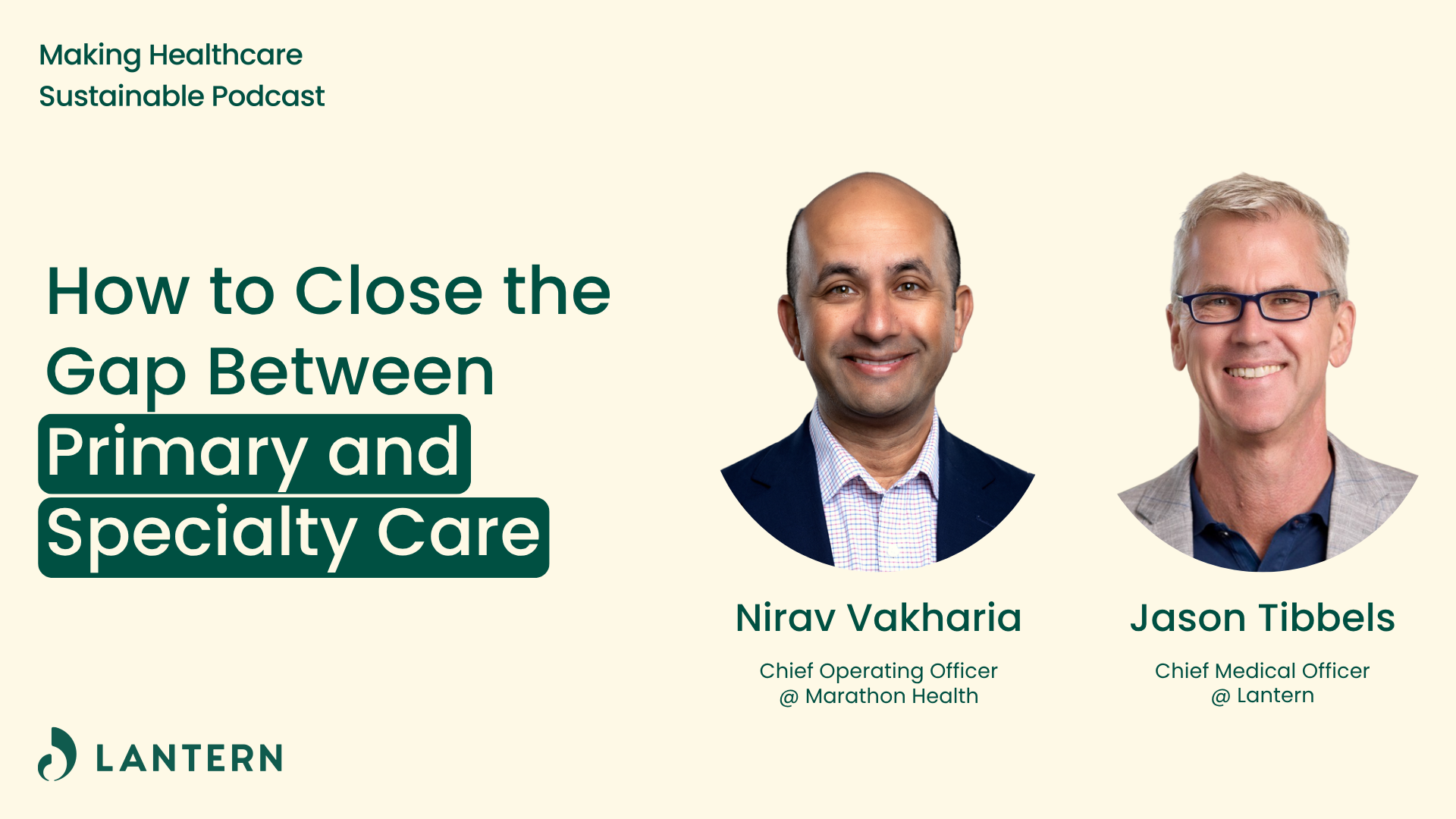
Nirav Vakharia, Chief Operating Officer at Marathon Health, and Jason Tibbels, Chief Medical Officer at Lantern, explore how stronger primary care, better specialist quality data, and warmer handoffs can close the gaps between primary and specialty care. They discuss why trust drives follow-through, how advanced primary care can prevent unnecessary referrals, and what it takes to build a more connected healthcare experience that improves outcomes while lowering costs.
In this episode, you’ll learn:
- How stronger primary care can reduce unnecessary specialist visits by giving physicians more time, continuity, and capacity to manage complex conditions
- Why objective quality data matters when choosing specialists and can help patients avoid unnecessary procedures, complications, and higher costs
- How warm handoffs between primary care and specialty care build trust, improve follow-through, and create a more connected patient experience
A Second Opinion Avoided Surgery for a High School Athlete
Dr. Tibbels shared a story from his personal life about a time his son needed to see a specialist. His 16-year-old son, a high-level basketball player, had a foot injury, and Dr. Tibbels did what any primary care physician would do. He referred him to an orthopedic surgeon he knew well and had sent patients to many times. The diagnosis was a Jones fracture, and surgery would have meant three months out and a lost basketball season.
He also had access most parents don’t. He was at Teladoc at the time, and he said, “I decided to take advantage of my own personal access and had one of the very top foot surgeons on the planet look at these films.” The expert didn’t know the patient was Dr. Tibbels’ son. “Whatever you do, don’t let anyone operate on this kid. This is not a Jones fracture. It’s close, but he just needs a non-surgical treatment rehab.”
Dr. Tibbels said the first surgeon wasn’t the problem. “This was a really challenging diagnosis, but when you really work to get people to the right expert, there can be tons of value in that.” The difference was ownership. “I owned and managed the referral, the follow-up and second opinion.”
Without a physician’s knowledge and connections, that second opinion might never have happened. A typical patient hears from a respected surgeon that they need surgery and has little reason to question it. Dr. Tibbels’ son avoided an operation he didn’t need because his father knew to ask.
Most Physicians Pick Specialists Without Objective Data
Both physicians said that, before their current roles, choosing a specialist came down to what was easiest. Dr. Vakharia relied on his own experience with a specialist and what patients reported back. “I was just trying to get through the day, to be honest.”
Dr. Tibbels said the same. “Where else on the planet is someone making a five-figure referral without really having any objective performance data? That’s me. And this is still the norm today, and it’s not because physicians don’t care, it is because they’re in the grind and there’s no easy way to get those objective data.”
Eleven-Minute Visits Send Patients to Specialists They Don’t Need
Dr. Vakharia said advanced primary care gives providers more time. Visits run “35, 40 minutes as a default for your visit time as opposed to what’s the typical industry average right now of about 11 to 15 minutes,” and providers hold smaller panels. In his earlier practice, the short visit shaped every decision. “I call myself a ‘which doctor’ because from the moment I enter, I’m just thinking, which specialist do I need to send you to so I can get on with my day?”
His example was headaches. “Back in my ‘which’ doctor days, every headache went to neurology, which also meant every headache ended up getting an MRI or a CAT scan and lots of follow-up neurology appointments for things that actually is a core competency in primary care.” Now he works them up himself and refers only when he reaches the end of his training.
Dr. Tibbels agreed. “Every diabetic doesn’t need an endocrinologist. Every hypertensive patient does not need a cardiologist, and a good primary physician should be taking care of those problems.”
Patients Fall Through “Human Size Cracks” After the Referral
When a referral is needed, the handoff is where things break down. “There are human size cracks that patients fall through in that handoff from primary care to specialist, and then I’m back from specialist to primary care,” Dr. Vakharia said.
The result, he said, is “a lot of delayed or deferred care, which then has its own consequences around unmanaged conditions, complications that arise, excess cost as a result, not to mention just a really poor experience overall with the healthcare system.” He said it isn’t anyone’s fault. “Everyone’s grinding.”
Patients Follow Through When Their Own Doctor Makes the Call
Dr. Vakharia said patients have learned where to go when they need help. “The general average patient only trusts two parts of the healthcare system, 911 and the emergency room, because those are the only two parts of the system that are there when you need them reliably.” The goal, he said, is to transfer that trust back to primary care as the front door.
For Dr. Tibbels, warm handoffs carry that trust forward. “Trust transfers, people follow through when they get a recommendation from a primary care doctor who actually knows them into a pathway where someone is expecting them.” Dr. Vakharia pointed to the research behind it. “The number one predictor of whether a patient will follow through on a healthcare decision is did your physician in general suggest it?”
Connecting Marathon Health and Lantern Increased Orthopedic Cases Reaching Lantern by 37 to 100%
Marathon Health took a select group of clients that already offered Lantern as a benefit and connected the two organizations on the back end. The program currently covers orthopedic care. Providers see data on the best orthopedic provider in the electronic health record, and a Marathon Health team schedules the patient, sends records and warm hands off to a Lantern care manager. Dr. Vakharia said providers keep the final say. “You know your patients best, you do what’s best for your patients, even if that’s a different decision than what we’re recommending here.”
The results: “Anywhere from a 37 to 100% increase in their orthopedics cases getting to the right Lantern specialist simply because we connected the wires better and provided that more integrated experience, not because they changed anything in their benefit design or their incentive plan or anything like that.”
A Referral Deserves More Scrutiny Than a $40 Prescription
Asked for a prediction, Dr. Tibbels offered a hope instead. “Maybe the referral or the transfer of care in that moment, that handoff moment, maybe we’ll start treating that as a clinical intervention with a dose, with a risk profile, with an outcome and not just this paperwork. Today there’s more scrutiny over a $40 prescription than there is this referral, which could be a $40,000 moment.”
Listen to the full episode of Making Healthcare Sustainable to hear how Dr. Vakharia and Dr. Tibbels think about closing the gap between primary and specialty care.
Episode Transcript
Nirav Vakharia (00:00):
There are human size cracks that patients fall through in that handoff from primary care to specialist, and then I’m back from specialist to primary care.
Jason Tibbels (00:09):
Where else on the planet is someone making a five-figure referral without really having any objective performance data? That’s me. And this is still the norm today. And it’s not because physicians don’t care. It is because they’re in the grind and there’s no easy way to get those objective data.
Nancy Ryerson (00:27):
This is Making Healthcare Sustainable, brought to you by Lantern. If you’ve worked in benefits for any length of time, you’ve probably felt this problem, even if you couldn’t name it. A member sees their primary care doctor, gets told they need a specialist, and then they’re on their own. They Google a name, ask a coworker, pick whoever’s closest. Nobody hands off the baton. That gap is expensive, and it’s not just a paperwork problem. It’s where unnecessary surgeries happen, where the wrong specialist gets picked, and where employers and funds lose the ability to steer people toward better outcomes at a lower cost. Today, we’re digging into what it looks like to close that gap. Nirav Vakharia is chief operating officer at Marathon Health, where he leads clinical strategy and population health for a primary care network serving millions of members. He’s a practicing primary care physician himself, and before Marathon, he was president of Cleveland Clinic’s Accountable Care Organization, where he helped build population health strategy for over 400,000 at-risk lives.
(01:39):
Jason Tibbels is Chief Medical Officer at Lantern, where he oversees clinical quality across our network of excellence. He’s a family physician by training. He previously served as chief quality officer at Teladoc Health, and he sits on the Texas Medical Board and NCQA’s standards committee. Both of these two have spent real time in the exam room, which is exactly why I wanted them together for this conversation. Nirav and Jason, before we get into the main part of our discussion, we’ll start with our think, feel, do segment. Nirav, let’s start with you. Which did you choose?
Nirav Vakharia (02:12):
I will start with feel. One of the things I’d like to start with is it’s an incredible time to be alive in this country and to have the opportunity when you need healthcare to be able to access the system. That is entirely today focused on when you get sick, and I think the system performs much better in those scenarios. My personal experience with this is with a close family member who was diagnosed with cancer, and to see the system mobilize, to deliver not just on the art, but also the science, to improve the experience, to save a life, and to restore function was exactly how this should work. And my wish for us all is that more people can experience that, and importantly, that it starts much further upstream for everyone.
Nancy Ryerson (03:02):
We hear it called sick care instead of healthcare. Is that the kind of difference that you’re thinking of?
Nirav Vakharia (03:07):
Correct. I think so much as we know from the data, today’s healthcare utilization happens downstream, happens after development of risk factors, if not the disease itself, if not the complications from that disease, and our opportunity to work upstream where there’s plenty of data as well as just conventional wisdom, that that’s where the leverage point is to extend life, extend people’s ability to participate in the dignity of work for longer, take care of their families, live longer, have a higher quality of life. There’s ample evidence to show we need to move upstream.
Nancy Ryerson (03:44):
Yes. Jason, over to you. Which should you choose, think, feel, or do?
Jason Tibbels (03:48):
I think this is feal. I don’t know. I was trying to think of this prompt in the context of the conversation today around the system working and not working specifically in the context of referrals, like Nirav have made hundreds if not thousands of referrals over the last couple of decades. But I think this one might help set up some of our later discussion and involves my own family and a bit of my own failure maybe. My youngest son was 16. He was playing very high level basketball at the time, about to enter his junior year and had a foot injury. So like any normal primary care physician, I sent him to the orthopedic surgeon who I knew pretty well, just general orthopedist, and I had referred him many times, had great reputation, was a good surgeon, all those things that you’d affect. So he was diagnosed with what’s called a Jones fracture, and he was told he needed surgery, he would be out for three months with a very long rehab and he’s going to miss the whole basketball season.
(04:48):
So okay, it’s not cancer, it’s not life and death, but to a 16-year-old, probably felt like it. So really big deal to him. I knew enough just to be dangerous, I guess, and that there’s a ton of nuance around this diagnosis based on exactly where these fractures occur. It was at the time when I was at Teladoc and was super well connected with a lot of the top experts in the world through the second opinion service there. So I decided to take advantage of my own personal access and had one of the very top foot surgeons on the planet look at these films, review the case, and basically he said, “Hey, whatever you do,” he didn’t know it was my son, “Whatever you do, don’t let anyone operate on this kid. This is not a Jones fracture. It’s close, but he just needs a non-surgical treatment rehab.
(05:29):
He’ll be back on the coordinate weeks unrestricted in 12.” So I think the point of the story, again, in the context of today’s discussion is that getting people to the right place for what they need has tons of value. And often that value, like in this case, is avoiding care that’s unnecessary. And this isn’t a condemnation of the first surgeon. He’s a great surgeon, is really great at a lot of things. This was a really challenging diagnosis, but when you really work to get people to the right expert, there can be tons of value in that. So what was different here? I think I just owned it. I owned and managed the referral, the follow-up and second opinion. And this referral moment, and I’m sure Naral deals similarly, it’s one of the most consequential decisions in healthcare. And I owned this one, often this moment goes unknown, which I think is your point earlier, Nancy, around running to Google.
(06:24):
I
Nancy Ryerson (06:25):
Think it’s a great example because obviously you’re a doctor, you know what you know, and you knew to seek out the second opinion, but I think the average person probably would’ve pursued that surgery initially.
Jason Tibbels (06:39):
Yeah, I think that’s right.
Nancy Ryerson (06:40):
To get a little bit into each of your backgrounds, Jason, would love to start with you. For you, being a doctor is a bit of a family tradition, which I think is really interesting. So would love for you to just share a bit about that.
Jason Tibbels (06:51):
It goes back to my great-grandfather who was a family physician in very rural Arkansas. I didn’t know him, but he had a ton of influence on my dad, who is definitely the most influential human on my professional career. And my dad was a real dying breed, the small town doctor, took care of the whole town, and for years he did house calls, obstetric surgery, did all of his own hospital work, critical care work. He knew everything about his patients, took ownership in their care and would take offense at others meddling too much in the care of the people he knew really well. And he didn’t just know them medically, but he knew them psychosocially. He knew their personal situations, he knew their spiritual backgrounds. So I kind of grew up in this environment really understanding that a really good primary care physician is not a gatekeeper.
(07:41):
They’re the person who knows everything, who knows the whole story. They know that Mrs. Johnson’s knee pain matters not just because it hurts, but because she takes care of her grandkids three days a week and that her husband died last year and if she can’t drive, she can’t get to her appointments. And the context is data that doesn’t show up in a chart. So my dad is now 76, still practicing a few days a week. He’s sharp as he’s ever been. I still think of him as maybe the best physician I know and I know a lot. So that’s kind of how I grew up. I still really value that personal primary care relationship, but I still practice myself in a town of about 7,000. I do that on purpose. When you run clinical quality for millions of people, it’s dangerously easy to start thinking in spreadsheets and only at population levels.
(08:30):
And I would say my patients keep me honest. And every time I put something in place at Lantern, I ask myself a couple questions, is this going to work for the person I just saw in clinic last week? And just as importantly, is it going to work for the providers that we work with at Lantern? So it is certainly a family tradition despite lots of pressure to stop. I continue to practice the frontline medicine because I think it’s important.
Nancy Ryerson (08:53):
Yeah, Jason, I know whenever someone looks at your calendar, sometimes people wish they can meet with you on your day in clinic, but I think it’s good for Lantern and your community that you’re still practicing. And Noah, I’m curious to hear from you. I know Marathon does advanced primary care, so maybe compared to maybe what Jason sees in a small community and maybe compared to your previous experiences, what makes advanced primary care different and how is your day-to-day different in that space?
Nirav Vakharia (09:20):
I think the simplest way I could put it is imagine the concierge model that is becoming increasingly in vogue but available to the masses, and that is essentially the hallmarks of what advanced primary care is built to deliver on. To be more specific, it’s more accessible than what we traditionally see out in the community. So same next day access is typically 100% versus in the community, average time to wait for an appointment can be dozens of days. Time with your provider is typically much longer. So on average, you’re talking about 35, 40 minutes as a default for your visit time as opposed to what’s the typical industry average right now of about 11 to 15 minutes. There’s continuity because your provider is holding a much smaller panel of patients that he or she is responsible for. And all of those structural factors allow for a more expansive, and I would call it aggressive approach to whole person care.
(10:21):
So with that extra time, with that accessibility, with more touch points a year, you’re able to manage a lot more and ideally be that sort of one-stop shop or that true medical home for patients who have the benefit of engaging in this type of primary care model, as opposed to at least my experience prior to coming to an advanced primary care model, which was very different. Unfortunately, I call myself back then a ‘which’ doctor because my entire job in the 11 minutes I had with that patient where from the first minute I walked into that room, I’m plotting my exit because I have two more patients waiting. I have a full schedule of 30 that day, and I know I’m booking three or four months out for follow-ups. I call myself a ‘which’ doctor because from the moment I enter, I’m just thinking, which specialist do I need to send you to so I can get on with my day?
(11:13):
And that wasn’t because that’s how I wanted to practice. It was just unfortunately the way the system is currently set up forcing that style of practice. And I do think it’s a major contributor to why you see less people wanting to enter the field overall and why there’s an acceleration of people leaving traditional primary care as well. And so those are some of the differences. And I think to Jason’s excellent point, if we build a model that is sustainable for the people delivering the care, that translates into a better experience and better outcomes for the people receiving the care. And for me, I find this model much more sustainable as I go to my clinics one day a week as well and wish that for all of my brothers and sisters in the primary care field.
Nancy Ryerson (11:54):
I heard you call yourself kind of a Marty McFly back to the future kind of framing in terms of primary care. And I was curious what you mean by that. I know we say Marathon is advanced primary care, but is there a way that it’s also a bit of a throwback to an earlier time before the 11 minutes that you’re referring to?
Nirav Vakharia (12:14):
Yeah, I will call it boldly basic, if not back to the future, in that there are just some essential truths to what I think if we polled anyone, no matter what your political persuasion is, there’s not a lot of debate on the fact that building in a trusting relationship with someone who is expert in this field and who is there to advocate for you, not just during your FaceTime, but throughout the year, throughout any touch point and in between them is something I think we all wish for ourselves and our loved ones, and yet is an increasingly limited supply in this country. And so those are just core truths. And fortunately, it’s not just what we feel, but it’s also what we know in terms of what the data shows. The data shows that primary care is actually the only health service that is consistently proven to have a positive ROI that is driven by more prevention, as I talked about earlier, more focus on early intervention, more holistic care where you’re treating not just the body but the mind as well, which we know is a major contributor to people’s overall health outcomes, that we know that continuity with the same provider improves those outcomes and we know the following.
(13:33):
We know that as people have a higher quantum of primary care access and utilization, the self-reported quality of life improves, actual objective disease markers improve, quality scores improve, utilization patterns improve in terms of less emergency room, less hospitalization, less unnecessary specialty utilization, that cost of care overall goes down, and very importantly, life expectancy goes up. And so that’s established and there’s not much controversy around it. So we wanted to make sure we honor those truths, but also recognize we’re in the 21st century. We could be using data and analytics to drive care more than perhaps we have historically. We can use technology to fill in the gaps on access. We can provide more continuous care by leveraging that technology as opposed to just being visit-based. Yes, it is honoring what has historically really worked that we all agree on, but also bringing it into the current age where we can sort of build on that and build an even better model as a result.
Nancy Ryerson (14:36):
That makes sense. Jason, I’m curious, how much time do you typically have with your patients and do you know around how much time your dad has in his practice?
Jason Tibbels (14:45):
Well, I’m probably an outlier. I don’t need to make a living on my clinic day, so I’m very intentional about going slow. So I’m able to enjoy practicing in a style that probably most of my primary care colleagues would love. So I would say 30 to 45 minutes is pretty average for me, but that’s just incredibly atypical for a clinic-based practice. But it’s just the luxury of not having to grind out a living or work for someone that is demanding a certain number of RVUs per day and those kinds of things. My dad is also, he’s 76, he’s at the end of his career. He doesn’t care about any of that. He spends tons of time with his patients. He’s practicing because he loves it, doesn’t need to. Those are extreme outliers. Most of my primary care friends are just, they’re in typical clinic settings, are just grinding away and more and more are attracted to the concierge or advanced primary care setting for the reasons that Nirav pointed out is just the ability to take time.
(15:41):
And I want to bring something else Nirav said back up. And he said we kind of intuitively and objectively know this, people want what I did for my son. They want someone to just stop for a minute, really care and really advocate for the thing that they’re facing at the moment, which usually comes down to some medical uncertainty when people are facing that, whether it’s an uncertain diagnosis, cancer, or what do I do next? They’re looking for someone to stop and just come alongside them. And this advanced primary care model, I love the way you frame it, Nirav, of you’re honoring the beauty of the past where doctors like my dad were able to do those things and then layering on and filling in the gaps of where a lot of our predecessors were missing things with incomplete information and incomplete data and being asked to do things without the tools that we have today to make things even better.
(16:29):
So I really love the way you framed that.
Nancy Ryerson (16:30):
Thank you for bringing up those threads that Nirav brought up. I think that’s really relevant. And Nirav, going back to your time as the ‘which’ doctor, before you know what you know today from being a marathon and having the partnership with Lantern, how did you choose which specialist to send people to? What was your process?
Nirav Vakharia (16:48):
What was easiest? I was just trying to get through the day, to be honest. Typically, it would be my purely subjective experience on what was my experience with that specialist in the past. Were patients reporting that they had a good experience? Was access something that they could offer? I’d be delighted if there was a live conversation that ever happened with that specialist because both he or she and I had time to connect and really talk and strategize and make sure that this was a valuable experience for the patient going there. But that all of the above rarely happened in a busy traditional fee-for-service primary care practice, and that specialist also subject to the same pressures. That’s typically how it worked in the past. It is not how it should work though, if you ask me.
Nancy Ryerson (17:33):
Yeah. Jason, what about you? Does that approach resonate with you as well prior to your Lantern days?
Jason Tibbels (17:37):
Yeah, I’ll tell on myself, same answer, especially early in my career. It’s a little different now, but early in my career was who do I know? What’s their local reputation for doing good work? And I’d have a sense of that. Do patients like mentioned that that was really important. What did I hear from patients when they came back to me? Are they available? Do they communicate back? That was always really important to me as a primary care doc. That kind of it. And I was conscientious about it. I referred to people I trusted. Here’s what I know now. I actually knew nothing of their true complication rates for talking about surgical-based specialties. It’s kind of hard to know, but I though I did. I couldn’t assess how often they operated when conservative therapy might’ve been better. I didn’t know how often they were recommending the wrong procedure or piling on extra duplicative things to generate fees.
(18:22):
Where else on the planet is someone making a five-figure referral without really having any objective performance data? That’s me. And this is still the norm today, and it’s not because physicians don’t care, it is because they’re in the grind and there’s no easy way to get those objective data. So if I were to pick stocks the way physicians pick specialists, I got to be broke. And now that I’m on the other side and have spent a couple of decades in the quality space, and also I would say seven years on the medical board and spending a lot of time on the disciplinary committee, I have a whole new perspective on how to find a good specialist. So visibility and outcomes and appropriateness and experience and all of that really matters a lot, but same as neuron, just kind of what’s easy?
Nancy Ryerson (19:05):
Yeah. And on the patient side, I’m curious where you two feel like the patient experience kind of falls apart, or if it does, between you get a referral from your primary care doctor and then the ball is in your court. So what’s that patient experience like?
Nirav Vakharia (19:20):
How well contrast what it was like and what I now have the privilege of offering as an experience. There are human size cracks that patients fall through in that handoff from primary care to specialist, and then I’m back from specialist to primary care. And what that results in is a lot of delayed or deferred care, which then has its own consequences around unmanaged conditions, complications that arise, excess cost as a result, not to mention just a really poor experience overall with the healthcare system. Why that is, it’s because it’s not anyone’s fault. It’s, to Jason’s point, everyone’s grinding. And if those pathways aren’t built to identify who’s the right first stop for this patient and there’s sufficient accessibility on that side, there’s transparency and visibility to the cost of that visit for the patient as well as to their plan, and then a lot of that objective data that Jason mentioned to help guide that decision.
(20:20):
When that’s not present, I think each of those things just kind of knocks down the success rate of getting patients there and getting them back and having that be a really high quality experience. So if you fast-forward, you say, well, let’s correct for all those things. Let’s first, I think most importantly, try to just send patients on that handoff journey only when they absolutely need to. And there’s a lot of times they don’t need to go when you can take care of things in primary care if it’s structured properly and you have that sort of mindset in primary care that, yeah, I can actually handle more. So back in my ‘which’ doctor days, every headache went to neurology, which also meant every headache ended up getting an MRI or a CAT scan and lots of follow-up neurology appointments for things that actually is a core competency in primary care, but I just wasn’t equipped in my clinic in 11 minutes to be able to handle all of that.
(21:09):
Today, I work up headaches. I start the treatment plan based on my initial diagnoses. I’ll see them back or I’ll talk to them three days from now. We’ll do some testing if needed in the primary care setting. And only when I reach the end of my training, the end of my comfort level, do I then have to say, okay, let me go figure out who’s the best neurologist for you based on objective data as well as perhaps my subjective experience factored into that as well. And then when that decision’s made, how do we make sure that patient doesn’t fall through the human size crack in the foundation? How do we ride alongside them? And if we go back to the concierge concept, which is not what I’m sort of proposing here, but just say if we look at what people really want, in the concierge model, your primary care provider is often coming with you to that specialist appointment and really closing that communication down.
(21:56):
Now, of course, that’s not always possible, but how do we approximate that same level of collaboration? Because to that patient, regardless of where you sit in the healthcare ecosystem, they want a seamless and integrated experience. They want to know that their doctors are talking to one another. Ideally, their doctors are aligned with their insurance plan, and that all of this feels really put together as opposed to them having to defragment the system themselves, which is typically an exercise of futility. If we can figure out how to overcome some of those things that introduce friction to the system, use the best data, provide a real high quality service to get their data there as well as the patient there, get them back, have those providers collaborate on a treatment plan, that’s what typically improves the success rate, reduces the need to delay or defer care, and ultimately gets people moving on their healthcare journey much faster than I think what is traditionally available out there today in the community.
(22:51):
And so it’s really nice to see that model. The feedback from patients is excellent. And of course, as a result, you see overall improved spend profile in particular. And so it’s possible. We know it can work, but we just have to train more of the system to do it.
Nancy Ryerson (23:04):
Yeah. I think the headache example, I think that’s such a great example because it’s not that you don’t have the capability or didn’t have the capability of treating that. It’s just a time crunch, and then that creates that unnecessary care and the scans, and you can just see the dollars adding up really for no reason other than logistics and the timeframe and the incentives in place. And Jason, it reminds me of when we were chatting before the podcast, how you like to run your practice. And again, you do have another job here at Lantern, so you’re not relying on the payment structure that we talked about, but I think you said you also like to treat someone yourself for as far as you can before bringing in a specialist.
Jason Tibbels (23:47):
Oh, when Rob said that, I wanted to stand up and share, and it’s one of my great irritations with what primary care has become. I’ll tell you a funny story. When I went to medical school and was trying to decide what to do, I went in, I’m doing family medicine. This will sound absurd now, but I truly thought this was the case. I thought specialists were the doctors who weren’t smart enough to do everything like my dad did. They can only do one thing. Now, when you get to medical school, you realize brilliant people are all going into these super subspecialties. So this is kind of funny to think back on that, but that’s what I watched. I watched my dad treat everyone to the very, very end of his capability and they did a lot of it. So the referral was the exception. Again, it’s not a condemnation of the individuals.
(24:29):
It really is the time. If you’ve got 11 minutes, it takes a lot of actual time and mental bandwidth to really get into what do I do next? Every diabetic doesn’t need an endocrinologist. Every hypertensive patient does not need a cardiologist, and a good primary physician should be taking care of those problems. I love that so much. I just have the luxury of getting to do that, and I love it. I like medicine. I like doing hard stuff. I would much rather work up a hard case and spend the time digging out the nuances than to refer it or take care of a URI. So yeah, that’s probably one of the greatest things about Advanced Primary Care is giving really smart, good primary care docs the time back to practice the craft that they love.
Nancy Ryerson (25:14):
I think something interesting that we’ve seen already with the partnership between Lantern and Marathon Health is that more referrals to Lantern, we saw that in our pilot, but also better adherence to care. So I’m curious to hear from you two, what do you think is going on there? What do you think really is making the partnership work on that patient side?
Nirav Vakharia (25:33):
A secret Jason and I have that not probably most of the listeners here won’t experience is that I think it goes back to Jason’s opening story about his son. I have much less anxiety that drives my healthcare decisions about where to go for care. It’s because I have in my phone a contact list of 50 different doctors who are friends from every specialty I could think of where when one of my kids gets sick, I know I can send a photo, give them a call, do a FaceTime message or call and get answers that drop my anxiety level quite a bit. The reduction in that anxiety is what prevents me from going straight to the specialist, straight to the emergency room, spinning up a whole lot of testing because I have a trusted relationship with someone just like sort of Jason’s example with the surgeon who helps walk me back from the cliff when my anxiety level is high.
(26:24):
And I wish that for every single person in this country, right? We actually have enough supply of healthcare. We spend enough in healthcare. It’s currently just misallocated. But if you think about the sum total we spend, everybody should be able to have that experience where you have access to the right provider of an answer that you need to not just advance your healthcare journey, but also to lower your anxiety level. And that’s what I think our partnership is really founded on. The right answer is getting people to the network that Lantern has built, how you get them there though, how you build the pipes, if you will, or connect the wires, to use a different analogy, to try to get closer and closer to that experience that every single patient should have, in my opinion, of I trust that when I need something, I will get that answer.
(27:09):
It will be timely, it will be high quality because all these people behind the scenes know each other and are working together. And frankly, it’s the need for care that’s driving my experience, not how the business model is set up, not how the reimbursement is set up, which is unfortunately what colors most of the healthcare experience today. Those are the principles that our partnership is founded on, and then there’s details on top of that, but I think that’s where I’d love to just make sure there’s that understanding of that sort of true philosophical alignment we have about improving the experience, which then drives all the better downstream impact on cost and quality, et cetera.
Nancy Ryerson (27:43):
It’s not only someone you feel like you can trust and who’s going to take care of you, but also that you can pay for it or the case of Lantern, maybe it’s free for you. I actually just today, I’m in a group chat with parents in my neighborhood and a parent shared that her daughter hurt herself, I think her foot in gymnastics camp, and she was so stressed because she said, “I need to see an orthopedic surgeon. I don’t want to go to this local hospital near us. Does anyone know a surgeon?” And just people are messaging, “Oh, I know this guy. This guy was good, just all over the city.” And then she said, “I have to make sure they take my bad insurance.” I just felt like it was a good example of the typical system, just parents in New York, she didn’t have a primary care doctor to turn to.
(28:28):
She was worried about the costs. She was worried about going to the wrong specialist. And it was timely because she said, “I can’t send my kid back to camp until this is fixed, and now I have to find alternative childcare.” So I feel like we all see these kinds of examples every day, unfortunately, of how the system does currently work for most people.
Jason Tibbels (28:47):
Rob nailed it, and you’ve heard me talk about this too. If you grow up in a family of physicians, you just have the cheat code, you know all the people, you know where all the back doors are. When you mentioned timeliness, which by the way, is one of my very favorite quality domains because it matters so much how quickly and timely you get people to the right care, and we just have the ability to shorten that cycle. And I think what Marathon is doing is kind of democratizing that everyone deserves that level of access. It’s not actually fair that Niram and I have it and everyone else doesn’t. And I think that that’s part of what Marathon’s doing is democratizing that and trust keeps coming up. And I would say trust transfers, people follow through when they get a recommendation from a primary care doctor who actually knows them into a pathway where someone is expecting them, and hopefully that’s been the case with this partnership.
(29:37):
And when that relationship is at its best, it comes with trust and confidence. And you would think that steering people like that would create friction. It’s just the opposite. These kind of warm transfers dramatically increased follow through. And Rob, you tell me if you agree with this, but my experience has been patients don’t want to disappoint their doctor. When you have a really good relationship with a primary care doctor, those referrals, the follow through on the Actually going to the appointment and following through with what they need to do when they come back. They don’t want to tell you, “Oh, I didn’t go,” or, “I didn’t take that advice.” They want to please you in a way. And so that relationship is actually kind of greases the wheel on follow through and reduces a lot of that delay. I could go on and on about this.
(30:16):
It sounds like Nirav and I are cut from quite the same cloth. Every time I hear him say something like, “Yep, that’s it. That’s it.” But it’s probably just the universal primary care experience.
Nirav Vakharia (30:27):
My observation from time in practice is currently the general average patient only trusts two parts of the healthcare system, 911 and the emergency room, because those are the only two parts of the system that are there when you need them reliably. And so it doesn’t surprise us then that we see overuse of that when the front door to the rest of the healthcare system, which is probably a better first stop for you, is so much smaller and so much harder to get through. And so big picture, what we’re trying to do as two organizations coming together is transfer that trust back into, well, the right front door, which is big enough, wide enough, the lights are on, the door’s always open, come back through primary care because eight times out of 10, we’ll take care of it right there. And you may not need to go see an orthopedic surgeon or a specialist of any kind.
(31:15):
But when you do, let’s deliver that really high quality experience and importantly, make sure that it’s the right cost profile. And that’s really important here because you can actually have it all here. You can have better care at a lower cost when you use the objective data that Jason’s described to really guide that navigation decision. And that navigation decision, to Jason’s point, people will follow what their primary care doctor tells them to do. They want to please us, and there’s actually data to show this. The number one predictor of whether a patient will follow through on a healthcare decision is did your physician in general suggest it? In fact, it even applies to behavior change. So the number one predictor of will someone quit smoking is did actually your provider talk to you about it? There’s a lot of evidence to show that. So I do think this trust in a person as well as a system of primary care working on behalf of the entire healthcare ecosystem to help you navigate it is a really important factor in making any of these sort of right decisions actually materialize at scale.
Nancy Ryerson (32:15):
That’s so interesting, the finding that people have trust in 911 in the emergency room. And I think you’re right, 911, you know they’re going to answer. In the emergency room, no matter who walks in, they do have to help you and there just aren’t really other healthcare experiences that the average person experiences that’s like that.
Nirav Vakharia (32:32):
Yeah, I’ll tell you in my old practice, it would always frustrate me when I got the emergency room notification that one of my patients went in and I’m like, “Ah, what a missed opportunity.” And then I’d see them for their follow-up visit. Why didn’t you call? They’re like, “I don’t even bother calling anymore because I know I can’t get in with you for three months.” And so we’ve trained people, unfortunately, that we’re not going to answer the phone when you need us. And so that’s what restoring trust is, and it’s a really different model overall of that front door to healthcare, primary care in particular.
Jason Tibbels (33:03):
When I grew up, our home phone number was listed and our phone rang off the hook. And my dad was talking to patients every day, all hours. We live in a rural community. Oh, I cut my finger on some farm equipment. Don’t go to the ER. I’ll meet you at the clinic. I’ll set you up. It’s Saturday afternoon. What Rob is talking about is how it used to be. And that always open, let’s avoid the expensive care that for some reason today is just no longer seems to be available anywhere else. But it’s crazy today.This will be crazy to every doctor out there that our phone number was listed in the phone book and patients called our house every day with my dad answering. I couldn’t do it.
Nancy Ryerson (33:46):
Yeah, that is a little hard to imagine today, but I mean, I’m sure that was so great for his patients and we’ve come so far. I don’t know if either of you would advocate for having your phone number available twenty four seven, but I think the current approach where someone did say, might as well just go to the emergency room because I’ll never be able to get in to see my doctor, that’s definitely too far in the other direction. And since you are both doctors, I was curious when it comes to explaining the partnership, explaining Lantern to Marathon Health physicians, for example, how are you all positioning it? How are you building trust in Lantern with your doctors so they feel comfortable with that referral pathway?
Nirav Vakharia (34:24):
The fidelity to the model requires that we build trust with our patients. And the most important contributor to that is that our providers also trust that. And so this is not in any way about rationing care. It is not about eliminating choice. To our providers, we always say, in the end, you know your patients best, you do what’s best for your patients, even if that’s a different decision than what we’re recommending here. But the path of least resistance is going to be because we’ve built all these connections, we’ve connected the wires as I described earlier, that if and when you’ve reached the end of the line, and currently we’re sort of partnering just on orthopedic care, but we hope to expand that over time. If you reach the end of the line in primary care, you’ve done everything you can conservatively, you’ve done a course of physical therapy, and it’s now time to get the input of the orthopedic surgeon, let us help you do that.
(35:16):
Let us bring that data right into your consciousness, right into your electronic health record around who is the best provider of that care. And then importantly, let’s smooth the path for that patient so it’s not extra work for our providers or the care team that supports them by having this white glove service, we call it, to help that patient schedule, get all their records over to Lantern and do that warm handoff to the Lantern care manager who will take it from there. And that we have visibility around what’s happening in that pathway so that if and when that patient’s coming back to us, we say, yep, we know you’re working with Lantern right now. We see where you are in that process. Great, keep going. This is exactly what the happy path should look like here. When we do that and there’s fidelity to that, we get very high rates of alignment.
(36:03):
Last year was sort of a year of us building this program together and we took select number of our existing clients who actually already independently had Lantern as a benefit. They’d already been working with Lantern and they were working with us and we said to them, well, why don’t we just connect on the backend? And so we accomplished that and each of those clients saw a massive increase. I think depending on the client, anywhere from a 37 to 100% increase in their orthopedics cases getting to the right Lantern specialist simply because we connected the wires better and provided that more integrated experience, not because they changed anything in their benefit design or their incentive plan or anything like that. So it just shows the power of building on that trust that people build in their primary care provider to help guide them through their healthcare journey.
Nancy Ryerson (36:51):
Exactly. Yeah. And it sounds like you have a lot of trust in your physicians too. I like that you present Lantern, but at the end of the day it is their choice. But obviously Lantern we hope is the right path. And Jason, I’m curious when you’re talking to other doctors about Lantern, where you work, how do you describe our approach to quality?
Jason Tibbels (37:10):
So let me just say a few things. So one thing that I think surprises people is that the very best specialists in the country aren’t afraid of being measured. They know they’re good and they’re actually a little bit frustrated that nobody’s actively measuring them. If you’re an orthopedic surgeon with genuinely excellent outcomes and you practice appropriately, the status quo is infuriating. And many of these surgeons are treated as interchangeable with the surgeon down the street who operates twice as often unnecessarily with worse results. But on the health plan directory, you’re both just labeled as orthopedics and network with 4.2 stars. And so really great surgeons love the idea of being measured. And I don’t have time today to get into all the methodology we use to identify the best of the best. When I describe this network to other physicians, it’s a network you got to earn your way into and keep earning to stay in because we’re looking at outcomes, complication rates, appropriateness, really important topic.
(38:11):
Does this surgeon operate when the evidence supports it or they operate on everyone who walks in and we keep looking at it while they’re in the network. And that’s not how most networks work. Most networks are built on two questions. Do you have a license and will you take our rate? The reason doctors, surgeons like being in our network is we’re sending them volume of the right patients with context who are appropriate for their care, arriving again with records and context. We pay fast, there’s no prior auth. And then I think some of these surgeons like the recognition that comes with being in a really narrow, high performing network and get the joy of practicing a system like that.
Nancy Ryerson (38:50):
That’s great. I do love to end with predictions for the future. I think along the lines of what we’re discussing, what is your vision for five years from now of how benefits leaders are solving some of the challenges that we’re discussing? And you can go in an optimistic route or pessimistic or I think Jason, you talked about putting beds, but whatever direction you want to go.
Nirav Vakharia (39:15):
I mean, look, we’re all talking about costs these days and the inexorable rise every year, in particular healthcare spending. And if we zoom out, because we exclusively work with employers, union benefit trusts, but what we’re seeing is increasingly that spending is crowding out the other areas where these organizations really want to invest. So for a manufacturer, it might be building a new factory or introducing more different products, whatever it might be. For a school system, it might be hiring more teachers and they’re less and less able to do it because they’re constrained by the growth in their health spending. And so we’re very excited to play a role in seeing how do we bring better value on the important spend you do have on maintaining the health and the wellbeing of your most important resource typically, which is your people. What I think will happen as a result of that is that there will be increasing scrutiny on which of their benefits are actually driving a positive ROI, objectively speaking.
(40:13):
And so as a result, I think we’ll see a shrinkage and a focus on the really higher quality benefits and appropriately a forcing function of how do you unlock the potential energy that sits between the different solutions that they have in place. So most of the employers we work with, you’ve got this primary care offering, which we hope they think of as that front door to all of your healthcare needs, ideally, based on everything we’ve talked about today. That’s the way we’ve set up the model. If they choose to work with a couple of other, what we call point solutions out there, how do we use your primary care investment to really give you control and agency as a benefits leader around creating that happy path for your members to go through? So you might start with primary care, but then let’s get you over to a lantern certified orthopedic surgeon because we know highest quality, lowest cost is where you’ll achieve that.
(41:09):
But at the same time, we might have patients with mental health needs or diabetic needs where we want to get them to a different solution. And so we think of this as sort of the 21st century version of an alternative health system where it’s not sort of aligned around hospitals, but it’s aligned around a primary care base or platform and all the great solutions that are out there, which we will curate over time because they’re driving great ROI, all come together and deliver that integrated experience.
Nancy Ryerson (41:38):
You’re absolutely right. That’s what benefits leaders want is that cohesion between their solutions. And I think this is a great example of what can happen when solutions talk to each other appropriately. All right, Jason, over to you.
Jason Tibbels (41:50):
You’re talking about five years. It’s probably more of a hope than a prediction, and it’s maybe a dumbed down version of a lot of what Neron just said. Maybe the referral or the transfer of care in that moment, that handoff moment, maybe we’ll start treating that as a clinical intervention with a dose, with a risk profile, with an outcome and not just this paperwork. Today there’s more scrutiny over a $40 prescription than there is this referral, which could be a $40,000 moment. We’ve got prior auth for everything, but we don’t have real dedicated management to this handoff referral moment. So again, probably not a prediction as much as a hope that we will put a measurable focus on that moment.
Nancy Ryerson (42:34):
Well, great. Well, thank you so much for taking the time. This was a great conversation. Thank you for listening to Making Healthcare Sustainable. If you want to learn more, be sure to check out our YouTube channel, Lantern Specialty Care, or check out our website where you can find additional resources.