
Episode Overview
The most expensive healthcare problem might not be the one getting the most attention.
The solution may be in place, the savings may be possible, and the care may be better, but none of that matters if employees aren’t engaging with it. Unlocking that value takes more than administration.
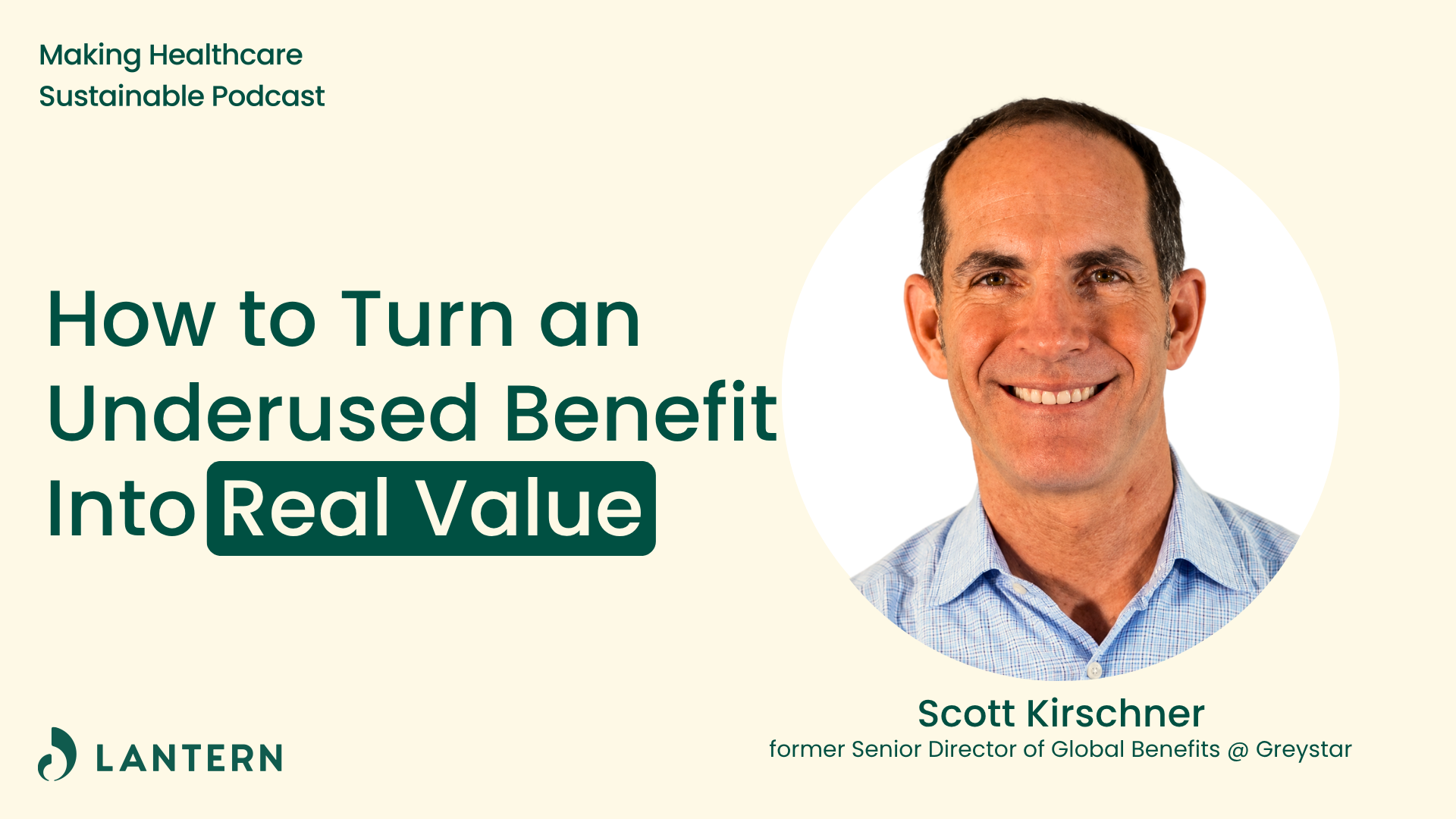
Scott Kirschner, former Senior Director of Global Benefits at Greystar, shares how he increased engagement with Lantern, identified cancer care as a major cost and care opportunity, and shifted from traditional benefits administration to a more proactive strategy. He discusses data-driven decision-making, persistent employee communication, centers of excellence, and why better care and lower costs do not have to be competing goals.
In this episode, you’ll learn:
- How better communication and stronger incentives can turn an underused healthcare benefit into a program employees actually understand and use
- Why healthcare data can reveal high-cost opportunities, like cancer care, that traditional benefits reporting may fail to surface clearly
- What benefits leaders can do to move beyond traditional plan administration by using centers of excellence, targeted solutions, and persistent employee outreach
Highlights:
(00:00) How Greystar unlocked more value from an underused benefit
(03:00) The changes that drove a 250% to 300% utilization increase
(06:00) Why the benefits leader role has moved beyond administration
(09:50) The data that made cancer care impossible to ignore
(13:02) Why traditional health plans fall short on cancer navigation
(16:23) The overlooked role of behavioral health in cancer care
(21:33) Why benefits communication needs to shift from pull to push
(27:02) When making centers of excellence mandatory makes sense
(30:21) How Greystar saved about $15,400 per procedure
(35:02) Why modern benefits strategy starts with better data
(37:36) How to prioritize benefits based on impact, not anecdotes
Resources:
Nancy Ryerson’s LinkedIn: https://www.linkedin.com/in/nancyryerson/
Scott Kirschner’s LinkedIn: https://www.linkedin.com/in/scottkirschner/
Key Moments
Lantern Was in Place, But Nobody Knew About It
When Scott Kirschner, former Senior Director of Global Benefits at Greystar, joined the company in September 2023, Lantern had already been in place since 2019. His predecessor had held the role for more than 23 years and ran benefits with an administration-first approach. Kirschner spent his first weeks talking with the consultants and the Lantern account manager about how the program had been set up and what the experience looked like.
“It quickly became apparent that Lantern was operating with not just one hand tied behind its back, but both hands tied behind a back. And nobody knew about it, very low utilization and engagement, a hard restriction on any kind of marketing or communications or awareness, barely any incentives to use it,” Kirschner said.
Within his first 6 months, he removed those restrictions.
“We implemented a new direct marketing campaign. We had revamped some of our benefits communication materials, and we really started highlighting what Lantern could do for people. And then we further reinforced that deductibles and out-of-pocket co-insurance, we would pick up the cost to do that. And if you had to travel, we would pay for you and another person to travel to the place of care,” he said.
The response from members was immediate.
“We literally have people saying, ‘I never knew this existed. And how long has it been in place?’ And we saw 250, 300% increase in utilization year over year,” Kirschner said.
Push Communications Reached People Who Aren’t at a Desk
Greystar has roughly 27,000 to 28,000 US employees, about 80% of them in property management and about half hourly. Service technicians, maintenance staff and leasing professionals make up much of that group, and most of them aren’t on a computer during the day. When Kirschner arrived, the benefits guide ran 55 to 60 pages and lived on an intranet site members had to seek out.
“I think of communications as a push or a pull,” he said. “How do we push out communications to you where it’s convenient to you? And whether it was print and mail, documents to people’s homes, never happened before. Now we are doing a lot of it, to video testimonials, microsites.”
One message, sent once, isn’t enough for a benefit most people don’t know exists.
“You have to be persistent in your communications. You can’t just do it once and say, ‘Okay, we’re done.’ You have to have it where people hear the Lantern name and hopefully associate the program where they’ve heard it so much by the time they’re told, ‘Oh, you need a particular kind of surgery,’ they would think to call,” Kirschner said.
An economist by training, Kirschner builds every message around a single question.
“Put yourself in the shoes of your target audience and answer the question of what’s in it for me,” he said. “And those answers are financial. You won’t have that cost-sharing… these are vetted surgeons, surgical teams and facilities, and they have been chosen purely because of the quality of their care. And I think the third part of this is that this also will probably result in a better outcome for you.”
The Data Put Cancer at the Top of the List
Standard reporting from the plan administrator wasn’t going to surface where the real opportunities were, so Kirschner pushed Greystar’s brokers to build a data warehouse. Once he had it, one category stood out.
“One of the things that really jumped out to me was how much oncology was neoplasms as a diagnostic category was driving our trend and our costs. It was neck and neck with maternity for our top cost area. And it was very much the highest area of large losses,” he said.
He sat down with Lantern and gave direct feedback on where the cancer solution needed to improve.
“One thing I do give credit to your leadership for is they’re good listeners and they’re always thinking about how do we evolve this and move it forward. And in the span of about nine months from that initial meeting, there were notable improvements in the program to the point where we said, ‘Let’s put this in June of 2025,’” he said. “And it was really to hopefully get people better supported, reduce waste, improve care, and at the end of the day, have just a better treatment of that patient.”
The addition of behavioral health support was one of the improvements that mattered most to him.
“Having that ability to also be supportive of the mental health side is dramatically important because I think that as well in the health plan gets completely forgotten,” Kirschner said.
Expert Review Wherever Members Are
Part of what pushed Kirschner toward a dedicated cancer solution was how much of a member’s experience falls outside what a health plan is set up to do. In his experience, a plan’s role after a diagnosis is mostly to evaluate the treatment an oncologist proposes and handle pre-authorization.
That review, he said, runs on purchased medical guidelines. When a human reviewer is involved, it’s usually an oncology nurse, and a case has to be escalated before a physician weighs in. Second opinions tend to happen only when the member asks for one.
“You really have to escalate things to get it looked at by a physician,” Kirschner said.
That, he said, is why expert second opinion services have grown. It’s also where Lantern comes in: connecting members with specialists who focus on their specific type of cancer to review their records and treatment plan.
“There’s been a growth of second opinion services that will take your medical records and say, ‘I’m here in Boston, so we’re going to have the leading specialists at Dana-Farber take a look at this and express their opinion… this may be the expert in your particular type of cancer reviewing your medical records and suggesting treatment,’” he said.
Ongoing support from an Oncology Nurse Navigator also gives Greystar associates more time to ask questions and understand their treatment plan. Treating oncologists have limited capacity to walk patients through what’s ahead, and he thinks benefits leaders often underestimate that.
“They only have so much time to talk to you and help you as a patient. But a Lantern and the team there, they’re configured, they’re designed to listen and provide the time and attention that patient probably so greatly appreciates,” he said.
When members recognize that support is coming from their employer, he added, the goodwill carries over to how they feel about the company.
Going Mandatory Brought Some Noise, Then Savings
This year, Greystar made Lantern mandatory for certain procedures, starting with joint replacement and spinal fusion. Anyone who contacts the plan administrator about one of those surgeries is directed straight to Lantern.
“There are orthopedics who are really good at knees. They do a lot of knees. You don’t want them doing your hips or you don’t want them doing your spine. And Lantern knows who’s good at what and will direct them to the right place and the right surgeon to get it done at a much higher rate of positive outcomes than just navigating on your own,” he said.
Kirschner’s peers often ask about pushback. His answer is that it fades quickly, especially when the employer keeps the ability to grant exceptions.
“The transition period from voluntary to mandatory, you’re going to hear a little bit of noise in that first kind of three months, and then it really goes away,” he said. “But the vast majority of people, they’ll be glad that they won’t have any cost-sharing. They’ll be glad that they’re going to vetted surgeons.”
Once Greystar had a large enough sample, the comparison to the health plan was hard to argue with.
“We were saving almost $15,400 on average a procedure. You multiply that over the hundreds of procedures that we are doing in Lantern by the time I left, that’s serious money,” Kirschner said. “It is really hard to also say no to that when you know you’re leaving money on the table that could be directed to savings, especially in the current environment with trend the way it is.”
For benefits leaders weighing the same move, he sees a case for starting voluntary.
“I think sometimes starting voluntary can be good because you’re acclimating people to this new solution. And if you communicate it and market it well and incentivize it well, you might get a decent rate of utilization in the first year or so. But you may start to recognize those opportunities of requiring mandatory procedures,” he said.
Benefits Leaders Have More Tools Than the Health Plan
Kirschner spent 14 years in large-firm consulting and 6 in middle-market brokerage before moving in-house, and he has watched the benefits leader’s job change over that time.
“I think historically as a benefits leader, you were resigned to what can the health plan do? What can the PBM do? There were not a lot of other things you could do, but with this explosion of venture capital, looking at ways to leverage technology and ideas in different ways, that has given consultants and brokers and benefits leaders and their teams a much bigger arsenal of tools to deal with longstanding problems and growing problems,” he said.
With so many point solutions competing for attention, he sees COEs as one of the easier calls to make.
“One thing about the center of excellence kind of approach is it’s an easy return on investment to quantify. You generally going to pay less per procedure than you would through the health plan. That is easy versus some others are pretty nebulous. So this is an area that it’s almost like, why aren’t you doing this?” Kirschner said. “This arguably is one of the first things you should do if you have say 5,000 employees and you feel like you’re overwhelmed.”
His closing advice came back to where he started.
“Understand your data. Get beyond what your health plan can provide you. Really push brokers and consultants for access to data warehouses. Really drive into where the opportunities are and really understand what’s possible,” he said.
Listen to the full episode of Making Healthcare Sustainable to hear more from Scott Kirschner on rebuilding a benefits communication strategy from scratch and what benefits leaders should ask of their brokers.
Episode Transcript
Nancy Ryerson (00:03):
This is Making Healthcare Sustainable, brought to you by Lantern. When Scott Kirschner joined Greystar as Senior Director of Global Benefits, Lantern was already in place, but it wasn’t working as hard as it could. Today, Scott is breaking down what he saw, what he changed, and what happened when the data made cancer care impossible to ignore. Since launching with Lantern in 2019, Greystar has saved nearly $8 million, and a big part of that story is about a benefits leader who refused to leave a good program on the table. Scott, welcome.
Scott Kirschner (00:41):
Thank you, Nancy. Great to see you.
Nancy Ryerson (00:43):
You too. So getting into our little time machine for a moment, when you first joined Greystar and looked at Lantern, what did you see that made you think we’re not leveraging this to the extent that we can be?
Scott Kirschner (00:56):
I would begin with some background in that. I began in September of 2023, and I replaced a benefits leader who had been there 23 and a half of the 26 years that the company had been in existence up to that point in time. And I would describe my predecessor as a benefits traditionalist, very focused on administration and very change resistant, just keep things going. And he was actually forced to put in what at the time was Surgery Plus, and now has become Lantern, as a solution to try and address some of the cost concerns that existed. And when I began, I had a number of conversations with the consultants at the time about, okay, we have this. Tell me a little bit more about the program, how it got put in, what the experience is. And also early on got to know the account manager.
(01:58):
And it quickly became apparent that Lantern was operating with not just one hand tied behind its back, but both hands tied behind a back. And nobody knew about it, very low utilization and engagement, a hard restriction on any kind of marketing or communications or awareness, barely any incentives to use it. So early on, I mean, within my first six months, I took all of those restrictions off. And we actually changed account managers. One of the people at Lantern was somebody I had worked with in a prior position. And she’d said, “I know him. Let’s work together.” And so we implemented a new direct marketing campaign. We had revamped some of our benefits communication materials, and we really started highlighting what Lantern could do for people. And then we further reinforced that deductibles and out-of-pocket co-insurance, we would pick up the cost to do that. And if you had to travel, we would pay for you and another person to travel to the place of care.
(03:16):
So really started to raise awareness of that to the point where, I mean, we literally have people saying, “I never knew this existed. And how long has it been in place?” And we saw 250, 300% increase in utilization year over year.
Nancy Ryerson (03:36):
Wow. Yeah, that’s a huge jump.
Scott Kirschner (03:38):
Yeah, big jump.
Nancy Ryerson (03:39):
And going back to what he said about your predecessor that they were more of a traditionalist, what do you think from that traditional lens was sort of unappealing or even scary about a program like Lantern?
Scott Kirschner (03:51):
I think some of it really was that it was outside of the traditional health plan administrator. He even still had that old school mentality that, “Well, isn’t that the plan administrator’s job to direct people to centers of excellence or the best place of care?” And it’s just not the way health plans work, especially when you have the broad networks that most employers operate with when they are self-insured. And I think some of the issue also kind of got into not fully understanding the cost of that procedure at that particular facility under the existing plan administrator versus a lantern and how that direction of volume results in lower case costs too with generally better outcomes. And if you really start to get more of those procedures done in the vetted centers of excellence, you’re going to have lower overall costs both from that case rates, but also from better outcomes and postoperative care, there’s going to be less of it necessary.
(05:11):
And I don’t think it really went through his mind to look at it that way. And I think some of it frankly could have been, it wasn’t my idea. Somebody else forced me, so I’m going to do this begrudgingly. It’s like they we eat with a toddler. Yeah, mom, you’re going to make me eat my broccoli? Okay, I’m going to eat the smallest piece. I ate it.
Nancy Ryerson (05:36):
Yeah. So someone with a toddler that is very accurate. Who is the parent in this scenario? Was it the consultant suggested Graystar bring on Surgery Plus at the time?
Scott Kirschner (05:46):
It was, and they got the ear of some of the senior executives. And so I think once the senior executives say, “Yeah, we really think this is a good idea. Let’s do this.” He had to do it.
Nancy Ryerson (05:59):
Yeah, that’s really interesting. It’s also interesting to think about someone being at the same place for over 20 years. And we’ve been talking at Lantern just about how the role of the benefits leader has changed over that time, where maybe it used to just be kind of like, okay, just administer the benefits, don’t make any big changes. But that’s really changed, especially in the last few years.
Scott Kirschner (06:19):
A good story that’s related to that is I had been in the big firm consulting world for 14 years and in middle market brokerage for six. And a person who I had met at an earlier point in my career, he landed at an existing client of mine when I was middle market brokerage, this technology company as a vice president at comp and benefits. And we did some great work there. They got bought by Oracle. He kind of moved on. Well, he ended up as the VP of compensation and benefits at Iron Mountain. And he reached out to me and said, “Let’s get lunch.” So we did, and he said, “I’m going to hire you to head up benefits at Iron Mountain.” And I was like, “Well, I haven’t been in a corporate role.” Said, “Our healthcare costs are horrible. We can’t keep doing the same things.” And you’ve always brought a good approach to dealing with these health issues that are above and beyond what I hear from most consultants and brokers.
(07:22):
So it was at a time when point solutions and even the original centers of excellence concept were starting to come about. And I think historically as a benefits leader, you were resigned to what can the health plan do? What can the PBM do? There were not a lot of other things you could do, but with this explosion of venture capital, looking at ways to leverage technology and ideas in different ways, that has given consultants and brokers and benefits leaders and their teams a much bigger arsenal of tools to deal with longstanding problems and growing problems. Because if you just think about, we’ll get into cancer care, but even just surgical care that move away from inpatient to outpatient care and how health systems look at outpatient care as their primary profit driver. And there are times where that same procedure in an outpatient setting can be more expensive than an inpatient setting and letting the patient stay overnight in an inpatient facility.
(08:36):
That’s insane. But it is all of these tools. And I think for my predecessor, he had been in cruise control the latter part of his career. And he always had too small of a team. He just saw his role as just keep things rolling. Just don’t upset things too much. And that’s some of the challenge of thinking beyond what a plan administrator can do to say this is much. And I think the brokers, they’ve been in place so long and butted their heads up with, “Here’s an idea. Here’s an idea and been told no.” They just finally gave up. No, I’m going to stop asking. Back to raising kids. It’s like, you’ve been asking to go to Disney World for 10 years and I still said, no, we’re not going. And then the kid finally gives up.
Nancy Ryerson (09:31):
Might give up eventually. Yeah, no, I think that’s a good metaphor. Yeah. Well, that’s great that you took that step to get actual engagement with Lantern and yeah, 300% increases. That’s great. And then how long was it until you started looking into cancer or what did you first notice in cancer spend at Greystar?
Scott Kirschner (09:50):
I very firmly believe in data-driven decisions. And very early on, I asked the former brokers, because during my time there we changed to another firm because of the lack of support from them. But I was like, my expectation is you will build out a data warehouse for us. Because the standard reporting, even ad hoc reporting from the plan administrator, it’s like walking into a time machine back to 2001 and going, “Here’s your report.” But one of the things that really jumped out to me was how much oncology was neoplasms as a diagnostic category was driving our trend and our costs. It was neck and neck with maternity for our top cost area. And it was very much the highest area of large losses. And I think I tied back into that also this aspect of we really need to have better utilization of preventative care.
(10:54):
People were not getting enough preventive care. We are far below any kind of metric. But once somebody hears that cancer diagnosis, it is a daunting journey to navigate our healthcare and insurance system while dealing with that diagnosis. And whether you have a robust group of people supporting you or you’re doing it on your own. And honestly, none of the health plans are particularly good at helping people navigate cancer. All they do is evaluate suggested treatments from oncologists or radiologists or whoever, surgeons, and do pre-auth. That’s about it. Even what I would say is the early thoughts around the cancer care solutions still need to work. And I had a long meeting with some people from Lantern and I gave them honest feedback and said, “These are areas.” And one thing I do give credit to your leadership for is they’re good listeners and they’re always thinking about how do we evolve this and move it forward?
(12:07):
And in the span of about nine months from that initial meeting, there were notable improvements in the program to the point where we said, “Let’s put this in June of 2025.” And it was really to hopefully get people better supported, reduce waste, improve care, and at the end of the day, have just a better treatment of that patient and how they and their, call it their care team deal with this diagnosis. So it was this idea too that we don’t have to accept how people have done it in the past. Why continue to do that? Look at cancer care solutions as a way to address that triple aim of right care, right time, right place.
Nancy Ryerson (13:02):
Yeah, absolutely. And I’m curious, you said that the health plan traditionally reviewed maybe the treatment recommendations, but what’s the lens that they would review those? I know at Lantern we talk about having a clinician or a specialist oncologist reviewing for clinical appropriateness, but what is the lens for that health plan?
Scott Kirschner (13:20):
Yeah. And the helpline side, it’s simply medical guidelines that they’ve purchased. If there’s pushback from, let’s just say the oncologist, the treating oncologist, they may have a clinician look at it. But usually first view, if there’s going to be a human reviewer, it’s going to be an oncology nurse. It won’t even go to that physician level. And that’s the lens. I mean, you really have to escalate things to get it looked at by a physician and the treatment. And even second opinion, health plans don’t do second opinions unless you demand it and you say, “This is the surgeon I’m going to go to.” And that’s why there’s been a growth of even second opinion services that will take your medical records and say, “I’m here in Boston, so we’re going to have the leading specialists at Dana-Farber take a look at this and express their opinion versus we’re not here to necessarily fully second guess that the person treating you, this may be the expert in your particular type of cancer reviewing your medical records and suggesting treatment.”
Nancy Ryerson (14:30):
Yeah, exactly. And cancer research and treatments change so much. I mean, we hear from our partner Access Hope that unless you’re really looking into it every single day, you start to fall behind in the latest available treatments, especially for those more rare or complicated cancers.
Scott Kirschner (14:44):
And I think one other issue that we have in modern healthcare, especially in the US, is you get that diagnosis. And the first thing you do is you either Google it or you go to Claude or ChatGPT and say, “I have thoracic cancer. What do I do?” And it could send you down the worst rabbit hole ever. Stories are good. I had a former pretty senior person at Greystar whose wife had a recurrence of cancer she had had treated several years before. He started doing his own research, dangerous thing. And he said, “I think she needs mistletoe therapy and we don’t cover that.” And I was like, “What the heck is missiletoe therapy?” I may have used a stronger word, but I had to look this up and I went, “Oh, this is so out there.” It’s like literally putting mistletoe on your body and the healing powers
Nancy Ryerson (15:54):
Of
Scott Kirschner (15:55):
What cure the cancer. And no, no, no, go talk to a real expert. No, don’t believe some YouTuber you saw. Seeing that through it. And I think one other thing that I don’t want to forget is one other positive of Lantern’s cancer solution as it evolved was the addition of behavioral health. It’s one thing to deal with chronic conditions and deal with the mental health challenges of that, but it doesn’t have to necessarily be embedded as part of the care team. But you get that diagnosis and things can happen quickly, but rarely is it a quick treatment in your set. It is a long process. And having that ability to also be supportive of the mental health side is dramatically important because I think that as well in the health plan gets completely forgotten. It’s like, oh, we have mental health professionals and network, which one thing you may not know, the number one type of out-of-network claim in a self-insured plan is mental health because the mental health networks are so pitiful.
(17:16):
And so I think another part of that, supporting that patient in that part too can be incredibly valuable to that patient. So again, it’s like how do you support that person in their most dire time of need?
Nancy Ryerson (17:32):
I think that goes back to if you don’t feel listened to by your care team turning to ChatGPT, which will always validate you no matter what you say. So I think to your point, having that emotional support too is so important, as well as a real expert to ask your questions to.
Scott Kirschner (17:52):
And it’s interesting to see how sometimes decisions within employers get made because HR leaders, benefit leaders, leadership themselves go through their own personal experience and they start to question things. And I think you don’t necessarily reach that point where you do have to have somebody experience it themselves. But I think when it comes to cancer care and a solution like this where, to your point, a person feels heard, they have access to a diverse team of people whenever they need it and longer. And benefit leaders, HR leaders, leadership, they don’t get how oncologists and their teams are stretched thin. They only have so much time to talk to you and help you as a patient. But a lantern and the team there, they’re configured, they’re designed to listen and provide the time and attention that patient probably so greatly appreciates. If they get that it’s coming from the employer, their sense of appreciation gratitude too can be infinitely better than just being thrown to the traditional model of our health plan plays the claims, you go deal with everything yourself.
(19:24):
You’re on your own.
Nancy Ryerson (19:25):
It’s such a better employee experience too. And to your point, oh, this is feeling supported by your employer.
Scott Kirschner (19:33):
Yeah. Yeah.
Nancy Ryerson (19:34):
Taking a little bit of a step back, what is the population of Greystar? What kind of jobs do they do? Are they distributed?
Scott Kirschner (19:41):
Greystar is the largest property management and developer. So what’s called the vertically integrated real estate company in that they have an investment management arm that brings in investment capital. A lot of those people came from investment banks, hedge funds, private equity, things of that nature. So highly educated, highly compensated. There’s a development arm that identifies sites for new construction, new developments of apartments. And then there’s a construction group that operates as a general contractor and project manager. And then about 80% of the workforce is in property management. So Greystar manages about 4,000 properties across about 45 states and District of Columbia. There’s a merger happening in the industry that may make that new company larger, but it’s been for a long time the biggest. They also have a private student housing business and a small 55 plus community. So about half the workforce is hourly, and almost all of the hourly workforce is in property management.
(20:46):
And those are our service technics. So the repair teams, the maintenance staff, they may be janitors. A lot of the janitors are Greystar employees. And then leasing professionals may be hourly, a lot of them too. So a lot of long service people, they’ve greatly reward tenure. So another reason to think about things like cancer care, because the turnover is significant in the first year, but it isn’t so significant. And once somebody gets past that first year, it tends to be pretty low. About 27, 28,000 US employees.
Nancy Ryerson (21:26):
Yeah, that’s a diverse workforce. What are some of your approaches to reaching all those different people in so many different places and job functions?
Scott Kirschner (21:33):
I think the first issue is a lot of those people are not on computers during the day. I think of communications as a push or a pull. And he very much took the approach of, I want to pull people to an intranet site, a SharePoint site, and you have to go find stuff and read it and figure out what it means. And we’ll put together this benefits guide. And when I first started, that benefits guide was about 55, 60 pages.
Nancy Ryerson (22:07):
Oh
Scott Kirschner (22:07):
Wow.
Nancy Ryerson (22:08):
Oh, so digestible.
Scott Kirschner (22:09):
Going to read this. No one’s going to read this. So a lot of effort went into making that more streamlined, a lot more links, didn’t have very many links in it, and getting it more digestible and really starting to think a lot more about push communications. How do we push out communications to you where it’s convenient to you? And whether it was print and mail, documents to people’s homes, never happened before. Now we are doing a lot of it, to video testimonials, microsites. When I left, we were looking at getting a rich text messaging service to. We had virtually everybody’s cell phone number. And we were going to start pushing out text messages based on a lot of different factors, but really try to direct people and raise awareness of services that they existed. So communication is a huge challenge, but a great opportunity too.
(23:17):
One of the things that I’ve challenged my peers and consultants and even my team and myself to think about is too many times benefits people think that we operate in a vacuum. And the things that we do, whether it’s designing programs, thinking about how people use this program and how are we going to communicate it, we’re not going to think about what’s going on in the world at large. And we can learn so many lessons about how we interact with the world at large today and how are we truly leveraging technology to get messages out to people? How are we making it easier to understand? And how are we thinking about engagement measures and trying to put as an objective for us to improve engagement and utilization? Not just saying, “Oh, go find your own SharePoint anymore.” That doesn’t work anymore. We don’t operate like that in our everyday life.
Nancy Ryerson (24:29):
Yeah, that’s so true. I’m sure there was a time when that was kind of your only option for getting information, but now we’re so used to being able to get answers a lot easier than reading a 60-page document.
Scott Kirschner (24:40):
Yeah. Yeah. And people’s patience with finding the answer gets really low. Even my own team would ask me questions about our plans and I would say to them, “What does the SPD say?” Oh, I don’t know. I don’t have the time to look at it. And I’m like, “Here, let me show you how to find things quickly in the SPD and figure out what the answer to that is.” And I would say, “Don’t just cut and paste what it says in the SPD to the person asking the question. Put it in a way that they can understand that’s really simple. Put some thought into it.” Because I’d seen some of the answers where people are literally cutting and pasting two paragraphs from the SPD. I don’t know what this means.
Nancy Ryerson (25:29):
Yeah. So it’s generally not written in a catchy marketing, copywriting kind of way. I’m sure it’s very jargony.
Scott Kirschner (25:36):
It’s very jargony. You can tell lawyers had a hand in it. Yeah. No, don’t do that.
Nancy Ryerson (25:43):
Yeah. I think also for something like Lantern, if you need surgery, it’s not like you’re likely to know if something like Lantern exists where you would go to your benefits guide and say, “Oh, could I get this for free or at a reduced cost?” Because most people don’t know this kind of program even exists. So to proactively look for it would be pretty rare, I would think.
Scott Kirschner (26:01):
Yeah. I talk about persistency. You have to be persistent in your communications. You can’t just do it once and say, “Okay, we’re done.” You have to have it where people hear the Lantern name and hopefully associate the program where they’ve heard it so much by the time they’re told, “Oh, you need a particular kind of surgery,” they would think to call. And even beginning this year, we went mandatory for certain procedures because it didn’t make sense for people to navigate the system. I think particularly with joint replacement and spinal fusion, there are orthopedics who are really good at knees. They do a lot of knees. You don’t want them doing your hips or you don’t want them doing your spine. And Lantern knows who’s good at what and will direct them to the right place and the right surgeon to get it done at a much higher rate of positive outcomes than just navigating on your own.
(27:07):
So when anybody contacts the plan administrator for a surgical procedure, they’re directed immediately to Lanter. And I think there are a lot of procedures that should be mandatory through the Center of Excellence.
Nancy Ryerson (27:19):
And that’s that guidance to where you need to go instead of needing to find your own way.
Scott Kirschner (27:24):
Yeah. And when the patient’s told, “Oh, by the way, you won’t have to pay your deductible or your co-insurance. Greystar is going to cover it 100% when you go to Dr. Jones.” It’s a further incentive for the person to be happy working with Lantern.
Nancy Ryerson (27:46):
Yeah, definitely. If you were getting another benefits leader advice on mandatory, would you recommend having it voluntary first and then going mandatory? I’m just curious what your advice would be.
Scott Kirschner (27:55):
I think there’s a degree where it works well as a long-term strategy because you’re going into a COE partnership and you’re not going to just give it one year and go. I think sometimes starting voluntary can be good because you’re acclimating people to this new solution. And if you communicate it and market it well and incentivize it well, you might get a decent rate of utilization in the first year or so. But you may start to recognize those opportunities of requiring mandatory procedures. And I can tell you amongst my peers, the question has absolutely come up. And the biggest concern is noise. Is there going to be a lot of pushback? And I’ve said the transition period from voluntary to mandatory, you’re going to hear a little bit of noise in that first kind of three months, and then it really goes away. If you retain that ability to give exceptions, every now and then you’re going to have that squeaky wheel that, “Oh, I know this surgeon and he’s the greatest in the world at this and he’s not in Lantern.
(29:08):
How good can Lantern be?” We’ll give you an exception. And retaining that ability to do that even shows your flexibility as an employer. But the vast majority of people, they’ll be glad that they won’t have any cost-sharing. They’ll be glad that they’re going to vetted surgeons. And also they’ll be glad that maybe they’ll get in someplace that they thought, oh, I know this is the best place in Atlanta. I’ll use Boston, for example. There is a small hospital here, New England Baptist. All they do is orthopedic. And you can get orthopedic procedures from all the big health systems here. And Boston has world-class health systems. New England Baptist is Lantern’s partner here for orthopedics. So Sometimes when you try and get in there, they’re backlogged, but Lantern can get them ahead in the line and the queue. So even that ability is a positive outcome from that relationship that Lantern has developed with the notable orthopedic facility in New England.
Nancy Ryerson (30:21):
Yeah. So it sounds like the noise dies down once people start going through the system and seeing some of the benefits you’re describing.
Scott Kirschner (30:28):
Yes, absolutely. And I think we dived in pretty well once we had a good sample size of what would we have spent with the health plan administrator versus Lantern. And we were saving almost $15,400 on average a procedure. You multiply that over the hundreds of procedures that we are doing in Lantern by the time I left, that’s serious money. So it is really hard to also say no to that when you know you’re leaving money on the table that could be directed to savings, especially in the current environment with trend the way it is. It is the kind of thing of, look, you’re going to get your surgery. We’re going to pay the full cost of it, but you’re going to go where we tell you to go and we’re going to send you the best person within your city.
Nancy Ryerson (31:30):
Yeah. At the end of the day, all you really miss out on is the fun of finding your own provider, which I think we all know is definitely not fun. But people do like choice. I think there is that initial reaction of, don’t tell me what to do. Kind of what we were saying earlier about kids.
Scott Kirschner (31:44):
Yeah. I
Nancy Ryerson (31:44):
Think it’s natural.
Scott Kirschner (31:46):
I think there are certain aspects, even in adults, that we don’t let go of some of our childhood behaviors.
Nancy Ryerson (31:51):
Exactly. Yes. But once you get past that initial reaction in a program like Lantern, there’s a lot of benefit.
Scott Kirschner (31:58):
Yeah. It gets back to one of those things that we kind of communicated about a little bit, which is I’ve long taken the idea, I learned this a long time ago, of put yourself in the shoes of your target audience and answer the question of what’s in it for me. Because my background, I’m an economist, I took a lot in behavioral economics. I very much believe in concepts around behavioral economics and people will generally act in self-interest. So answer that question of what’s in it. And those answers are financial. You won’t have that cost-sharing quality in that these are vetted surgeons, surgical teams and facilities, and they have been chosen purely because of the quality of their care. And I think the third part of this is that this also will probably result in a better outcome for you. The likelihood of surgical complications is much lower when doing this.
(33:07):
People get nervous thinking about surgery and they get nervous getting treated for cancer. So these ideas around how this solution improves your odds for better health. So if you can communicate those three things to the patient, most of us would say, “That sounds great to me.” I’ve done global work for quite a while now, and our approach to particularly health insurance is it’s a mess. And most Americans find it incredibly frustrating and time-consuming and challenging. And even those aspects of working with a lantern makes it so much easier. Why do that to yourself? Why just say, no, I want that choice of going to this other surgeon because I’ve heard good things and yeah, I’ll pay the stuff and I’m going to deal with the health plan and I’m going to deal with their office and I’m going to deal with their billing department and I’m going to get stuff for the next 12 months from them.
(34:20):
Oh, the anesthesiologist is out of network by the way. And all of that, why put yourself through that if you don’t have to?
Nancy Ryerson (34:29):
Yeah, definitely. I think you were talking earlier about the awareness of the benefit and having to hear something multiple times. It is a new concept and just getting all of those elements to stick that, hey, there actually is a better way. You might not have ever experienced it, but there is a different way to go through the healthcare system. There
Scott Kirschner (34:48):
Is a different way. And especially if you’ve never had surgery before and it’s your first time looking at having that, having that partner in a corner can be really great, very helpful.
Nancy Ryerson (35:01):
Yeah, I think another theme I’ve picked up on is just that old school traditional approach versus where we are now. I’m curious from a benefits leader perspective, what do you think is the percentage of companies that still need to make that switch, leaders that still need to come into the new millennium in terms of their benefit strategy?
Scott Kirschner (35:22):
I think most of the large employer benefit leaders really see their approach as part of an ecosystem that the health plan is just one part of the equation and we need to look at solutions beyond that. I think another part of that is increasingly people have been getting better data and better understanding of their data and understanding where the opportunities are and getting better at identifying, taking a different approach to addressable problems. I think one thing is we’ve had saturation of point solutions and other kinds of solutions. And I think one thing about the center of excellence kind of approach is it’s an easy return on investment to quantify. You generally going to pay less per procedure than you would through the health plan. That is easy versus some others are pretty nebulous. So this is an area that it’s almost like, why aren’t you doing this?
(36:36):
It’s also the kind of thing that you can put in when you need to. You don’t have to draw it out so much. Although person who’s worked for me twice, has been looking at COEs, they draw everything out. They move like molasses going uphill in a winter snowstorm. And it’s just like, just do it. Just do it. You are looking for ways to improve efficiency, do it. I think a lot of the opportunities start to be more in the middle market where ideas start to trickle down to them. And smaller teams, they can only manage so much. This arguably is one of the first things you should do if you have say 5,000 employees and you feel like you’re overwhelmed. And it’s like, I can only do one or two things a year as a priority.
Nancy Ryerson (37:30):
Great advice. This has been a great conversation. Any other closing words of wisdom you’d like to share?
Scott Kirschner (37:36):
I really believe in data-driven decisions. Many companies make decisions based on the right person, talk to the right leader, and suddenly you’re doing something to respond to that. And I’ve seen very low utilized solutions because one person thought we need a fertility benefit. And it kind of took their eyes off of others. And there’s nothing wrong with fertility benefits. For people going through that, that could be absolutely the most important thing in the world. But if you are deprioritizing things that could benefit your overall plan to a greater degree and more people, your priorities are kind of skewed. So understand your data. Get beyond what your health plan can provide you. Really push brokers and consultants for access to data warehouses. Really drive into where the opportunities are and really understand what’s possible and work with organizations like Lantern to take a look at that, to really quantify, here’s how we might benefit you better than kind of the standard data packages that you get out of all of the TPAs and health plans.
Nancy Ryerson (38:53):
Yeah, starting with the data, that’s always great advice. With
Scott Kirschner (38:56):
The data, understand where the opportunities are. Definitely.
Nancy Ryerson (38:59):
Well, Scott, thanks so much for being on the show. Really appreciate you taking the time.
Scott Kirschner (39:03):
Oh, my pleasure. I love the steps. It’s great to chat.
Nancy Ryerson (39:08):
Thank you for listening to Making Healthcare Sustainable. If you want to learn more, be sure to check out our YouTube channel, Lantern Specialty Care, or check out our website where you can find additional resources.