
Episode Overview
You’ve probably tried explaining a new benefits program to friends or family members, and gotten the tell-tale blank stare. Healthcare isn’t always something people want to hear about. But when you need it, especially for something complex, all of a sudden, you need to be an expert in everything you have access to. And that’s no easy feat.
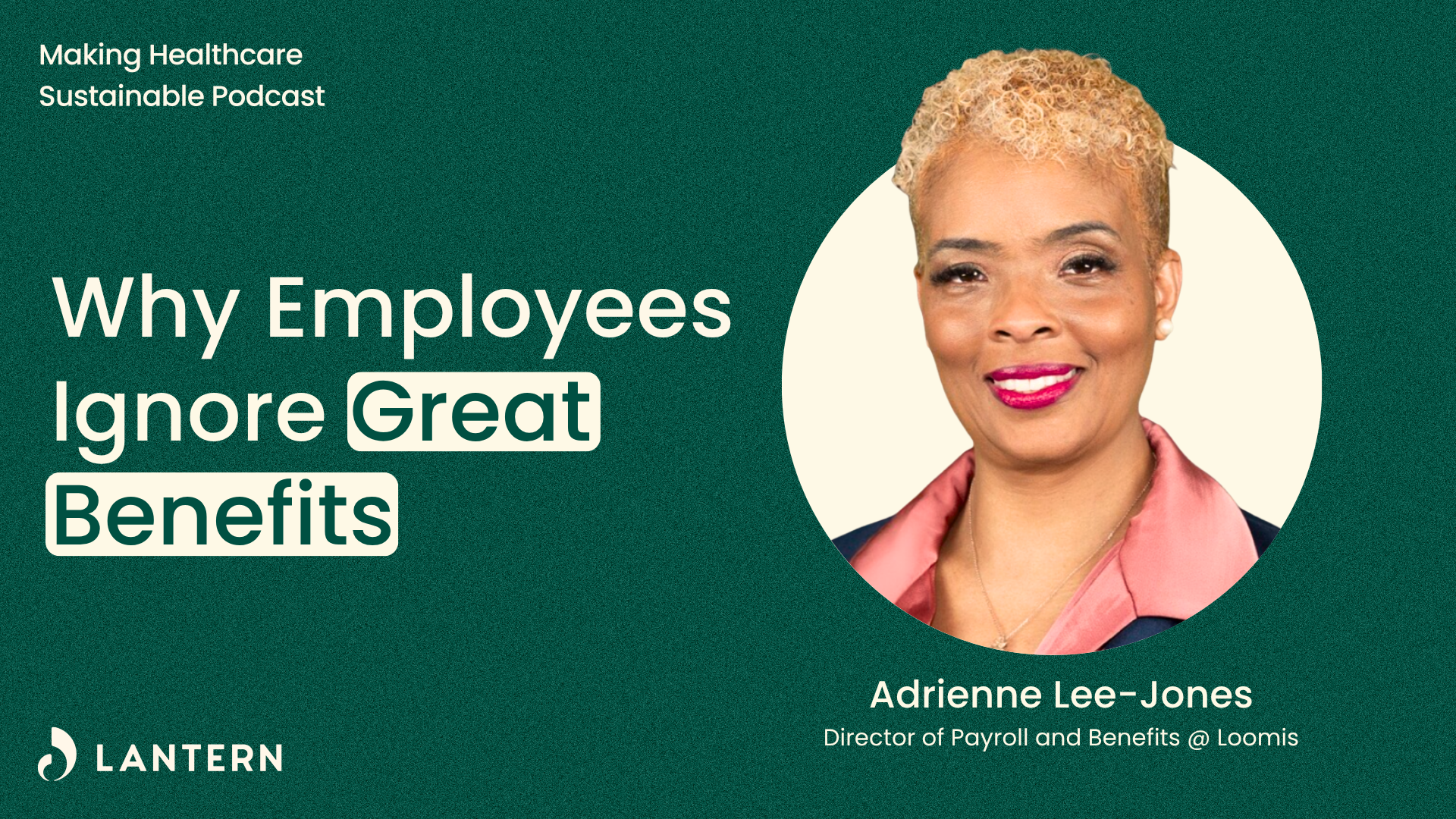
Adrienne Lee-Jones, Director of Payroll and Benefits at Loomis, talks about how her experience using Lantern has shaped how she describes it to employees. She shares what her surgeon showed her about what quality looks like in practice, how concierge-style healthcare support improves engagement, and the communication strategies she uses to help employees understand and use their benefits year-round.
In this episode, you’ll learn:
- How personal experience and concierge-style healthcare navigation can help employees feel more confident when making complex care decisions
- Strategies for explaining specialized benefits in simple, relatable terms that drive employee understanding and engagement
- Creative ways to build year-round benefits awareness through testimonials, wellness initiatives, and open enrollment communications
Highlights:
(0:00) Meet Adrienne Lee-Jones
(1:23) Adrienne’s Lantern surgery experience
(3:38) The value of compassionate care
(6:16) Why dedicated support matters
(7:07) Building a year-round benefits strategy
(8:49) Communicating cost savings and quality
(9:10) Turning employees into benefit champions
(10:00) Using testimonials to drive engagement
(16:56) Helping employees understand complex benefits
(19:05) Real examples that make benefits click
(24:49) Reaching employees beyond email
(26:26) The rewards and challenges of open enrollment
Resources:
Nancy Ryerson’s LinkedIn: https://www.linkedin.com/in/nancyryerson/
Adrienne Lee-Jones’s LinkedIn: http://linkedin.com/in/adrienne-lee-jones/
Loomis’s LinkedIn: https://www.loomis.com/en/
Episode Transcript
This has been generated by AI and optimized by a human.
Nancy Ryerson (00:03):
This is Making Healthcare Sustainable, brought to you by Lantern. It’s summer and you know what that means? Sunshine, relaxing by the pool and getting ready for open enrollment. That’s not exactly anyone’s dream vacation, but we’re hoping we can make it at least a little bit fun with the guests we’re inviting this summer leading up to go time in October. They’ll share their own OE strategies, creative ideas to try, what works and what doesn’t. Our goal is for you to head into OE season feeling inspired with a few new tricks up your sleeve. Today I’m joined by Adrian Lee Jones, Director of Payroll and Benefits at Loomis. She has an interesting perspective because she’s not only a benefits buyer but has also used specialty care benefits herself. I thought she’d be a great person to talk to about how to describe complex benefits in layperson’s terms from someone who’s used them herself.
(01:03):
Adrian, welcome so glad to have you.
Adrienne Lee-Jones (01:06):
Thanks. Happy to be here. Thank you for inviting me.
Nancy Ryerson (01:09):
Of course. So like I just said at the top, I know that you used Lantern yourself so I think that’ll be a really interesting point of view. Maybe we can start by just sharing a little bit about your experience with Lantern.
Adrienne Lee-Jones (01:23):
I actually had a great experience with Lantern and it was trimming behind having to have a corrective surgery from two prior surgeries that did not do what they were supposed to do. And so as you can imagine, I was a tad bit apprehensive because now we’re on third try and I appreciated the fact that I was going to get some white glove concierge service because it meant that I was changing my provider, which I needed to do anyway, but I was apprehensive about that because I wanted to make sure I was going somewhere that I was going to be well taken care of and they were truly going to address my need. So after given my three options and I chose the doctor that was in the zip code that was close to me in the area that I had provided, I was still nervous going in to the visit, but between everybody handholding me, handholding my process up to the visit and then when I met the doctor, it just kind of changed my entire experience.
(02:25):
It took away all apprehensive. I did not feel rushed. I felt heard. He understood my fears and my qualms about the fact that I was going to have to have this foot surgery for the third time. And he really listened to me and answered all of my questions and made sure that the path that we were taking was one that we both agreed upon, but I also fully understood what it was going to mean as far as the procedure and everything that was going to be required following it. So it was a very great experience where I didn’t feel like I was being shuffled through to get something done.
Nancy Ryerson (03:03):
How did it all go? Do you think hopefully this will be the last time you get this surgery?
Adrienne Lee-Jones (03:08):
Well, I think this is actually the great part of the sad story is that I ended up having surgery number four and it wasn’t really because of anything the doctor had done by my body. I had to have apparatus placed in my foot and my body simply did not accept it. And when he came in knowing that he was going to have to say, “I’m sorry Adrian, you’re going to have to have another surgery.” I was already visibly upset with the thought that that might be what he said. He walked through the door and the first thing he did was to hug me and I was so taken aback by that because it was so unexpected, but it was exactly what I needed. And then we talked through, “This is what we’re going to have to do. ” That was the last surgery and he made a commitment to me that no matter what, he was never going to go back into my foot again.
(03:57):
What he was doing was more old fashioned than new thing, but it’s done the tric. And even at the end, he made sure that I was good before he released me and said, “Okay, this is where we are and you should be good from here.” So I really, really appreciated everything that was a very, not only just physically exhausting period, but actually emotionally exhausting and the care that I received from my surgeon was just absolutely… And his entire staff actually was just absolutely fabulous.
Nancy Ryerson (04:30):
I love that they acknowledged and addressed the emotional side of the whole experience. I feel like you don’t always get that.
Adrienne Lee-Jones (04:36):
No. And especially for surgeon, right? They’re usually kind of just very, “Let’s get in there, get things done.” He was not like that at all, which I think speaks to part of what Lantern does when they’re choosing people to be in their network.
Nancy Ryerson (04:52):
Yeah, absolutely. Yeah. That pre-op process and really how you explain the whole experience to someone makes such a difference in making them feel comfortable and just ultimately having those better outcomes. So really it fits well with our communications theme today. So now that you’ve used Lantern yourself, I am curious, did you explain Lantern to any of your friends and family as you were getting ready for the procedure? Because I wonder if that is a good way to frame the benefit. I know sometimes when I explain where I work to people, I can see them getting a little confused. I’m curious how you presented the information when you were talking about it just casually.
Adrienne Lee-Jones (05:30):
Oh
Nancy Ryerson (05:30):
Yeah.
Adrienne Lee-Jones (05:31):
You say employee benefits and people’s eyes start to roll back in their head. They do, yes. What? I did. And of course by the time I got to my Lantern experience, my friends and family were also concerned for me because it was surgery number three. So they were just like, “Well, you’re picking a new provider. How are you making sure this is being done?” And so being able to explain that it wasn’t just me randomly going out there finding somebody, but that there was a process and this was a very specialized group of people and that everybody is not allowed into the Lantern Network and that the providers that are chosen to have to have a certain record of success and how they handle care and it wasn’t just about cost. It was also about the care and the outcomes and knowing that I said, “I have a dedicated person, so if I have any questions along the way, I don’t have to call and get random.
(06:22):
I get to call and talk to my person who supported me through the entire process.” And so when I explain that to not just them, but when I’ve also explained that to employees, it makes a difference knowing that you have a person. So just like people know that if they have a problem with their employees here at Loomis, they can call Adrian knowing that when I started my process with Lantern, I wasn’t going to be flipped around from person to person. That was probably one of the very resounding things that made people be like, “Oh, that’s really nice.”
Nancy Ryerson (06:51):
Healthcare can be so challenging to navigate. So the idea that you have a go – to person has really resonated.
Adrienne Lee-Jones (06:57):
Yes, absolutely.
Nancy Ryerson (06:59):
How would you describe your benefits strategy? What kind of messages or benefits typically resonate with your employees?
Adrienne Lee-Jones (07:06):
I actually have had the opportunity to create a different culture of communication since being here at Loomis. We weren’t really communicating other than during open enrollment and so it was kind of just there. There weren’t in between messaging. And then we’ve rolled out several new programs across the past few years. So making sure that during each open enrollment I was making prominent the things that were changing, the things that I wanted people to pay attention to and postcards that we mailed to people’s phones before open enrollment and then in our messaging that we had both in our enrollment guide and as we were doing employee presentations, that has been key. So if there wasn’t a lot of change spent as, not that we ignored it, but that’s not where we spent our time. We spent our time and our efforts pointing out, “This is a change we want you to pay attention to it.
(08:05):
” And so with Lantern, because you can choose Lantern or you can still use our main provider, it was very important that we help people understand the difference between the two. And so spent time doing that and worked with Lantern as well to make sure that they were helping us with the marketing that were hitting people individually so that they realized that there was this benefit out there that was not just cost efficient, but that white glove service was out there ready to help them if they should experience a need in any of the areas that are covered with Lantern.
Nancy Ryerson (08:38):
Have you found that it’s a challenging message at all the idea that it is lower cost but it’s also higher quality? I think so many people were just not used to those going together.
Adrienne Lee-Jones (08:49):
Right, because it sounds like you can’t do both. How can you pay les and get better? It’s actually true, you can pay less and get better. So that is kind of the confusing thing for most people. I think the other part is that you’re not just getting better from a medical perspective, but just that white glove service. Helping people understand the process has been really key. And when people get it, they become my champions. So I have had people that have gone through the Lantern process have been kind of, “I don’t know how this is going to work, but because it’s lower cost, I’m going to go ahead and give it a try.” And then they give it a try and wow, they become my champions because they are saying how great the experience is and how much they appreciate the service that comes to do that as well as the care that they get from whichever provider it is that they saw.
Nancy Ryerson (09:39):
We hear that a lot, that word of mouth is really like the most powerful communications channel.
Adrienne Lee-Jones (09:46):
Especially when it comes from somebody that’s not me, because that’s what I’m supposed to do. I’m supposed to tout. But the fact that I can say, “Hey, not only am I saying this because of my role, but I’m saying this because of my experience and here are some other people who can also speak to it, ” it makes a huge fabulous difference.
Nancy Ryerson (10:02):
And do you leverage those testimonials in your communications or does it just kind of spread naturally?
Adrienne Lee-Jones (10:10):
Both. It has spread naturally. Loomis is nationwide and we have people at branches. So we have found that somebody at the branch who has used Lander has told somebody else at the branch and that resonates because you’re right there with that person. But we actually took some snippets. We got permission to use some snippets of people and we made them anonymous, but we used their quotes to say, “This was my experience.” And we put it out there to help further market the benefits of using the Lantern benefit.
Nancy Ryerson (10:42):
Have you done that with other benefits too, or has Lantern kind of been the first opportunity?
Adrienne Lee-Jones (10:47):
I have. We have another benefit that we actually rolled out different product, obviously, but it was having to do with hypertension and blood pressure. And it’s another point of service that we offer the same year and we did the same thing. People who were raving over that, we used the testimonials. Those really resonate with employees because then it’s somebody who’s just telling their honest truth and not as they’re not paid advertisement. It’s not somebody like me once again who’s getting paid to do the job. It’s from somebody who has actually experienced something positive that makes people more interested in taking a peak to see what it’s all about.
Nancy Ryerson (11:27):
I’ve seen some of those member testimonials come through and people do say like, “Oh, clearly I’m not getting paid to do this. I’m not a super commercial.” Yeah. But I think you’re right that that really resonates like, “Oh, someone took time out of their day.” Because I’m sure a lot of the time will tell me, do you sometimes get complaints as well? So it must be nice to –
Adrienne Lee-Jones (11:49):
Of course. Hear
Nancy Ryerson (11:49):
Positive. Well,
Adrienne Lee-Jones (11:51):
Let’s be honest, I get more complaints than the things that are good. So it is nice to have the offsetting thing of somebody who is not saying this didn’t work the way I expected it to say, “Hey, this worked even better than I expected it to. ” So yes, it’s nice to have some of that balance.
Nancy Ryerson (12:10):
Yeah, love that. And as you’re getting ready for open enrollment, do you have a theme planned? Is there anything new or creative you’re trying this year?
Adrienne Lee-Jones (12:19):
So one of the things that we did do new this year is we have a new wellness program and it is a complete diversion from what has been done in the past. And so we have been having fun with it. We now have a new wellness theme that I’m trying to kind of integrate into everything that we do is that it is about your total wellbeing and that when you pay attention to your total wellbeing, your wellbeing in motion helps you live happier. So I’m weaving that concept into everything that we do.
Nancy Ryerson (12:57):
So it’s kind of a 360 health, like taking care of yourself kind of theme.
Adrienne Lee-Jones (13:01):
Correct. Financially, mentally, emotionally, physically, total 360. And of course, the wellbeing in motion is because Loomis our trucks move, so we’re emotion, so we’re just trying to tie the whole thing in together.
Nancy Ryerson (13:16):
Yes. Yeah, that’s clever. Have you done other themes that are related to Loomis, like other kind of car related or truck related giveaways or anything like that?
Adrienne Lee-Jones (13:27):
Well, that would be nice. I don’t have the kind of budget, but it is something to think about. I wish I did have that kind of budget because then that would be great. That would be great. But no, we try to keep that idea and everything even when we can’t give out prizes that are that way. So with our first giveaway, we basically just gave out gift cards and it was amazing. It was just to go into the new wellness program, complete a personal wellness assessment. It those questions about you, it’s nothing you had to think hard about. And we were able to use our budget to give out $5,100 gift cards across the company. And once again, those are the things that resonate because then everybody said, “Oh, look what I got.” And then the people are like, “You mean all I had to do was spend 10 minutes of my time?
(14:18):
That’s all you had to do. And you could have been in that raffle.”
Nancy Ryerson (14:21):
So
Adrienne Lee-Jones (14:22):
We are definitely trying to use our momentum of the people, the word getting helped. And our current wellness challenge we’re doing one per quarter is a team-based one. So it’s gathering groups of people to get excited
Nancy Ryerson (14:35):
About
Adrienne Lee-Jones (14:36):
That wellbeing emotion. So we’re trying different things, trying to catch our employees’ attention so that they’re paying attention to their benefits all year long and not just during open enrollment. And then open enrollment is, “Hey, what brand new thing are they going to share with us this year?” That’s kind of where I’m trying to go with all of that to get everybody 12 months involved in benefits and not just
Nancy Ryerson (15:00):
One. Yeah. No, that’s smart. So it sounds like you’re having a competition, group competition trying to drive engagement that way.
Adrienne Lee-Jones (15:08):
Yes, absolutely.
Nancy Ryerson (15:10):
Yeah, I’m sure that some people are getting pretty excited about that. We do a lot of competitions here too. And it’s funny how once your reputation is on the line, even if it’s the prize isn’t even that anything too crazy, people get very excited. It
Adrienne Lee-Jones (15:25):
Has been absolutely amazing and a little bit hilarious to me about how competitive people have been, because it’s simply just a move challenge. So the team that gathers the most points for moving across a period of time, you get 15 teams free lunch and the competition has gotten pretty steep.
Nancy Ryerson (15:42):
Wow. Yeah. I like that too, that kind of training people to, when they think about open enrollment, they’re going to see something new, but all the rest of the year they can keep up with all the resources that they have available. I know so many people really only maybe think about their benefits when it’s time for open enrollment, but something like Lantern, you don’t actually even have to enroll. You already have it.
Adrienne Lee-Jones (16:05):
It’s just there.
Nancy Ryerson (16:07):
Do you have any other advice for someone who is trying to communicate maybe something a little more complex? Like we were saying earlier when you were explaining you were going in for another surgery, “Oh, well, what is Lantern?” I haven’t heard of that. So what advice do you have for maybe breaking down some of these more complicated health benefits?
Adrienne Lee-Jones (16:26):
Part of my role is to always be the patient even when I’m not the patient, always be the participator in the program, even when I’m not the participator in the program. And so it is important to me that I’m always kind of speaking in layman’s terms and I’m bringing things into a very personable description of how things can be used. And I always think that the most effective way is to use actual examples and they don’t necessarily have to be a people, but just think about using it as a participant and how you would describe it as a participant so that you’re breaking it down to the user level and you’re taking away all the acronyms and you’re taking away all the big fancy words and just saying, “This is what this offers to you in very simple terms and provide examples and mechanisms where people can take their own time later to say, Oh, okay, now I see where that makes sense.
(17:22):
So just being very simple in language and providing examples I think just goes a long way and then just making it fun. Don’t make open enrollment a drudge that somebody’s like, oh, we got to do this again. It’s that time of year. It should be like, oh, what’s happening with open enrollment this year? So I think that the combination of those things are very helpful in engaging the employe population.
Nancy Ryerson (17:46):
Yeah. I really like the idea of open enrollment as something you look forward to instead of, oh no, I need to remember to do this. Yeah.
Adrienne Lee-Jones (17:53):
Right.
Nancy Ryerson (17:54):
Well, I’m wondering sharing examples of how Lantern works, I guess do you have an example of an example that you’ve put together that helped people say, “Oh, okay, now I get what this is for.
Adrienne Lee-Jones (18:04):
” Yeah, absolutely. It’s the thing that people don’t think about. So sometimes I use a colonoscopy because most people think about it from the, “Oh, I’m of that certain age, so it’s a required exam, so I have to get it. ” But they don’t think about the fact that now I might need this for diagnostic and they don’t think about a colonoscopy as a surgery. So they think Lantern, they think surgery and they think, no, it’s not that, but it is that. And so I’ve had people just amaze, “Oh, you mean that’s covered with them?” Absolutely covered with them. And I also talked to people about, well, before you think you need surgery, how about you talk to Lantern because maybe you don’t. And if you need one, then they can direct you to somebody who can help you with that, but maybe you don’t need it so you engage in the process anyway to see whether or not there’s an alternative that is not surgical because Lantern is also helpful in that area as well.
(19:03):
So I just routine, I make it clear if it’s emergent, please go. But if it can wait and you can pause, take the time and invest in yourself to do a litle bit of research and have some conversations and that I think also helps us using those words of investing in yourself, just take a little time. And I think people understand that that’s okay and that I personally feel like if you have a medical or healthcare provider who’s rushing you into somebody, that’s not the healthcare provider that I want. The healthcare provider that I want is somebody who is going to take the time and is going to allow me to take the time to make the right decision for me.
Nancy Ryerson (19:41):
And that’s such a big part of how we build our network is making sure our surgeons aren’t rushing into surgery, that they are considering is surgery even the right choice. And for certain procedures like a lot of orthopedic procedures, even up to 30% of the time they say, “Oh, actually you could do physical therapy or pain injections, less invasive path.” Were you the person who was evaluating solutions like Lantern? Did you choose that? Have you been with Lumas from the start there?
Adrienne Lee-Jones (20:10):
I am the person who is evaluating. It was actually brought to the table by our broker, but I will be honest and admit that I in my previous employment had Lantern. And so when it was brought to the table, I was like, “Hey, I agree we should do this personal experience.” I actually used it before with my former provider and had the same excellent service at that time. I was very excited to see, but I was with a different healthcare provider and so being with a different healthcare provider and knowing that Lantern was also a partner with them, it was kind of easy breezy when everybody looked at me and said, “Adrian, what do you think? ” I was like, “This is what we should be doing. We absolutely need to consider this. ”
Nancy Ryerson (20:54):
What were some of the challenges that the team was looking to solve? Why did the broker bring it to the table?
Adrienne Lee-Jones (20:59):
Cost alternative cost for what it takes to have procedures. So when they first brought it to the table, that was one of the things. And then for me, also understand when you understand your population and when people have certain things and you don’t know, having that white glove service is helpful because if I know if I have an orthopedic need and I already have an orthopedic surgeon in my back pocket, that’s one thing. But if it’s a new thing and then I have to choose from the list that’s like this long versus the list that’s this long and these physicians that are vetted at a very different level than the level that’s used by our healthcare provider as a whole, because that’s all that Lantern does. They’re not in a whole bunch of ponds, they’re in this pond. So it was a cost and a care consideration as well as understanding that a lot of our employees, when they’re in these situations, they do need the help of somebody that they can say will advocate for them and help them through the process
Nancy Ryerson (22:03):
Yeah, it’s so hard to know where to start. Maybe you go on your insurance website or you do a Google search, but yeah, you just don’t have the data really to know if they’re going to be good or not. Yeah. And tell me a little bit about Loomis employees. Are they truck drivers? Are they in offices or all across the board?
Adrienne Lee-Jones (22:23):
So we have a corporate office, obviously that’s where I sit. It is the smallest percentage of our population. Our branches are spread out across the United States of America and within our branches, obviously we have operations. So we do have administrative staff, operational staff that sit in the branch. A lot of our branches are truck drivers because they go out, they’re picking up the valuable, the cash, the valuables, and they’re bringing them to wherever place that needs to be. But then within our branches, we also have people that are tellers, kind of like a bank teller because you’re in our cash, you’re bringing it in, it has to be counted, has to be counted. And then we have a vault because we also store money. So we have the truck drivers that are actually going out to pick up the money. They bring it back in and then we have the staff that work in the branch at that level.
(23:11):
As you can imagine, things like this is not things that they pay a lot of attention to until they need it. So having information available when they call or when they need it, it’s going to be because it came to them, not because they were thinking about it in any type of proactive type of way. And as you experience with most people who really don’t think about their healthcare until they need it, they generally are going to need some help along the way in explaining their benefits because I have people that will call me in November to say, “Hey, who do we use for vision?” “Are you just now asking me this now?
Nancy Ryerson (23:50):
“I hope you can see too urgent.
Adrienne Lee-Jones (23:54):
They had it for 11 months and so now you’re asking who the vendor is. So I get a lot of that coming to me and my team to help supporting cooles.
Nancy Ryerson (24:03):
Yeah, I’m sure. So a program that also has that kind of navigation and they can answer specific questions is valuable. What have you had to be the best channels for reaching people if they’re maybe on the road or in all these different places?
Adrienne Lee-Jones (24:19):
Another new thing that I was able to roll out this year is we now actually have a benefits app. And so it has been the key thing that has helped us because as you can imagine, I mean, our people in the branches don’t sit at computers where they are accessing emails. They’re using the tools that they need to do the job and our truck drivers are not sitting at computers at all. And so I was looking for a mechanism that I could use to reach everybody that was not sitting in an administrative function like myself and sat at a computer all day because the emails were not it. And so we were able to develop a Lumis benefits app that’s actually available out on the Apple and the Google Play Store that people can download onto their phones and it has all of our benefits information at fingertips.
(25:08):
It has summaries. The benefit summaries are sitting in there. I have some of our vendors that are single sign on to it. And so for instance, if you were looking for options for medical care, you’re going to see our healthcare provider, but you’re also going to see Lantern with a summary of the benefits and their contact information in that app. So it’s right there at their fingertips. And I found that for our population to be very key. So I can do push notifications through that app,
Nancy Ryerson (25:35):
But
Adrienne Lee-Jones (25:35):
I also know that it doesn’t matter where the employee is sitting. They have our loomist information or enrollment guide, everything that they need that’s benefit related sitting right there in that app.
Nancy Ryerson (25:46):
Yeah. Like you said, they don’t have to go searching for it. It’s just right there on their phone. Yeah. Well, do you feel like you look forward to open enrollment season or is it a little stressful, kind of a mix? What do you think?
Adrienne Lee-Jones (25:59):
Being honest, it’s a bit of a mix. It’s stressful getting all of it together and where it needs to be and the perfectionist in me, the way that I would like for it to look and feel and after all the decisions are made, it is a lot of work. But then I get excited because I actually do enjoy the interaction. I enjoy educating employees and so that part of it, I look forward to it. Everything leading up to that, it can be a little tense sometimes, but at the end of the day, I’m generally very excited about the package that we’re able to present and then being able to share the information and interact with employees. I do enjoy that part of it.
Nancy Ryerson (26:35):
Well, and it sounds like you have great resources and information to share, so that’s great to hear. Anything else you wanted to add? I think this has been great.
Adrienne Lee-Jones (26:43):
I appreciate the opportunity to share today. I appreciate being able to partner. You guys have been a great partner, I hope that anything that I’ve shared has been helpful and I always enjoy networking and just like I’m sharing ideas, I like to share ideas. So this idea of the podcast is great to me. I think that’s great and I’m glad you guys are doing it.
Nancy Ryerson (27:05):
Yeah, we are too. Well, thanks so much, Adrian. Really appreciate you coming on the show.
Adrienne Lee-Jones (27:09):
Thank you, Nancy. This has been great.
Nancy Ryerson (27:14):
Thank you for listening to Making Healthcare Sustainable. If you want to learn more, be sure to check out our YouTube channel, Lantern Specialty Care, or check out our website where you can find additional resources.