
Episode Overview
What does it take to get employees genuinely interested in a benefit they may not understand or even believe is real? At a crowded benefits fair, a flyer is rarely enough.
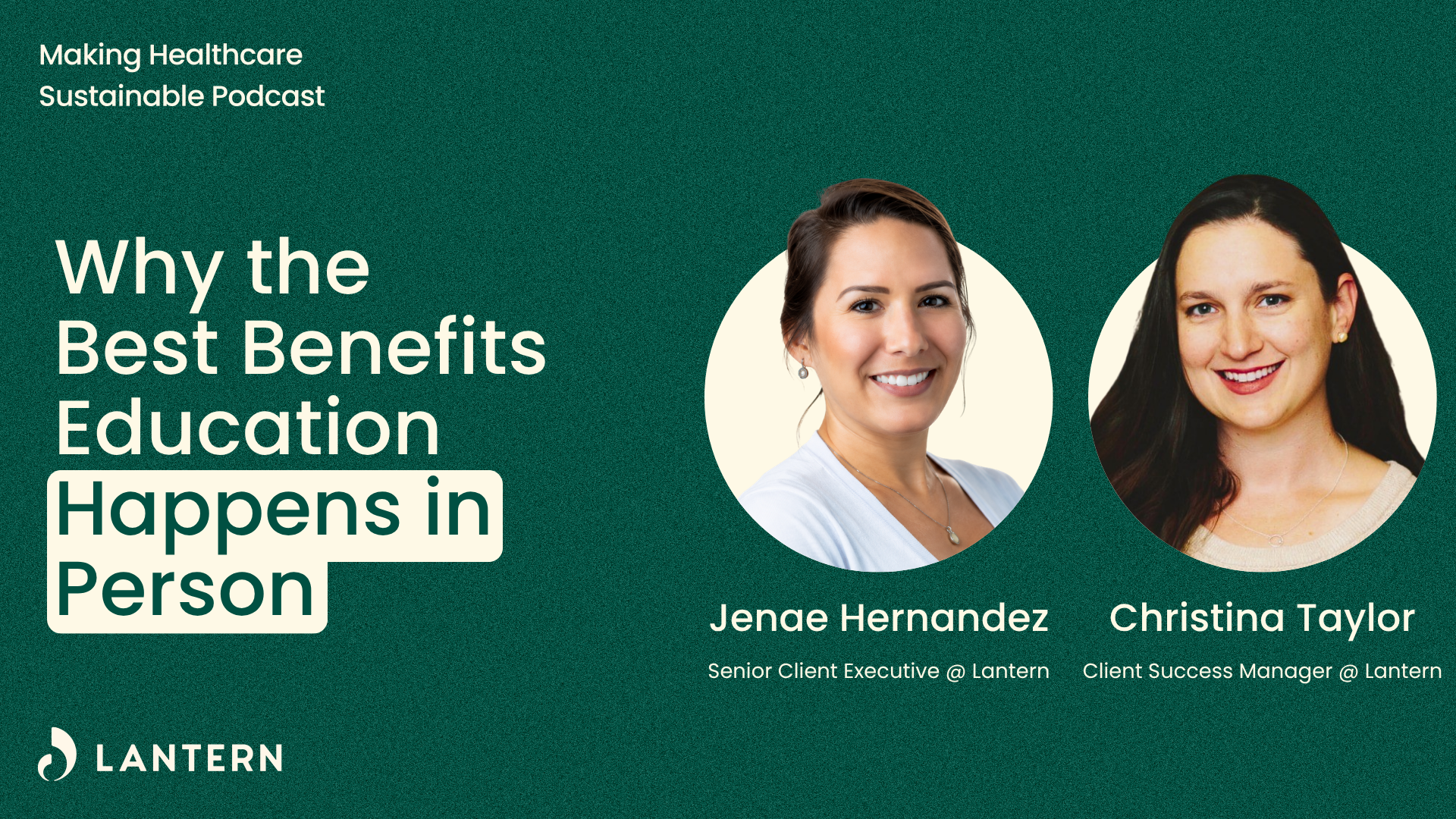
Jenae Hernandez, Senior Client Executive at Lantern, and Christina Taylor, Client Success Manager at Lantern, share what they have learned from attending benefits fairs across the country. They discuss common employee questions, creative ways to increase engagement, and why real member stories build trust.
In this episode, you’ll learn:
- How face-to-face conversations can overcome employee skepticism and make unfamiliar healthcare benefits easier to understand and trust
- Strategies for using games, giveaways, and proactive outreach to turn a benefits fair booth into a meaningful employee interaction
- Why tailoring the conversation to each employee’s health plan, personal needs, and stage of care can increase benefits awareness and utilization
Highlights:
(00:00) Meet Jenae Hernandez and Christina Taylor
(01:47) Why employees overlook benefits that sound too good
(02:22) The member stories that instantly build trust
(03:38) How direct conversations outperform repeated communications
(04:48) Explaining how free surgery actually works
(07:33) Why high-quality providers create long-term savings
(07:53) Candy, games, and the secret to booth engagement
(08:54) Why stepping out from behind the table matters
(11:01) How proactive outreach reached one family in need
(12:43) Making overlooked benefits feel relevant to employees
(15:40) How employers gamify the benefits fair experience
(21:29) Extending the benefits conversation beyond the booth
Resources:
Nancy Ryerson’s LinkedIn: https://www.linkedin.com/in/nancyryerson/
Jenae Hernandez’s LinkedIn: https://www.linkedin.com/in/hernandez-relationshipmgmt/
Christina Taylor’s LinkedIn: https://www.linkedin.com/in/taylor-christina/
Lantern’s LinkedIn: https://www.linkedin.com/company/lantern-specialty-care/about/
6 Lessons From a Season of Benefits Fairs
Between them, Lantern’s Jenae Hernandez and Christina Taylor have worked dozens of benefits fairs this year — Christina alone hit about 20 last year and has 20 or 30 more on the calendar for this one. We sat down with them on the *Making Healthcare Sustainable* podcast to find out what actually gets employees to stop, listen, and understand a benefit. Here’s what employers can borrow from their playbook.
1. Use nostalgia as a hook.
Both Jenae and Christina reach for the same prop: a classic Operation game. “A lot of us will bring an Operation game, the game that buzzes you if you pick the wrong knee bone or something out of the little guy,” Christina said. “And it’s just very nostalgic for adults to play that game.” Jenae uses it the same way to pull people in: “When’s the last time you’ve played this? Come, give it a shot. Let’s see what your hand looks like. Is it steady like a surgeon’s or is it messy like a benefit fair attendee?” As she put it, “That draws a crowd because there is typically, like Christina mentioned, it’s very nostalgic for adults to see the game.”
2. Face-to-face time is what makes a complicated benefit click.
Lantern is a benefit that can take some explaining. Free or low-cost surgery, that’s high quality? It’s not a combination people are used to hearing. “It requires a good five-minute, let me give you all the ins and the outs,” Jenae said. That’s exactly what a benefits fair gives you that a flyer can’t: “It’s complicated, which is why I do love these benefit fairs, because you can take the time to have conversations with people when you kind of trap them at the booth, because I do, we trap them.”
The question they hear most is some version of: how can this possibly be free? “Somebody’s got to be getting paid. What’s the catch? How do you make this work?” Jenae said. Her answer walks people through exactly how it works: “Here’s how we’ve built our network and here’s why we’ve become a certified TPA, so we can have autonomy and the controls and guardrails around the provider contracted pricing, we can pass those savings on to your employer. And as a thank you for using Lantern, they’ll pass the savings on to you.”
Christina breaks down the same story in plain terms: “Lantern builds our own network. We only contract with the very highest quality providers, so we know that you’re getting the best possible surgery the first time. That saves in costs down the line so that we’re not having to pay for a second surgery.” And on why it costs the member nothing: “our services, our surgeries are much lower cost for your employer. And in order to encourage you to come to Lantern, they are sharing that savings with you by not making you pay a copay or a deductible.”
3. Encourage vendors to move around the space instead of sitting and waiting.
Jenae doesn’t stand behind the booth. “I actually like to position myself more in front of the table, kind of catty-corner from one angled side of the table or another so that I feel as though I’m more approachable.” Her advice to anyone working a table: “definitely be comfortable being uncomfortable, meaning don’t feel like you’ve got to just stand behind the table and wait for people to come up to you.”
Christina put it even more directly, and told a story to prove it. At a manufacturing facility’s biometric screening event, employees sat down and largely ignored the vendor tables — so she brought the flyers to them instead. “It’s really important to not just let folks come to you because a lot of employees see us as sort of salespeople… it’s important to go to them if you can.” One man she talked to teared up when he realized his benefit meant his wife could finally get the double knee replacement they hadn’t been able to afford: “he was so excited that he was going to be able to go home and tell her that she can get her knee replacements.”
4. A bingo card gets people to every booth.
“The go-to that I love the most is the bingo cards or some sort of raffle card,” Christina said. “So they have all of the vendors listed, and that really encourages employees to hit all of the vendor tables… they will turn that into their employer and they are entered into a raffle prize.”
5. The best activations come from local partners—and help you save, too.
Some of the most memorable moments Jenae and Christina described didn’t cost the employer much at all. One vendor set up a wine ring-toss: “You toss the ring and if you get it on the bottle of wine, you keep the bottle of wine. And that was a huge hit. There was just a crowd there all day.” At another event, a local aesthetics business gave out free facials in exchange for handing out their own cards — “that was essentially free to the employer.” A massage chair with a 10-minute shoulder massage drew a line all day and, Jenae noted, gave her a new pitch: “did you know that there are also these really great benefits available to you offered through your employer after your massage?”
6. Personal stories do more than any handout.
Nothing converts skeptics like hearing from a coworker who’s actually used the benefit. Jenae described a member who “calls herself the bionic woman sponsored by Lantern just because of any surgery that she’s ever held off in her life,” and who shows up at every fair ready to tell her story. As Christina put it, “The employer can send out tons of communications, but there’s never going to be a better way for folks to understand the benefit without having that direct conversation so they can ask questions and get those answers.”
The bottom line: if your organization stopped doing benefits fairs after COVID, Christina’s advice is to bring them back. “There’s just no better way to get in front of their employees and make sure that they know about their benefit.”
Transcript
Nancy Ryerson (00:03):
This is Making Healthcare Sustainable, brought to you by Lantern. Benefits fairs. You’ve probably either hosted one or walked through one, booths, brochures, and the challenge of getting people to stop and engage. Today, I’m talking with two members of the Lantern team who’ve spent a lot of time on the ground at these events this year. Jenae Hernandez is a Senior Client Executive at Lantern, and Christina Taylor is a Client Success Manager. Between them, they’ve been to dozens of benefits fairs across the country, and they’ve seen a lot. We’ll discuss moments that surprised them, the questions employees ask, and what it takes to help someone truly understand a benefit like Lantern in the middle of a crowded gymnasium. Jenae and Christina, welcome.
Jenae Hernandez (00:53):
Thanks, Nancy.
Christina Taylor (00:54):
Thanks so much.
Jenae Hernandez (00:55):
Our favorite topic.
Nancy Ryerson (00:57):
Yes. So I have to ask, how many of these fairs did you two go to this year?
Jenae Hernandez (01:02):
Oh, Christina’s got to go first. It’s much more impressive from her perspective.
Christina Taylor (01:06):
Yeah, I go to as many as I possibly can. I find a lot of value in them, and so I’ve probably done 20 last year, and I have probably 20 or 30 planned this year. Wow.
Jenae Hernandez (01:19):
Wow. Christina’s our road warrior. I always ask her how her delta points and miles are stacking up.
Christina Taylor (01:25):
Pretty good.
Nancy Ryerson (01:27):
I bet. You’re in the lounge for sure after all that. Well, that’s great though. What a great perspective on, you’ve seen so many. So when you’re at the booth, what kind of feedback do you get about Lantern? I’m sure probably a lot of people aren’t sure what it is. So what are some of the trends that you’ve seen?
Jenae Hernandez (01:46):
When we join benefits fairs for clients who’ve partnered with Lantern for several years or so, it’s really exciting because you get a little bit of a different experience where employees run to the booth because they want to tell their story. I used Lantern and this is how it changed my life. I typically will try to ask them to hold their story until I can get a little crowd gathered and say, okay, tell them. Gives me a break, saves my voice because it’s not just a handout a flyer and like, “Here’s some information on Lantern. Thanks for stopping by.” Get really passionate and want to tell the entire story. And if anybody’s ever tried to describe Lantern, it’s not a story you can tell in 30 seconds. I mean, it requires a good five-minute, let me give you all the ins and the outs, and that’s when you start to see the surprise on people’s faces like, “Really?
(02:38):
This is crazy.” So it’s a really cool experience.
Nancy Ryerson (02:42):
Yeah, that’s so smart to wait until there’s a little crowd so you can take that break. But also I’m sure hearing from their colleagues is even more effective than hearing from Lantern.
Jenae Hernandez (02:52):
100% because they’re hearing from somebody who’s still used the program. It’s not like, okay, that all sounds great. Like Christina said, too good to be true. What’s the catch? Those are a lot of questions that we get too. And so it’s really easy to say, well, I’ve got an answer for what the catch is. But when they’re hearing from one of their own who’s actually used it and say, no, really, I didn’t pay a dime for my surgery. I had the best surgeon, the best experience. They walked me through the entire process. And I’ve got a woman who every time I go to a benefit fair for this specific client, she calls herself the bionic woman sponsored by Lantern just because of any surgery that she’s ever held off in her life. She’s like, going to Lantern, I’ll call Lantern. They’ve put me back together piece by piece, and she’s always there to tell her story.
Nancy Ryerson (03:38):
That’s amazing. Well, in addition to members sharing their experiences, what do you feel like does help people start to understand what Lantern actually is?
Christina Taylor (03:49):
Having a second to really highlight the benefit to them because it’s very different from other types of surgery benefits that they have. It’s very different from their standard insurance. And so a lot of people understand it after we’ve had that 30 seconds and then it’s clear to them. We get a lot of what’s the catch? To Jenae’s point, we get a lot of, why is this free? We get that type of thing. And so yeah, it’s just having that time to really explain it to them. And then of course, to Jenae’s story there, having someone there that has used the benefit, that is able to say, this works, this is legit, is always super, super helpful. But yeah, I mean, we can send out what I said before, we can send out all the communications every month. The employer can send out tons of communications, but there’s never going to be a better way for folks to understand the benefit without having that direct conversation so they can ask questions and get those answers.
Jenae Hernandez (04:48):
The question I get a lot too, like Christina mentioned, is how can my surgery be free? Somebody’s got to be getting paid. What’s the catch? How do you make this work? And I love that Lantern gives us the autonomy to be able to explain exactly how we’re able to do that and be very upfront and transparent about that because when we’re able to answer that question, when we’re able to tell them, here’s how we’ve built our network and here’s why we’ve become a certified TPA so we can have autonomy and the controls and guardrails around the provider contracted pricing, we can pass those savings on to your employer. And as a thank you for using Lantern, they’ll pass the savings on to you. And so when they hear the story told from that perspective, they’re a lot more willing to, I’ll say, consider Lantern if they think they’ve got a surgery coming up.
(05:38):
So it’s kind of a really cool angle to take.
Nancy Ryerson (05:41):
How do you explain in layperson’s terms how we do have more affordable surgery and what a TPA even is? Because I think we all live in this system, but most people just really, it’s so complicated. Most people don’t really know the details.
Jenae Hernandez (05:58):
It is. It’s very complicated, which is why I do love these benefit fairs because you can take the time to have conversations with people when you kind of trap them at the booth, because I do, we trap them. I know both Christina and I have shared stories and we both find ways just to get them to stop and stay.
Christina Taylor (06:13):
I generally just explain the cost savings in that Lantern builds our own network. We only contract with the very highest quality providers so we know that you’re getting the best possible surgery the first time. That saves in costs down the line so that we’re not having to pay for a second surgery. Members often get that really quickly because they’ve always. Every person has heard of someone that has had multiple surgeries in the past. And my dad, for example, needs back surgery and he’s afraid to have a back surgery because he’s heard some really horrible stories about folks who had a back surgery and now need to have another. And so that story really resonates with folks. And so they understand that there’s a savings there. And then I just sort of explain that we contract with the providers, we pay them very, very quickly. That also resonates with the members because they understand that it takes a long time through traditional insurance to get payment sometimes.
(07:07):
And so that really makes them understand why there is a savings there. And then I like to highlight that the employer is allowing this cost savings for them. So I’ll say our services, our surgeries are much lower cost for your employer. And in order to encourage you to come to Lantern, they are sharing that savings with you by not making you pay a copay or a deductible. And so that’s generally the quick 30-second pitch on how it’s free or low cost for them.
Nancy Ryerson (07:32):
Yeah, I really like how you two ground them in something they probably already are familiar with in the healthcare system, that unfortunately people often do need multiple surgeries if you’re not going to the best and just understanding the basics of their insurance plan. That’s smart. And what are your special techniques for getting people to stand there and listen to these stories?
Christina Taylor (07:54):
I really like to have fun during a health fair and make it not as monotonous as just going and picking up a flyer and going about your day. I always have candy at the booth. We can have hundreds of dollars worth of swag and prizes, but candy is the number one encourager for someone to come to the booth. And so always candy. And then a lot of us will bring a operation game, the game that buzzes you if you pick the wrong knee bone or something out of the little guy. And so a lot of us have those. And it’s just very nostalgic for adults to play that game. So if I have swag, I’ll say, “Hey, if you want to play my game, I’ll give you a chapstick or whatever the swag is.” And that’s really fun and it encourages more people to come over.
(08:38):
They call their friends, “Hey, come play this game.” And that while they’re playing, that gives me a couple of seconds to really highlight, “Hey, do you know that you get free surgeries through your benefits here or you get really low cost surgery?” And that is a really good way to get them engaged.
Jenae Hernandez (08:54):
That’s a really good one. I love Christina comes up with all really great ideas. I have two different approaches here. One is for your standard benefit fair where there are vendors in a room and you’re standing behind a table. I actually like to position myself more in front of the table, kind of catty-corner from one angled side of the table or another so that I feel as though I’m more approachable. I’m more out front. I can catch people as they’re walking by. Sometimes I’ll hold the operation game in my hand and say, “When’s the last time you’ve played this? Come, give it a shot. Let’s see what your hand looks like. Is it steady like a surgeon’s or is it messy like a benefit fair attendee?” Kind of get a laugh out of them. That draws a crowd because there is typically, like Christina mentioned, it’s very nostalgic for adults to see the game.
(09:47):
And so everybody will come to watch and that’s the great chance to take the opportunity to say surgery is kind of stressful, isn’t it? Did you know that your employer has made it more of a stress-free experience through Lantern? Let me explain how. The other approach is less of a traditional benefit fair setting where our employers will ask us to attend something like a diagnostic event where their employees have been invited to come do lab work and preventative care, and they just want us there as kind of a supportive vendor to answer questions. Typically, while people are waiting for their turn for the lab work is when I’ll walk up to the people who are waiting there, pass out the flyers, or I’ll bring the game and say, “Have you given this a try?” Let them ask their questions and take that chance to explain the benefit as well.
(10:40):
So it really depends on the setting and the approach that you can take. But I would say definitely be comfortable being uncomfortable, meaning don’t feel like you’ve got to just stand behind the table and wait for people to come up to you. Just be personable, have a smile, be welcoming, be warm. And it’s definitely more of a chance that people will be willing to stop and talk to you for a little longer.
Christina Taylor (11:01):
I’ll add to Jenae there just saying it’s really important to not just let folks come to you because a lot of employees see us as sort of salespeople. They think that we’re trying to sell them something, and so they don’t want to approach us. And so it’s important to go to them if you can. I have a story, the one that I will never forget from recent benefit fair season. I was at a manufacturing facility and they had a biometric screening event. All of the folks came in, they signed in and they sat down. They sort of ignored the vendor tables and they sat down at their waiting station for their biometric screening. And so I took some flyers and I went over and I said, “Hey guys, you know that you get free surgeries.” In this case, all of these employees received free surgeries.
(11:45):
They had no high deductible health plan. And so I said, “Do you know that you get free surgeries through your benefits here?” And of course that perked them up like, “What? What are you talking about?” And so I explained the benefit and one man in particular was really interested. And so we chatted a bit about the benefit. And then at the end, his eyes sort of got cloudy. He teared up a little bit. And he said, and this was an older gentleman, probably late 50s, early 60s. And he said his wife has been in pain for many years in need of a double knee replacement and they haven’t been able to afford it. And so he was so excited that he was going to be able to go home and tell her that she can get her knee replacements. And that Jenae and I, we have lots of stories like that, but that one in particular, when you almost make a grown man cry, that one really sticks with you.
(12:34):
So yeah, it’s important to go out and make sure these folks know about the benefit and not just wait for them to come to you because a lot of times you’ll miss those type of people.
Nancy Ryerson (12:43):
Yeah, I love that. And it’s funny you say that because I just had that thought too. I don’t know if you guys have ever sold things at a craft fair or I was a Girl Scout, I sold Girl Scout cookies. And you can just tell people walk quickly like, oh, they’re trying to sell me something. Let me get past this. But we’re really not. It’s actually like, “Hey, come back. It’s free.” So that’s great. That’s really smart that you go to them so that they are brought in to hear more about Lantern.
Jenae Hernandez (13:09):
Yeah, for sure. Because in many cases, there are a lot of vendor tables there and there’s so much that the employers, so our contacts have to educate their employees on. And typically if it’s not relevant to you at the time, you’ll ignore it. And surgery being more episodic, likely one time per lifetime for many people, it’s something they just kind of put to the back of their mind. They don’t really give it a thought. So you really have to make sure that you say, “Here’s what our benefit can do.” It’s not just for complex procedure types because things that have become very popular, employees have started asking a lot like, “Do you cover colonoscopies?” “Yeah, we do. So let me tell you about that. “People get so excited because the way that the healthcare landscape is evolving, I think there’s more of a desire for people to want to leverage that kind of preventative care.
(14:09):
And if that includes things like colonoscopies and we say, yeah, we can help you cover this. Because a lot of times people will skip their colonoscopies, which in many people’s eyes is just a minor procedure, nothing really to think about, but they get stuck with that diagnostic colonoscopy unaware, unbeknownst to them, and that’s suddenly going to become a couple thousand dollars out of their pocket. But when we can talk to them about, no, we’ll cover it regardless of whether it’s preventative or diagnostic, that kind of perks their ears a little bit and they’re willing to say, okay, well, I’m going to give Lantern a call today. So it’s really taking the time to think through not just, here’s Lantern and what you need to know about us, but tell me more about your situation and active listening to find out where employees might be in their own journey so that you can use that hook and really say, well, hey, I’ve got answers for you too.
Christina Taylor (15:04):
And I think it’s also really important to know your audience. So the colonoscopy example is great. What we also use a lot is the tonsil surgery, that type of thing. If I’m going to a benefit fair for a school system, for example, and I know there’s going to be a lot of young moms there and a lot of their employees are going to have kids, then I want to really make sure to highlight those types of things because a lot of people don’t think about that with our benefit. They think of large complex surgeries. They don’t think about the general surgeries that Lantern can really be impactful on as well.
Nancy Ryerson (15:40):
Yeah, that’s a great example too. Well, on the employer side, I’m curious if you have seen the client do anything creative even to get people in the door in the gymnasium to begin with. Sounds like candy’s a big draw. Anything else you’ve seen that you would recommend others try?
Christina Taylor (15:56):
There’s been a lot of creative ones. The go-to that I love the most is the bingo cards or some sort of raffle card. So they have all of the vendors listed, and that really encourages employees to hit all of the vendor tables. And we will generally have a stamp or we sign our initials as a vendor to say that, yes, this person did attend our table. And then at the end, once they’re done, they will turn that into their employer and they are entered into a raffle prize. Typically, we will bring a raffle prize, something really nice. And so that encourages folks to make sure to hit all of the tables. So that’s the primary one. But there was one really large benefit fair where they had an actual bingo situation where they had huge raffle prizes at the front. Any free thing that we can provide to employees, and it doesn’t have to be an expensive thing, even little tchotchkes.
(16:48):
People just like free things. And so yeah, anything we can do in that way to encourage. I did also see there’s a lot of gamification. One particular event, a vendor booth, not the employer, but the vendor booth had wine, which you don’t typically see at a vendor event. And their game was that it was like ring toss. You toss the ring and if you get it on the bottle of wine, you keep the bottle of wine. And that was a huge hit. There was just a crowd there all day.
Nancy Ryerson (17:19):
Yeah, that’s unexpected. I don’t
Christina Taylor (17:20):
Know.
Nancy Ryerson (17:21):
Yeah, that stands out. Jenae, what about you?
Jenae Hernandez (17:25):
Yeah, I’ve been seeing that the commercial benefit fairs have gotten very popular regardless of the client’s size. I mean, they can be smaller in volume in terms of employee count, 5,000 employees, or they can be 15, 20,000 employees or more. And I still see a really, really great turnout when it’s more of that kind of commercial benefit fair where they’ll have DJ, they’ll bring in local vendors like, “Hey, we’re giving out Froyo. We’ve got various representatives from our local gyms, local shoe apparel stores.” So it’s less come learn about your benefits available to you that we offer through your employer and more about full health and wellness. We’re giving out free workouts at these various gyms and you can come learn about how, I don’t know, your local shoe apparel store can fit shoes for your aching feet when you’re trying to work out. Just things like that.
(18:30):
So bringing in more creative vendors from the local area has been very popular. It works really well when you’ve got some sort of, like Christina mentioned, a game or something for people to get involved in because you’re talking about interrupting people’s workday usually towards the end of the day. So they need some excitement, they need just a perk of energy in their day. So anything that you can do to bring the energy to help get them excited about things, I think works really well. I would double down on Christina’s suggestion. Any sort of a bingo card that employers can implement that isn’t just, “Please come to our benefit fair and see how that works.” If you incentivize them by saying, “If you are able to get a stamp from either all of the vendors available or 75% of the vendors available, then you’ll be entered for a raffle.” Not to mention whenever each vendor is giving out works really, really well.
(19:31):
So for the employers that are listening, just try to get creative, whatever your budget allows, of course, but make it exciting. Benefits aren’t always super sexy, but if there’s a way that we can provide a different angle for employees to feel a little interested, like it’s really meant for them and not just a, “We want you to come see all the work that we’ve done for you, but have some fun too,” that tends to be really, really successful.
Christina Taylor (19:58):
Jenae, you reminded me of when you mentioned local community organizations coming in. There were actually two events that I attended at the end of last year. It was the same client actually, they just had a lot of events and they really did a great job at engaging things in the community. So at one of their benefit fairs, they had facials. So it was a local facility that did Botox and that type of thing. And they came in and gave everyone free facials and handed out their cards. And that was essentially free to the employer. It was sort of an advertising opportunity. And so that is a really great way. People loved it. And then at the second event they had, this did cost the employer a bit, but they had a massage chair and they had a person giving massages and there was a line for that.
(20:44):
People said they have that every year and they love it. It’s like a 10-minute shoulder massage, and it really went a long way. And that certainly encouraged more people to come in to talk to the other vendors while they waited.
Jenae Hernandez (20:57):
And that’s a really good opportunity too when there are vendors like that that generate a line for people to wake their turn. Leave your table with information, go up to the line and say, “Hey, while you’re waiting, because I’d love a massage too, but did you know that there are also these really great benefits available to you offered through your employer after your massage? If you’re still in pain and you need to look at options for an orthopedic surgeon, make Lantern your first call, hand them out the flyer, let them play the game. I mean, you don’t have to stay tied to your table. You can go to the people wherever that is. That’s what I would recommend.
Nancy Ryerson (21:36):
Yeah, that’s smart. Yeah. While they’re trying to win that wine, they can try out the game too.
Jenae Hernandez (21:43):
Do a cheers with them real quick.
Nancy Ryerson (21:44):
Exactly. Yeah. End of the day. That’s great. And I think those are smart ideas too for opportunities employers have to have this kind of co-branding or advertising opportunity with local businesses and then they don’t have to pay. I would think you can definitely measure a return on investment too. I mean, thinking of something like Lantern, the more people know about it, ultimately you can reduce your own costs. So it’s great to hear that a lot of employers are putting a little investment behind these events to make them fun so people will come and actually and learn about their benefits. And to your point, you might not need it tomorrow, but I would think these experiences would help it really settle into your memory if there is this memorable moment to go with it.
Jenae Hernandez (22:29):
Yeah. And I would say one more thought for any employers who might be listening. Another thing that I do for these kind of commercial fairs when they’re inviting local businesses, organizations, whether they’re gyms, massage therapists, physical therapists, things of that nature, I’ll go up to those tables and I’ll talk to their representatives and ask them, “How often do you see X client’s employees on a regular basis?” And so if their response really is, “Yeah, they’re in my office all the time,” I ask them, “Can I leave you some flyers?” Because if it’s something like a gym or physical therapy where they might hear stories from employees who say, “I’ve just been in pain and I’m not really sure. Really hope I don’t need surgery.” If surgery ever becomes a trigger word, “If you can help me advocate for Lantern, because here’s what we do, this flyer has all the information on it,” that’s just spreading the word through opportunities that the employer has generated without them having to lift a finger.
(23:27):
So another really great chance for us to just broaden that awareness horizon, if you will, and have more people working for the benefits that they’re providing.
Nancy Ryerson (23:37):
Yeah, that’s so smart. Well, thanks so much for joining me. Anything else you wanted to share?
Christina Taylor (23:43):
No, it’s been great to chat about it. Again, I love the benefit fairs. I love my job in general, but by far the most rewarding part of it are the benefit fairs because I get to actually potentially make an impact on someone’s life by making sure that they’re aware that they have this amazing benefit that they don’t know about. And so I certainly encourage after COVID, I hear a lot of employers say that after COVID they stop doing benefit fairs and that type of thing. So I would definitely encourage any employer that’s considering a benefit fair to do them because there’s just no better way to get in front of their employees and make sure that they know about their benefit.
Jenae Hernandez (24:20):
Yeah, agree.
Nancy Ryerson (24:21):
Amazing. Well, thanks so much for coming on the show and enjoy next time you’re out on the road. Excited to hear what else you see.
Christina Taylor (24:28):
Thanks so much.
Jenae Hernandez (24:28):
Thanks, Nancy.
Nancy Ryerson (24:33):
Thank you for listening to Making Healthcare Sustainable. If you want to learn more, be sure to check out our YouTube channel, Lantern Specialty Care, or check out our website where you can find additional resources.