Episode Overview
Data and AI are transforming how we deliver healthcare, making it smarter, more affordable, and personalized for every employee.
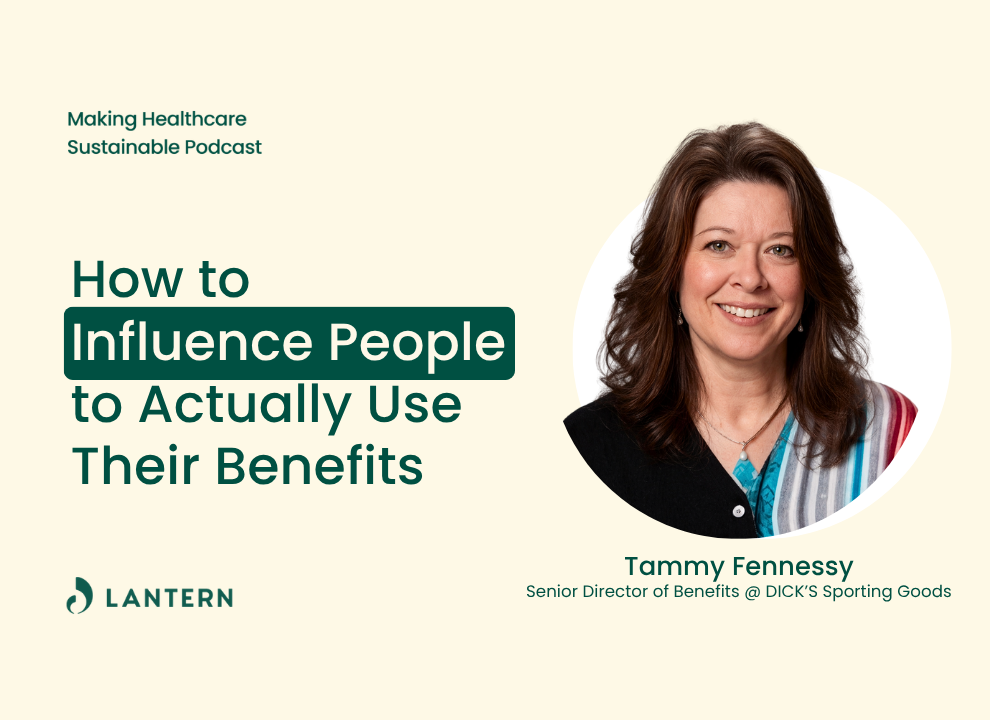
In this episode of Making Healthcare Sustainable, host Nancy Ryerson chats with Tammy Fennessy, Senior Director of Benefits at DICK’S Sporting Goods. They talked about how data, behavioral economics, and a sharper focus on specialty care are changing healthcare benefits and how people access them and ultimately use them. Tammy shares how DICK’S has successfully reduced costs while improving employee health outcomes, focusing on the power of personalized, data-driven communication strategies.
In this episode, you’ll learn:
- How data and behavioral economics shape benefits strategy
- How preventive care and better specialty care can both lower costs
- How AI and personalization drive employee engagement with benefits
Highlights:
(00:00) Meet Tammy Fennessy
(02:48) Applying behavioral economics to drive meaningful change in benefits
(04:43) From the restaurant industry to benefits management (Tammy’s career path)
(09:55) Challenges at DICK’S Sporting Goods and the importance of analyzing data
(12:46) Utilizing data analytics and AI to improve health outcomes
(22:13) Using personal employee stories to drive benefits awareness
(26:05) Why preventive care is a top priority for DICK’S Sporting Goods
(29:12) Integrating AI into benefits communication to enhance personalization
(35:52) Interoperability and collaboration with vendors in the healthcare system
(38:19) Tammy’s prediction for the future of universal healthcare
Resources:
Nancy Ryerson’s LinkedIn: https://www.linkedin.com/in/nancyryerson/
Tammy Fennessy’s LinkedIn: https://www.linkedin.com/in/tammy-fennessy-healthequity4all/
DICK’S Sporting Goods LinkedIn: https://www.linkedin.com/company/dick’s-sporting-goods/
Episode Highlights
How Behavioral Economics Can Transform Employee Benefits
What makes people actually use their benefits? Tammy Fennessy explains how behavioral economics, claims data, and thoughtful nudges can help benefits leaders create a more personal experience, drive lasting behavior change, and improve outcomes
“A lot of my time and my history has been spent really trying to understand population health management, behavioral economics, how you can really move the needle to try to get people to change their behaviors and actually want to do it, not have to do it because they’re being forced to, so that you can have lasting behavioral change.”
How Modern Healthcare is Reinventing the HMO Philosophy
Healthcare benefits may be evolving, but some familiar ideas are coming back in a new form. Tammy Fennessy shares why older care models are resurfacing, how quality is getting renewed attention, and what that shift could mean for benefits leaders on this episode of Making Healthcare Sustainable.
“I’m finding right now it seems like everything’s coming full circle. Many of us whisper like, ‘Okay, we’re back to HMOs or whatever because it’s like common philosophies are coming back up, but I think they’re doing it in a way that is being reinvented.’ And I think more so with, again, the lens I think around behavioral economics where people are trying to develop centers of excellence in a way that they can incentivize through plan designs where people are feeling, okay, if I don’t do this, I’m going to pay a lot more money and I am kind of being told that these are the best doctors and that I’m going to get a better experience. So it’s making it hopefully not like a pill that they have to take, but more of an enhanced experience.”
Leveraging Analytics to Identify Solutions That Actually Deliver
What do you do when the data shows your population is not getting healthier? Tammy Fennessy shares why strong benefits leaders follow the biggest pain points, question every vendor promise, and define ROI and value clearly before making long-term decisions
“When I first got here, it was more of a very basic structure. They felt like they were being taken care of. But I think from my perspective, looking at the data and digging into the analytics, it was quite apparent that the population was not getting healthier. A lot of what I’ve tried to do since I came here was to really lean into where we’re seeing the most spend, where we’re seeing our population struggle most so that we can figure out what types of solutions we need to put in place and/or if they exist in the medical insurance space or in the prescription drug space, we’ll leverage what’s there, but we do it cautiously.
We want to make sure that the solutions that we’re looking at actually have a history of making an impact.”
Episode Transcript
This has been generated by AI and optimized by a human.
Tammy Fennessy (00:00):
You can’t be complacent. You have to look at your data, you have to not be afraid of your data, seeing what’s going on. Really when it comes to the Center of Excellence space, I think we’re at a pivotal moment where it’s time to lean in. There’s a lot of good doctors that are in our country who really want to do the right thing and really focus on patients, deliver the best care possible. And I think it behooves all of us to really move in that direction and do what we can to support that.
Nancy Ryerson (00:29):
This is Making Healthcare Sustainable, brought to you by Lantern. Over the last decade, the role of a benefits leader has changed. Skyrocketing costs mean that you have to be more diligent than ever in demanding real results from your healthcare solution partners. And getting people to use or even know about their benefits is also no easy feat. It can feel like benefits leaders need to be data analysts, marketers, and doctors all in one. My guest today knows exactly what this feels like and has led some creative solutions to break through the noise and make an impact on health outcomes and costs. Tammy Fenasi is the Senior Director of Benefits at DICK’S Sporting Goods. She’s been at the forefront of this evolution and is currently transforming the specialty care strategy at DICK’S. Tammy will share her insights into why DICK’s is focusing on specialty care, the lessons they’ve learned along the way, and what’s on the horizon for the future of benefit.
(01:33):
Tammy, before we get into the main part of our discussion, we’ll start with our think, feel, do segment. Which did you choose?
Tammy Fennessy (01:40):
I’m going to choose Feel. From my perspective, when you talk about benefits, it’s such an individualized personalized experience. I think a lot of our time right now is being spent on trying to make sure that we’re crafting everything that we do with the patient lens. And a lot of my time and my history has been spent really trying to understand population health management, behavioral economics, how you can really move the needle to try to get people to change their behaviors and actually want to do it, not have to do it because they’re being forced to, so that you can have lasting behavioral change. And I think we’re trying to do that in a lot of different ways, in the ways that we’re structuring our different benefits and our communication efforts.
Nancy Ryerson (02:24):
Yeah, absolutely. And yeah, I actually just started reading a book on behavioral economics and it was really interesting to me and it made me think about what shapes my habits and how hard it is to change a habit. But then in some ways, if you set up your environment correctly, it doesn’t have to be hard. So I would love to hear maybe some of how you’ve applied that thinking in the benefits world.
Tammy Fennessy (02:48):
Yeah. I think when you’re talking about pretty much anything that you’re trying to roll out, there has to be that give and take, right? That people need to understand that they’re going to lose something if they don’t do something, but they also need to understand the what’s in it for me above and beyond that. So I think a lot of the times when I’m trying to think about how we can bring benefits and then maximize utilization, it’s just from that lens where people … Well, there’s a lot of different elements of behavioral economics, so I’m not doing it like total justice, but I think it’s a very deliberate approach. There’s a process that you go through where you really do try to figure out how to build in nudges. People get kind of perturbed if they’re being told to do something versus just given careful nudges at the right time.
(03:36):
And I think a lot of what we’ve started doing, but more so what we’re going to be doing as we evolve into a new benefits enrollment and administrative platform and start, we’re planning to leverage our claims data and have AI really deliver some meaningful nudges. So moving from having just an enrollment platform to actually having a platform that’s interactive with our population and can deliver that individualized approach that can make it more meaningful for people. So we’re hoping that that is an attraction for them that will keep them coming back to find out, oh, what is it going to tell me now? And what can I learn more about and start understanding that this isn’t just us trying to save money or anything along that line. I mean, we’re really focused on the quadruple aim and just really trying to improve the outcomes, reduce the spend of medical, both for our population and our company simultaneously and improve satisfaction levels across the board while driving up that high quality type of focus.
Nancy Ryerson (04:41):
Yeah, absolutely. And I’m curious to hear a bit about your career path. It sounds like you have such a great background in all these different elements that really shape how you view benefits. Did you intend to get into benefits when you started your career or did you find yourself heading in that direction?
Tammy Fennessy (04:59):
No, I had no intention of getting into benefits when I first started working. No, no. Out of college, my goodness, I was in the restaurant industry. So my first career was actually in the restaurant industry for about 20 years, about over half of which I was managing, pretty much worked every role, whether it was on the line or if it was serving or I didn’t bartend. I helped where I could. Definitely a very challenging atmosphere where you had to have boots on the ground, you had to instantaneously make people happy and figure out ways to make them happy day in and day out. It makes you feel good, but at the same time, there’s a lot of forethought that has to go into that and building relationships with those around you and figuring out how you can make them deliver on the promise of a great customer experience, despite all odds.
(05:53):
And they often say you get your best customers out of having a very detrimental experience and turning it around and making it a wow experience. That’s what people talk about most often. You don’t want that in healthcare, that’s for sure.
Nancy Ryerson (06:07):
No.
Tammy Fennessy (06:08):
So it’s definitely different from that perspective, but I think I’ve had to get very creative throughout my career. When I got into benefits, it was really because a lot of my skillsets from the restaurant business and opening up restaurants and managing large teams with high quality standards, a lot of what I had gained were HR-related skills. So when I decided that I wanted to move into the benefits space, I first was in HR for about a year and a half, and then the benefits space actually came quite naturally at a time when a lot of change was going on. So 2008, if anyone recalls.
Nancy Ryerson (06:48):
Yeah, that’s a big, big one.
Tammy Fennessy (06:49):
Yeah. So it was definitely a good spot for me because I get bored easy and I definitely was able to pivot quickly, really hone up on my skills, take a lot of classes, went back to school for a population health management master’s degree at Johns Hopkins and really FTF just really focused on trying to be the best at my craft.
Nancy Ryerson (07:11):
Yeah, I love that. I really do see the through line, like you mentioned from creating that great experience at a restaurant and motivating people to the benefits world. So it seems like a great fit. But you’re right, I wonder how many people kind of find themselves in benefits versus choosing it as a career path. I think something like even my job in marketing is almost similar. It’s not like when you’re a little kid, you say, “I want to go into marketing.” But you find yourself, you can follow your skills and your passions and find your way.
Tammy Fennessy (07:42):
Yep, absolutely. It’s been a fun journey.
Nancy Ryerson (07:45):
Yeah. And since 2008, how do you feel like the role has evolved?
Tammy Fennessy (07:50):
Quite a bit. Gosh, I think back when I first started, a lot of people had given up obviously on the HMO space and were trying to figure out what else can we introduce. I’ve seen high deductible health plans introduced. All of the legislation, like many benefit professionals, just like me, have had to figure out how you best support all of the moving pieces that tend to change on any given year. I definitely feel that there was not a lot of focus in the past, at least with the big four or even industries outside of maybe Kaiser and a few small, smaller, or not small, but smaller folks who are in more centralized areas were really focused in on that quality and the patient centered medical homes and the ACOs and really trying to make a big change in that space. I’m finding right now it seems like everything’s coming full circle.
(08:47):
Many of us whisper like, “Okay, we’re back to HMOs or whatever because it’s like common philosophies are coming back up, but I think they’re doing it in a way that is being reinvented.” And I think more so with, again, the lens I think around behavioral economics where people are trying to develop centers of excellence in a way that they can incentivize through plan designs where people are feeling, okay, if I don’t do this, I’m going to pay a lot more money and I am kind of being told that these are the best doctors and that I’m going to get a better experience. So it’s making it hopefully not like a pill that they have to take, but more of an enhanced experience. And what we’re hoping for sure is as they go through this, that when they come out on the other side, they say, “Wow, that was unlike any other healthcare experience I’ve had in the past,” so that that can be a catalyst and they can be willing to share that story and that journey with others that are going through similar situations.
Nancy Ryerson (09:47):
Absolutely. Yeah. We definitely find Atlanttern that word of mouth is our best piece of marketing that we can put out there. Yeah. And thinking about how you’ve brought on Lantern, you have a specialty care strategy. When you arrived at DICK’S, what was already in place? What challenges and opportunities did you see? What were you prioritizing?
Tammy Fennessy (10:07):
So I think when I first got here, it was more of a very basic structure. There weren’t a lot of point solutions in place at the time. The plans that were in place had been structured in the way that they were for at least 10 years. So people at our company definitely felt like they were good benefits. They felt like they were being taken care of. But I think from my perspective, looking at the data and digging into the analytics, it was quite apparent that the population was not getting healthier. A lot of what I’ve tried to do since I came here was to really lean into where we’re seeing the most spend, where we’re seeing our population struggle most so that we can figure out what types of solutions we need to put in place and/or if they exist in the medical insurance space or in the prescription drug space, we’ll leverage what’s there, but we do it cautiously.
(11:06):
We want to make sure that the solutions that we’re looking at actually have a history of making an impact. We’ll be here for the long haul. That’s the other piece because there’s so many point solutions out there and we spend a lot of time making sure that the contract is set up in such a way that makes sense to us. How are they defining ROI and VOI? How would we define that? And is it going to be measured fairly and in a way that are non-merchant procurement teams and us and our legal teams and everyone can really feel confident that the solutions are delivering on the promises that they’re making?
Nancy Ryerson (11:45):
Yeah. Yeah. In the intro, and I said it seems like you all have to be data analysts and just be experts in so much to have that critical eye to make sure you’re really getting the results that you need.
Tammy Fennessy (11:57):
Yeah, we definitely do. And we also have to communicate the heck out of it. Yes,
Nancy Ryerson (12:01):
Yes.
Tammy Fennessy (12:02):
Because we definitely have a … And here we have a younger population, so predominantly male as well. So just saying.
Nancy Ryerson (12:09):
They’re invincible.
Tammy Fennessy (12:10):
Yeah, absolutely. Absolutely. So yeah, it’s challenging because people don’t want to think about it until they absolutely have to think about it in many cases. So trying to present, I think the entry into the healthcare ecosystem in a friendly and fun way when you don’t need it so that you aren’t scrambling when that moment does come, where you need something that’s more serious, I think is always kind of a goal of myself and the strategy. We want our people to have the tools to live their healthiest lives.
Nancy Ryerson (12:44):
Yeah, absolutely. And going back to what you said about the population wasn’t getting healthier, what kind of metrics were you using to come to that conclusion? And then what do you ideally want to see now that you have some of these solutions in place?
Tammy Fennessy (12:59):
Thankfully, we’re already starting to see it, which is good. So yeah, so from a baseline perspective, I mean, we work with a data analytics company to pull in our data. We’re actually getting more robust with that. We’re going to start pulling in. We’re working on the feeds for HRIS data, even disability data, point solution data to be in. I think many employers are solely focusing just on the medical and the prescription drug data, but I do think there’s a bigger picture there. Once you pull all of these different components in, I think we’re going to be able to really hone in a lot more on the needs of our population, even social determinants of health and other factors that may be weighing into why they interact with the system the way that they do. But we look at it, we try to find baseline numbers.
(13:46):
I also pulled a lot of data out of, with Express Scripts, we use a HealthConnect 360 platform, which is an adherence and maintenance platform with risk guarantees. So we can pull data from there as well to see how our population is interacting with some of our programs and how they’re actually managing chronic and deep conditions that they’re battling. So kind of taking the combination of those two analytics platforms, I was able to really, really get a very clear picture that our population, I knew what percentage of our population was dealing with chronic conditions, whether it was female or male, even down to the generations of what we’re battling within it most. I can tell you that it’s across the board. It doesn’t matter what generation you’re in, you’re fighting with these things. But I do think it helps us to specialize and really hone in on the communication style that we want to use if we know what generation we’re talking to.
(14:43):
We have put in some solutions that, for instance, I did have a point solution and it was focused on prediabetes and hypertension, but wasn’t seeing the uptick that I wanted on hypertension. And it’s our number two chronic condition second to only mental health. So we really wanted to get something good in to see if our population would respond within just a couple of months of putting in a new solution. We had about 2,000 people that had gotten into the program, which was exponentially higher than what we had before. And we’re starting to see it in the chronic condition percentages as well, like the chronic conditions in our population. When you look at the total population, it’s decreased from 38% to 36. So as long as we’re like, if I see things starting obviously to jump back up, and I don’t just take the percentages at whole, I tie them back to the data.
(15:33):
It’s a fun exercise for me, but I like data, but also our consultants know that they’re on this journey with us as well. We expect that they can help us to identify if things are not working and really reward the vendors that are doing the best job for us.
Nancy Ryerson (15:50):
Yeah, that’s great that you’re already seeing that impact. And in the program that you brought on that had so much more uptake, what do you think was the difference in approach that attracted people?
Tammy Fennessy (16:02):
We do adopt what vendors are asking us to do when we launch out a new plan. I think it’s very important. And I know a lot of research has been done from a lot of the vendors in this space to try and figure out how to get the highest utilization and get the word out in the best way possible. So we do leverage that research. The point solution vendors have done on their own to try and do things, but we also leverage a lot of what we do in- house, doing live benefit fares, bringing vendors on site to have those one-on-one conversations with people either at our distribution centers or at our corporate offices. I think it’s just really important. And people, especially during COVID, became so isolated and forgot how to have that one-on-one interaction and really engage with people at that level. And I think it’s a very welcome thing right now.
(16:55):
People want to engage and they have questions and I think they feel quite comfortable asking questions when they’re in front of someone versus being on a webinar or what have you. But I think we just really try to hit key moments to communicate. And we do have a structure around our communication strategy where we try to really plug into what’s going on in the company in regards to the themes and things like that so that what we’re pushing out in that month is relative and can make sense and has a good flow and is more natural for them to lean into. So for instance, if we’re going after women’s health, I think this past month, we’ve been talking about colon awareness. So it’s been a perfect opportunity for us to plug in and say, “Hey, by the way, did you know that colonoscopy is actually a surgery?” People don’t think about that.
(17:50):
They definitely don’t until they have a polyp removed and they get a bill and then they’re like, “Wait a minute, I thought this was preventive. I thought this was covered at 100%.” And it’s like the exam is, but they find something, it is a surgery and you are going to get a bill for that unless you have it structured in such a way where you can go through a program like Lantern and you don’t. I think it’s educational for our population. I think you have to make it real. You have to make it human, tie things back to things that happen in daily life.
Nancy Ryerson (18:19):
Yeah. And those are such important marketing principles too, that you have to see something … I used to hear seven now. I feel like I hear 40 times before it really sinks in and you remember it. And you’re right seeing it in all these different contexts and maybe sometimes it applies to you, sometimes it doesn’t, but just something to trigger that memory of, “Oh, I have this benefit.” And definitely for specialty care specifically, it’s not something you don’t know you need it until you need it.
Tammy Fennessy (18:46):
No, absolutely. We’ve also been trying to have what we call the, it’s the Power of Prevention Series. We’ve done two of these so far, and it’s been really nice. And we’ve been taking what teammates have been coming, which is what we call our employees when they come to us and share something that is deeply meaningful to them. We had one of our teammates that came to us that had been diagnosed with Parkinson’s. So that was our first power of prevention webinar that we did. And having that teammate tell his story and then having the clinical side of it and talking about it in such a … It was a very natural context. We had another teammate who actually raised her hand and said, “Hey, I’ve just been recently diagnosed as well.” And we were like, “You can join us. Do you want to be a part of this?
(19:35):
” And she was like, “Oh my gosh, yes, I would love that. ” Because she’s like, there’s things that our store managers can even do that could even help our athletes if they know that they’re battling with this or are trying to overcome some of the side effects of Parkinson’s. So that was one. We did another one that was based on alcohol substance use, again, based off of a teammate who actually reached out to us at the time when we didn’t really have a lot of resources around alcohol. And since he had reached out, it sparked us to accelerate putting in a substance use disorder benefit. And once we did, we asked him if he would be a part of the power prevention webinar so that he could also share his story and why something like this would be so important. So it’s not even that they have to use the benefit, it’s more about just like we love it when people come to us and they’re advocates or they’re bringing up something that hasn’t been solved yet because we know they’re not alone.
Nancy Ryerson (20:34):
Have you heard a lot of personal stories and experiences like that? Just hearing that, I guess I’m a little surprised someone would come to you and say, “Hey, I’m struggling with this. ” I think that that’s really brave and that’s great that it led to an expansion of benefits. Would you say that’s somewhat common or that individual stories are often maybe the impetus for new programs like that?
Tammy Fennessy (20:56):
I think so. It has been my whole career and definitely in talking with other benefit professionals, I would say it’s probably more common for people and benefits to hear what’s going on more personally with an employee than other parts of HR. Yeah, obviously it depends on your culture, but I do think if you’re fostering a culture of having an open door telling them, “Please come to us if you’re running into something that you don’t understand or you think we should probably have something and you just don’t know where to go. ” But yeah, I think especially people I’ve, gosh, in my history going to distribution centers and meeting with people, they’ll meet all day, every day and tell you about their experience because they really just want help navigating. They want to understand what is out there for me, what should I be doing? Where do I need to go?
(21:48):
Help me get there.
Nancy Ryerson (21:49):
Yeah, and it is so complicated. Something I’ve learned about just here at Lantern, if you want to find a surgeon so often, maybe you’ll just get a referral from your primary care doctor, maybe it’s his friend or her friend, and you don’t necessarily have those quality metrics that actually make someone an expert in what they
Tammy Fennessy (22:06):
Do. Well, I mean, it’s a fact and it’s actually, it’s a problem in a lot of spaces. For instance, if I’m looking at a distribution center, maybe in more of a rural environment, more than likely they probably have at least five relatives working at the same distribution center. So they really do. They rely on each other and that network of, “Hey, tell me who you used for that. Tell me who you used.” And if it’s not a good doctor, then they don’t really know where to go from there. They’re being told that from a loved one or a good friend that someone else did this surgery, they kind of do just take the total leap without doing any research. So I do. I think it’s very important to have a program like this where we can try to steer them and teach them about why this is important, that just because you have doctor in your title doesn’t mean you’re a good one.
(23:02):
And that’s a hard kill to swallow.
Nancy Ryerson (23:04):
It is, yeah. Or even if maybe you’re good at knee placements, but you don’t know what to do when it comes to wrist surgery or something
Tammy Fennessy (23:12):
Like that. Right. No, absolutely. Absolutely. I don’t think people understand that if their surgeon has done this surgery five times, that doesn’t mean they’re a good surgeon. This is not what they actually excel at, but they don’t ask those questions. They don’t even know to ask those questions.
Nancy Ryerson (23:28):
Yeah, exactly. It’s not even knowing to ask. And when you’ve been communicating the benefit, how do you balance … And obviously this is a larger question for Lantern, but balance the message that, “Hey, you can save all this money when you go through this network, but also it’s high quality because we’re not used to associating those
Tammy Fennessy (23:47):
Things.” No, we’re surely not. Yeah, we think everything that’s higher quality should cost more. And I think from the very beginning, we were sharing that with our population. So we went live with Lantern January 1st of this year, and I’ve been looking at this space for quite a few years because it’s definitely, it’s something that’s very well needed. And I’ve often said, and it’s nothing against the BUCA or any health system that’s out there, but they’re compromised. And I didn’t share this with our employees. It’s like there’s no way you can get around that. Every insurance company has contracts with doctors. They can’t tell you if Dr. A is better than Dr. B. They have their algorithm, their algorithm works. You see it all, it’ll pop up on each of their websites saying, “This is the preferred doctor,” but they can’t tell you when they compare a bunch of them with the same criteria that have ended up with the same grade, who’s better than who?
(24:40):
And they won’t because they have contracts. So it’s a very interesting dilemma. So I do feel like, I mean, without a program like this, you’re never going to get to the cream of the crop. You’re never really going to be able to slice away and get to the top percentage percentile of doctors that are out there. So I mean, we explain that. We explain definitely to your point that high quality does not equal high cost, nor should it. As we’re getting better and better at this, we try to pull in examples of buying car insurance and things like that. Don’t overinsure yourself, but then we tie it back to also things just as people get better at things, prices should go down. If you’re not readmitted one, two, or three times, you should be paying much less. If your doctor doesn’t have to jump through hoops and do a lot of administrative work and push paper back and forth, they’re going to be happier, they’re going to be willing to charge less, and we can also pay them faster.
(25:37):
Obviously through programs like this, it’s a win-win. It kind of goes back to that quadruple aim piece and what we’re trying to achieve here. So I think bottom line, I mean, that’s what we’re trying to do. We’re trying to educate our population on what is our end game. We need shared responsibility. We need them along for the ride. We’re going to continue to build out our benefit ecosystem based on what we’re hearing from them and what we’re seeing in our data, and now we need them to respond.
Nancy Ryerson (26:03):
Yeah. So you feel like you’re communicating like, “Hey, this is good for the company.” If we’re able to get everyone healthier, reduce those readmissions, have a more efficient system that benefits circles back into the company as a whole.
Tammy Fennessy (26:17):
Yes, the company, but probably more so the employee. And they’re worried about their premiums. They don’t want their premiums going up. They don’t want copays changing or deductibles or maximum out of pockets. They really just want to get the care. So I mean, we’re trying to tell them, “Look, I mean, we’re putting in, we’re giving you tools. We’re trying to make the system more efficient by design and by giving you channels to go through to access the highest quality care.” If you do that, yes, that could have a true impact on how we can deliver benefits to you in the future and hopefully some stability so your raise can be your raise.
Nancy Ryerson (26:56):
Yeah, that’s such a good way of putting it that you’re kind of investing in this ecosystem where you can keep your premiums affordable if the whole fund is able to reduce these costs through better care, not just for stop getting care, that’ll save us money. And really that doesn’t save money in the long term anyway if people are putting off that
Tammy Fennessy (27:18):
Care. Yeah, no, no, we definitely want preventive care to be our number one expense in the system and we’re getting there. We are.
Nancy Ryerson (27:24):
Yeah. That’s interesting. How do you think about that, having preventive care as the number one, and that’s for making that long-term investment in their health?
Tammy Fennessy (27:32):
Yeah, absolutely. I mean, we figure if they’re engaging the system and they’re doing well and they’re walking out of that office and they’re getting their gold star, they’re getting that positive reinforcement to continue to live and nurture healthy habits that hopefully they’ve had throughout their lives or maybe have just started. So we want them to get all of their exams. We want them to take care of the little stuff so that the big stuff doesn’t come.
Nancy Ryerson (27:59):
Yeah. Do you have a favorite prompt or campaign you’ve done to drive that behavior that comes to mind?
Tammy Fennessy (28:07):
Elevate your game. That was the first one that we came up with when I first came here, which I appreciate that because I think obviously we’re a sporting good company. I think whatever we’re trying to do, we’re just trying to make it relatable to our population and tying it back into the business, I think it’s a fun way to get people to open up our guide, to take a look at what’s going on instead of coming at it in an intimidating way.
Nancy Ryerson (28:36):
Yeah, that’s smart, just tapping into people’s existing interests and passions. I saw a tip and now I’ve been seeing it everywhere that just try and fit the phrase March Madness into your marketing, like people will open it, engage with it. Sure. And now I feel like every commercial I see there, “It’s March Madness for buying a car.” I’m like, “That’s a stretch.” Right? People do it because it works.You grab the attention and then you have them and then you can connect them with the message that you want
Tammy Fennessy (29:01):
To convey. Absolutely. Yeah. Yeah. It’s a slam dung.
Nancy Ryerson (29:04):
There you go. Yeah. Yeah. Love that pun. Well, you’ve talked a lot about the in- person conversations that you’ve had with people, but you also mentioned at the top of our conversation how you’re integrating AI. So would love to hear about where you see AI going in the benefits world and what direction you’re going.
Tammy Fennessy (29:22):
Yeah, no, I definitely feel that it’s such an interesting area to be in, especially from a healthcare standpoint. I actually worked on the … I’m on the board of IBI, the Integrated Benefits Institute, and we did a research project on this as well, kind of looking at how people consume benefits information from their benefit departments, and definitely found that the hybrid is the way to go. People don’t want a full replacement of AI, and they really do have an appreciation for the human element, but they also want to navigate the system very quickly when it’s something easy. So I think for us, we’re We’re going to try to do things very thoughtfully. So like I was saying, we’re moving to a new benefit administration platform that has the ability to take in claims data, be able to identify when people may have a claim that comes through that may inevitably make them a great candidate for one of our point solutions or what have you.
(30:20):
So we are looking to leverage that as much as possible. But at the same time, when we introduce this, we’re going to be very deliberate in giving specific questions that we want people to ask when they go into the system. So when you’re engaging AI, they can do so in a way that’ll teach them the types of things that’ll be prompted forward, but also steering them to say, now if you have a question like this about a specific maybe of a claims issue or things like that, this is where you’re going to contact a human. You’re not going to get that resolution through this. And also I think we’re going to be doing just a lot more additional communication. We’ve already said it in some of our talks with our people, but making sure that they understand that we are not looking to leverage AI in such a way that they’re going to have a claim denied because of AI.
(31:14):
Yeah, I think it’s a very important piece because it’s just a very sensitive area and we want to make sure that they understand what our intentions are and clearly what they are not. But I’m excited that if something comes through in someone’s claims data and we can push forward a little nudge about, “Hey, by the way, we’ve got this substance use disorder program that’s in here. We have these mental health solutions and this is how you can engage with them today.” Things like that. I think hitting them in the moment of when things are actually happening and leveraging the data that we have in just a constructive way, I think people are going to appreciate that.
Nancy Ryerson (31:55):
That makes sense. Yeah. And I think sometimes people worry or people are going to be creeped out, but I think to your point, if you’re clear about how it’s being used and not used, and then also this is kind of our world. We get targeted ads all the time and sometimes I’m grateful. I’m like, “Oh, I need that. ” Appreciate the timely message.
Tammy Fennessy (32:16):
We’re not going to be listening to people through Alex or anything. No, yes.That’s when I get creeped out for sure.
Nancy Ryerson (32:22):
Yeah. It sounds like you’re striking a good balance.
Tammy Fennessy (32:25):
We’re trying. I think it’ll be a good learning experience. I think some things we’ll probably do very well and others we’ll learn from and the feedback will be very important.
Nancy Ryerson (32:35):
Yeah, absolutely. Yeah. And it seems like you have great quantitative feedback and then it sounds like you’ll also get qualitative feedback on what the experiences are of your teammates.
Tammy Fennessy (32:45):
Yeah. We are actually pushing out our first ever benefits survey just completely specific to benefits this summer. We’re really looking forward to doing that and seeing how our population feels about all the changes that were made because there were a lot of changes for 2025. So we want to get that real pulse of how people are feeling. And if we’re missing the mark anywhere, we want them to be honest and candid with us so that we can take all that good feedback back to the table and figure out what we’re doing.
Nancy Ryerson (33:16):
I know something we’ve probably talked about at the Specialty Care Summit is the idea of not giving a point solution just a free pass like, “Well, we bought it, now we’re committed.” But having that moment to look at performance and be really critical and you don’t have to keep everything.
Tammy Fennessy (33:30):
No, you really don’t. And I think we definitely look for where things are overlapping and where we may not be seeing the best results. But to your point, I mean, I think it is, we’ve got the quantitative pieces of this, but having the qualitative lens from our population around the different programs that are out there, I think are going to be really important. Employers can’t have a very difficult time measuring satisfaction.
Nancy Ryerson (33:55):
And I know something else we talk about is the interoperability between your solutions. So I know Lantern has a few partnerships with other solutions in your ecosystem. How do you think about that? And it’s another way to make sure people hear about their benefits.
Tammy Fennessy (34:08):
It’s a very exciting challenge. So I know we’ve had a couple of vendor summits. Actually, Debbie on my team has been leading that effort and she just had our third one where we bring our vendors together. And the primary pieces of it are to educate everyone in the room on the different programs that they’re offering, almost like a Shark Tank type of thing, but so they can come out, they can talk about what you’re doing usually for like 10 to 15 minutes. And then we have about five minutes for additional questions. And then at the end of it, she kind of wraps it up so that all of them start really talking about, well, what has been achieved from the last meeting based on some of our takeaways, because we always have takeaways that we want the vendors to work with each other on, but we also ask for them to come up with new ideas and new integration points so that they can continue the work over the next six months until we have our next vendor summit.
(35:04):
So the push has been around if someone in our benefit population is to engage the system no matter where they do, every link of that system should understand what we are doing and the other partners that we have in our benefit ecosystem. It does put more onus on our vendor partners, but I think it behooves everyone to be involved in this, to really lean in and help each other to navigate our population. Because if someone’s going to interact with the system, that’s their moment. And we want to capture them where they are and make them knowledgeable with everything that we’re trying to do, everything that’s at their disposal and all these tools instead of having them dig around and find out about them and many times after the fact.
Nancy Ryerson (35:52):
I think we’re all used to maybe having separate dental, but even, oh, this is vision, but it’s not the eye ophthalmologist, it’s the optometrist. Even little things like that that pretty much everyone deals with, that’s confusing enough when you add on all these other point solutions. But if there is someone who can guide you at each of those points, then that’s great.
Tammy Fennessy (36:11):
Well, for instance, so if someone was going through like a knee surgery, if they’re contacting our life and disability vendor after this vendor summit that we just had, we would hope that we’re building relationships to the point where that life and disability vendor would say, “Oh, by the way, are you engaged with Lantern? Do you know that you have an MSK digital solution available to you that can help you pre and post-op?” And just really kind of having those connection points. And maybe that person also says, “You know what? And I’m a heavy smoker trying to figure out how to deal with that. ” We also have this substance use program that you want to take advantage of. And all these things are offered to you at no cost. So jump in, get started, and let’s get you healthy.
Nancy Ryerson (36:57):
That’s a great example too, because it really speaks to how whatever you’re dealing with, it’s not in a vacuum. It’s not like, well, I need my knee replaced. That’s the only thing I have going on. Maybe you also are a smoker or you need to lose weight or a myriad of other things. So being able to have those solutions talking to each other makes so much sense. Well, great. Do you have any final pieces of wisdom for your fellow benefits leaders? I think you’ve said so much great stuff about assessing solutions with a lot of rigor. So are there any recommendations you have on if you are considering a specialty care solution, make sure you look at X, Y, Z.
Tammy Fennessy (37:35):
Yeah. I mean, any benefits leaders that I’ve ever talked to, I think most in my circle we’re aligned. You can’t be complacent. You have to look at your data, you have to not be afraid of your data, seeing what’s going on. And really when it comes to the Center of Excellence space, I think we’re at a pivotal moment where it’s time to lean in. And there’s a lot of good doctors that are in our country who really want to do the right thing and really work at the top of their license, focus on patients, deliver the best care possible. And I think it behooves all of us to really move in that direction and do what we can to support that.
Nancy Ryerson (38:13):
Yeah, and make it possible for an average person to find those providers. Great. Well, we also like to close out just with a prediction. It can be as blue sky as you want or as regular as you’d like, but what do you feel like is in your crystal ball for the benefits world? If
Tammy Fennessy (38:31):
I had a crystal ball or maybe a magic wand, I am definitely one of the advocates for Healthcare for All. So I would hope that over the next … It’s probably going to take at least 10 years, probably maybe longer. I hope not. But I really hope that at some point in time that we realize how important it is that everyone has baseline care.
Nancy Ryerson (38:52):
That’s really a selfless wish with Universal Healthcare, maybe there’d be less need for … I’m sure there would still be a role for benefits professionals, but I think that you’re saying universal healthcare is more important than the benefits
Tammy Fennessy (39:07):
Role. Yeah. Well, at least to give everyone out there the chance to live a healthy life. We’ll always have certain diseases and we’ll always have certain surgeries that need to happen and people do need to see doctors throughout their lives. It’s a critical component, I think, of all of us being able to stay healthy as we go through all the different stages of life. And there’s add-ons. I don’t think insurance companies would go down the tubes either. I think they would have top-up plans and things like that where employers could make things even more attractive because I think there’s an element of that. We always want to have programs that can attract and retain our people. But I do think bottom line, if we’re ever going to get upstream of this and take the preventive approach, there has to be something there that can help people out of the gate.
Nancy Ryerson (39:57):
Yeah. Yeah. Love that. And I’m reminded too of what you said about supporting all of the different generations with connecting with different approaches. Yeah. Is there anything you’d want to add on that theme? Anything you’ve seen, “Oh, this didn’t work for young people, but it works for older people or vice versa.” I’m just curious from a marketing lens. I
Tammy Fennessy (40:16):
Think the only thing we’ve struggled with in that space is like 401k and really getting a driven home with the younger populations, just how absolutely important it is to do this while you’re young.
Nancy Ryerson (40:28):
Yeah. I personally, when I was younger, I was inspired just by meeting friends’ parents who, oh, they’re retired and they’re going on, they’re traveling all the time. So I would kind of picture that. Then think of people I knew who had not saved and what they were up.
Tammy Fennessy (40:41):
Yeah. Still working in their 80s. Yeah.
Nancy Ryerson (40:44):
Yep, exactly. Exactly. Thank you for listening to Making Healthcare Sustainable. If you want to learn more, be sure to check out our YouTube channel, Lantern Specialty Care, or check out our website where you can find additional resources.