Episode Overview
Specialty care serves a small group but drives 50% of healthcare spend, yet many benefits leaders still overlook its value.
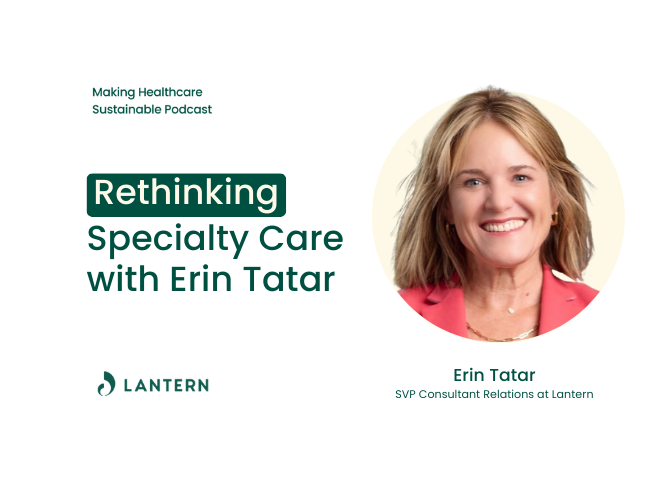
In this episode of Making Healthcare Sustainable, Nancy Ryerson chats with Erin Tatar, SVP Consultant Relations at Lantern, about the complexities of specialty care. Erin breaks down the key components of specialty care (including plannable surgeries, cancer care, and specialty infusions), how it’s different from traditional healthcare models, and how it can be packaged to provide customers with a higher quality experience.
In this episode, you’ll learn:
- Why specialty care programs are cost-efficient
- The importance of evaluating the appropriateness of care for any treatment
- How benefits leaders or employers can benefit from offering specialty care programs
Highlights:
(00:00) Meet Erin Tatar
(01:55) What happens when the healthcare system isn’t working
(05:05) Defining specialty care
(07:35) Specialty care as a cost-efficient approach to health programs
(08:46) Advantages of specialty care over the centers of excellence (COE) model
(11:53) Why patients need specialty care programs
(16:28) The challenges of transitioning from a pharmacy-first healthcare model
(19:49) The importance of receiving appropriate care
(24:38) Opportunities and risks in navigating specialty care
(28:29) The future of specialty care programs
Resources:
Nancy Ryerson’s LinkedIn: https://www.linkedin.com/in/nancyryerson/
Erin Tatar’s LinkedIn: https://www.linkedin.com/in/erintatar
Lantern website: https://www.lanterncare.com
Episode Highlights
Why plan sponsors need to focus more on surgery spend
Not many people know that surgery care makes up 20% of all employer healthcare spend. Erin Tatar breaks down why this category gets overlooked and what plan sponsors are missing out on by not prioritizing specialty care benefits on Making Healthcare Sustainable.
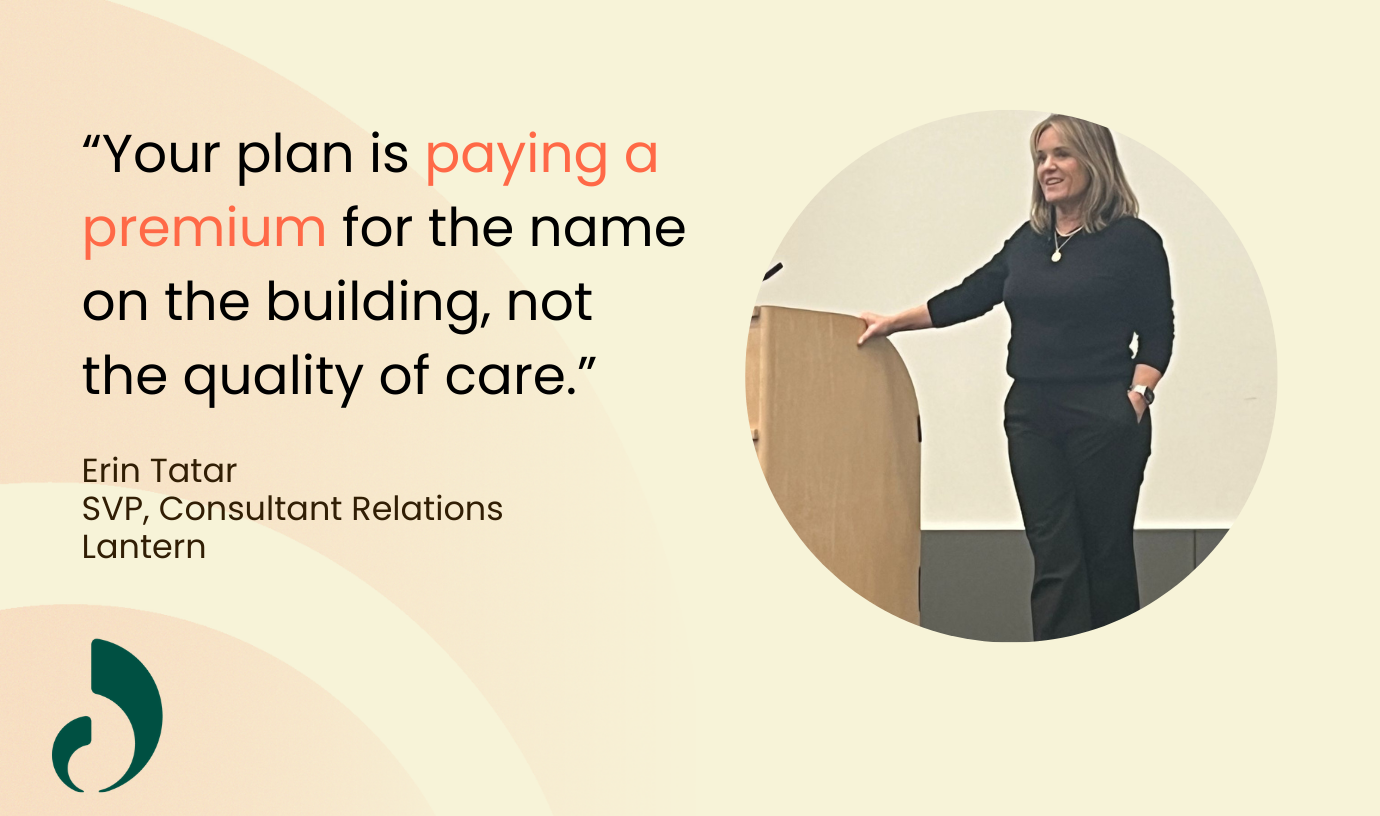
“Where I think folks are most surprised is the surgery care bucket making up 20% of care because you very rarely see any kind of standardized reporting from a TPA or health plan or from a data warehouse vendor that evaluates surgery spend as a category.
They don’t see it in that way. All of that reporting is typically organized at the condition or DRG level.
So they see what’s happening with musculoskeletal spend. They see what’s happening with cardiovasculars and metabolic spend. They see what’s happening with oncology spend, but they don’t see surgery as a category. And that’s where I think folks have a bit of an aha moment.”
What do surgery, cancer and infusions have in common?
Surgery, cancer care, and infusion therapy are daunting—rare, high-stakes moments most people are unprepared for. Erin Tatar stresses the importance of providing plan members a good experience throughout the care journey on this episode of Making Healthcare Sustainable.
“They’re all scary, highly emotional experiences. Anytime you think you might need to go to the hospital, even for something pretty straightforward, it’s still scary. And most of these things are not things that people do multiple times. For many of us, if you have any of these procedures or diagnoses, it’s one time, two times in your life, maybe. And so you don’t have experience to draw from.
So that’s where our sort of laser focus on the member experience comes into play. Across all of our products, we really prioritize guiding members step-by-step through the entire care journey and then steering them to individually selected providers.
The other thing that they have in common is they actually touch in one given year, a very small percentage of the population who then drives 50% of the cost.
And so there’s really no other lever available to plan sponsors and benefits leaders today that is as efficient as this kind of strategy when it comes to disrupting a very small percentage of the population and having an impact across the whole plan that benefits everybody who’s insured with your benefits.”
Episode Transcript
Erin Tatar (00:00):
Surgery care, infusion care, and cancer care. They’re all scary, highly emotional experiences. And most of these things are not things that people do multiple times. For many of us, it’s one time, two times in your life, maybe. And so you don’t have experience to draw from.
Nancy Ryerson (00:26):
This is Making Healthcare Sustainable, brought to you by Lantern. Hello, everyone, and welcome to the show. On today’s episode, we’re talking about a care category that impacts a small portion of your population, but has an outsized impact on spend. Chances are you don’t think of it as a category like you do cancer or MSK. It’s specialty care, and even how you define it really varies. We’ve invited Erin Tatar to bring us some clarity. She’s a seasoned benefits consultant with years of experience working closely with employers to navigate the complexities of healthcare. She has some valuable insights on why specialty care needs to be a top priority for benefits leaders, and how failing to address this could have a major impact on both employee outcomes and healthcare spend. For those who aren’t familiar, we start every episode by asking our guests to choose a question in three categories.
(01:29):
Think, feel, do. Erin, which one did you pick?
Erin Tatar (01:32):
Well, I think anyone who knows me well would realize that I’m going to go straight for feel.
Nancy Ryerson (01:38):
Let’s hear it.
Erin Tatar (01:40):
So the question was, share a moment where you saw firsthand what it looks like when our healthcare system functions the right way or the wrong way and how healthcare impacted them, positive or negative. And the example that I have is my dad. He was under the care of the largest health system in his community, an integrated delivery system, generally regarded as the top hospital, with sort of a mystery condition that was continuing to get worse and worse. He was in and out of the hospital, driving significant cost, but more importantly, not getting better. And finally, at one point when he was effectively parked in the hospital, one of the hospitalists on rounds just took an interest in his case, started going through his chart and happened to discover that some of his labs were very unusual. Ultimately, we ended up at the Mayo Clinic in Rochester to get the inaccurate diagnosis, but at that point, it was too late.
(02:49):
And this happens over and over and over again. Also, these are the cases that consistently end up in the lapse of the benefits leaders that we serve as we work with self-funded plan sponsors. And I know that they’re desperate for support in a lot of cases because they view their responsibility as being to take care of the most vulnerable, sickest members of their plan. And they’ve really lacked the resources to do so in a way that they feel confident is going to ensure the member gets the best possible care.
Nancy Ryerson (03:29):
Yeah. Yeah. I’m sorry to hear he had that experience. Was he working at the time?
Erin Tatar (03:35):
No, he was a retiree, but in a self-funded employer-sponsored plan. So he was having that cost impact that could have been eliminated had he been correctly diagnosed six, eight months before.
Nancy Ryerson (03:49):
Yeah. If you don’t mind sharing, what did they initially think was the problem and then what ended up being what he was dealing with?
Erin Tatar (03:56):
He had a very rare condition called amyloidosis, which it’s sort of related to blood cancers. It hardens the heart. It hardens all of the internal organs. And Mayo sees so many of these, they actually have a CHF ward within their cardiac floor, specifically for these patients. For other folks, it might present in the form of kidney failure. His GI tract had also completely shut down eventually, but he’d had so many cardiac workups, GI workups, and no one knew what to look for. Yeah.
Nancy Ryerson (04:31):
And unfortunately, I think that is a good example of specialty care that we talk about, those episodes of care that are so complicated and that you really need that guidance. To lead into our conversation, how do you define specialty care? And then how do you talk about it with consultants? How do you define it in those conversations?
Erin Tatar (04:49):
Well, Lantern defines specialty care obviously as plannable surgeries and procedures, cancer care, and specialty infusions that are paid through the medical plan. And when I’m speaking with consultants, which is what I actually get to do day-to-day, I define it within those three categories and then explain that this makes up 50% of healthcare spend and is typically increasing at a cost higher than the nine, 10% trend that plan sponsors might be experiencing overall within their self-funded plan.
Nancy Ryerson (05:28):
And when you talk about that, are they kind of used to hearing it position that way or is that new for them?
Erin Tatar (05:34):
It’s new. I mean, we’ve been, I would say, slowly moving the market from the idea of centers of excellence to network of excellence to specialty care. And I do think that it’s starting to take hold. We’ve actually seen some copycat behavior in the market, but we still get lots of RFPs and requests for Center of Excellence proposals, and we’re more than happy to respond to those. But we really are trying to get the market to zoom out and understand that this is more than just an opportunity to send someone to a great hospital. This is an opportunity to take that segment of their healthcare plan where, first of all, it’s very high cost. Second of all, there is significant variation in both the cost and the quality. That means it’s impactable in real time. Through simple steerage to lower unit costs at higher quality, you can literally pull that inefficient spend out of the plan in real time.
(06:42):
We are using the idea of specialty care as a broader category to really get folks to see that this is so much broader than the traditional Center of Excellence and add together the impact of surgery care, infusion care, and cancer care. Based on our book of business averages, we can save $20 per employee per month for a plan sponsor, which is unheard of for a point solution.
Nancy Ryerson (07:10):
Yeah. What would you say if there even was that kind of savings for traditional centers of excellence? What would be the average for a more traditional approach?
Erin Tatar (07:19):
What we’ve seen historically, if I go back way back Time Machine, say 15 years ago, when Lantern, formerly known as Surgery Plus, first started, I actually placed our longest standing client with us. I’ve always been a fierce advocate for the Center of Excellence model, but at that time, care was much less distributed. It did tend to be more focused on the largest cities, the largest systems. There are other models out there that still look like that. And when we get experience from potential clients who might’ve been using one of those models, we’re seeing savings that might look more like one or $2 per employee per month, which you really start to run into, is the juice worth the squeeze question. But I would also say you’re really doing folks a disservice. It doesn’t matter how amazing the quality is of your network of providers if nobody uses it.
Nancy Ryerson (08:19):
What are some of the reasons that someone is more likely to maybe use a program that’s focused on specialty care as a whole as opposed to these more narrow centers of excellence?
Erin Tatar (08:30):
Well, one, again, is that idea of utilization. And when you make a program available and relevant to a broader segment of the population, it absolutely creates a flywheel effect. We started that by expanding from the traditional COE procedures of joint replacements, spine surgery, bariatric surgery, and cardiac surgery, to all planable procedures. And we’ve seen this again and again with our clients where when you jump from your product being relevant for maybe a small single digit percentage of the population to 13 or 14% of the population, they’re more likely to use Lantern to have a great experience and then to come to us for those higher cost procedures. That’s just surgery care. When you expand upon that to these other areas where we have found our very specific expertise is equally relevant, you’re even further amplifying the volume, right? More folks are going to be aware.
(09:41):
More people are going to hear about a teammate or colleague who had an amazing experience with Lantern and is now our best advocate. That’s one reason. The other reason is most benefits teams are severely understaffed. Since I started in this business over 30 years ago, I feel like they’ve just … HR and benefits has shrunk and shrunk and shrunk. And the bandwidth required to even simply add a new solution can be pretty intense. Even if we might think, oh, it’s just an eligibility file, maybe an accumulator file and a contract. That’s a lot for somebody who is already managing a bunch of other programs and the day-to-day politics of HR within the organization. And so the extent that we’ve been able to add categories like cancer and infusion as part of our core offering, we’re allowing them to significantly expand the impact they can have on their spend with the ease of just retaining one vendor relationship.
Nancy Ryerson (10:52):
And when you think of our solutions together, what do you feel like surgery, cancer, and infusions have in common maybe in terms of what the benefits leader is dealing with, but then also the patient experience? What kind of ties them together in terms of challenges?
Erin Tatar (11:08):
Well, they’re all scary, highly emotional experiences. Anytime you think you might need to go to the hospital, even for something pretty straightforward, it’s still scary. And most of these things are not things that people do multiple times. For many of us, if you have any of these procedures or diagnoses, it’s one time, two times in your life, maybe. And so you don’t have experience to draw from. So that’s where our sort of laser focus on the member experience comes into play. Across all of our products, we really prioritize guiding members step-by-step through the entire care journey and then steering them to individually selected providers. The other thing that they have in common is they actually touch in one given year, a very small percentage of the population who then drives 50% of the cost. And so there’s really no other lever available to plan sponsors and benefits leaders today that is as efficient as this kind of strategy when it comes to disrupting a very small percentage of the population and having an impact across the whole plan that benefits everybody who’s insured with your benefits.
(12:37):
And I say disruption very broadly. Most of our clients make our programs available on a fully voluntary basis. So it’s good disruption. It’s trying to get them to pay attention, to follow a different pathway, to call Lantern first and then engage with us at the beginning of their journey.
Nancy Ryerson (12:55):
Yeah. And that 50% number, I hear it all the time from working here, but how does that land with people? Are they surprised when you say specialty care makes up 50% of spend? Or do they kind of feel like, “Oh, if you add all those up, that makes sense.”
Erin Tatar (13:09):
You see both
(13:11):
Where I think folks are most surprised is the surgery care bucket making up 20% of care because you very rarely see any kind of standardized reporting from a TPA or health plan or from a data warehouse vendor that evaluates surgery spend as a category that illustrates for the recipient of that reporting what their PMPM cost is and what the benchmark is for their industry, how much it’s increased year over year. They don’t see it in that way. All of that reporting is typically organized at the condition or DRG level. So they see what’s happening with musculoskeletal spend. They see what’s happening with cardiovasculars and metabolic spend. They see what’s happening with oncology spend, but they don’t see surgery as a category. And that’s where I think folks have a bit of an aha moment. As an example, many employers and plan sponsors carve out their pharmacy benefits, which consume a similar amount of health plan resources, typically around 20, 25% of total cost.
(14:30):
And they invest a crazy amount of time in managing that pharmacy cost with good reason, but they’re carving it out to a PBM, our pharmacy benefits manager, they have entire strategies around specific drugs and they disrupt their entire member population on a regular basis in order to reduce those spends. Adding in new prior authorization requirements and step therapies, we see that continue to grow in the types of categories where that’s in place. Anytime there’s a change in a PBM, everybody gets a new ID card, but also it changes the formulary and a lot of people have to change their drugs. It’s extremely disruptive. We represent the same amount of spend and can be made available on a purely voluntary basis and save the same amount of money that they would save through a PBN shift when it’s actually just a win-win for employees given that our clients typically waive member cost sharing either a hundred percent or after the minimum HSA required deductible.
(15:38):
So that’s the analogy we try to draw and to get people to think about it differently.
Nancy Ryerson (15:42):
Why do you feel like there is more of a willingness to disrupt the pharmacy experience? Do you think it’s just the conversation has been had for longer or …
Erin Tatar (15:53):
People started doing it 15, 20, 25 years ago, and the market expects it. People are used to pharmacy being kind of a painful benefit to navigate and manage. That doesn’t mean that’s okay, but I really just think it’s that. And also, I mean, there have been multiple times over the last couple of decades where pharmacy costs have just been out of control relative to other areas of healthcare spend, so well into double-digit trends when medical was maybe mid-single digits. And that forced action that maybe plan sponsors hadn’t been as willing to take historically and set a precedent, and that’s just the way that it works today.
Nancy Ryerson (16:44):
Do you think eventually the market will view this category similarly where, okay, we have to do something about this?
Erin Tatar (16:51):
I think plan sponsors who don’t start to more aggressively manage this category are going to be at risk that their peers will. And there’s a lot you can do with $20 per employee per month in the way of reinvestments in other benefits or holding healthcare premiums flat in a given year. And so there’s a competitive threat for those who aren’t taking this kind of action. There’s also, some might say, a potential fiduciary risk that plan sponsors are not prudently managing their healthcare plan and exploring all potential avenues to ensure that they are delivering benefits at the best possible value for both the plan as well as for their members. The other risk is that we’re in a financial affordability crisis, not only for the employers that fund these plans, but for the members that are supposed to be benefiting from these plans. We’ve kind of hit the max in most cases of where plan sponsors can realistically go from a deductible and out- of-pocket maximum perspective, but it’s still very common to see family out- of-pocket maximums, eight, nine, 10,000, 12,000, $15,000.
(18:20):
And that is completely unaffordable for somebody in a retail environment, for example, a lower-skilled healthcare worker. And so they’re risking that their employee population is not getting the care they need because they can’t afford it. And it’s probably having an impact on productivity, on availability to work because they’re not healthy.
Nancy Ryerson (18:45):
Yeah, absolutely. And going back to what you were saying about value, I think something else that connects surgery cancer infusions is that there are these paths people can take where maybe there’s waste or it’s not, they’re not on the appropriate care path. So can you talk a little bit about that?
Erin Tatar (19:04):
Yes. I mean, in all three areas, a cornerstone of our process is to identify and guide to individually selected providers and facilities. And I think most can acknowledge that even at an academic medical center or a very well-regarded hospital, there’s still going to be a bell curve. And every provider is going to have areas that they’ve really specialized in. And so part of the value that cuts across, to your point, Nancy, all three products, is that you can see that variation and quality that can be addressed through a rigorous quality evaluation process that becomes then part of that guidance into a narrow network. One of the things that Lantern has done that’s unique is we have an exclusive partnership with Global Appropriateness Measures or GAM for both quality metrics, but also very specifically designed and clinically driven metrics around appropriateness of care. You could have a surgeon who’s done 300 knee surgeries in the last year with a very low complication rate, a very low readmission rate, but did all of those surgeries need to happen in the first place?
(20:27):
That sort of upfront evaluation and redirection is valuable across all kinds of care and really foundational to how we think about quality at Lantern.
Nancy Ryerson (20:40):
Going back to the story you shared in the beginning, especially for cancer, getting the right diagnosis is so important. And if you go down that treatment path that isn’t right for you, or if you’re not getting care at the right place, that can have such an impact.
Erin Tatar (20:54):
Yeah. We’ve tried to build our cancer product, which really is sort of adjacent to our network of excellence. We’ve built a much more comprehensive care management program around oncology due to how uniquely complex and emotional that journey is for patients. And part of that is we’ve built a separate product specific to oncology. The way that Lanterns has structured our product architecture is we have our network of excellence, and then separately we have specialized care management, which is intended to address these very complex emotional conditions like cancer. We assign someone a dedicated nurse as soon as they enter the program. And one of the things that our oncology trained nurses are doing is evaluating both diagnosis and treatment plan against NCCN guidelines. And anytime that they see something that looks out of sync with what they might expect, or if it’s a more rare type of cancer or a late stage cancer, then they’re going to recommend a second opinion.
(22:11):
You would not believe how many people are reluctant to get a second opinion because they trust their oncologist and they sort of don’t want to go behind their back. And so a big part of the role that we play is encouraging and facilitating that so that we can achieve much higher utilization, whether it’s a remote second opinion through an organization like Access Hope or Teladoc Best Doctors or a in- person second opinion that we might facilitate access to City of Hope or Moffitt Cancer Center, for example. Additionally though, there’s real value and a continuous evaluation of the accuracy of the diagnosis and the appropriateness of the treatment plan based on the claims that are continuously being submitted and then passed over to Lantern. And we’ve partnered with Access Hope to do that on a regular basis. So you’re getting that NCI level review and evaluation, not just at the beginning of somebody’s care journey, but throughout in order to ensure they have the peace of mind that they’re getting the right care, which is so incredibly complex in the current oncology environment.
Nancy Ryerson (23:23):
Yeah. And depending on where you live, you might not have access, especially if you have a more rare cancer to someone who has really dealt with that before. Yeah. Is there anything that you would say to consultants or to anyone listening that really positions the risk and opportunity
Erin Tatar (23:40):
For their clients, they risk that someone else will. And I sat in those shoes for 30 years. I realized how challenging it is to not only stay abreast of all the different trends and the thousands of different vendors that pop up every day, but also even to get the attention of the client, to get them to sit down with you and talk more strategically about something other than just this vendor’s renewal or these underwriting results. And I would say make it a priority to consider a solution like ours as you’re talking to clients about how to prioritize their very limited time resource over the next year. Again, I’ll just repeat what I said earlier. There is no more efficient lever to shrink the pie, to pull inefficient spend out of the plan, making care more affordable for members, and then ensuring they actually have support through the whole care journey and have better clinical outcomes, significantly better clinical outcomes than they could expect based off of averages in the community.
(24:48):
And the implementation of a solution like Lantern is very low lift compared to the change associated with a health plan change or a PBM change. We also now are partnered with several of the major health plans, Anthem, Aetna and United Healthcare, where we can be added as an amendment to an existing contract with pre-established integrations at no cost to the plan sponsor, but we also share dozens upon dozens of clients with all the other big health plans, as well as a number of smaller TPAs and smaller blues plans. So the days of old where folks might have been concerned about carving out a voluntary specialty care program or center of excellence because the health plan won’t integrate, we’re past that and we know that we can deliver a great experience because we’re integrated so well with those health plans.
Nancy Ryerson (25:50):
Yeah. One theme I think we’ll come back to on the podcast is disruption. It is a valid concern for benefits leaders, but the system in a lot of ways isn’t working. So there’s a question of maybe it’s okay to disrupt a system that’s not working. But I think what you’re saying is that we have enough integrations and experience that it really doesn’t even have to be particularly disruptive to bring on something like Lantern.
Erin Tatar (26:15):
Exactly. For the plan sponsor, the folks doing the work behind the scenes within benefits or for the member, it really can be a fairly low lift and positive disruption for the member.
Nancy Ryerson (26:28):
Yeah. Yeah. And talking to members, I think the average person hasn’t heard of a program like this, but then once they call and they experience it, they’re like, “Oh, this is great. You’re going to make these appointments for me. ” And then they love their doctors. It’s a much more positive experience overall than what they’re used to. But first you just have to figure out what it actually is. And sometimes they’ll say, “Is this real? Is this spam?” That’s a communications challenge. Well, great. So we’d like to close out with hearing your predictions, I think more on the optimistic side of things. So if you have a dystopian healthcare prediction, feel free to share that as well.
Erin Tatar (27:04):
Well, it’s interesting. I think a year ago, I might’ve predicted that more and more employers would actually be getting out of the business of sponsoring healthcare plans and putting in ICRAS, but the success of an ICRA strategy requires a robust individual insurance market and/or an ACA exchange. And I think we’re in an environment now where it is quite possible you could start to see sort of a death spiral, especially with the ACA exchanges. So I’m going to back off my ICRA prediction, but I would expect that plan sponsors are going to evaluate every category of care within their plan and be required to manage it with the same rigor and the same appetite for disruption that they do for pharmacy today that while I feel like since before the ACA, we’ve been saying we’re at a tipping point, healthcare costs are unsustainable. They clearly have been because we’ve kept going along as we had.
(28:09):
At this point, I mean, it’s crowding out the ability for employers to do so many other things, and it’s so unaffordable for members that I have to think there’s going to be C-suite level expectation for just a different level of management from these teams, and hopefully they will then also resource them differently so they feel like they have the time and the bandwidth to do that. But that’s where I would hope to see self-funded plan sponsors headed. Use the same rigor to purchase healthcare for your self-funded benefit plan as you do in other areas of purchasing within the business and really ensuring that you’re getting the best unit cost for the highest possible quality.
Nancy Ryerson (28:58):
Yeah. Well, we’ll see what happens.
Erin Tatar (29:00):
Yeah.
Nancy Ryerson (29:00):
Well, thanks so much for joining us, Erin. Really enjoyed the conversation.
Erin Tatar (29:03):
Great. Thank you so much.
Nancy Ryerson (29:08):
Thank you for listening to Making Healthcare Sustainable. If you want to learn more, be sure to check out our YouTube channel, Lantern Specialty Care, or check out our website where you can find additional resources.