
Summary
- Benefits leaders are evolving from traditional plan managers into strategic fiscal leaders, adopting an era of “responsible disruption” to combat rising 8-10% healthcare cost trends.
- Evaluate true clinical quality and vendor ROI by auditing the clinical appropriateness of care, leveraging data to track 10 or fewer high-impact KPIs, and maintaining contracting leverage to tie vendor payments directly to hard-dollar savings and clinical outcomes.
- Drive utilization with omnichannel consumer marketing by leveraging one-to-one personalized outreach, eliminating confusing healthcare jargon and deploying communication tactics to meet members at the right time.
More than 41 benefits leaders and 15 industry experts gathered at Lantern’s three 2026 Specialty Care Summits in Aspen to network and share ideas on how they’re taking control of healthcare costs while improving quality and outcomes.
Benefits Leaders are Moving into an Era of Responsible Disruption
The role of the benefits leader has changed more in the last few years than it did in the previous 10. For a long time, the job was about plan design, open enrollment and vendor management. But as healthcare costs climb toward an unsustainable 8-10% trend, the conversation has shifted. The role is no longer just about benefits strategy, but high-stakes fiscal strategy. Today, benefits leaders are being asked to be part finance specialist, part data analyst and part clinical navigator.
Unsurprisingly, many of our conversations during the recent Lantern Specialty Care Summit came back to navigating these unrelentless cost pressures while improving the healthcare experience and affordability for plan sponsors and members. And many shared that maintaining the status quo is now more disruptive to a company’s bottom line than making bold, decisive changes.
As one benefits leader explained, we’re moving into an era of “responsible disruption,” where the goal isn’t just to provide a plan, but to actively lead your team members toward the best possible care at the best rate.
To help navigate the future of benefits, our team compiled some of the best insights and actionable takeaways from our thought-provoking conversations. We hope you’re inspired.
The status quo is more disruptive than bold change.”
Disruption by Design: How Benefits Leaders are Taking Control of Cost, Quality and Outcome
Stop Counting Stars, Start Counting Good Outcomes
The last time you needed a new doctor, how did you find one? Most people ask their primary care doctor, friends and family, and of course, Google. But even if your provider ranked in a prestigious “top 10” list, that doesn’t necessarily mean they’re providing the level of care you need or that you would want your employees or members to receive.
The truth is, there is no data set that allows you to stack rank doctors. And benefits leaders are learning to dig in deeper when a solution claims to include only “the top 10%” of providers.
When someone says the top 10%, you should ask, ‘Of what? As measured by whom?’” says Jason Tibbels, MD, Chief Medical Officer at Lantern.
In the past, benefits leaders may have relied on their health plan Centers of Excellence, but the reality is they only rate the facility, not the doctors performing the procedures. At Lantern, volume, complication rates and appropriateness of care play a critical role in whether a provider gets into our network.
Traditional quality measures that only examine post-procedure outcomes miss the most important question, too. “You need measures in place to determine if the care your employees are receiving was necessary and appropriate in the first place,” said Dr. Tibbels, who notes that Lantern’s exclusive partnership with Global Appropriateness Measures (GAM) allows it to leverage more than 300 measures to evaluate appropriateness and outcomes in real time.
Clinical quality assessments need to include data points beyond claims analytics, including license status, malpractice history, board sanctions, fellowship and patient-reported outcomes. Assessments should also include an in-depth review of surgical volume thresholds. For example, Lantern wouldn’t send a member to anyone who does fewer than 100 procedures for a given CPT code.
“I tell people, ask your doctor how many of these procedures they do. If they get offended, run out of the office because they should be very willing to tell you,” says Dr. Grant Zarzour, owner and surgeon at Southern Orthopaedic Alliance, who sits on Lantern’s medical advisory board.
And clinical quality isn’t the only thing that matters. Ask vendors if they can provide Patient-Reported Outcome Measures (PROMs). They tell you how members actually feel and function after surgery. They’re not coded by a biller and not interpreted by a clinician. The patient says how much pain they’re in and if their quality of life has changed. For plan sponsors, PROMs validate the recovery experience and should show if the surgical pathways deliver faster, better recovery from a patient’s point of view.
Strategic Action
Surgical volume leads to better outcomes.
Ask your vendors:
- How many surgeons are contracted in their network for your top 20 CPT codes?
- How many procedures did the vendor deliver for those CPT codes in the last 24 months?
- What was the MSK avoidance rate because the surgeon recommended a non-clinical pathway (not because the member opted out or went silent)?

The Hard Dollar Reality Reshaping Employee Benefits
The days of soft-dollar savings and trusting a vendor’s calculations on outcomes are over. “If you’re relying on your carrier partner to build out metrics for you, you’ll never get a great outcome,” says Michael Costello, Senior Director, HR, Benefits Commercial Strategy at NextEra Energy Inc. He emphasized harnessing your own data to achieve true vendor accountability.
That doesn’t have to look like tracking 40+ metrics. Instead, focus on 10 or fewer key performance indicators that truly align with your organization’s values and objectives. Lean on actuaries, analysts or even an AI tool to reconcile vendor data, identify billing errors and measure true ROI.
To understand COE impact, ask vendors how many procedures they delivered per 1,000 members in the last year. Don’t trust the savings analysis at face value; ask for validation. Historical performance drives future results.”
When it comes to choosing vendors, Rosa Novo, Administrative Benefits Director at Miami-Dade County Public Schools, recommends shifting the language from Request for Proposal (RFP) to Invite to Negotiate (ITN) for a more collaborative, negotiation-focused relationship with vendors. And don’t award the contract until you’ve reviewed the actual contract.
“Once you tell the vendor they’ve won, you lose all leverage,” says Cora Opsahl, former Director at 32BJ Heath Fund.
Benefits leaders need to be in the driver’s seat to implement contracts that tie vendor payments to clinical outcomes, engagement and cost savings.
Meg Barron, Managing Director at Peterson Health Technology Group (PHTI), says you must be willing to bring the conversation to the table first. “We’ve got to nudge the vendors to better understand that these are new rules of the road in terms of expectations and these are the outcomes you have to see,” she says.
Strategic Action
Narrow focus on the KPIs that drive hard dollar savings and ask vendors for the detail behind each calculation. Reduce friction on your next vendor negotiation, check out PHTI’s contract template.

Omnichannel Consumer Marketing Tactics are Breaking the Engagement Ceiling
Benefits leaders today are thinking like marketers and even hiring new team members who have marketing backgrounds. Influencing people to use their benefits is a full-time job that deserves a thoughtful strategy, especially when you’re trying to improve health outcomes and drive savings. Part of that communications strategy also includes empowering your vendors.
Dawn Beaudin from Hyatt put it simply: “The vendors who deliver hard dollar savings are going to get my approval to do more outreach.”
You can’t just send 20 emails per year per solution, of course. You need an omnichannel approach with emails, bulletin boards, signs, social media ads and more. To do this, use one-to-one targeted outreach using claims data to reach members at the right time with the right message.
Shelly Towns, Chief Marketing Officer at Lantern, says in 18 months, 80% of Lantern’s member outreach will be personalized based on claims, plan design and demographic signals. “Think about the products you consume. Did you order pizza from the new pizza place after seeing one ad? No. You heard about it 10 times, multiple different ways and then decided to try it. Benefits marketing has to apply the proven tactics from other industries,” Towns says.
And while mail and digital communications matter, talking directly to employees is just as critical and helps put a human face behind the program, says Tammy Fennessy, Senior Director of Benefits at DICK’s Sporting Goods.
“We talked with a lot of our store managers and regional directors, to make sure Lantern was the type of benefit that would resonate,” Fennessy says. “We actually had champions before we launched. At our store manager leadership conference, they were pulling people over to the Lantern booth and saying, ‘Have you heard about this yet? This is life-changing.”
7 Tips to Engage Employees
- Tailor your messaging toward different populations in your workforce
- Always have a clear call to action and avoid confusing healthcare jargon that average people don’t understand
- Create in person emotional connections at benefits fairs
- Educate managers about the value and have them remind employees about their benefits
- Use clear visuals, short videos and plain language in your communication
- Ask employee advocates to share their experience
- Take an omnichannel marketing approach to create surround sound
Strategic Action
Identify and cultivate employee advocates who have experienced the benefit firsthand to provide authentic testimonials and peer-to-peer education.
“We talked with a lot of our store managers and regional directors, to make sure Lantern was the type of benefit that would resonate,” says Tammy Fennessy, Senior Director of Benefits at DICK’s Sporting Goods.“We actually had champions before we launched. At our store manager leadership conference, they were pulling people over to the Lantern booth and saying, ‘Have you heard about this yet? This is life-changing.’”
The Case for a More Strategic Approach to Cancer Care
Cancer has become the no. 1 cost driver for many companies, and it’s an emotional journey for employees, too. Benefits leaders at the Summit said it’s becoming one of their biggest strategic priorities.
There are three primary reasons why cancer costs have skyrocketed in recent years. First, most cancers are now being treated as a chronic condition, not a death sentence. Survival rates have been increasing since the mid ‘90s which is great news, but it also means that more people are staying on expensive therapies for longer. Second, there has been an explosion of new drugs that are very costly. Finally, cancer prevalence among the younger working-age populations is on the rise.
When diagnosed, many patients assume they have to go to a National Cancer Institute to receive the best care, but being treated in the community can be an equally effective option. Having access to someone to help decide which option is best is invaluable for cancer patients and their families.
NCIs should be reserved for rare and/or highly complex cases. They can also be a valuable place to validate a diagnosis, but ongoing chemo or radiation treatments are best done in the community from both a patient experience and cost perspective.
To help their employees through an emotional journey, benefits leaders are leveraging partners with oncology nurse navigators to offer guided support. That includes helping with second opinions (only 4% of patients get one today), validating treatment options and providing ongoing review of each cancer case.
Lantern has taken steps to ensure better access and treatment review by partnering with AccessHope. They provide ongoing expert reviews from NCI-designated comprehensive cancer centers to the treating oncologist in a community setting, which operate at significantly lower costs than hospital-based or NCI centers. The partnership also improves access to clinical trials, facilitated through expert matching.
“Only 4% of cancer patients seek a second opinion, but that should be the standard of care,” says Dr. Yousuf Zafar, Chief Medical Officer, AccessHope. “And second opinions are not just available upon initial diagnosis. They can be extremely valuable later in the patient’s experience if the cancer spreads or if the treatment is not working. These second opinions can also help recommend clinical trials. Today, only 7% of cancer patients are enrolled in trials.”
By offering dedicated support, expert-level reviews at every treatment stage and clinical trial matching, employers are giving employees the best experience, improving outcomes and reducing the cost of care.
Strategic Action
Reduce cancer spend by deploying oncology nurse navigators to guide patients to the best care and prevent ER visits, while using NCI subspecialist reviews to optimize treatment and validate the diagnosis.
“Only 4% of cancer patients seek a second opinion, but that should be the standard of care,” says Dr. Yousuf Zafar, Chief Medical Officer, AccessHope. “And second opinions are not just available upon initial diagnosis. They can be extremely valuable later in the patient’s experience if the cancer spreads or if the treatment is not working.
AI is Reshaping Benefits, but Empathy Still Runs the Show
Benefits leaders are no longer questioning if AI belongs in healthcare, but where it creates real value. What repetitive tasks can AI take over? And where is the “human touch” still needed?
Some of AI’s most immediate impacts reclaim significant time, from comparing vendors to analyzing contracts and creating clear narratives from complex data.
AI is also showing up in member-facing experiences, from AI-powered chatbots and benefits navigation tools to improved access and responsiveness. This only works, however, when it’s paired with human oversight. Employees want faster answers, but they still want reassurance, empathy and accountability from HR leaders because healthcare decisions are personal.
On the clinical side, AI is playing a more powerful role in healthcare delivery, including medical record review, clinical matching and documentation. Advances are helping care teams work smarter and reduce burnout, but as one healthcare leader summed it up: “High tech only works when it’s anchored in human-centered foundations.” Judgment, trust and behavior change are ultimately anchored in patient and provider interactions.
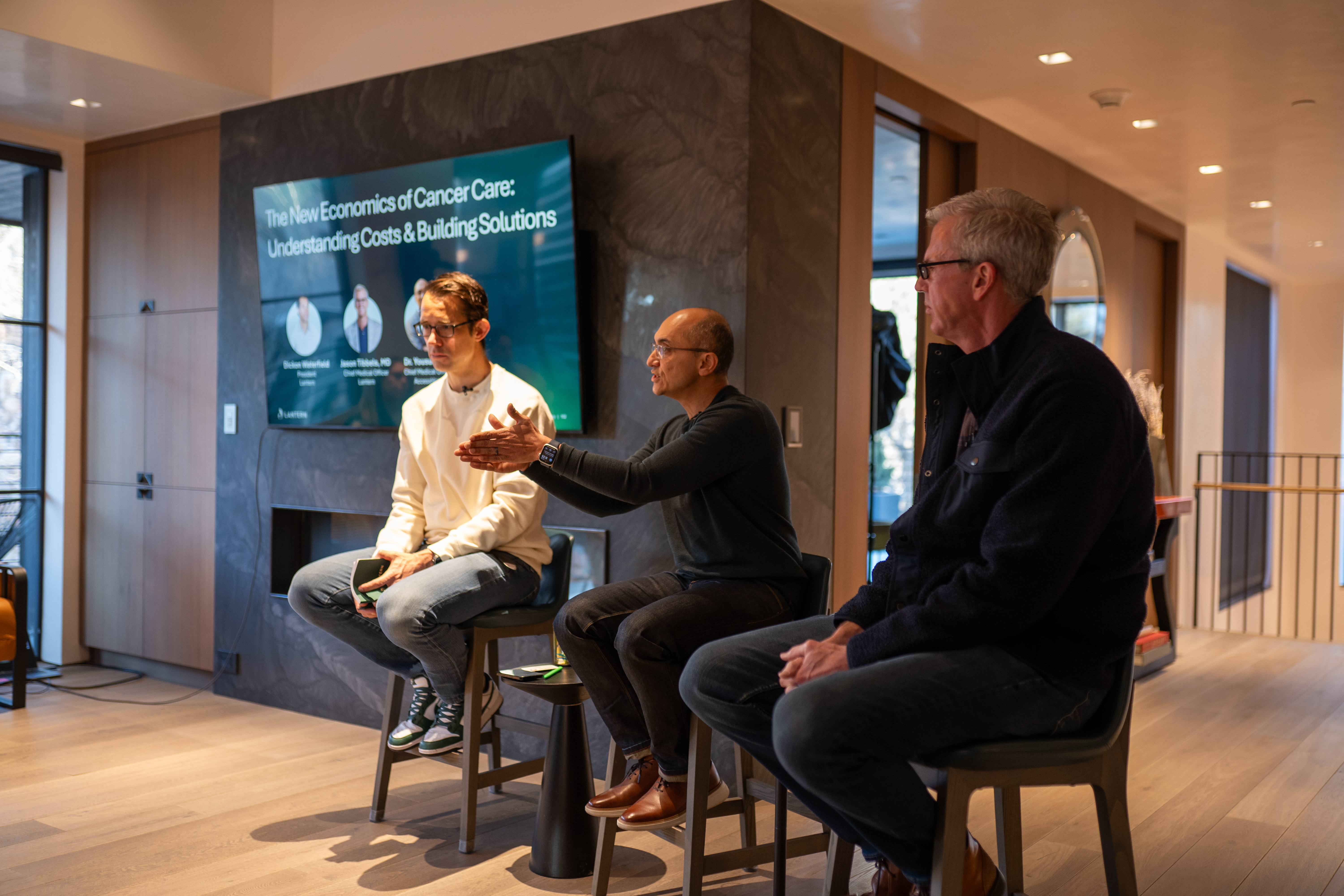
“AI is changing our abilities to support our oncology nurses,” said Dickon Waterfield, President of Lantern. “Fifty pages of medical records can be summarized in 45 seconds. That gives nurses more time helping members, which is the most valuable thing we can offer.”
Strategic Action
AI must be part of your benefits strategy and healthcare delivery, but when it comes to your people, don’t forget to anchor high-tech tools with human empathy.
To learn how benefits leaders are using AI to reduce friction and meet employees in moments of need, read the blog: How AI is Reshaping Benefits Strategy

Listen In: Making Healthcare Sustainable
Hear from bold thinkers, advisors and changemakers transforming high-cost problems into life-changing outcomes.
Through interviews, insights and storytelling, we explore what it takes to deliver better care while optimizing the system and budget. This is where benefit design meets business impact. Because when healthcare works better, everyone wins.