
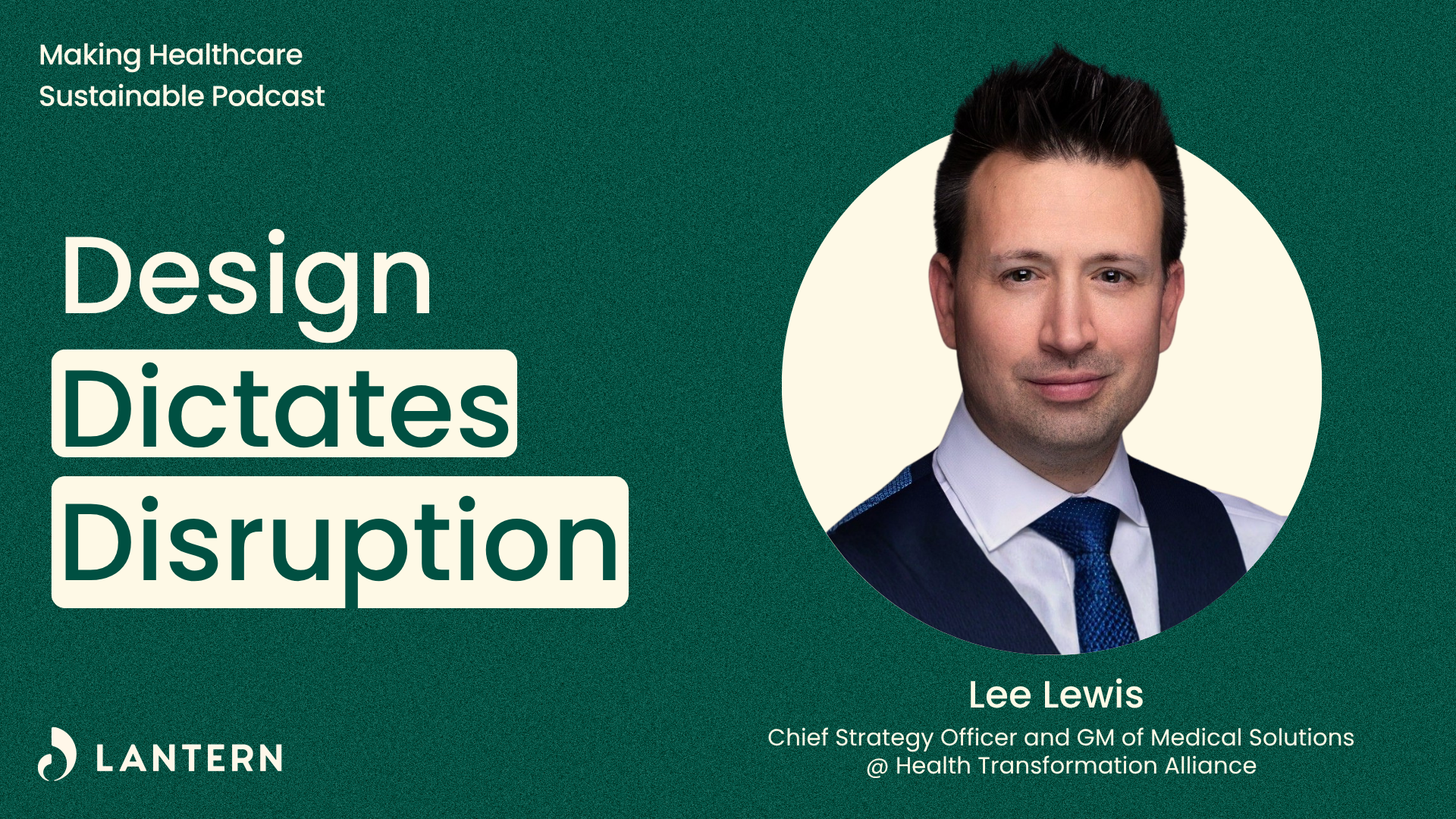
Episode Overview
Healthcare costs keep rising, but many employers are still approaching benefits the same way they did 20 years ago. Those who are taking a more radical approach might want to consider these three words: design dictates disruption.
Lee Lewis, Chief Strategy Officer and GM of Medical Solutions at the Health Transformation Alliance, shares a blueprint for getting the lower costs you need while rocking the boat (or pirate ship—tune in to learn more) just the right amount.
In this episode, you’ll learn:
- How to reduce healthcare disruption through smarter benefit design
- Why simplicity helps employees make better healthcare decisions
- The ABC framework employers can use to strengthen their benefits strategy
Highlights:
(00:00) Meet Lee Lewis
(01:41) Why employers are embracing healthcare innovation
(02:23) How alternative health plans simplify care
(05:20) Does innovation always create disruption?
(07:09) What makes a modern Center of Excellence work
(12:00) Why employees just want “the good doctor”
(17:10) The biggest barriers preventing change
(19:55) Lee’s playbook for improving benefits plans
(26:27) Why behavioral health access matters
(33:03) Why trust changes healthcare outcomes
(35:07) Predictions for the future of employer healthcare
Resources:
Nancy Ryerson’s LinkedIn: https://www.linkedin.com/in/nancyryerson/
Lee Lewis’ LinkedIn: https://www.linkedin.com/in/leewlewis/
Health Transformation Alliance’s LinkedIn: https://www.linkedin.com/company/health-transformation-alliance/
Episode Transcript
This has been generated by AI and optimized by a human.
Lee Lewis (00:00):
One of our advisors at the HTA, he was a reformed CHRO and he said, “For 20 years, I managed healthcare with two commandments. One, keep us in the herd and two, keep it quiet. No disruption and I don’t want to do anything different, just do the same thing as everybody else.” And he sort of had a change of heart. He was born again into saying, “No, no, no, we need to actively manage this.
Nancy Ryerson (00:23):
This is Making Healthcare Sustainable, brought to you by Lantern. If you’re listening to this podcast, you’re well aware of the problems in the healthcare system. Care costs more than ever, but people aren’t getting healthier. Patients don’t know where to find quality care or can’t afford it or don’t really know they need it. And chances are if you’re a benefits leader, you get pitches every day from solutions who say they can help. So how do you sift through what might work, decide to take a risk and make the case to your leadership team? Today’s guest talks to benefits leaders about transformative solutions every day. Lee Lewis is Chief Strategy Officer and GM of Medical Solutions at the Health Transformation Alliance, a nonprofit cooperative representing more than 50 large and Jimbo employers and six million employees. Lee leads efforts to save lives and save money through improved health delivery, outcomes and experience.
(01:27):
He’s a straight-talking, data-driven voice on what’s actually working in employer healthcare, what needs to change and how to actually make that change happen. Lee, before we get into our discussion today, we’ll start with our think, feel, do segment. Which did you choose?
Lee Lewis (01:42):
Let’s do it. I think right now what is interesting is that employers are starting to, I think, shift more assertively and in an innovative direction and explore new items. It’s fascinating to see the surge in the number of employers who are using alternative health plans like Surest, Centivo, SimplePay or Coop Health, ExoHealth, others that are popping up that are giving employers something new that they can do.
Nancy Ryerson (02:17):
Yeah. Can you say more about those alternative health plans and what makes them different and what problems they can help solve?
Lee Lewis (02:24):
They’re trying to deliver on a couple of really important principles simultaneously, which is I think why they’ve been so popular. The first is getting to simplicity on the other side of complexity. We’ve been building complexity into health plans for 30 years. Words like co-insurance or max out of pocket, people have a very hard time understanding what any of that means. I mean, even people in the industry struggle with this. And so to expect regular people going to a janitorial job or a regular accounting or IT position, they don’t have any knowledge of these concepts. And so the alternative health plans largely anchor in aggressive simplicity, copays. Everybody gets a copay. There’s no balanced bill, there’s no surprise bill on the other side of it. And this provider has this copay, this provider has a different one. It’s a simple fixed price. Everybody can get that.
(03:24):
And what we found is that people aren’t just horrible healthcare consumers, which is what we’ve been led to believe, but that if we make healthcare simple enough and it mirrors other types of transactions, you can reengage that American spirit of consumerism and people start to shop a litle bit more. They start to behave more like consumers and that’s really exciting. But you have to make it just dead simple. It has to start to look like other types of transactions. The second thing that it does is it gets to steerage. It’s very hard to try and help people get to the right place at the right time in the right moment in whatever city they’re in. It’s extremely difficult logistical challenge. And when you have variable copays and you lower the copay where it’s higher value and you raise the copay where it’s worse value, people begin to respond to that and you start getting opportunities to steer more of your budget through the patient population over to higher value stops.
Nancy Ryerson (04:30):
That’s really interesting. And obviously something we talk a lot about at Lantern too. Especially for specialty care, something so complex, people just really don’t know where to start and having that cost waving incentive makes such a difference in guiding them to the right care. But without guidance, you’re just kind of like, “Oh, I guess I’ll ask a friend. I’ll Google it. ” And things can really kind of go the wrong direction when you find care that way. And on the PBM side, I’m sure we could have a whole conversation about that, but what’s exciting to you about innovation in that space in the pharmacy space?
Lee Lewis (05:04):
I love everything that’s happening there. What we’re seeing is there’s a further confluence of drug spend where the line between the medical plan and the pharmacy plan is becoming very blurred and the line between direct contracting and contracting through a major vendor also blurred.
Nancy Ryerson (05:20):
One thing we’ve been talking about lately on the podcast is the idea of disruption. A lot of benefits leaders have shied away from that in the past, but then with the direction things are going, the status quo itself can be disruptive because you pay more and more. So I’m curious, these changes you’ve seen or directions that you think are positive, how disruptive are these to employee populations when employers bring these on?
Lee Lewis (05:44):
Sometimes they can be really disruptive. This is more of a design question. The default assumption is that it’s always going to be disruptive and I think that’s a bad assumption. I think that it’s like saying, “Oh, I’m going to do a remodel on a bathroom in my home.” It’s like, okay, that’s going to be disruptive. Immediately you think, okay, that’s the worst. It’s going to be really hard on the household and everything like that. And if you just do it straight away, it can be. Or you could go on a 10-day cruise and have someone come and do a four-day remodel and it all happens while you’re gone that then suddenly becomes non-disruptive. And that’s a design challenge, not a rule. And I think that’s a litle bit of the way that we look at change is that you can do innovative, bold choices and decisions, but disruption is more of a variable based on your creativity and your ability to structure the way it’s implemented.
Nancy Ryerson (06:45):
Love that metaphor. It sounds so nice. I would love to go in a cruise and then my bathroom is renovated like a back.That’s great. So obviously we talk mostly about specialty care. Is there an example of a cruise while your bathroom is being renovated in specialty care specifically? So surgery, cancer infusions that comes to mind that you’ve seen innovative employers put in?
Lee Lewis (07:09):
The way that this looks to me is, okay, here we have a specialty network of capabilities where the physicians have been vetted far beyond whatever is typical in a regular carrier. It’s a much, much narrower network of great physicians. The pricing is pre-established, clear and competitive. And under any microscope, an informed employer wants to use these physicians for these services and an informed patient would also want to use these physicians for these services. That’s a great asset. So now we can deploy it. And as we just discussed, design dictates disruption. Design dictates disruption. So how do we design our deployment so there’s little or no disruption, which is what we want. Well, the easiest way to do that that I tell every employer to do is I say, “Look, there is no reason in the world not to offer this on a voluntary basis.” Give it to people, say, “Look, we’ve already got a great health plan.
(08:17):
We’d love for you to be able to use it. It does have a high deductible. We’ve heard that feedback. It’s kind of expensive.” And for some of you, that’s very inconvenient. And so we’re going to offer a special additional option where these are amazing doctors who have prearranged pricing. It’s great value for us and for you. And you know what? If you are willing to inconvenience yourself to use this, we will pick up the tab. That’s a great message. Why wouldn’t you love to deliver that message to your employees? It’s a terrific benefit. How much does it cost? Well, you can put it in as a PEPM or if you’re just kind of getting your toes in the water, you could offer that just on a per use basis. So say, look, we’re only going to pay for it if we use it. That means you’ve totally de- risked that.
(08:59):
So you’ve de- risked it financially so you only pay if it gets used and if it does, it’s better than free because you save money. Second, it’s a enhancement to your benefits, not a takeaway, it’s not a limitation. And you can just give it to your people and communicate it really aggressively. Now, people will say, “Well, wait a minute, Lee, won’t that dilute your savings?” Yeah, it will. If the issue that we’re solving for is disruption, then this is the way to deploy it so there’s no disruption. That’s going on the cruise while the bathroom gets remodeled. If the problem we’re solving for is just savings, then you can do it mandatory and do a plan design change and say, “Look, for one half of 1% of our people, these are our suppliers. We have a narrow network for this narrow band of services, and we know that it is more disruptive.
(09:51):
It’s more of a hassle, that’s okay, but we’re doing that in order to protect everybody’s livelihoods. And if you can deliver that message really well, again, you can reduce some of that disruption if it’s really well messaged, well communicated. If it’s communicated poorly, that disruption goes up. And so these are ways that you can deploy either to control for disruption overall, or if you really need those big savings, you can still deploy this in a way that is a little more soluble into the population.
Nancy Ryerson (10:20):
Yeah, I think that’s a great way of looking at it. You do have options and communication is so key to how you present it to employees. And then I think at Lantern, one experience people obviously don’t like is they go down a path towards surgery and then right at the end they learn that they were supposed to have used lantern all along. So obviously that’s a disruptive experience you want to prevent.
Lee Lewis (10:41):
And that gets into the design. What’s our rollout? What’s our communication pattern? What are the corrals? People talk, oh, it’s a carrot or a stick. I don’t like either. What I like and I think most people like are corrals, not a carrot, not a stick. Just make a path with guardrails on either side that tells me exactly where to go. The worst part for many people about healthcare is the agita and anxiety of making a decision with little expertise. That is stressful for any homosapien. If I have to make a decision and it is unclear how to make the right one and the stakes are modest to high, that creates significant cortisol, that’s stressful. And so I don’t even want carrots or sticks. I just want to know what to do and I wanted to make sure that it’s safe and somebody smarter than me was the architect of the decision.
(11:34):
Those are ways that we can create good models that help people get to the right place without them having to do a cost benefit analysis or comparison. Let’s just make it really easy for people to do the right thing.
Nancy Ryerson (11:45):
Do you think some people do resist the idea of having choice limited? I think that that’s kind of a human nature aspect that comes up. But I think you’re right, it is so stressful. I mean, I know I would like someone to just be like, ” Here’s your dentist. He’s down the street, you’re done.
Lee Lewis (12:00):
“This is the way that I think about this. Every homo sapien wants the same doctor, everybody. Everybody you know wants the same doctor or the same dentist. And what is that? They want the good one. That’s the dentist and the doctor that we all want. We want the good one. If we don’t know who the good one is, then the second thing that we demand is we want access to every doctor and every dentist. In the absence of getting the good one, I want access to all of them because then I at least know the good one will be in that array and so I can find them. And we have defaulted into that being what we want to deliver to everybody is I want to have the broadest possible access all the time thinking that’s what people want. No, that’s their second choice. The first choice is I just want to know who the good one is and I want to be able to get there.
(12:58):
In order to deliver the good one, we have to have trust, we have to communicate pretty well and then we need to make it easy. And if we can do those three things, people are satisfied with a narrow network as long as they trust it.
Nancy Ryerson (13:11):
What ways have you seen employers build that trust? Do you think it’s about the relationship between the employer and the employees or what have you seen that’s effective?
Lee Lewis (13:19):
First is good communication. If you are actively telling people about the benefits, if you’re trying to make it easier for them, if you’ve got new programs going in, we are consumers at heart. If we see that the benefits team is trying stuff and they’re trying to make it better and it’s not just takeaways, like what are you communicating? Is it like, oh, we’re raising the deductible another $1,000. Oh, now we have to do an active enrollment. Ugh. Is it always like a hassle? If that’s the message that always comes out of benefits that people don’t learn to love it, it gets associated with a hassle. If the communication is, “Hey, we’ve got a great new program in behavioral health. We’ve got a new behavioral health vendor that’s way better than the old one and we want you to know about it. You may not need it, that’s okay.” “Hey, we’re offering a new fertility program.
(14:11):
We want to take care of you. We want to help people who are struggling to have kids. We want to help you make a family. “Wow, that’s a cool thing. They ran a study on when we offer a fertility benefit, that’s a pretty narrow benefit. That helps a small subset of a small subset. It’s families of a certain age dealing with a very specific challenge, dealing with a declining, unfortunately sort of declining choice that people choose to make of having kids or starting family. And so it’s a narrow, narrow, narrow and it’s moderate cost. And so they said, when an employer offers this, we know the people using it like it, but what about the 99, 98% of people who are never going to use that benefit? Think the old curmudgeonly divorced 60-year-old man who lives alone, what does he think about this? And you would think it’d be a normal human response to say,” Well, he probably doesn’t like that because that’s maybe less money that might be able to accrue to him.
(15:15):
“And he says,” Hey, why are you putting this new benefit in? Pay me more. “Or something like that. That would be a normal human response, though maybe they like it as well. So they ran the experiment, the study
(15:26):
And found that everybody across the, I mean not every person to a person, but in serving the population of the 98, 99% who never used the benefit in learning that their employer was providing a fertility benefit to that very small segment, the loyalty and the satisfaction of that entire population who would never use it on average went up significantly. They felt pride in their employer that their employer was doing that for that segment of their coworkers. Isn’t that wonderful?That just gives me faith in humans that we can se past our own selfish interests and say,” I’m glad that my employer’s doing that. I feel better about my employer, about my job, about my role, because my employer was considerate and thoughtful enough to try and help out a small subset of my coworkers. “That is a beautiful thing. And so when we can communicate these positives, it does have an impact on the whole population, even if you don’t use it.
(16:28):
If I’m offering a surgical benefit or a specialty benefit or infusion benefit to people that only applies to one or 2%, don’t think, oh, the 98% are going to be mad that I didn’t do something for them. Understand that have a little more faith in all of us that the 98% are actually going to be proud of you for making that decision. And so make it with Gusto.
Nancy Ryerson (16:51):
Yeah, there’s really a halo effect and it affects that employer brand and employer perception.That’s a great example. So in addition to, we talked about disruption, what do you feel like are other barriers that you hear from benefits leaders who maybe they’re like, okay, I’m sold. I want to try something new, but what’s keeping them from implementing it?
Lee Lewis (17:12):
First is many benefits leaders are in a culture where the preference from either the immediate or one or two levels up boss, the culture might be very conservative, which is okay. In the past when they’ve tried things, it didn’t work out. So it’s normal to be pretty conservative. One of our advisors at the HTA said it, he said, look, for 20 years, he was a reformed CHRO. And he said,” For 20 years, I managed healthcare with two commandments. One, keep us in the herd and two, keep it quiet. No disruption and I don’t want to do anything different, just do the same thing as everybody else. “And he sort of had a change of heart. He was born again into saying,” No, no, no, we need to actively manage this. And if you’re in the herd, you’re going to get in real trouble because the herd is getting you to financial sort of insolubility or insolvency.
(18:08):
“That’s where the herd is headed. It’s not going well. The results we’re getting in healthcare are not good. We need to get away from that. Nevertheless, that was kind of the way it was managed and many benefits leaders are under a very conservative approach, maybe not dissimilar from that. And the suggestion there would be, well, take very modest steps, find ways to de- risk programs. Similar to what we just discussed, maybe it would be offering say a specialty program as a voluntary program, just make it an incentive, give people lots of options and make this one very, very attractive.That doesn’t cause disruption. That doesn’t make for problems. That’s a very reasonable conservative thing we can do. On the other hand, you can also do it on a smaller portion of the population. Maybe you do an experiment and say, look, for one office, maybe you’ve got 10 diferent offices, one of those offices, you say,” We’re going to try this.
(19:00):
We’re going to offer this new benefit and see what people think. “We can do a SurveyMonkey, it’s free before and after just to check and see that it’s okay with the employees, see if they like it, see if they want to use it. That’s a really low stakes way to be able to test a new concept and you can do things off cycle versus on one one. We often encourage you. If you’re going to try something new, maybe release it in May when people are kind of going about their business, do it for a limited population or make it voluntary, do a litle bit of communications around it and see how it goes. There’s lots of really creative ways that you can try something that might be innovative, but do it in a way that’s still in a very conservative environment.
Nancy Ryerson (19:36):
Yeah, that’s a great way of looking at it. Yeah, de- risking and then you can go from there. If it’s successful, if your trial is successful, then you can expand it.
Lee Lewis (19:45):
Exactly.
Nancy Ryerson (19:46):
Let’s say you were a benefits leader, you got a new job, you’re taking over a plan and they don’t have much in place in terms of these innovations we’ve talked about. What do you think you would do first?
Lee Lewis (19:56):
There’s a few steps. The playbook that I have come to understand is aggregated through best practices I’ve seen across the HTA co-op of large Fortune 200 sized employers as well as lots of interviews, say from podcast guests who have shared great advice. And the sequence would be if I was just dropped brand new into a role first, I’m going to meet with my broker consultant and learn what I’m paying them, what are the resources they have, et cetera. And then I’m going to put that out to RFP. We’re going to check that out. Even if I stay with the consultant, going out to RFP allows us to set a clean slate and reestablish the rules of the commercial part of the relationship just so that we have everything caught up because there could be all kinds of side arrangements or deals or handshakes that you don’t know about.
(20:52):
And so that’s the first thing is let’s reset that broker setup just so that we have a clean slate on the transaction and move them to fixed fee, no commission. The second thing, I’m going to go to bid my medical. In the medical bid, I’m going to look at independent TPAs because it appears to have greater flexibility and greater access to data and greater and also better financial performance by separating the duties between who is running my network and who is running my bank account. It can even be a TPA that is owned by the carrier like UnitedHealthcare owns UMR or Aetna owns Meritain. Those are fine. You still can have those even under the same corporate umbrella, but by having a separate entity make the payments from the coworker who is setting up the contracts, that performs very, very well. Financially, we’ve seen that performs very well.
(21:44):
It does have its own challenges. I’m not saying that it’s perfect. I like to say the grass is greener, but you have to weed. So there are additional things to look out for. Third, and within that, I’m going to look at getting better transparency around all my fees. I’m going to look at making sure that we have all of our data flowing consistently into a server that we control. I’m going to look at inserting plan design elements that accelerate our ability to capture opportunities. And there’s details on that we can talk about later if we want to or people can email. Then within pharmacy, we do the steps that I described earlier. If we can take those apparent best practices and insert some or all of those into our pharmacy approach, maybe not all at once, but over time, those tend to be best practices that get great results from what I’ve seen across employers.
(22:33):
And then in the clinical stack, I would look to capture around or really provider stack. Within the provider stack, we call it A, B, C. Everybody should do this. You can do this at zero cost right now, zero incremental. There’s no PEPM required and you can significantly augment your network. A is advanced primary care. Add in a network of advanced primary care so that you can access providers all over the country. You can do that through Appley. You can do it through Align Marketplace. You can do it through Hint Connect. There’s many different vendors that can help you to quickly and efficiently add primary care doctors, advanced primary care doctors. Second is B, supplement with behavior, role health. Do that with a Lyra, spring, a modern, et cetera, a journey that can give you a supplemental network of therapists and psychiatrists in order to get better access there.
(23:23):
Also, the acute behavioral clinics like the ketamine clinics, those are hard. A lot of times the therapies aren’t well vetted into … They’re well vetted in terms of therapy, but the codes they use and the pricing is a little bit all over the place. They’re often out of network. You can add a supplemental network like NFEA, E-N-T-H-E-A, that can help you to be able to access these types of therapies in network at low reasonable fixed prices. Awesome. And then finally, C is centers of excellence. You should add a center of excellence network of surgical, ideally infusion, et cetera, that is able to get you low fixed, reasonable pricing with great physicians all across the country and make those free and available and incentivized for all your staff to be able to use. And if you add in that A, B, C, those supplemental networks really round out your offering, allow you to differentiate and add huge value for your plan members.
Nancy Ryerson (24:18):
Yeah. Got to start with the C as Lantern. What do you feel like … We like to frame it as traditional centers of excellence versus independent. There are a lot of different ways to go. I think a lot of people still think of CenterPoint of Excellence as very specific locations around the country they might have to travel to. How do you think of a modern approach to a COEs?
Lee Lewis (24:38):
I’m a fan of what the data shares and it seems to share that if people can drive to the COE versus fly, you get five times more engagement, which means five times more savings, five times more dollars saved by my plan members who aren’t having to go to a pawn shop to finance their surgery. I think that’s really positive. So I think you should try to get a network that is drivable. Go for a drivable network. The second thing is get in early rather than late. We’ve talked about that through incentives or making it voluntary to begin with. I think you should look to get as many services as possible offered under this. If you’re just testing it, don’t handicap the test by saying, I’m just going to cover it for bariatric, or I’m just going to do this for knees just to see how it works.
(25:27):
Do it for as much as humanly possible. And if you want to narrow because of de- risking, narrow the number of people who are trying it or make it super voluntary and throw in lots of incentive rather than narrowing the number of services. I think that’s, from what I’ve seen, appears to be the best design strategy.
Nancy Ryerson (25:47):
And is that so more people can use it, start spreading the word about it, or is it more savings you think for going that direction?
Lee Lewis (25:56):
Both. If nobody uses it, you get no savings.
Nancy Ryerson (25:59):
Very true.
Lee Lewis (25:59):
So don’t handicap your test by narrowing its use. So make it drivable, not airlines only. Make it for as many services as possible. Don’t limit the services. Make it free and available as much as possible. If you need to limit it so that it’s less disruptive, make it voluntary instead of mandatory. If you need more savings, make it mandatory and communicate it heavy. And if you also need to de- risk it, you can make it on a smaller population.
Nancy Ryerson (26:27):
Yeah. And going back to B, I think that surprised me just because I don’t know if I see behavioral health as being that top spend category the way I see orthopedics or cancer. Why would that be top priority for you as a benefits leader?
Lee Lewis (26:46):
Look, if you’re a pirate out at sea with a bunch of seal meat, if you don’t have Lymes, you are dead. I’d like to think about the networks as that’s 90% of your diet, it’s good, but you are absolutely missing and you must supplement. The doctor with A, the doctors who are taking insurance are not taking patients. The doctors who are taking patients are not taking insurance. We call that the paradox of primary care. You must solve that. You need to supplement with primary care because it is going away. Your people cannot access primary care. So hence you got to supplement for it. Behavioral health, is this a big savings category? No, it’s not. It’s not a big savings category. The reason you must supplement is because people cannot get behavioral health right now. And is that a huge risk to you? It might be.
(27:32):
So the Department of Labor testified to Congress and said, we couldn’t find anyone who was MAPEA compliant. MAP is the Mental Health Parody Addiction Equity Act. And it says that you need to have as good a coverage on mental health as you have on your medical and surgical health. And we just simply don’t have that day. According to the Department of Labor, nobody has that today. And so clearly you’re at sea without limes. You need to supplement behavioral health. It’s the right thing to do. People are in desperate need and it appears that the savings are at worst breakeven, but probably a lot better than breakeven, that you’re going to get savings by allowing people to have active, unlimited access to low cost behavioral health so that you can have a pressure release valve on your population that doesn’t drive them into self-medicating through alcohol or other substances that doesn’t drive them into deep depression, burnout, suicidality.
(28:27):
Those are the downstream consequences of not having upstream, easy access to therapists. And so it’s the right thing to do. I think it saves money. And according to the law, the Mental Health Parity Addiction Equity Act, you need to be supplying something because what you’re sitting on today with a regular carrier appears to not be satisfactory.
Nancy Ryerson (28:51):
Yeah, so you’re really closing those gaps. I wasn’t sure where you were going with your pirate metaphor, but then I like where it landed.
Lee Lewis (28:58):
Okay. I stuck the landing. Good. I’m ver impressed.
Nancy Ryerson (29:00):
It was
Lee Lewis (29:00):
A close
Nancy Ryerson (29:01):
One. Yeah. But I like that the A is really for that preventive health and for that front door into other care people need that primary care doctor is so critical to that. And then B, not everyone’s going to have a mental health challenge, but when you can’t access it and you can’t get that help, that just can lead to so many issues. And then C, of course, we love as a center of excellence ourselves.
Lee Lewis (29:26):
And in looking at those, the big, big savings C drives your savings right away and it’s acute. So it’s big savings, big visibility, small number of people. B is fuzzy savings, but it’s broad need, broad adoption, something that you need to do. And then A sort of gets at both, but it’s a slow burn. A is giving a relationship of trust. Advanced primary care is a relationship of trust with an affordable, accessible doctor. That is the nucleus of everything. That is the most powerful benefit anybody can give to anyone in their … Population is a relationship of trust with an affordable, accessible doctor. Nevertheless, that is a slow burn. You’re going to get 1% or so of your population usually over time to adopt into that unless you’re taking really aggressive approaches. I know there’s people in the comments like, “No, I got 80% engagement in two months.” There are people who can be pretty extreme on this and get great engagement.
(30:21):
But at a large population, similar to the employers that I work with, that Lantern majority has, it’s a slow burn of getting people into relationships trust with doctors. But once you accomplish that, it flattens your trend for those families and gets you significant cost savings over time. And it feeds well into the use of both the supplemental behavioral network as well as helping to get into the right surgeons in the surgical network and the COE.
Nancy Ryerson (30:47):
Do you think there’s a case to be made for being more aggressive on A of driving people to that primary care?
Lee Lewis (30:54):
Terrific case to be made. Again, design dictates disruptions. So if we are making it mandatory, making it required, it’s going to be more work on the benefits team to really get that message out there. You need to make sure that you have good coverage for your population because some people might live in an area where there’s not an advanced primary care doctor nearby. So there are some considerations there. You might need a supplement with some virtual. If you’re using one of those national aggregated network supplement vendors that I mentioned earlier, that can allow you to get a good national network all at once. Nevertheless, that is I think the way that you can do this and get a lot more adoption more quickly. Groups will find that, hey, many people will say, “If we’re going to make a discounted health plan, but in order to have this health plan, you must establish a relationship with a doctor.” That is a perfectly reasonable way to provide an aggressive caret and an incentive for people to adopt into a certain plan design and then be able to sign up and use a doctor to be able to start having a relationship with trust.
(32:02):
And if you do those, you can get enormous 80, 90, 100% engagement and do it in a modest period of time. And I think that is a very, very strong strategy for employers who can do that. And if you can’t, more often than not, I see employers who aren’t doing anything with it and we say, “Look, well then offer it tomorrow as fast as we can. You don’t have to force people to do it. You don’t have to design a new plan. Just get it out there, get the boat in the water. Let’s get access available to people and then we can build from there.” And so those are different approaches. But yes, I think a really proactive employer would be very, very wise to highly incentivize and require people to have a relationship trust with a doctor. Because if you do, your plan is going to perform outstanding and you’re going to have good sustainable access and care for the long term.
Nancy Ryerson (32:49):
Yeah. It’s interesting that trust has come up a few times, trust between the employer and the employee and then the doctor, the doctor and patient and how important those are to getting people to use their benefits and get healthier in the long run.
Lee Lewis (33:03):
For 10,000 years, trust was the only medicine available to our species. Think about that. That was the little bit of like, “Oh, well, maybe we got some herbs and could rub them together.” No, it’s basically trust. Why? Because trust heals. Trust is the most studied medication that exists. There’s been over 300,000 fully vetted financed clinical trials studying trust. We don’t call it trust, we call it placebo. It’s the sugar pill. It’s belief. Placebo is hard to beat. Any pharmaceutical manufacturer will tell you this. It is hard to beat the medicine of trust because placebo works really well. It works really well. 40% of all gastrointestinal symptoms can be addressed by trust alone. The sugar pill and M&M. Behavioral health, massively responsive, but it gets into most other … I mean, it doesn’t fix a broken femur or something like that, but it heals really, really well for a lot of ailments.
(34:08):
And so we need to be any conversation about medicine that doesn’t have trust at its core is missing out on a major element of healing. You want to have doctors who take good care of patients. You want a good experience so people can feel like that it’s going to work. If people believe that they’re going to get better, guess what? They do. A lot faster. That’s free benefit, certainly for the health plan. You don’t have to pay for that. You don’t have to pay for that healing.That healing’s free, but you need to build systems and do everything you can to make it so that people have confidence in the care they’re receiving.
Nancy Ryerson (34:47):
Well, before we enter our conversation, we’d like to have our guests look into the future. I know, Lee, you joined us at one of our summits and shared a few bold bets. So if you can narrow it down maybe to on prediction for can be the next few years, it can be farther into the future, but yeah, would love to hear what you see ahead.
Lee Lewis (35:08):
There’s going to continue to be a surge in alternative health plans. Advanced primary care is going to continue to grow as more employers offer it and as more doctors enter in on the supply side. Once half the doctors in America, let’s say, in primary care, are practicing this model, do you think you can offer a health plan that doesn’t cover it? Of course not. You’re going to have to solve this problem and people will continue to do so. I think there’s going to be more variability in the way that we purchase and engage with medications and drugs. Cell and gene therapies are coming down the pipe. People can’t … Straight up, we cannot afford them. If all of them were to come to fruition and we’re available for all the patients who might be benefited from them at the prices that are anticipated, no, it’ll bankrupt every household in the country.
(35:57):
There’s going to have to be some reckoning that comes with that and we are going to have to find ways to lower the cost of these new innovations or they simply won’t be available for people and that’s going to be a reckoning that we deal with. There’s going to be significant pressure in the next couple of presidential cycles for some type of safety net healthcare. And I would not be surprised if something like that comes along. Those are my bets.
Nancy Ryerson (36:23):
Well, thanks so much for joining us, Lee. And do you want to plug your podcast real quick before we go?
Lee Lewis (36:29):
Sure. Everybody’s listening to this look at broken benefits. I’m the host of that podcast and I interview people who have run health plans, large health plans and made a difference. And so especially if you yourself are running a health plan or thinking about it or maybe advising someone who is, give it a listen.
Nancy Ryerson (36:46):
That’s great. Yeah. Thanks so much, Lee.
Lee Lewis (36:48):
Thanks, Nancy. Thanks for having me. Take care.
Nancy Ryerson (36:53):
Thank you for listening to Making Healthcare Sustainable. If you want to learn more, be sure to check out our YouTube channel, Lantern Specialty Care, or check out our website where you can find additional resources.