
Episode Overview
Healthcare costs keep rising, and most employers feel stuck.
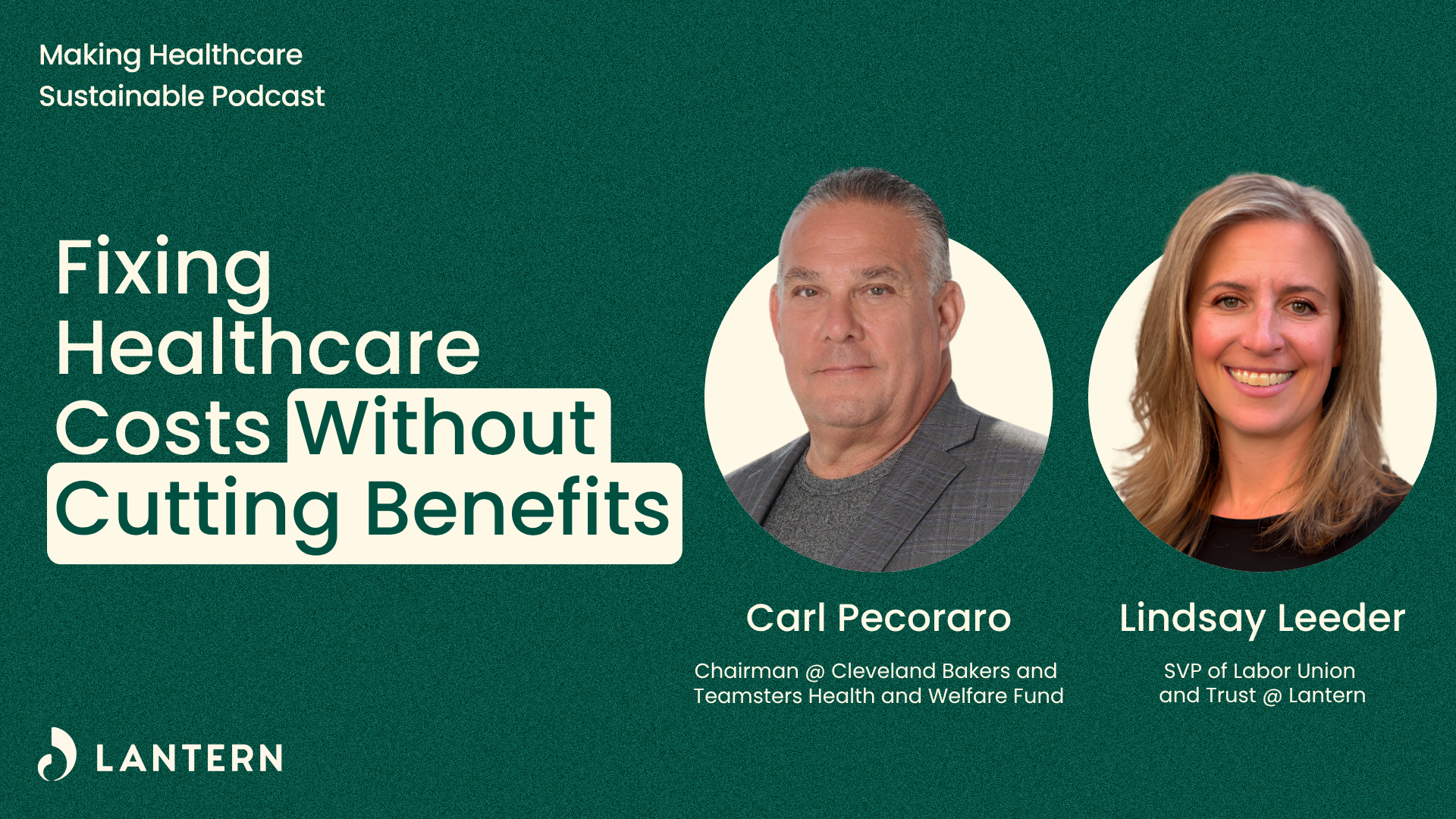
Carl Pecoraro, Chairman of the Cleveland Bakers and Teamsters Health and Welfare Fund, and Lindsay Leeder, SVP of Labor Union and Trust at Lantern, share how one fund changed that. Carl walks through building a plan with 21-point solutions and holding inflation to 1%. Lindsay brings the provider’s view on what better care looks like.
In this episode, you’ll learn:
- How to build point solutions that lower long-term healthcare costs
- Why primary care access changes outcomes and spend
- How better provider experience leads to better patient results
Highlights:
(00:00) How one fund beat healthcare inflation
(00:28) Meet Carl Pecoraro and Lindsay Leeder
(01:38) Think, feel, do on today’s healthcare reality
(04:11) Lindsay on primary care and better outcomes
(07:05) Building a point solution strategy that works
(11:25) Finding Lantern and moving to direct contracting
(17:53) Driving utilization through better navigation
(21:48) Who the members are and why benefits matter
(24:43) Plan design: wellness incentives that actually work
(28:59) Fund leaders have more power than they think
(33:08) What happens when you get all your vendors in a room
(34:46) What the future of healthcare could look like
Resources:
Nancy Ryerson’s LinkedIn: https://www.linkedin.com/in/nancyryerson/
Carl Pecoraro’s LinkedIn: https://www.linkedin.com/in/carl-pecoraro-93ab4142/
Lindsay Leeder’s LinkedIn: https://www.linkedin.com/in/lindsay-leeder-msn-arnp-6a3740146/
Cleveland Bakers and Teamsters Health & Welfare Fund: https://www.cbtfunds.com/
Episode Highlights
How CB&T Promotes Its Solutions
Timestamp: 17:53
No matter how robust your benefits program is, if you just send out an email or two about it and call it a day, you’re not going to see the results you need to make an impact on costs and outcomes.
Pecoraro shares his fund’s approach:
“Whatever point solutions you have, it’s work. If all you do is you send out a mailing to people or you shoot them an email, that’s going to get people to take advantage of something, that doesn’t work. Yeah, you’ll get some on board, but if you don’t have a primary care network to communicate to your participants through, or you don’t have an app that you can shoot blasts out to people on a regular basis, letting them know about these initiatives and what they do, it’s the old adage, you got to spend money to make money. In healthcare, that’s true, especially if you have a lot of plan solutions, you need to have a robust communication system in place to get people to take advantage of this stuff.”
The Stories Union Officials Love to Hear
Timestamp: (22:56)
Even though programs like Lantern are different from what members might be used to, Pecoraro doesn’t consider them disruptive. Instead, Lantern stories are positive enough that members want to share them. And that’s what union officials love to hear.
“The one thing that union officials hate is when the member calls and says, ‘This didn’t get paid.’ Or, “They pointed me in a direction to go to this location and they didn’t do what it is that I thought I was going in there to get.’ And so it’s important to us as labor to deliver to our members what it is we’re telling them that we’re delivering to them. And certainly companies like Lantern are a big piece of that.
If I can go to some of the local hospitals in Northeast Ohio and get my knee replacement done or get whatever it is. I mean, I have a guy who I was standing on a picket line a few weeks ago and he’s like, ‘I don’t know how you guys do it.’ I go, ‘What’s that?’ He goes, ‘I went and saw my primary care physician at Marathon. They called, hooked me up with an orthopedic physician. The orthopedic set up my knee replacement, and when it was all said and done, I didn’t spend a penny and I got my knee replacement done.’ Those are great stories. And those are the kinds of things that as a fund we can do with these point solutions that we’re going to continue to promote them because again, getting those kind of results and then people going back to their companies and talking about it is just going to continue to push that momentum even further.”
Episode Transcript
Carl Pecoraro (00:00):
We have created a system at the CB&T that literally has taken healthcare inflation out of the equation. I say that because our fund has seen 1% healthcare inflation a year for the last 10 years. It started a number of years ago when we put wellness in and wellness started to build into some of these point solutions. And today we have 21 point solutions on our fund.
Nancy Ryerson (00:28):
This is Making Healthcare Sustainable, brought to you by Lantern. Trustees for labor funds tend to be expert negotiators, which makes perfect sense. Today, we’ll hear about how they’re getting a better deal on some of the top healthcare costs all benefits leaders are dealing with. We hope you’ll walk away with some ideas you can use in your strategy, whether you’re managing a health fund for a union or for a private employer. We’re joined by two experts who are deeply involved in shaping the future of healthcare for union members. First, we have Carl Pecoraro, the chairman of the Cleveland Bakers and Teamsters Health and Welfare Fund. With years of experience managing health benefits for union members, Carl brings invaluable insights into the challenges and opportunities within union health and welfare funds. We’re also joined by Lindsay Leader, the SVP of Labor Union and Trust at Lantern. Lindsay has a wealth of experience in both nursing and healthcare leadership, and her background gives her a unique perspective on the intersection of health quality, member needs, and union benefit management.
(01:38):
Together, Carl and Lindsay will share their expertise on improving care, managing costs, and innovating for the future of union healthcare. Before we get into the main part of our discussion, we’ll start with our think, feel, do segment. Let’s start with Carl. What did you choose?
Carl Pecoraro (01:54):
Probably tied to what we’re talking about here. Certainly when you watch the news today, you think about healthcare crisis and people having access to care or affordable care and all the things that we read in the media. And in my mind, that is probably one of the biggest concerns that we have as a fund because it’s out of control. As chairman of a benefit fund, I have a unique experience in dealing with better ways to deliver healthcare. So when I look at what we do today with our point solutions like Lantern, we have created a system at the CB&T that literally has taken healthcare inflation out of the equation. And I say that because our fund is seeing 1% healthcare inflation a year for the last 10 years. And it started a number of years ago when we put wellness in and wellness started to build into some of these point solutions.
(03:00):
And today we have 21 point solutions on our fund. And so it’s work, but when I see the healthcare landscape today, there’s ways to deal with this if you’re willing to put a little bit of energy into it. As the future goes, I think for benefit funds, continuing to develop solutions that deal directly with providers is really becoming what I think providers want because providers, doctors especially, they want to practice medicine. They don’t want to deal with insurance companies. They don’t want to deal with mountains of paperwork for billing and all that kind of stuff. They want to provide healthcare. And I think when you look at what Lantern does and some of the other point solutions that we utilize, it really is a great way to deal with these future costs as we go down the road because I think you’re going to see more and more of a buy-in from both benefit funds, participants, and certainly providers.
Nancy Ryerson (04:02):
Absolutely. And I’m excited to get more into your strategy and how you’ve achieved that 1% inflation. But before we get back to that, Lindsay, did you have one you wanted to share?
Lindsay Leeder (04:11):
Actually, piggybacks a bit on what Carl was talking about. So you mentioned that I have a nursing background. I’m a family nurse practitioner by background, and I practiced medicine for about 14 years, five years of that, practicing occasionally within an advanced primary care setting while I was also building out solutions for Taft-Hartley funds. And the experience I had around when we talk about this question, when did you see healthcare work well? Well, I spent many years in a volume-driven practice where I was seeing 25, 30 patients a day, and I didn’t feel like it was working well, and it was really hard to feel like you were having an impact. And to Carl’s point, I didn’t get into it to have a volume play and have everything I was doing be driven by financial incentives. I got into it to help people. And so by practicing in an advanced primary care setting, a dedicated clinic, which Carl, I know you have a vendor in place to do that, it allowed me as a provider to spend more time with my patients and to really do a deep dive around what was really wrong, but not just throwing meds at the patient, but to be able to ask holistically how I could help them in that moment.
(05:19):
And so by doing so, I was able to not only address their immediate needs that maybe brought them into the clinic, but by having a time and structure behind me and being able to practice independently, not owned by a giant system that was only incented by high cost dollars, I was able to actually sometimes make huge impacts in people’s lives where maybe it was a diagnosis they were carrying for years that no one was able to uncover or they didn’t feel comfortable expressing what was actually wrong because they were already on a time clock when they came in the clinic. And so being able to practice in that setting not only informed further the kind of work I wanted to do in healthcare by trying to make a difference more globally, but it also helped me see how broken things were. If as a provider, I don’t have the freedom and flexibility to really cater to my patient’s needs or have the visibility into what the downstream impacts are.
(06:16):
If I need to refer them into the system outside of primary care, that’s an injustice to our patients, to our people. And for a system that spends so many dollars in healthcare, it is unacceptable how broken it is and how members, patients, individuals don’t have visibility into the care journey and feel very helpless and powerless. But as a provider too, I would argue that many providers feel like they don’t have that visibility either and frankly don’t have the time or the energy to care about it. And so really thrilled to be having this conversation with Carl who’s taken the initiative with his team to really put solutions in place that are going to be impactful because when it comes to healthcare change, it truly is either fund leadership, employers that are going to actually make the difference and put the pressure on the systems in place to do that.
Nancy Ryerson (07:05):
Yeah. And I’m excited to turn it back to Carl. So a lot of the time when we talk to benefits leaders, sometimes they’re trying to consolidate their point solutions. They’re not necessarily seeing ROI from everything, but it sounds like your program is doing really well based on just that inflation number you shared. So I’d love to hear about how you built it, what were some of your criteria for bringing on point solutions. And then we were chatting before we started recording that you also have a good way of helping members know where to go within that system.
Carl Pecoraro (07:35):
So I’ve been chairman of the fund since 2000, and it was a pretty traditional plan. We had our medical provider, we had a PBM, we may have had a dental provider, an eyecare provider separate and apart from those, but outside of that, we were a pretty traditional plan. We started to see costs really started to escalate mid to late 2000, and we knew we had to do something. We were also dealing with some issues on our pension fund, and we needed to get more money into that plan to help with some funding things. So you look at a lot of funds and the simple answer is they just cut benefits. And we talked to our participants, and for our participants at the time, it was a free benefit. And when I say free, it was a hundred percent employer contribution and there was no employee contribution.
(08:26):
And we found that our participants were like, ” Don’t cut my benefits, let me have an opportunity to opt up and to maintain my level of benefits. “And so that was our first attempt to put some awareness to people of what the cost of benefits are and to start paying attention to staying well, find good solutions, take care of things when you need to take care of them before they turn into high claimants. So we did that shortly thereafter we created, in our mind, one of the first wellness initiatives that you’d see in the Taft-Hartley world where we actually required our participants annually to go through the whole wellness process. So get there, it’s a six point, they check diabetics for diabetes, they check cholesterol. Are you a smoker? Is your BMI over certain numbers? There’s two others. And when I was working with our consultant, they were the ones that convinced me that, Carl, you change healthcare by one, 2%, it’s millions of dollars.
(09:33):
And so we bought into it as a fund. And so we rolled this out. That was kind of the beginning of what we get to today. So then we started to see the mindset change. We were able to identify who the less healthy people were, middle of the road and the very healthy people. And then we started to focus on that pot of people that were not very healthy because they certainly drive 80% of your claims. The first thing we did is we hired a company that was a primary care network, and we were the first one in the Cleveland area, first half Hartley fund to contract with them when they came into town. And the biggest reason was we found that like 70% of our participants didn’t have a primary care physician. That was our first point solution that a member could go visit with a doctor.
(10:27):
And to Lindsay’s point, instead of going in and seeing your doctor for two minutes and seeing a nurse or some other associate for the balance of your appointment, you would go in there and you’d see your doctor for 40 minutes and you’d talk about everything. And so that was the first step in the point solution arena. Then it just kept growing. So now we went out and we found a cancer point solution. We have heart point solution, we have diabetes point solution, you name it, we have it to where today we’ve got 21. Then we went into the arena of these narrow networks. So I get an email, I’m going to the marathon client conference and I get an email from this young lady named Lindsay who invites me to be on a round table discussion at the conference. So I’m like excited. I had never done that at a conference.
(11:25):
So she shoots me an email, says,” Hey, why don’t we meet the day before whatever. So we’re going to meet down by the pool. “And we were down there and we had already probably started drinking a little bit. And Lindsay showed up with someone else and breaks my heart and says,” No, we didn’t ask you to be in around … “It was a sales pitch. She just wanted me to come to their breakout session and hear their spiel. I’ll tell you in the end, I’m glad I did because I still remember going back to our consultant who was with us at the meeting and told them what Lantern was able to do. She didn’t believe me. Well, she believes it now. She went back. She did her due diligence on behalf of the plan. But yeah, I got invited to a session just like this and it never happened.
Lindsay Leeder (12:12):
Actions to that story.
Nancy Ryerson (12:17):
Well, we’re writing that wrong today.
Carl Pecoraro (12:19):
We’re writing that wrong today. Yes.
Nancy Ryerson (12:21):
Before you met with Lindsay, perhaps Center Falls pretense, it sounds like you weren’t familiar with Lantern. Had you noticed high surgery costs? I guess what did catch your eye about the pitch when you did hear it?
Carl Pecoraro (12:32):
So at the time we were working with one other point solution. What caught our interest with Lantern was they had access to a number of hospitals in Northeast Ohio, which the other solution does not. In addition, their access to infusion products, both that are done actually in people’s homes a lot of times or certainly in facilities, the savings that can be generated from that is huge. And we’ve got a specialty initiative, we’ve got biosimilars. We’re taking advantage of all of these things as it relates to drugs and infusions and things of that nature. And so when I heard a Lantern presentation down at the Marathon Client Conference and what they were able to do from a cost perspective with the providers and the number of providers that they had access to, it was a no-brainer that we needed to get Lantern into the plan. And early indications are it’s starting to get traction.
(13:39):
It’s getting good traction. People are starting to become aware of it and they’re taking advantage of it.
Nancy Ryerson (13:46):
We love to hear that. Lindsay, Carl mentioned that when he … Did you say you talked to your consultant and they hadn’t heard of a solution like Lantern? I’m curious what you find to be the awareness of this kind of program among health fund leaders who you talk to?
Lindsay Leeder (14:02):
It’s interesting. Lantern’s been around for so long, but as you know, we were employer direct. We went through this rebranding before I was even hired. I didn’t start until December 2024, and that’s when our company had just rebranded to Lantern or was just about to rebrand and had realized, look, we have over 400 employer clients, many multi-employer clients, public entities, but they didn’t really understand labor. And so our organization decided to really invest in the space. So I was honored to come on to lead labor and then build a team. And so really there wasn’t a ton of awareness. Although there is some familiarity with direct contracting and a traditional center of excellence model where maybe you have five dots on a map of high profile health institutions, this was changing. It was like, how do we enter into the labor space and really educate on the fact that there is this narrow network capability where we start first with contracting directly with the surgeons, with the people delivering the care, with the infusion specialists, as well as the facilities, therefore expanding access for members.
(15:13):
And I think when it comes to health funds as opposed to a traditional employer, it’s so important to have wide geographic access. There’s large geographic distribution of membership. So then if we can be the best quality and as close to home as possible, that takes away the barriers for members to actually seek this kind of care when they need it. And when it comes to surgery, infusions or cancer care, these are critical moments. It’s a scary moment for members. Members often can’t take time away from work because they don’t have a banked PTO. They’re skeptical of the healthcare system in general. They don’t know how much it’s going to cost and it’s frightening, especially in these moments. So I think it was newer in this space, but we’ve gained so much traction just in the first year of labor. Our first client as a Taft Hartley fund was 32BJ out of New York.
(16:04):
Carl was in CBTA where the second Taft Hartley fund we signed, and since then I’ve signed eight more just within a year. And anyone who’s listening who knows Taft Hartley to sign any group within 12 months is sort of a miracle. And I think it speaks to the relevance of the product, the risk of the product and the member experience. I think that’s what fund leaders are looking for is how can I cut costs, but not change a member experience, but make the member experience better and add to the benefit structure, and that’s what’s relevant for people.
Carl Pecoraro (16:38):
I think the Taft Hartley world is about 20 years behind the real world sometimes because we’re stuck in our old ways. Certainly we don’t like member disruption. And so that willingness to try new things, to Lindsay’s point, it’s difficult. I mean, this is like to sign on with Lantern’s like a no-brainer. Okay, we can give you the ability to go out there and pay claims at some ridiculously reduced cost from what you’d pay with your traditional medical provider. And in our case, members have zero copay, zero deductible, and they can go get the exact same things done. And since we had some familiarity with that whole narrow network concept, when I saw what Lantern’s capabilities were, I had something to measure it against and it was honestly, Lantern was the better solution. We still have the other one working with us, but it’s what Lantern is able to do is so much more than the provider that we had when we brought them on.
(17:53):
But going back to the Taft-Hartley piece, whatever point solutions you have, it’s work. So we were talking before we went on camera about the problem is if all you do is you send out a mailing to people or you shoot them an email, that’s going to get people to take advantage of something, that doesn’t work. Yeah, you’ll get some on board, but if you don’t have a primary care network to communicate to your participants through, or you don’t have an app that you can shoot blasts out to people on a regular basis, letting them know about these initiatives and what they do, it’s the old adage, you got to spend money to make money. In healthcare, that’s true, especially if you have a lot of plan solutions, you need to have a robust communication system in place to get people to take advantage of this stuff.
Lindsay Leeder (18:44):
The distinction here for anyone who’s listening is not part of a Taftar Leaf fund. Taftart Leaf Funds don’t have, there’s not a benefits office. There’s not a chief people officer and a director of benefits. It’s trustees, it’s a consultant, it’s their fund administration that are not only trying to determine the best benefits for their members and are on the hook financially because the members are the ones paying dollar every cents every hour into their fund to produce these benefits, but they’re also managing negotiating contracts and project labor agreements and everything else. So it takes so much time and courage to take the risk to change things, but when they do, there’s this opportunity to really have an impact for their membership.
Nancy Ryerson (19:28):
Yeah. And Karl, going back to the differences you’re seeing between Lantern and the other narrow network that you had before, what do you think is contributing to … Are you seeing a difference in utilization so far? What do you think is driving that?
Carl Pecoraro (19:43):
At this point, it’s the utilization piece though, you’re definitely seeing a spike of participants taking advantage of Lantern. I think a big piece of that is we have a healthcare navigation program where now a member, not only a member can reach out to them and try to find the best solution to get whatever medical procedure that they may have need of. In turn, that healthcare navigation is getting medical claim information and is reaching out to our participants and saying, “Hey, we see you’re getting infusions. Your fund has a point solution that can save you money.” And in a lot of cases, it’s the exact same place that the person’s going to already, which is crazy. So again, I think that what we’re going to see with Lantern, it’s going to continue to grow the way it’s grown over the last three or four months as people become aware of it.
(20:44):
And certainly as we help assist people in taking advantage of the program like we have with Lantern, our numbers are going to grow. I mean, I looked at some statistics where we’ve already surpassed in, is it four months now, Lindsay? We’ve doubled what their normal book of business is. And I think I told you earlier, I thought that was low and they’re like, “These are great numbers. It’s only going to get better.” So yeah, what I do know of Lantern compared to the other provider is they have a much better, stronger network. They’re out there expanding that network on a regular basis where I think our incumbent group was not doing a whole lot. And so I expect to see that momentum continue.
Nancy Ryerson (21:32):
Yeah, we do too. And when you’re talking about your members, I’d love to hear a little bit about them and the jobs they do, maybe some of their concerns. Do you feel like … I mean, affordability, I think everyone values, but is that something that’s particularly important to the people you’re supporting?
Carl Pecoraro (21:48):
Teamsters in our world represent everything from animal keepers to truck drivers to maintenance folks, warehousemen, machine shops. We have a Baker’s Union that has large manufacturing baking facilities that make bread and buns and pastries and all kinds of things. They have Dan and Yogurt or Danon is in our fund. We have public sector groups in there. We just brought in roughly 500 people with the City of Cleveland. It was the first city of Cleveland group that has broke away from the city’s plans and came into a Taft Hartley plan. And it was programs like this that was the sales pitch. It was, you can go to this primary care physician for free. You can take advantage of Lantern or a number of our other point solutions and there’s no member out of pocket. And so as we continue to educate people on that stuff and they realize that there’s better ways to deliver healthcare and they start taking advantage of it and they see it in real life, it’s great for our members because the last thing you want is disruption.
(22:56):
The one thing that union officials hate is when the member calls and says, “This didn’t get paid.” Or, “They pointed me in a direction to go to this location and they didn’t do what it is that I thought I was going in there to get. ” And so it’s important to us as labor to deliver to our members what it is we’re telling them that we’re delivering to them. And certainly companies like Lantern are a big piece of that. If I can go to some of the local hospitals in Northeast Ohio and get my knee replacement done or get whatever it is. I mean, I have a guy who I was standing on a picket line a few weeks ago and he’s like, “I don’t know how you guys do it. ” I go, “What’s that? ” He goes, “I went and saw my primary care physician at Marathon.
(23:46):
They called, hooked me up with an orthopedic physician. The orthopedic set up my knee replacement, and when it was all said and done, I didn’t spend a penny and I got my knee replacement done.” Those are great stories. And those are the kinds of things that as a fund we can do with these point solutions that we’re going to continue to promote them because again, getting those kind of results and then people going back to their companies and talking about it is just going to continue to push that momentum even further. I’d
Nancy Ryerson (24:25):
Love to hear a little bit about your plan design and some of the incentives you have for these solutions. I thought it was interesting you said that one of the first things you did was require people to get those preventive screenings done. And when you say require, what was the mechanism? How did you drive people to do it?
Carl Pecoraro (24:43):
You’re right. The word require is something a union official would do, but if I was in front of a government agency, of course you don’t have to go get your wellness done, but we created a structure that if you did your wellness and you passed the three out of six, your contribution towards your healthcare is about half of what it is if you don’t do it. So in turn, we get almost 90% participation every year in the wellness, and we do it every year. That wellness has helped people find out that they’re on the verge of getting heart attacks. That wellness has helped so many people that, like earlier when I was talking about the three pools of healthy middle of the road and not so healthy, our not so healthy pool has shrunk so much over the last 10, 15 years and it was all attributed to wellness.
(25:39):
And then when you add in our healthcare navigation now, which I think is just the game changer because it takes all of these point solutions that we have built up over the last five, six, eight years, they coordinate between participant and doctor, they communicate with vendors. Now we have vendors talking to vendors. Yesterday I met with two of our vendors. One was a nutrition vendor that we utilized. One was one of your local exercise places. It’s a national company and talking to them about how they could help each other, even though technically they’re competitors, but if somebody’s over at the gym and they’re like, “I got to change something else. The gym’s just not enough to connect them with our nutrition vendor who has phenomenal success, we’ve now created a system where vendors are working together.” And the net result is people are healthier, we’re having far less large claimants than a lot of funds similar to us, and we’re saving money and the participants are saving money.
(26:52):
And so the program works, but it was not taken well initially because we were forcing people to do something. Now, the net effect of that is, and we do a lot of good communication with folks, is we’ve merged five plans into ours, five other Taft Hartley plans who see what we do and they were smaller and they said, “We want to be part of this. This is a good program because we’re controlling healthcare costs.” In every one of those funds, they were paying at least 80 to $100 more per member per week towards healthcare than what they’re paying now. And so what does that result in? Better wages, better time off, because you can take those assets and instead of dumping it all in healthcare, you can put them in other benefits or wages, which again, is a win for the member. That’s what we’ve been able to create.
(27:46):
We’re negotiating healthcare rates today that we were negotiating 10 years ago, just because we’ve done such a put this program together that’s just resulted in such great savings and controlling that cost.
Nancy Ryerson (28:00):
That’s amazing. And it’s really, we talk to employers who know maybe not in the health fund world, but who see double digit increases in spend. So that’s pretty amazing that you’re seeing similar numbers to 10 years ago.
Carl Pecoraro (28:12):
Yeah. I met with one of our employers a couple weeks ago. They’ve got the same medical provider as us. They’ve actually got the same consultant as us. And it’s a public sector organization and their per employee per cost is like $1,900 or $2,000 per month. Ours is like 1,300, so six, $700 difference. And we may bring them into the fund to come next year because it’s not that they have bad experience, it’s just they’re not big enough, but bigger, they’re not doing other things to help control that cost. They were a little disappointed when they were looking at what we’re doing. It’s like, why didn’t they bring all this stuff to us? And it’s like, well, now maybe they will.
Lindsay Leeder (28:59):
It’s interesting too though, because I think a lot of fund leaders and or employers, they don’t realize they have so much power to actually push change. Like Carl said, he’s not only created this ecosystem of partners, he’s brought us all together to have conversations and brought us into a room and said, “Hey, all vendors, you need to work together. You’re serving my members.” It takes the leadership to make that step and you do have the power in this situation.
Carl Pecoraro (29:30):
Well, in medical providers, consultants can be your friends and then consultants can be your worst enemy because if they’re not willing to bring these to you, that’s part of the problem. And your medical provider, the last thing they want you to do is work with a company like Lantern or self-insured. So our medical provider only gets paid when there’s claims. Well, if the claims are going with Lantern or with somebody else, If they’re not seeing those claims, or if our members are going to Marathon for their primary care, we’re paying a lump sum every month for those members to participate. So they’re not seeing that business or those claims. So why would they want you to do that? So I mean, we initially got some pushback from the medical providers, but it was a simple answer. Well, if you don’t like it, we’ll go to market.
(30:24):
I’m sure somebody will agree to do it, and they all can form.
Nancy Ryerson (30:29):
That’s interesting. Yeah, that the incentives aren’t necessarily aligned to give you the tools that you need to reach these goals, and maybe you have to go looking for them yourself.
Lindsay Leeder (30:41):
We’re disrupting things, right? But we’re disrupting things to reduce cost and improve a member experience. And so when we look at the consolidation in healthcare and the misaligned financial incentives that are the foundation in which the US healthcare system operates, you have to be innovative. And he’s absolutely right. There are great consultant partners out there that bring these solutions to the table, but they’re also inundated with solutions. So it can be hard to piece through what’s going to make a difference and what’s not. And it takes a lot of thought leadership and collaboration.
Carl Pecoraro (31:14):
Certainly as a board of trustees, we meet quarterly, but our healthcare subcommittee meets a minimum of two times a year. Sometimes we may meet more than that. I work it every day as chairman of the fund. I’m working with my staff and working with the consultants, monitoring what our point solutions are doing. And when we’re successful, great. And when we’re not successful, then we’re out there looking for somebody to fill that void. And there are companies out there to fill the void. To Lindsey’s point, you’re trying to find the right one. I mean, when we went into the narrow network arena, it was like, wow, this is great. Let’s see how this goes. The network, it wasn’t huge, but we had success with it. I have to be honest, when we saw what Lantern was able to do, it was a game changer because it just expanded the network of available doctors and facilities and paths to treatment that was well beyond that we already had in place.
(32:11):
You got to continue to manage it. You got to continue to make sure that they’re providing the service that you expect for your participants, and it takes work.
Nancy Ryerson (32:23):
Yeah. And the narrow network you had previously that I think you said you do still have in place, did it also cover a more narrow set of procedures compared with Lantern?
Carl Pecoraro (32:31):
Yeah, it was more generic type things. It wasn’t the specialty stuff that we’re starting to see with Lantern. There was some of it, some of the orthopedic stuff, but really I think the addition of Lantern has taken it to a whole new level.
Nancy Ryerson (32:47):
I love to hear that you bring your vendors together to communicate with each other because that’s something we hear a lot too. A lot of the times someone will go to one point solution and then let’s say you think you need surgery, then you don’t. And it’s like kind of the end of the line instead of then connecting them to physical therapy or other resources. So good job bringing everybody together.
Carl Pecoraro (33:08):
Yeah. We had a vendor summit back, I think October, November, where we actually brought every vendor in for two days. And I kind of ran it, but it was really an opportunity for the vendors to talk to each other and then talk to union stewards and some of our staff as to what they do. And I have to tell you, to watch the vendors interacting with each other on how they could support each other, and that’s just continuing to evolve. It was really kind of surprising that that wasn’t the norm. You would think that if you have a heart vent point solution and somebody was going to see somebody else, that they weren’t connecting with each other to try to make sure that that participant was getting what it is that they need to be getting done. And we’re starting to see that in our plan right now, where vendors are working with each other or a vendor will call into HealthActive and get ahold of one of the advocates and say, “Hey, I’m working with Joe participant here.
(34:11):
This is what he needs.” And so it’s evolving, but it’s evolving in a good way.
Nancy Ryerson (34:16):
Yeah. And that’s something at Lantern, we’re always trying to connect the dots better onto making sure we have that connectivity with everything else in a client’s ecosystem. So that’s great that you’re seeing that more overall. Usually at the end of the conversation, we like to hear from you on what are your predictions for the future of healthcare? It can be short-term, long-term, can be positive, it can be apocalyptic, whatever you’re feeling. So yeah, I would love to hear what you feel like is ahead for healthcare.
Carl Pecoraro (34:46):
I got to believe as the future goes, we cannot rely on the federal government to do anything in a positive vein. One is it’s a lot of money and it takes people that deal with healthcare on a regular basis to one, really know what changes those people that you cover through your plan, whether it’s Taft Hartley, employer, whatever it might be, what are your participants looking for? And we’ve seen healthcare is now as important as wages when it comes to organizing, when it comes to contract negotiations, because people talk to their friends, they talk to their neighbors, they have these high deductible plans where it’s $10,000 upfront before the insurance company pays a nickel. I think the future is going to be just continuing to develop strategies like what we’re talking about today to get those kind of tools in place for everyone. And we’re never going to see national healthcare, but if we did, you’d be able to roll these things out there because you’d be able to put programs out there like this.
(36:01):
But since you’re not, I think it’s going to be up to providers like Lantern and those other point solutions to communicate with employers and really show them that you can control your healthcare costs without cutting benefits by taking advantage of these things. And I think that’s where this thing is really going to evolve. I mean, to what we talked earlier, Lantern just got into the Taft Hartley arena roughly a year or so ago. Why weren’t they 10 years ago? Some of these things could have been out there and people could have been taking advantage of it. So I think you’re going to just see that start to grow significantly.
Nancy Ryerson (36:39):
You make a great point about healthcare being now part of negotiation and what people are looking for when they’re considering their wages because it can cut so much into your take-home pay. And if you have a high deductible, you’re functionally uninsured. You can’t even really use it. So yeah, I think that makes a lot of sense. I was on a
Lindsay Leeder (37:01):
Podcast a few months ago and the host asked if I thought healthcare could get worse. And I said 20 years ago, I didn’t think so. And now definitely, yes, it’s just gotten worse. My prediction, we’re going to continue to see rising rates, inflation with Medicaid cuts, especially right now, unless things are severely disrupted, as long as you have health plans that need to negotiate with health systems and cover all losses based on certain rates, maybe you’re going to see costs continue to rise because you have to rely on top line revenue for the systems to remain in place. So again, it’s just kind of this cycle. And maybe that’s a really complicated answer just to say things are expensive because there’s a lot of waste in the system and they’ll continue to be expensive to cover the losses related to all the waste. So I see that not improving anytime soon.
(37:54):
I do see funds and employers taking more risk to adjust things because the costs are not sustainable at all. And we’ve said that in the past, but to your point, Nancy, the groups are seeing double digit increases. CBT is very unique. And so when you’re seeing inflation and rising premiums of 12%, 14%, you can’t sustain that and you have to break something up. And so I think we’re going to see more groups focused on solutions that are … I wouldn’t even call us a point solution. I’d call us an ecosystem that integrates into what they already have in place to drive cost savings. So I think more groups will look at primary care and specialty care solutions as a whole to affect change. When you look at what we can affect, if you look at surgery, infusions and cancer care and look at that as 50% of a plan spend when only 8% to 10% of the members are driving that, if we can redirect two to 3% of the eight to 10% of people and have thousands of dollars of savings, that’s a way to put something in place without a lot of disruption.
(39:02):
I think fund leaders will look at those kind of solutions as a way to drive some cost-effective change.
Nancy Ryerson (39:09):
Yeah. We had someone, I think was on one of our webinars share that not doing anything actually is disruptive because costs are going up so much and because you’re going to have more and more out- of-pocket costs and anyone have access to healthcare. So even if it’s maybe a different way of doing things, working with some of these point solutions, it’s better really than the disruption of, “Oh, I can’t even afford to get healthcare anymore.” So I thought that was a good … I can’t take credit for that concept, but I thought that was a good way of putting it. Well, great. Any other final pieces of advice for our listeners, Carl?
Carl Pecoraro (39:42):
As we go, just keep doing what you guys are doing. I mean, it’s such a critical part of the overall healthcare spend and the more what you’re doing evolves and helps us control the cost, the better it is for the fund and for the participants. And so we look forward to seeing more people start to recognize what’s available to them with Lantern and continuing to move forward with this partnership.
Nancy Ryerson (40:16):
Thank you for listening to Making Healthcare Sustainable. If you want to learn more, be sure to check out our YouTube channel, Lantern Specialty Care, or check out our website where you can find additional resources.