
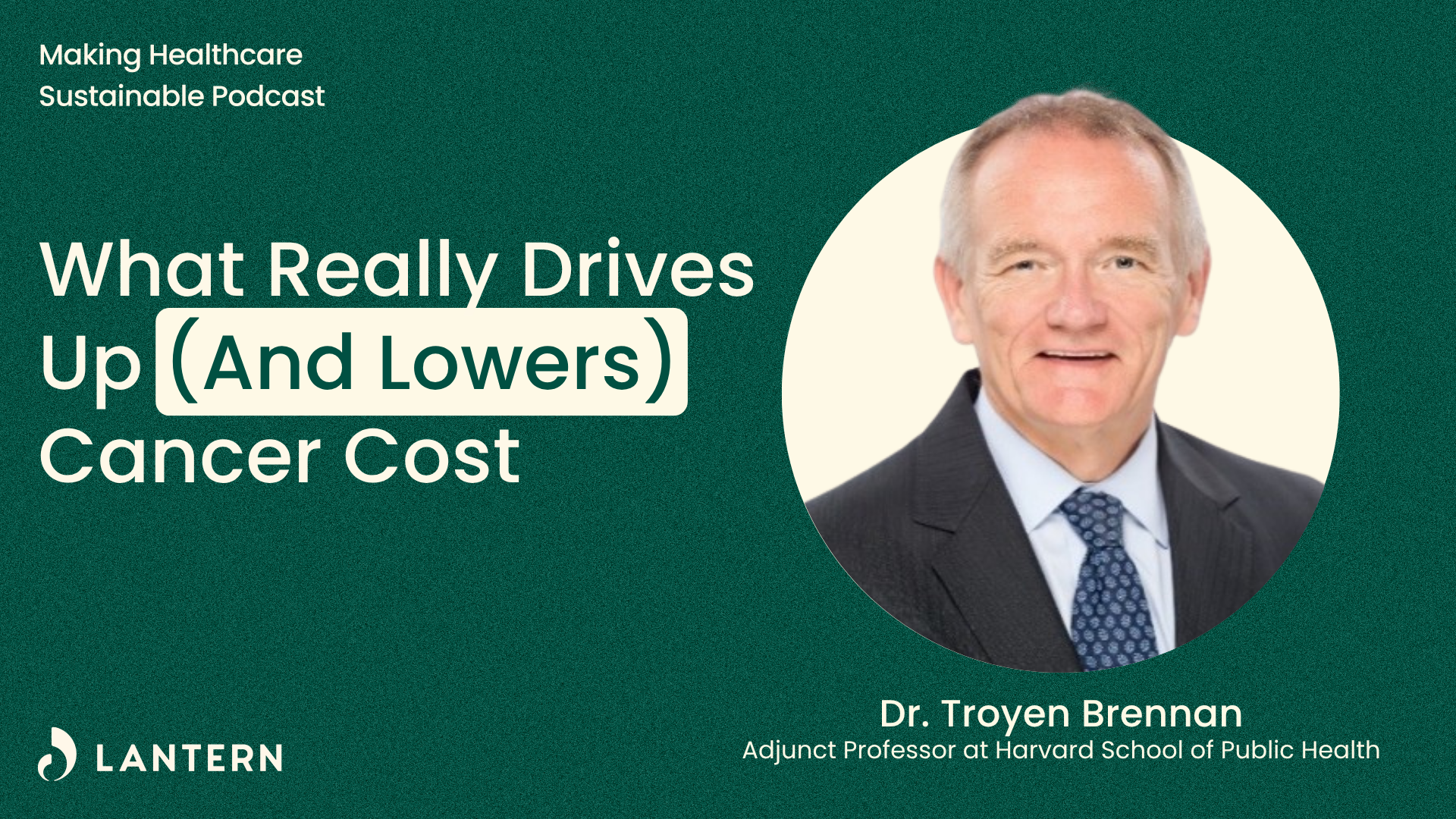
Episode Overview
Healthcare costs are rising, especially for cancer, but there’s a better way to provide care that’s both affordable and effective.
In this episode of Making Healthcare Sustainable, host Nancy Ryerson talks with Dr. Troyen Brennan, a healthcare expert, about the high costs of cancer care and specialty treatments. Dr. Brennan explains how a shift to value-based care can help reduce costs while improving patient outcomes. He also shares simple ways that employers and healthcare leaders can make care more affordable and effective for everyone.
In this episode, you’ll learn:
- How high costs in cancer and specialty care are impacting healthcare
- Why switching to value-based care can lower costs and improve care
- Easy steps for employers to make healthcare more affordable and efficient
Highlights:
(00:00) Meet Dr. Troyen Brennan
(01:58) The impact of Medicare prior authorization on costs
(03:40) Understanding provider-induced demand in healthcare
(05:14) The evolution of healthcare costs
(06:47) Why Dr. Brennan is focusing on cancer care
(09:08) The players in pharmacy commerce and their impact
(10:28) Biosimilars: Lowering costs and maintaining margins
(12:02) Changing incentives in healthcare to drive value
(13:06) How employers can influence healthcare costs
(15:28) Community-based care vs. cancer centers
(16:32) The challenge of keeping up with new therapies
(19:14) The future of cancer trends and screening
(20:40) Reality check: The effectiveness of wellness programs
(22:44) One key move for benefits leaders to improve care
(23:34) A look ahead: The future of healthcare costs
Resources:
Nancy Ryerson’s LinkedIn: https://www.linkedin.com/in/nancyryerson/
Dr. Troyen Brennan’s LinkedIn: https://www.linkedin.com/in/troyen-brennan-494bb533/
Dr. Troyen Brennan’s Email: troyenbrennan@gmail.com
Key Moments
The Hidden Economy of Cancer Drugs
Timestamp: 10:04
The more expensive the drug, the more money gets made. That’s the incentive shaping cancer care.
Dr. Troy Brennan explains how a huge share of oncology revenue comes from drug margins, and why that pushes the system toward higher-cost treatments.
If you’re trying to manage cancer spend, you have to understand what’s driving decisions behind the scenes.
“You’re always going to make more money if you choose the more expensive drug because there’s always going to be a larger arbitrage associated with it.
So the drive is towards use of more drugs and use of more expensive drugs. So it makes it a little bit harder to introduce a generic/biosimilar into that commerce than it did.
For instance, primary care doctors prescribing patented statins and then moving to generic statins. They had no dog in the fight. They weren’t making any money from the prescription of the statin itself, whereas the oncologist is making a great deal of money from the choice of drugs.”
The High Cost of Hospital Infusions
Timestamp: 14:43
Same care. Very different price tag.
Hospital-based infusion can cost far more than the exact same treatment outside the hospital. The difference comes down to pricing power and markups.
Dr. Troy Brennan explains why shifting to lower-cost sites of care is one of the most direct ways to reduce spend without sacrificing quality.
“You want to try to move patients to low cost sites of care. Unfortunately, in many ways, the hospital outpatient facility is highly paid for use of the infusion service. They negotiate very high prices, very good prices for the drug and then mark them up an extraordinary amount.
And then they also get paid better by the insurers and by the government for the same services that people will be receiving in an outpatient setting that wasn’t associated with the hospital. So you want to try to move patients to outpatient oncologists who aren’t associated with the hospitals where they get the same level of care, but with much lower costs.”
A Key Difference in Cancer Medications
Timestamp: 13;35
Oncology drugs are different from other medications in that infusion drugs are managed by insurance companies, while oral oncology medications costs are determined by PBMs. Dr. Brennan recommends coordinating with both sides to find savings.
“It’s important on the cancer side to recognize that most of the time, if I stand back for a second, if I’m somebody who’s a benefit manager, large corporation, I basically have insurance for the medical care and I have insurance for the pharmacy. And the insurance for the pharmacy is from the pharmacy benefit manager. The insurance is through the insurance company, the health insurer.
In oncology, it splits because the health insurer still has responsibility for most of the infused medications, which is a big part overall of oncology care. Whereas the pharmacy benefit manager is still going to take care of the oral oncology drugs and there’s more and more sort of oral oncology drugs.
So I’ve got to call on them. I’ve got to call on the insurer and I’ve got to call the pharmacy benefit manager and I’ve got to get them to coordinate and I’ve got to get them to sort of come up with solutions.
And if they don’t have solutions, then I have to turn sort of outside of my traditional approaches and try to find entrepreneurial individuals who are thinking about ways to reduce costs.”
Episode Transcript
This has been generated by AI and optimized by a human.
Troyen Brennan (00:00):
The other thing you want to do is to try to move patients to low-cost sites of care. Unfortunately, in many ways, the hospital outpatient facility is highly paid for use of the infusion service. They negotiate very high prices, very good prices for the drug, and then mark them up an extraordinary amount. And then they also get paid better by the insurers and by the government for the same services that people will be receiving in an outpatient setting that wasn’t associated with the hospital. So you want to try to move patients to outpatient oncologists who aren’t associated with the hospitals where they get the same level of care, but with much lower costs.
Nancy Ryerson (00:31):
This is Making Healthcare Sustainable, brought to you by Lantern. Hi everyone, and welcome to the show. Today, we’re diving into the complex world of value-based care in specialty care with a focus on cancer through a conversation with Dr. Troy Brennan. Dr. Brennan is a physician, lawyer, and expert on healthcare policy. He’s an adjunct professor at the Harvard Chan School of Public Health and a national advisor at Manit Health. Dr. Brennan is also the former executive vice president and chief medical officer of CVS Health, and he’s had a long career in both academic and leadership roles in healthcare, including as chief medical officer at Aetna and president of Brigham and Women’s Physicians Organization. Dr. Brennan is also the author of Transformation of American Health Insurance: On the Path to Medicare for All, in which he explores the evolution of health insurance in the US and the path toward universal coverage.
(01:29):
He’s a true expert in the field, and today we’re going to talk to him about value best care and specialty care with a particular focus on cancer. We’ll find out why he’s shifting his attention from primary care to cancer in his latest book, What Benefits Leaders Can Do to Improve Their Programs, and how all of these cost pressures and misaligned incentives are impacting both healthcare leaders and patients. Before we dive in, Dr. Brennan, I’d like to start with our think, feel, do segment. Which did you choose?
Troyen Brennan (01:57):
Think. Well, I thought it was more like something that occurred to me recently, and I was reflecting on a statistic I heard, and it’s a little bit complicated in terms of a statistic. The Center for Medicaid and Medicare Innovation, CMMI, is now instituting prior authorization in traditional Medicare. There wasn’t much prior authorization in traditional Medicare before, and they’re starting this program called Wiser, which is focused on 10 or 12 areas where they see sort of wide variation in utilization. And I think a lot of that utilization is not value-based. And they recently had analysis of their data. And the thing that struck me was they looked at by state the number of dollars that would be involved per Medicare beneficiary for these 10 or 12 areas that they were looking at. And the state variation was incredible. The lowest state, CMS was going after $12 worth of benefits per beneficiary.
(03:01):
And in the highest state Nevada, they were going after $1,200. That just means that the 10 or 12 different kinds of procedures that they’re looking at are used a hundred times more frequently in Nevada than they are in Vermont. And I thought that is just such a comment on the American healthcare system. Point being where there’s that kind of variation, there’s the ability to say some of that variation is not legitimate and should not be occurring and is costing us money, and that’s where value-based care comes in.
Nancy Ryerson (03:32):
Yeah, that’s so interesting. What a huge difference. Do you have any theories about why Nevada is at that level or what might be behind some of that variation? Well,
Troyen Brennan (03:40):
That kind of practice variation has been known about for years. In fact, the leading researcher in the area, a fellow named Jack Wemberg, who eventually became a professor at Dartmouth, lived in Vermont, but taught at Dartmouth. He demonstrated in small towns, in small metropolitan areas throughout Northern New England, that there was tremendous variation in the rates of certain kinds of procedures. And it was all driven by the number of practitioners that were available to do the procedure. So provider-induced demand is what accounts for that. And that’s demand that goes beyond what the patient needs and what the provider decides to produce. Some of that is unnecessary. In fact, a great deal of that is unnecessary. And that’s what is the result of the kind of system that we have, which is a fee-for-service system where people get paid more by doing more. So that kind of variation is something we knew about when our healthcare system cost us $250 billion a year.
(04:36):
Now it costs us $7 trillion a year, and we really haven’t been able to do much about this kind of variation. But obviously the stakes are much, much higher today than they were when Jack Wenberg first started his work back in the 1960s.
Nancy Ryerson (04:48):
Yeah. And that step as well into one of the first questions I wanted to ask you. I think you’ve presented yourself as a kind of historian of our system. And I was curious to hear, I’m sure there’s a whole book worth of information, but maybe in a short version, how did we get to where we are today with that increase in cost that you mentioned and just haven’t seen a lot of movement in getting closer necessarily to value-based care. So yeah, just curious about your perspective historically. Are we in a worse place than ever? Has there been any improvement? What’s your view?
Troyen Brennan (05:22):
Well, I think you mentioned, I wrote this book about the sort of transformation of American health insurance where I try to look at the long-term trends in American health insurance. And there I conclude that kind of the base for our insurance in many ways is the employer, 170, 200 million Americans get their insurance through their employer. But I believe that the cost of the system are in such a runaway status and the ability to sort of restrict those costs using the traditional means that insurance companies have taken to try to reduce those costs are failing such that eventually the system will just cost too much for employers and they’ll have to turn towards the government to provide healthcare benefits. And so that is a long 400-page book about that. We wouldn’t go into all the details around that. But the next book I wrote last year in 2025 was called Wonderful and Broken.
(06:13):
And it’s about the subtitle is The Complex Reality of Primary Care in the United States. And that was a book that was about value-based care. In other words, how are some primary care practices at least attempting to undertake value-based care to reduce the waste in the healthcare system and try to reduce the costs overall. So I has to make it affordable for everyone. And I think that there are some signs weak, but nonetheless, some growing signs that there is a value-based structure to the healthcare system that can be effectuated through stronger primary care. And that’s basically what I argue that we need. And then as you said, I turned in this third book I’m writing right now to cancer, which is completely a fee for service area. In fact, it’s sort of fee-for-service on top of fee-for-service in that you have the pharmaceutical firms, which own the patents that price the drugs very high to return as dramatic a profit as possible for a relatively short period of time, a 12 to 20-year period of time in which they own those patents.
(07:10):
But then they basically sell those into the system and they sell them to the providers, to the oncologists and to the hospitals, and then the hospitals sell them back at a huge margin to the insurers. So you got to only cost the drugs that come out, but then they get resold at much higher prices, all because everybody’s making money on each administration of those medications. And in cancer, those medications are absolutely necessary. So it’s to look at the other side of the equation, the sort of fee for service generation of costs and questions about how to control that are ever more difficult.
Nancy Ryerson (07:45):
Did you choose cancer because it is such a cost driver for employers?
Troyen Brennan (07:50):
Well, I chose cancer because it’s fascinating, first of all. I mean, a good deal of the book, it’s really about the 21st century war on cancer, which is a completely different war on cancer than the original war on cancer. And one that in many ways were winning. If you talk to an oncologist who started practicing in, say, 2000, they look back on their career and say, “In 2000, I had nothing. There was nothing I could do for patients. And now I have a lot of drugs that are available for these patients and patients are living much longer and better lives.” So they’re extremely heartened and they should be by the pace of the progression of the science associated with the study of cancer. But I also chose it because it is the place where many employers say our biggest growth in costs. They’ll always point out that cancer and musculoskeletal are their biggest cost drivers.
(08:39):
But most of all, I chose it because of the juxtaposition of the price of the pharmaceuticals and then the manner which our healthcare commerce drives them from the pharmaceutical manufacturer through to administration of the patient and the many places, the many different sort of factors and companies and industries that sort of touch on the oncology medication as it moves through commerce. And
Nancy Ryerson (09:01):
It seems like they’re all collaborating to raise costs. The costs just go up and up at every point along that path.
Troyen Brennan (09:09):
Well, there are players in what I call this sort of oncology pharmacy commerce, this is not a very pretty name, but there are players there who are meant to be reducing the cost, particularly the pharmacy benefit managers and the insurers. And they do have mechanisms to do so as well in that the pharmaceutical manufacturers, as I suggested, have a monopoly over these drugs. There’s a time limited monopoly, patents go away, and then there should be cheaper drugs that take the place of those original drugs, and we all benefit from that. We’ve seen that in other areas of medicine. The medications called statins that are used to reduce cholesterol. It’s completely a generic class now. It has huge benefit, huge cost effectiveness benefits for the healthcare system and for individual’s health. I mean, cancer, the story’s a bit a lot more complicated, but nonetheless, there are drivers in the direction of reducing costs.
(10:00):
It’s just in my estimation, I’d say 90% done with this analysis. In my estimation, they’re just being overridden by a drive to try to get as many new expensive medications into the clinic as possible.
Nancy Ryerson (10:15):
Yeah. So how does that work? Are there some drugs where at this point there should be a generic that’s more affordable, but pharmaceutical companies find a way to do something to kind of get that patent started over? Do you have any examples of that?
Troyen Brennan (10:28):
Well, one way to sort of look at it is, yes, there are some medications now where there’s at least three or four major medications in oncology that have gone generic. And slowly but surely, these generics, they’re called biosimilars because most of the medications that are being used are sort of large molecules that appear very similar to molecules that occur in the body. And so we don’t call them generics, we call them biosimilars. And there are biosimilars that are beginning to play an important role. But you have to remember, in oncology, the way in which an oncologist is compensated, first of all, probably 50 to 60% of the income for oncologists and oncology centers and cancer hospitals is based on arbitrage on the drugs. So I think most people don’t recognize that fact, but it’s the key driver of economic success in the cancer business. In that regard, you always have, whether you’re getting paid by the government, which pays one way or you’re getting paid by commercial insurance, which pays another way, you’re always going to make more money if you choose the more expensive drug because there’s always going to be a larger arbitrage associated with it.
(11:35):
So the drive is towards use of more drugs and use of more expensive drugs. So it makes it a little bit harder to introduce a generic/biosimilar into that commerce than it did. For instance, primary care doctors prescribing patented statins and then moving to generic statins. They had no dog in the fight. They weren’t making any money from the prescription of the statin itself, whereas the oncologist is making a great deal of money from the choice of drugs.
Nancy Ryerson (12:01):
Yeah. Do you feel like there’s a lot of much awareness of this dynamic, I guess, on people who are looking for solutions for better aligning these incentives? I know that I think a lot of people at Lantern have learned about this from you, from you talking about this, but is there a movement to change those dynamics or what do you feel like could happen next?
Troyen Brennan (12:20):
I would not say that there’s a sort of strong move. Over the course of the last 20 years, there’s been oncologists who’ve raised questions about the manner in which the drugs move through commerce and the cost of the drugs themselves. But I think the average person who’s running a big cancer hospital says, “I’m just trying to make ends meet. And if I don’t have this margin from the drugs, I’m not going to be able to provide the care that these cancer patients needs.” Everybody who’s in the business, everybody who prescribes these drugs, all the oncologists are sort of aware of these financial dynamics, but they don’t like to talk about them. And I found it to be relatively sort of difficult to get oncology leaders to talk about the nature of their business.
Nancy Ryerson (13:02):
Yeah, that sounds like something that would be difficult to untangle. And if you’re a benefits leader and you’re trying to manage cancer costs, what do you feel like are your levers that you can pull to try and match those costs? Well, of course, you want your employees able to access whatever their oncologist recommends most likely.
Troyen Brennan (13:21):
I would say it’s important on the cancer side to recognize that most of the time, if I stand back for a second, if I’m somebody who’s a benefit manager, large corporation, I basically have insurance for the medical care and I have insurance for the pharmacy. And the insurance for the pharmacy is from the pharmacy benefit manager. The insurance is through the insurance company, the health insurer. In oncology, it splits because the health insurer still has responsibility for most of the infused medications, which is a big part overall of oncology care. Whereas the pharmacy benefit manager is still going to take care of the oral oncology drugs and there’s more and more sort of oral oncology drugs. So I’ve got to call on them. I’ve got to call on the insurer and I’ve got to call the pharmacy benefit manager and I’ve got to get them to coordinate and I’ve got to get them to sort of come up with solutions.
(14:06):
And if they don’t have solutions, then I have to turn sort of outside of my traditional approaches and try to find entrepreneurial individuals who are thinking about ways to reduce costs. So there’s really sort of two ways. One is to make sure that you’ve got a strong control over the use of biosimilars and that there is a push towards the biosimilars and that people are using appropriate mechanisms for that, either through the formulary or through a copay mechanism using out of pockets to drive costs to drive people to use the right low cost medication. And then the other thing you want to do is to try to move patients to low cost sites of care. Unfortunately, in many ways, the hospital outpatient facility is highly paid for use of the infusion service. They negotiate very high prices, very good prices for the drug and then mark them up an extraordinary amount.
(14:54):
And then they also get paid better by the insurers and by the government for the same services that people will be receiving in an outpatient setting that wasn’t associated with the hospital. So you want to try to move patients to outpatient oncologists who aren’t associated with the hospitals where they get the same level of care, but with much lower costs. So those are really the two main things you can try to do as an employer.
Nancy Ryerson (15:15):
And from your perspective, do all of those levers not have a negative effect on the patient? So they’re going to get the same level of care and the same outcomes when those kinds of optimizations happen.
Troyen Brennan (15:28):
Yeah, that’s a question that’s pretty deep in the literature. A cancer center would say you want to have your radiology, your radiations therapy, your surgery and your oncology care all very well coordinated. And that’s true, but I think that can be done without the medical oncology care occurring at the center. There are some papers that you get deep in the weeds. There are papers that suggest that there’s a mortality impact from going to a cancer center as opposed to a private oncology practice. But when you read those very closely, it has a lot more to do with the surgery aspects than perhaps the radiation oncology aspects than it does with the medical oncology. So I would say I would feel comfortable going to a good community oncology practice. It was well versed in the care of my particular cancer. I don’t have cancer, but if I did, I think I’d feel comfortable doing that and efforts to try to move patients out of the large oncology centers and into lower cost outpatient settings of things that can be useful and avoid unnecessary costs.
Nancy Ryerson (16:31):
Yeah. And no one likes to obviously imagine themselves getting cancer, but are there certain diagnoses if you receive something more rare, would you go in one direction or if someone you in your family had a certain diagnoses, would you kind of guide them in one direction or another? How much is it about the specific cancer, do you think?
Troyen Brennan (16:50):
Well, I would say it’s exquisite almost everywhere you look in terms of the care you’re going to receive because not only are there lots of new therapies, but the therapies are quite sophisticated and they’re oriented towards a specific type, a specific genetic type of disease that you have. So I find in talking to the oncologist that the person who specializes in gastrointestinal oncology, that person doesn’t want to cover the lung cancer patients on the weekend because they don’t know the drugs and the choice of the drugs sort of well enough. It can be overwhelming. There’s a lot that can be done about that through the use of information technology, including artificial intelligence to keep people abreast of what needs to occur. And eventually most patients have care that’s protocol driven. Once you’ve decided this is a patient with this type of non-small cell lung cancer that has these particular genetic characteristics, this is the best therapy for them, then they go on that therapy and they stay on that therapy.
(17:47):
So I wouldn’t say that there’s any cancers that are easy today and think the oncologist, the community oncologist or the academic oncologist, they’ve got very tough jobs, but I think that it’s tractable for people to take good care of patients in a more community oncology setting.
Nancy Ryerson (18:04):
It sounds like overall there’s been a lot of good news for patients. If you’re diagnosed with cancer, you have a better overall survival rate, but there’s a complication as well. There’s just so much going on. I feel like I would feel nervous just from having these conversations at Lantern. Does my doctor have the latest information? Am I specifically getting the right care, just knowing how much is out there?
Troyen Brennan (18:26):
It can seem daunting. It can also seem heartening. I’m studying three cancers in some detail, metastatic colorectal cancer, metastatic non-small cell lung cancer and multiple myeloma, or at least look at sort of how the therapies for those have developed over the years. But you talk to the myeloma doctors and they are, especially the old hands, are incredibly heartened by what they’ve seen because they’re really getting much longer survival. And people who are living sort of normal lives who 15 years ago, that just wasn’t possible with this disease. So I think it’s obviously a field that’s hard, difficult to keep up, but it can also be quite heartening and gratifying to the individual practitioner because of the scientific breakthroughs that we’ve had.
Nancy Ryerson (19:11):
Yeah, no, that is exciting. I do feel like the headlines around cancer, and maybe this is just the nature of a media environment, but I feel like they tend to be very negative like, oh, more young people are getting cancer. What do you feel like is behind that? Is there an aspect of, do you think there’s overscreening or developments in screening that have led to more diagnoses?
Troyen Brennan (19:32):
Well, I think the most recent study I’ve seen sort of suggests that cancer incident is coming down overall, at least in the United States and relatively sort of dramatically. In some places you can put your finger on exactly what’s going on, non-small cell lung cancer is smoking. Smoking goes away, so does non-smell cell lung cancer. But in other areas, I think it’s because we’ve done a better job of screening and because I think people are healthier. But I do think that there’s sort of a continued concern about colorectal cancer in particular. And at least some suggestion that there is an increase in instances not related necessarily to screening. Some people, some very smart people have made the argument that this is just a screening phenomenon, not really a biological change in the population. But for those people who do believe it, they believe it’s a diet related issue and they strongly encourage people to eat less processed food and get more fiber in their diet.
Nancy Ryerson (20:25):
Yeah, that’s a good message. And I know benefits leaders do try programs to improve nutrition or get more exercise. What do you think about those kind of programs? Do you think those are worth investing in those population health style programs?
Troyen Brennan (20:40):
Well, there’s certainly the rage now, and there’s a lot of interest in adding the Department of Health and Human Services. And I think that there’s great benefits associated with keeping oneself healthy, keeping one’s weight under control, getting daily exercise. I don’t think there’s any doubt that you will live a longer and better life if you eat well and you exercise. But sort of having said that, wellness programs at corporations have put up have been studied fairly rigorously. And for us to be able to sort of do randomized controlled trials on this is very difficult, but nonetheless, they’ve been done. And by very good research teams, at least the two or three, maybe four major studies that have been done have shown no benefit. It’s hard. It’s very hard for anybody to get somebody who doesn’t want to eat right and doesn’t want to exercise to do so.
(21:27):
And there’s at least, and no evidence today that employers are capable of doing that.
Nancy Ryerson (21:33):
Yeah. I recently had my second child and I feel like I really understand America more than just our lifestyle. So I just really have been struggling to fit in cooking. We get a lot of takeout. It’s hard to fit in exercise. So I guess your employer could shorten your workday. That would probably make everyone healthier, but I’m not hearing a big call for that at the moment.
Troyen Brennan (21:54):
A busy parent working, two parents working and two kids at home, you’re busy and it’s very difficult to sort of make the right choices. I do think that the one place where I give the Department of Health and Human Services some credit today is on the emphasis they put on people trying to eat better and eat less processed food. That’s a good thing. They’ve done a lot of things that aren’t so good, but that’s a good thing.
Nancy Ryerson (22:19):
Yeah. And it feels like that message is getting through. I think also that more Americans are drinking less, I feel like is positive. I was just talking to someone about that over the weekend, like, “Hey, as a country, we’re making a positive health choice.” It feels like, well, like you said, smoking rates are down, but that feels like another probably good thing, the rise of mocktails and non-alcoholic beer on menus feels positive for our future health. So if you were, I think we talked about this, but if you were a benefits leader, what’s the one change you would make tomorrow to try and tackle those rising cancer costs?
Troyen Brennan (22:57):
I guess I would be looking for ways to try to move people to low cost sites of care where they can get care that’s equivalent to the high cost sites. I think that’s possible. And I’d be looking for intelligence and activism with regard to the use of formulary, both the PBM and the insurer side for cancer drugs and try to hear from them what new ideas they have about how they can make sure patients get the medications they need, but at the lowest costs.
Nancy Ryerson (23:28):
I feel like this conversation, there are things to feel positive about, maybe some to feel less positive about. So I’m curious, looking ahead, what’s your bold prediction or what’s in your crystal ball for where cancer costs are going, but then maybe also where cancer care and research are going?
Troyen Brennan (23:45):
Well, one hopes the research continues. One of the bad things that Trump administration has been doing is basically sort of killing research by making as hard as possible for people to do their jobs at the National Institutes of Health and basically sort of destroying the Centers for Disease Control. The EPA no longer thinks this is their job to protect human health. So all those things are sort of driving in the wrong direction. If it continues, we’ll be left with a much worse sort of set of environmental poisons that are associated with cancer and we’ll have much less dynamism in our science around discovery of new ways to sort of treat cancer. So those are all bad things that are happening and that could lead to sort of increased cancer burden. I think with regard to the sort of healthcare system overall, the healthcare system is increasingly a sort of federal healthcare system, more and more of the dollars.
(24:37):
If I’m operating in the intensive care unit today, 75% of the dollars are being coming through the federal government and the federal government is belabored in those costs, especially with an aging population, which not only means more old people to take care of, but fewer workers to put part of their wages to the care of those old people. I think next year the administration will spend $1 trillion on servicing the debt alone, and that’s only going to increase. With that being the case, we’re going to have to find ways to reduce healthcare costs. It’s just hard to see how that doesn’t happen. And I hope we can do it by maintaining the kinds of breakthroughs we’ve had over the course of the last 20 years in areas like cancer, but find ways to make it more affordable. And I think that there’s at least some suggestions we can have that might help that.
Nancy Ryerson (25:26):
All right. Well, really appreciate you taking the time to talk with me. Thanks so much.
Troyen Brennan (25:30):
Thank you. Appreciate it.
Nancy Ryerson (25:35):
Thank you for listening to Making Healthcare Sustainable. If you want to learn more, be sure to check out our YouTube channel, Lantern Specialty Care, or check out our website where you can find additional resources.