



Episode Overview
Most healthcare innovations fail for the same reason: they don’t address the underlying incentive misalignment baked into a fee-for-service system.
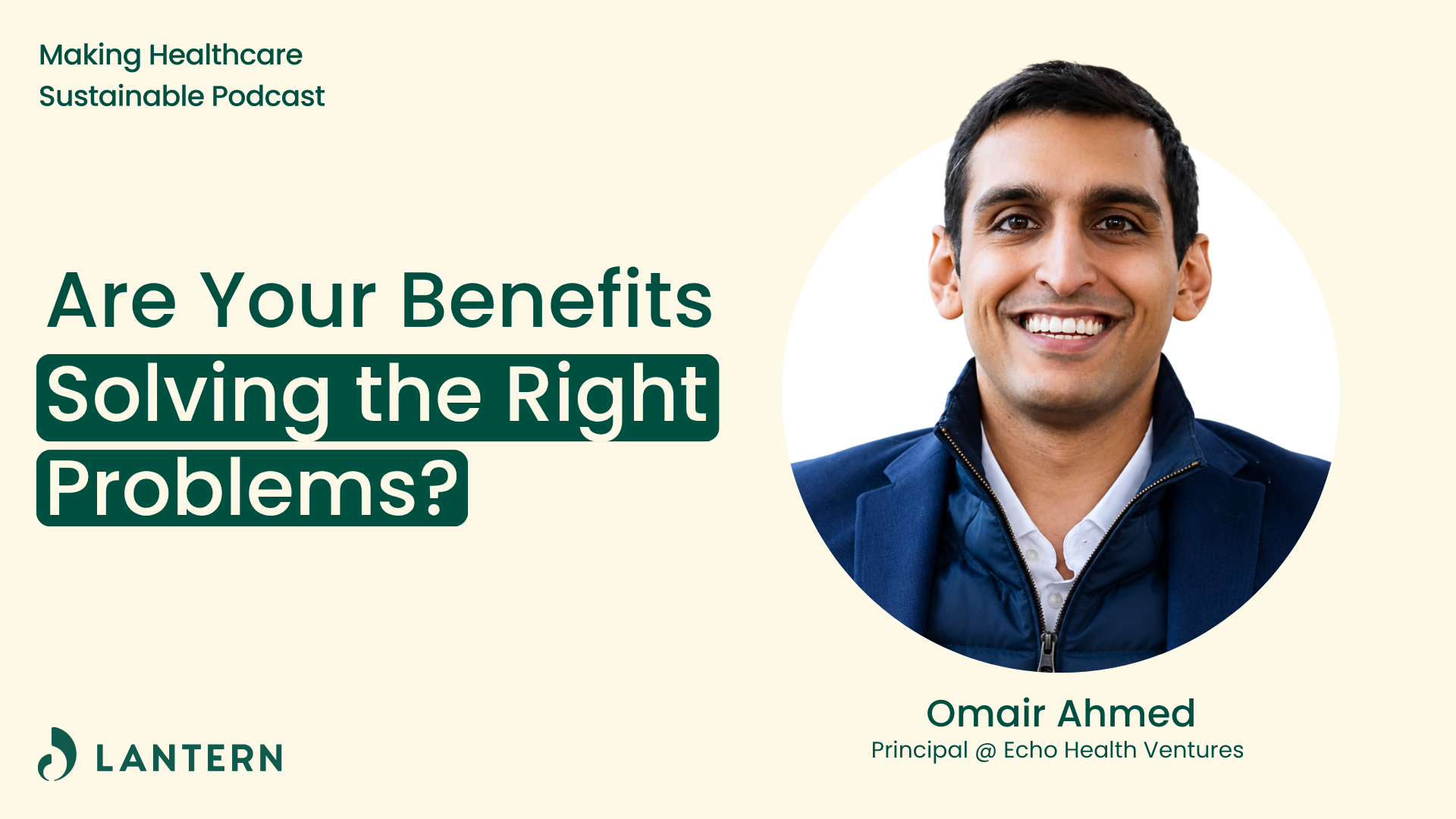
Omair Ahmed, Principal at Echo Health Ventures, explains why solving that problem first is what separates the solutions that actually move the needle from the ones that just add to the vendor stack.
In this episode, you’ll learn:
- Why incentive misalignment and data opacity are the root causes behind most of healthcare’s thorniest challenges
- How pairing quality analytics with benefit design nudges members toward better decisions and not just better information
- Why local networks of high-quality providers outperform traditional center-of-excellence models
- What benefits leaders who are early adopters are doing differently to evaluate solutions before they scale
Highlights:
(00:00) Meet Omair Ahmed
(02:07) Centering the patient experience
(04:14) Key challenges in healthcare incentives and data transparency
(07:00) Distribution and integration matter more than product innovation
(09:36) Lessons from public-private partnerships and Medicare innovations
(11:07) Why cost, quality, and access don’t have to compete
(13:00) Understanding how patients interpret cost signals
(15:43) The power of surgical volume and appropriateness in decision-making
(16:44) Evaluating ROI for high-cost, high-variability solutions
(20:04) Learning from churn and variation across clients
(22:38) Network of Excellence vs. legacy Center of Excellence models
(25:53) How local care improves adherence and outcomes
(27:07) Prioritizing high-impact solutions for employers
(30:29) AI, analytics, and culture driving optimism for healthcare innovation
Resources:
Nancy Ryerson’s LinkedIn: https://www.linkedin.com/in/nancyryerson/
Omair Ahmed’s LinkedIn: https://www.linkedin.com/in/omair-ahmed/
Echo Health Ventures’ LinkedIn: https://www.linkedin.com/company/echo-health-ventures/
Episode Transcript
Transcription
LANTERN | MAKING HEALTHCARE SUSTAINABLE | OMAIR AHMED
Episode Transcript
This has been generated by AI and optimized by a human.
SPEAKER FIRST AND LAST NAME:
Omair Ahmed (00:00):
You don’t need to have cost, quality, and access play against each other. You can actually have a win-win-win. I think the win-win-wins are what matter most in this system.
Nancy Ryerson (00:13):
This is Making Healthcare Sustainable, brought to you by Lantern. The problems with our healthcare system are complex to say the least. There are issues with access, with cost, and with quality and traditional solutions sometimes just don’t seem to help. So benefits leaders are increasingly looking for more innovative approaches to try and crack these challenges. My guest today is in the lucky position of getting to be one of the first to hear about some of these innovative solutions. Omair Ahmed is a principal at Echo Health Ventures, where they invest in and help build companies focused on transforming healthcare, everything from care delivery models to digital health and data-driven solutions that improve access, affordability, and outcomes. He’s going to share some of the innovations that help him feel optimistic about our ability to start solving some of healthcare’s thorniest challenges. Omair, before we dive into the main part of our conversation, we’ll start with our think, feel, do segment.
(01:17):
Which did you choose?
Omair Ahmed (01:19):
I chose to talk a little bit about the sort of share a moment where you see firsthand what it looks like where the healthcare system works well. I’m going to go with a sort of personal example. I think a mistake that a lot of us who work more on the business or administrative side of healthcare often do is we don’t talk enough and we don’t ground ourselves enough in the patient stories that are at the center of a lot of what we do. And so about three years ago, one of my family members unfortunately got really ill. They had multiple bouts in and out of the hospital for years. They were sort of bound to their bed at home when they were able to be discharged into the home. And I was thinking a lot in preparation for this segment about what was it that made that experience go well and what made it really troubling?
(02:07):
And I think the thing I was thinking a lot about was the part that was most valuable, the part that meant the most to us as a family, to my uncle, as unfortunately a patient, were all the things that made healthcare deeply personal. And so the way the nurses helped support him with a variety of the things that he needed when he was actually in the hospital. The way we had home health aide supported him in the activities for daily living and actually helped with not just the clinical things, but also actually a variety of support on not just taking pills, but helping you actually go to the bathroom and helping you actually take the right level of food. What I wanted to highlight maybe for this session is I think it’s always important for us to just center to the personal side of what matters in healthcare.
(02:56):
And in the work that we all do on not just talking about innovation and, hey, look how great and fancy this new tool is, but highlighting how does that tool actually get us down to what matters most, which is the doctor-patient relationship, the nurse-patient relationship, and how do we actually make sure that we can all maintain the intimacy of what makes healthcare so personal?
Nancy Ryerson (03:17):
Yeah, I think that’s a great example. I mean, when you do have a positive experience, it really is the people who you interacted with. I don’t think that many people would say like, “Oh, that MRI scanner, that was top of the
Omair Ahmed (03:30):
Line.” Yeah. It’s funny, there’s obviously been a dramatic change in the last two, three years or so around the utilization of things like AI note takers to help physicians. But the key value proposition that we should all remember there is having that run helps the physician spend more time with the patient, helps the patient get better care, more personalized care. And so I think that’s exactly right, Nancy.
Nancy Ryerson (03:53):
Yeah, that’s a much better metric. I like the focus on that. So from where you sit, I’m curious, you’ve been at EchoHubFilters I think for around 10 years. So what are the problems that a lot of the solutions you’re investing in today, what are they trying to solve and has that shifted at all in the last 10 years?
Omair Ahmed (04:14):
More broadly, I’m going to take a little bit of a step back to hit this question. I think there’s something to be said about what makes healthcare so challenging because I think you actually need to start there to talk about what have we actually seen investments go toward. And I think there’s two overarching factors that make a lot of these challenges really untractable. One is I think there is a broader lack of incentive alignment. And then two, I think there’s just a complete opacity of data around quality and cost. And so on the incentive side, I think we all know this is a fee-for-service system. This is a world where volume isn’t awarded and not outcomes, but it’s also a world where benefits are on annual cycles, where often ROI takes more than a year, but often the actual timeline at which benefits leaders or health plans are thinking about solutions can be more constrained.
(05:08):
And so it’s a situation where the innovations that matter most actually need to solve underlying incentive issues or at least face against them and also face against the fact that it’s just really hard to know who is a good doc, who is a good system, what are the right procedures to take, how to evaluate the clinical efficacy of multiple different interventions is just extremely challenging even to those people who actually understand and conversant in these issues. Lo and behold, those folks who actually may not be as conversant in understanding what the deductible copay or co-insurance looks like. And so the kinds of things we’ve seen a lot of investments in are what are ways to solve those two aspects. And that can be a clinical solution that thinks about how do you actually better align physicians and systems around the concept of value-based care. That can be in solutions that try to solve on the data side, the interoperability challenges that make it just so difficult to actually understand what are the data you actually need to drive the right intervention and to actually get patients to the right spot.
(06:13):
And that can even be in a lot of innovation. We’ll talk a little bit about this of how do we actually get members to make the right decision, not just know what the right decision is, but actually help support them in making the decision via things like benefit design. And so I’d always want to start on the systemic level of let’s take a step back and think about what is it really that’s causing all these problems.
Nancy Ryerson (06:34):
Absolutely. And it feels like in the last 10 years I’ve been in the benefits world for a bit as well. And in the beginning, I feel like there’s a lot of optimism like, “Oh, we’ll make this great tool and people will use it and we’re going to solve all our problems.” But I think you just mentioned even people finding out that they have access to something getting routed at the right moment, those have really emerged as big barriers to seeing the results that you’re looking for.
Omair Ahmed (07:00):
Yeah, I think that’s totally right. There’s a frame that a lot of folks I think are probably familiar with, which is in healthcare, unfortunately it’s not always product that wins, it’s distribution. It’s how do you actually think about not just distribution with the various stakeholders, the payers, providers, PBMs, benefit leaders, et cetera, but it’s how do you think about integration into the workflows that actually matter most? You can have the coolest fanciest new widget, but if the new widget goes completely outside of the existing healthcare ecosystem, I’m not sure you’re going to get enough of an uptake in that. And so I think that’s exactly right. How do you actually think about not just what works, but what works well within unfortunately a system that buy first principles is extremely broken.
Nancy Ryerson (07:50):
Yeah. Do you have any examples of maybe systems or solutions that you think are heading in the right direction to solve this problem in particular?
Omair Ahmed (07:58):
I’m going to go back to the value-based care comment I made earlier. I think there’s been, I think, a broad based push from a lot of folks for at least my entire career, which over the last 10 years talking about how do we actually help facilitate the shift for fee-for-service to value-based care. And I think a lot of this has been driven by strong support from the sort of regulatory environment. So the Center for Medicare and Medicaid Services, the Center for Medicare and Medicaid Innovation have supported launching a number of different innovation and payment models that have pushed us the right direction. And I think we’ve seen real movement on a lot of what we’re seeing with the Medicare shared savings program with a variety of ACO models coming out that have showed us that we can drive lower cost, drive better outcomes, and drive better access for patients across the ecosystem.
(08:49):
So I always like to talk about at a systemic level, how much is the public-private partnerships and how much is the things that CMS are doing driving real value? That’s most true in the sort of Medicare Advantage world, but I think there’s interesting lessons for us to take in the commercial world for how can we actually help benefit leaders think about this more proactively. I realize I threw out a billion acronyms there. And so if there are things that you’re like, “Hey, can you double click on I will…” Happy to hit that, Nancy.
Nancy Ryerson (09:20):
Yeah. We love acronyms here in the healthcare world. It’s
Omair Ahmed (09:22):
Healthcare.
Nancy Ryerson (09:23):
Yes, it’s healthcare. Exactly. But yeah, I think if you do have an example of one of those lessons that you think more the self-insured world can learn from what’s going on the public side, I think that would be really helpful for our audience.
Omair Ahmed (09:36):
About four or five years ago, we invested in a company called Imbold Health and one of the things and one of the lessons that Daniel Stein, who was the founder, had recognized is it’s not enough to just understand who is the right doc. They’ve created a bunch of data and analytics to try to understand what does quality actually look like at a physician level, but the data and the analytics itself is actually not enough. You actually need to think about how does this then layer into the sort of incentives and the way that you’re actually supporting members and making the right decision. And so they’ve paired a variety of these analytical tools with actual interventions with whether it’s nudges, with whether it’s differential copay design, with whether it’s other models that help members make the right decision, not just give them the right information, but help them understand, “Hey, the right decision is also going to lead to a better financial outcome for you itself.” And so understanding how do you pair benefit design, insurance design, the sort of impact of out- of-pocket costs with the right way to drive clinical decision making is I think something that we’ve seen clearly in the Medicare and Medicare Advantage world, but I think we’ve seen clear lessons as well in the commercial world.
Nancy Ryerson (10:51):
Yeah. And that is similar to what we do at Lantern and a lot of our clients have those incentives for people to choose a Lantern. A doctor, a lot of the time it’s free for them to get surgery as opposed to having to hit their out- of-pocket max a lot of the time.
Omair Ahmed (11:07):
Exactly. And I think that’s been a realization that your team has recognized is you don’t need to have cost, quality, and access play against each other. You can actually have a win-win-win. And I think the win-win-wins are what matter most in this system.
Nancy Ryerson (11:21):
Yeah. I’m curious if you feel like on the Medicare side that there’s a way of helping people understand why it’s more affordable for them. Because I know we find at Lantern sometimes people are a little confused because they’re not used to getting something for free that’s also better. We’re so used to paying more, we associate that with quality.
Omair Ahmed (11:42):
It’s a great question. I think one of the things that folks, and I’m not going to talk about this just in Medicare because I think this is all across the board, is I think having really strong communication to your member, your employee, your patient that highlights quality and not cost as part of the key driver here is what’s so important. You don’t want a patient to perceive either directly, indirectly, implicitly, explicitly that their plan, their employer is pushing them toward an option because it’s going to save the plan or employer money. You want the member to recognize, because I think this is what’s true, is you’re trying to help the member decide on the best doctor, the best procedure, the best system. That decision is just really, really hard for the member to make on their own. It’s just hard to have their level of data.
(12:32):
It’s hard to understand about what actually makes a physician good and what makes a system good, what makes a procedure good. And so recognizing how do you actually help the member recognize it’s the quality is what matters most, I think, for this spectrum. And almost having the cost be a part of it as you think about the benefit design, but not as the key marketing play of, “Hey, this is why we’re trying to help you make the decision you’re making.”
Nancy Ryerson (13:00):
I think people do, when you think about it, have an understanding that when you get better care, especially in something like surgery, you’re going to have fewer complications and that maybe your employer, obviously they want you back at work. It’s for your benefit, but there are benefits to the employer as well.
Omair Ahmed (13:16):
I think that’s true, but there’s a study and I can’t exactly remember where the study’s from, but it showed that if you actually showed patients the actual cost of an underlying procedure with no other data, some patients will think that a higher cost automatically equates to higher quality. And so you want to be a little careful around understanding what signal is it that the price or the cost of a specific procedure, physician, doctor, treatment, whatever is telling you. Because in every industry outside of healthcare, there is typically a strong signal between price and quality, but that just fundamentally isn’t true in healthcare and I think that ends up leading to a much more complicated consumer experience.
Nancy Ryerson (13:56):
Yeah. And since you’re also a New Yorker, I feel like the price of an apartment in New York City is also not correlated necessarily with quality.
Omair Ahmed (14:05):
On the one hand, I agree, but I will say there, it’s funny, my wife and I, we rent an apartment in Brooklyn and we have our lease coming up and it’s funny every time you have to go back out and look at another apartment and you think, “Oh man, why am I doing this? ” It’s just an extremely complicated process. You have no real understanding. There’s just a huge level of information asymmetry in apartment hunting in New York and I think that’s like way worse in healthcare. There is a massive information asymmetry where patients don’t really know what decision they need to be making. They really don’t know who they should be going to and they rely heavily on often the decision or the support or the advice that their physician is giving or that their plan, their bed, whatever is giving. And often to be honest, they probably discount a little bit of what they hear from the planner or employer.
(14:56):
And so working in that world from the micro world of New York City apartment hunting to the macro world of how do you choose the right doc for your family member is it’s a really intractable problem.
Nancy Ryerson (15:06):
Yeah. And you’re right. I mean, maybe you’re looking someone up online or looking at Google reviews or something like that, but you don’t have … And in New York, you can see the nice pictures that are always look a little different once you actually get there.
Omair Ahmed (15:19):
But you don’t realize there’s like a rat out of frame and it’s … Yeah, totally.
Nancy Ryerson (15:23):
Exactly. Yeah. And I think there is a parallel because it’s so difficult to access the metrics that actually make a difference. At Lantern, we talk about surgical volume. How many times a year does someone do this procedure? A lot of orthopedic surgeons do something a couple, dozen times a year, but the best ones do it hundreds of times a year.
Omair Ahmed (15:43):
It’s the fruition of the 10,000 hours concept, right? It’s, hey, would you rather be the first patient or the hundredth patient for someone who’s done twice a procedure? And obviously it’s not just volume. Obviously Lantern spends a lot of time not just thinking about volume. Obviously that’s a core part of it, but also how do you think about all the downstream clinical quality measures from the complication rate to even the total cost of care that a patient is facing? And so it’s a totally fair push.
Nancy Ryerson (16:11):
Yeah. Appropriateness is such a big one too. You don’t want those doctors who they do so many because they just operate on anyone who walks through the door, but there definitely are ways to explain it in a more accessible way and we’re always working towards that.
Omair Ahmed (16:24):
Yeah, it totally makes sense.
Nancy Ryerson (16:25):
And going back to what you said earlier that there’s this expectation of ROI or kind of a need for ROI in a short timeframe, how do you think about that when you are considering investing in a solution knowing that the buyer is going to have this limited timeframe to see the monetary value?
Omair Ahmed (16:44):
I’m going to answer it maybe a little bit indirectly, which is I think one of the things I think a lot about as it relates to ROI is one, every company that’s going to sell in the benefit space is always going to have some detractors. They’re always going to have some customers where they’ve had challenges. And one of the things we spend a lot of time on as investors is understanding what signal do the companies or do the customers where there have been challenges tell you. For example, there are always going to be customers who turn off a solution, but sometimes the churn actually tells you something good about what the solution is doing, right? And sometimes it’s, “Hey, for this specific population, it doesn’t make sense.” And I actually think a strong signal I would always highlight benefit leaders to ask a company is, “Tell me about someone who churned and why and what problems, what things have you learned from that?
(17:36):
” Because companies should continually be learning from both the great engagements and the poor engagements. And I think one of the things that we think a lot about is how do you not just combine the qualitative sort of intuition there, but back that up with actual quantitative metrics. So one of the data points that obviously a lot of folks think a lot about is actual engagement, right? How are members actually engaging with the solution? If you’re getting 10% engagement with X, Y,Z solution, that can sometimes be really good and that can oftentimes be really bad and I think having some way to compare to that. And one of the things I think I would recommend folks think about, because it’s something we think a lot about on the investor side is what is actually happening at the core level? Are you retaining the sickest, highest cost members and is that the right decision for what makes most sense for my clinical population?
(18:26):
Or are you retaining those patients who maybe aren’t getting as much value from a clinical perspective or a cost perspective out of this, but who are finding it really engaging and is that something you want? And thinking about what kind of or what type of the population is this solution actually engaging? I think one of the things that’s interesting about obviously a lot of what Lantern does is thinking about how do you address the sickest, highest cost, most intensive of the population, which is the population that’s about to go and get a surgery, which is an extremely intensive sort of part of a patient’s journey and a part of a person’s life where they’re spending far more time than anyone else in the healthcare system. So how do you actually understand, given a patient’s about to spend a lot of time in surgery, how do you actually make sure that you’re engaging them in the right way and engaging the right patients at the right spot to make the sort of right decisions?
(19:20):
So I think a lot about how do you actually think about what makes patients drop off, what makes customers drop off and then what does that tell you about the ROI itself? So I don’t know if that answered your question, Nancy. And if it did, and I’m happy to maybe answer more directly.
Nancy Ryerson (19:33):
No, I think that’s such an interesting suggestion to kind of make a solution, get honest about why customers have churned in the past. We actually have shared a story that very early on at Lantern, we had a customer come on and they ended up leaving Lantern because we didn’t have the network built out enough at that time. But then years later we came back to them and say, “Hey, we learned from that. Look how much we’ve grown.” And they ended up coming back at that time. So I think that’s a great example of the kind of stories you’re talking about.
Omair Ahmed (20:04):
And it goes back to churn isn’t necessarily a bad thing. It’s churn if you decided to learn nothing from it is a bad thing. And I think the learning is what makes this so important and recognizing that a lot of companies, a lot of startups are learning as they’re working through this and to recognize that the startups, companies, businesses, services, solutions that can learn in the right way, I think can drive the level of impact that I think we all dearly need in healthcare.
Nancy Ryerson (20:30):
Yeah. Another example we talk about is sometimes clients who don’t promote the program, who choose to not send out mailers, to not send out ID cards, they just don’t really see that engagement. So I feel like that could be another good example too, like, “Hey, you do have to, for best results, follow these practices.”
Omair Ahmed (20:49):
Totally. And this is true certainly for Lantern where I think you see a significant variation in the impact of Lantern depending on what levers the client is willing to turn on. And I think this is true in Lantern. It’s true in a lot of businesses in healthcare where are you as the client willing to share enrollment and eligibility data? Are you willing to layer in member incentives? Are you willing to make a program mandatory? And it’s totally fine if the answer is the other way because you may have a variety of patient experience, provider community and other constraints that you’re facing, but recognizing that the constraints that you put from an operational perspective, the solutions that you’re partnering with have a real impact on your ability to get the full ROI.
Nancy Ryerson (21:35):
Yeah, exactly. And since we’re talking about Lantern, we’d love to hear in short what stood out in terms of wanting to invest.
Omair Ahmed (21:43):
You hit the network piece directly head on. And so I think what stood out to us in Lantern is the thought that the team has put into the model itself. There’s a lot of thought into a variety of clinical metrics. There’s a lot of thought around how you drive cost savings. I’d want to start on the network side of the model because I think that’s what stood out to us. Center of excellence approaches not new, right? There have been center of excellences for longer than I’ve been working in healthcare and there have been many examples in the 2000s and 2010s where you would see large employers flying patients to a handful of partner center of excellences, national academic medical centers to get XYZ procedures done. And there were flaws in those legacy inherent models, a couple of flaws. So one I’d call out is patients don’t want to travel.
(22:38):
Patients want to stay close to home and they don’t want to be dealing with all the logistics of that. And I think about the story of my uncle. We went to a hospital that was close, but at the end of the day, we sometimes thought about whether we actually would send out to a little bit more of a distant AMC and I think the recognition of convenience is extremely important. And two, there are a lot of high quality physicians outside of just the largest, highest profile, highest brand prestige academic medical centers and quality and specialty care is much more distributed than what the original Center of Excellence thesis or model sort of assumed. And I think that innovation that Lantern recognizes, let’s not just be a center of excellence, let’s be a network of excellence. Let’s help patients get to the right specialist in their local setting.
(23:30):
Let’s have the right partnerships and the right curation of that network that can help a patient stay relatively close to home, get the convenience benefit, but also make sure that they’re going to the right physician for the exact procedure that they need. And that one design choice that shift from a travel heavy legacy model to a network of excellence I think changes everything about this model. It greatly expands the scope of what you can actually get members to do from a surgery choice perspective and it drives, I think, a far greater amount of clinical outcomes and cost savings than the traditional model. And so I’m starting at the highest level to say that is the piece that for us set Lantern apart, which is just the recognition of local first versus center first and versus brand first and recognizing the burdens that have historically existed in designing around the patient experience, at least to us set Lantern apart in this ecosystem.
Nancy Ryerson (24:31):
Absolutely. Yeah. Really looking at the surgeon level rather than just the name on the building of just gives so much more access. We were saying earlier, people do want quality, but I’m sure if it says, “Oh, but you have to get on a plane,” you’re going to lose them at that moment.
Omair Ahmed (24:45):
Exactly. And it’s important to call out. You want to highlight, this is quality. You don’t need to fly to MGH. You don’t need to fly to Mayo. You don’t need to fly to Cleveland Clinic to get the highest quality docs. There are high quality docs in a lot of these local jurisdictions and recognizing the value of those quality docs and communicating that those docs are quality in your community, I think demonstrates a lot of value, not just to the plan, not just to the employer, but to the patient who … To the first question, it should be at the center of a lot of how we think about this stuff.
Nancy Ryerson (25:17):
Yeah, exactly. When we choose our surgeons, we look at so much, we talked about appropriateness, complication rate, but then we do also think about what is their protocol before and after surgery to help create that better experience. I talked to one of our surgeons, Grant Zarzur, and he really coaches people. He walks them through, “Here’s what we’re working toward. You’re going to be running around with your kids or back at work in this shorter timeframe if you follow these steps,” but walking them through it and making them just feel really supported throughout. And that just makes such a huge difference.
Omair Ahmed (25:53):
It’s a reminder that a huge percentage of the outcomes associated with our surgery are actually the actions that the member needs to be taking outside of the surgery itself. And it’s a lot harder to have the member do those actions if the physician is five states away than if the member’s physician and care team is a 15-minute drive away. And I think the recognition of how local healthcare is, to Dr. Grant’s point is being local allows me to then actually help patients make the right decisions, not just pre-op, not just … And obviously they’re not making a decision in the operating room, but then certainly post-op taking the rehab steps needed, taking the right sort of physical therapy steps needed, thinking about the right way to actually do the lifestyle interventions necessary. And I think a lot of the local model ends up accentuating that, not dismissing it.
Nancy Ryerson (26:51):
Yeah, that’s a great point. So you hear about so many interesting solutions, I’m sure in your daily life. Have you ever imagined if you were a benefits leader and if you haven’t before you can right now, what would be on top of your priority list for solutions to bring on if you had kind of a clean slate?
Omair Ahmed (27:07):
The sort of obvious answer is just focus on the areas where you can have highest impact and that has to do with a stack rank of your key drivers of cost and where you have the biggest variability, but that’s kind of a boring answer because it’s obvious and true and that is the correct answer to do. I think it’s important to continue innovating, but then it’s really important as you’re innovating to continue to be very rigorous about evaluating what’s working. And I think a lot of people do really well at one or the other and I think a lot of folks need to recognize that doing this job well requires doing a little bit of both. A lot of people spend a lot of time under innovating. They wait for the perfect proof points. They don’t want to be in the first or second or third cohort.
(27:53):
They want years of data, but this is an industry that is moving extremely quickly and I think there are real credible solutions that are emerging that early adopters are benefiting from. And so I lean into that innovation where possible, but the other failure mode is not spending enough time on the evaluation of those programs. You often see programs get rolled out, deliver either a modest value or maybe less and then they just sit in the stack and then two or three years later after you start accumulating a number of these, you look at your vendor benefit stack and you say, “How in the hell did I end up with 40 vendors across each specific subspecialty or each specific part of this patient journey?” And so I think it’s really important to do a great job of adding and innovating, also being really rigorous around how do you actually evaluate the performance of those outcomes and not just saying, “Hey, I don’t have an RFP right now.
(28:50):
I’m not going to evaluate this. ” Actually doing a good job of maintaining that evaluation upfront and being honest to say, “Hey, sometimes you’re going to make bets that work and sometimes you’re going to make bets that you need to evaluate and that you need to make a change, even if you were the one who originally championed it. ” My push would be, yes, do what I said at the beginning of this question, which is pick the right areas that drive a lot of cost and drive a lot of a burden for your patients and innovate there or maybe even a more macro thing is don’t stop innovating and don’t stop evaluating. And the combination of those two I would say are what’s going to make a benefits program compound over time.
Nancy Ryerson (29:26):
Yeah. And I think something else from our conversation, you get out what you put in too. You can bring in these solutions, but if you don’t really give it the college try and letting people know about it or having it be part of your ecosystem so people can find it, you want to really give it a chance.
Omair Ahmed (29:44):
Yeah. Yeah. And being honest about if something’s not working, why? And spend time with your vendors and spend time with your community of fellow benefit leaders trying to understand, hey, there is variance between what different employers are seeing with a solution and that That’s driven to your point, Nancy, by the actions that sometimes an employer or a benefits team is willing to take. I think just being really transparent around understanding that as you’re evaluating the performance of some of these programs is important.
Nancy Ryerson (30:13):
Yeah. I said in the intro that I would think as an investor, you are maybe on the more optimistic side in terms of the future of healthcare, but is that true? Do you feel like we’re making progres towards solving some of these pretty intractable challenges?
Omair Ahmed (30:29):
I am definitely I think quite optimistic and I think two reasons for being optimistic. And it’s funny, we’ve gone, I don’t know, 30, 35 minutes and we haven’t really talked about AI, but I think the disruption that AI is going to have is significant. I don’t know if anyone really knows exactly what the disruption is going to be, but I think it’s just clear that whether it’s the way members perceive and interact and engage with their healthcare, whether it’s the level of speed that either vendors are in the ecosystem or that benefit leaders are going to be able to move on is going to be much faster, whether it’s the ability to get the right level of analytics so you can do the right level of evaluations. I think there’s just going to be a dramatic amount of change across the board. But I think what’s driving me even more optimistic, especially in the employer benefits space, is I think there has continued to be a greater appreciation for how challenging these problems are, how sophisticated you need to be.
(31:31):
And I think we have seen just a greater recognition of how do you actually get the right level of analytics associated with this. And some of the increased scrutiny around the fiduciary duty that these benefit leaders place or have, I think is driving a lot of plan sponsors to be going toward a higher standard of how they spend their benefit dollars on behalf of their employees. And I think we’re seeing a level of rigor in benefits procurement that I don’t think existed when I started on my investing side. And so I think the decisions that are being made are driving you toward better decisions, are driving you to faster decisions. And so my optimism is driven by, yes, a lot of technology changes that I think are driving real impact, but I think a fundamental culture change that is currently underway in the benefits ecosystem, and I think this is also true in the healthline ecosystem that I think is going to be good for helping companies that incredibly show hard ROI.
Nancy Ryerson (32:34):
I feel like I’ve seen that shift too. When I first started in these kinds of roles, there was a lot of talk of absenteeism, presenteeism. And not to say that those aren’t valuable, but I think you’re right, the hard dollar savings has really become more and more important.
Omair Ahmed (32:49):
Let’s be real. Some of that is because trend is seven, eight, nine, whatever percent it is, but some of it is a recognition that actually there is more capability to monitor and evaluate the performance of these solutions, of interventions, of whatever benefits leaders are doing beyond just, “Hey, X percentage of my employees are engaging.” We actually are getting to a spot where we can start making better analytical decisions. And I think continuing to build that infrastructure where you can actually get those analytics is I think going to be a really important part of how we get to a better world on the employer benefit side.
Nancy Ryerson (33:22):
Yeah, absolutely. Okay. Anything else you want to share?
Omair Ahmed (33:26):
I think just a continued excitement about where things are going and thank you so much for having me on and having the chance to share a little bit about what we’re seeing.
Nancy Ryerson (33:34):
Yeah. Thanks so much for joining us.
Omair Ahmed (33:37):
Thank you.
Nancy Ryerson (33:40):
Thank you for listening to Making Healthcare Sustainable. If you want to learn more, be sure to check out our YouTube channel, Lantern Specialty Care, or check out our website where you can find additional resources.